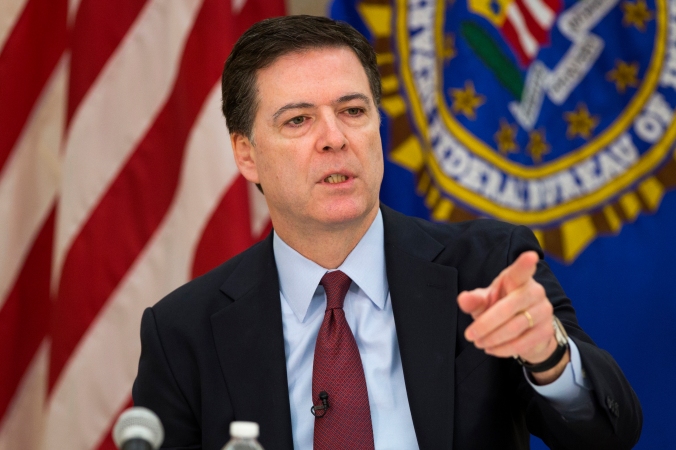
The transcript of FBI Director James Comey’s full remarks on the Clinton e-mail probe follow. I will highlight important sections in bold, and in some cases, bold and red. My observations will follow.
Good morning. I’m here to give you an update on the FBI’s investigation of Secretary Clinton’s use of a personal e-mail system during her time as Secretary of State.
After a tremendous amount of work over the last year, the FBI is completing its investigation and referring the case to the Department of Justice for a prosecutive decision. What I would like to do today is tell you three things: what we did; what we found; and what we are recommending to the Department of Justice.
This will be an unusual statement in at least a couple ways. First, I am going to include more detail about our process than I ordinarily would, because I think the American people deserve those details in a case of intense public interest. Second, I have not coordinated or reviewed this statement in any way with the Department of Justice or any other part of the government. They do not know what I am about to say.
I want to start by thanking the FBI employees who did remarkable work in this case. Once you have a better sense of how much we have done, you will understand why I am so grateful and proud of their efforts.
So, first, what we have done:
The investigation began as a referral from the Intelligence Community Inspector General in connection with Secretary Clinton’s use of a personal e-mail server during her time as Secretary of State. The referral focused on whether classified information was transmitted on that personal system.
Our investigation looked at whether there is evidence classified information was improperly stored or transmitted on that personal system, in violation of a federal statute making it a felony to mishandle classified information either intentionally or in a grossly negligent way, or a second statute making it a misdemeanor to knowingly remove classified information from appropriate systems or storage facilities.
Consistent with our counterintelligence responsibilities, we have also investigated to determine whether there is evidence of computer intrusion in connection with the personal e-mail server by any foreign power, or other hostile actors.
I have so far used the singular term, “e-mail server,” in describing the referral that began our investigation. It turns out to have been more complicated than that. Secretary Clinton used several different servers and administrators of those servers during her four years at the State Department, and used numerous mobile devices to view and send e-mail on that personal domain. As new servers and equipment were employed, older servers were taken out of service, stored, and decommissioned in various ways. Piecing all of that back together — to gain as full an understanding as possible of the ways in which personal e-mail was used for government work — has been a painstaking undertaking, requiring thousands of hours of effort.
For example, when one of Secretary Clinton’s original personal servers was decommissioned in 2013, the e-mail software was removed. Doing that didn’t remove the e-mail content, but it was like removing the frame from a huge finished jigsaw puzzle and dumping the pieces on the floor. The effect was that millions of e-mail fragments end up unsorted in the server’s unused — or “slack”— space. We searched through all of it to see what was there, and what parts of the puzzle could be put back together.
FBI investigators have also read all of the approximately 30,000 e-mails provided by Secretary Clinton to the State Department in December 2014. Where an e-mail was assessed as possibly containing classified information, the FBI referred the e-mail to any U.S. government agency that was a likely “owner” of information in the e-mail, so that agency could make a determination as to whether the e-mail contained classified information at the time it was sent or received, or whether there was reason to classify the e-mail now, even if its content was not classified at the time it was sent (that is the process sometimes referred to as “up-classifying”).
From the group of 30,000 e-mails returned to the State Department, 110 e-mails in 52 e-mail chains have been determined by the owning agency to contain classified information at the time they were sent or received. Eight of those chains contained information that was Top Secret at the time they were sent; 36 chains contained Secret information at the time; and eight contained Confidential information, which is the lowest level of classification. Separate from those, about 2,000 additional e-mails were “up-classified” to make them Confidential; the information in those had not been classified at the time the e-mails were sent.
The FBI also discovered several thousand work-related e-mails that were not in the group of 30,000 that were returned by Secretary Clinton to State in 2014. We found those additional e-mails in a variety of ways. Some had been deleted over the years and we found traces of them on devices that supported or were connected to the private e-mail domain. Others we found by reviewing the archived government e-mail accounts of people who had been government employees at the same time as Secretary Clinton, including high-ranking officials at other agencies, people with whom a Secretary of State might naturally correspond.
This helped us recover work-related e-mails that were not among the 30,000 produced to State. Still others we recovered from the laborious review of the millions of e-mail fragments dumped into the slack space of the server decommissioned in 2013.
With respect to the thousands of e-mails we found that were not among those produced to State, agencies have concluded that three of those were classified at the time they were sent or received, one at the Secret level and two at the Confidential level. There were no additional Top Secret e-mails found. Finally, none of those we found have since been “up-classified.”
I should add here that we found no evidence that any of the additional work-related e-mails were intentionally deleted in an effort to conceal them. Our assessment is that, like many e-mail users, Secretary Clinton periodically deleted e-mails or e-mails were purged from the system when devices were changed. Because she was not using a government account — or even a commercial account like Gmail — there was no archiving at all of her e-mails, so it is not surprising that we discovered e-mails that were not on Secretary Clinton’s system in 2014, when she produced the 30,000 e-mails to the State Department.
It could also be that some of the additional work-related e-mails we recovered were among those deleted as “personal” by Secretary Clinton’s lawyers when they reviewed and sorted her e-mails for production in 2014.
The lawyers doing the sorting for Secretary Clinton in 2014 did not individually read the content of all of her e-mails, as we did for those available to us; instead, they relied on header information and used search terms to try to find all work-related e-mails among the reportedly more than 60,000 total e-mails remaining on Secretary Clinton’s personal system in 2014. It is highly likely their search terms missed some work-related e-mails, and that we later found them, for example, in the mailboxes of other officials or in the slack space of a server.
It is also likely that there are other work-related e-mails that they did not produce to State and that we did not find elsewhere, and that are now gone because they deleted all e-mails they did not return to State, and the lawyers cleaned their devices in such a way as to preclude complete forensic recovery.
We have conducted interviews and done technical examination to attempt to understand how that sorting was done by her attorneys. Although we do not have complete visibility because we are not able to fully reconstruct the electronic record of that sorting, we believe our investigation has been sufficient to give us reasonable confidence there was no intentional misconduct in connection with that sorting effort.
And, of course, in addition to our technical work, we interviewed many people, from those involved in setting up and maintaining the various iterations of Secretary Clinton’s personal server, to staff members with whom she corresponded on e-mail, to those involved in the e-mail production to State, and finally, Secretary Clinton herself.
Last, we have done extensive work to understand what indications there might be of compromise by hostile actors in connection with the personal e-mail operation.
That’s what we have done. Now let me tell you what we found:
Although we did not find clear evidence that Secretary Clinton or her colleagues intended to violate laws governing the handling of classified information, there is evidence that they were extremely careless in their handling of very sensitive, highly classified information.
For example, seven e-mail chains concern matters that were classified at the Top Secret/Special Access Program level when they were sent and received. These chains involved Secretary Clinton both sending e-mails about those matters and receiving e-mails from others about the same matters. There is evidence to support a conclusion that any reasonable person in Secretary Clinton’s position, or in the position of those government employees with whom she was corresponding about these matters, should have known that an unclassified system was no place for that conversation. In addition to this highly sensitive information, we also found information that was properly classified as Secret by the U.S. Intelligence Community at the time it was discussed on e-mail (that is, excluding the later “up-classified” e-mails).
None of these e-mails should have been on any kind of unclassified system, but their presence is especially concerning because all of these e-mails were housed on unclassified personal servers not even supported by full-time security staff, like those found at Departments and Agencies of the U.S. Government — or even with a commercial service like Gmail.
Separately, it is important to say something about the marking of classified information. Only a very small number of the e-mails containing classified information bore markings indicating the presence of classified information. But even if information is not marked “classified” in an e-mail, participants who know or should know that the subject matter is classified are still obligated to protect it.
While not the focus of our investigation, we also developed evidence that the security culture of the State Department in general, and with respect to use of unclassified e-mail systems in particular, was generally lacking in the kind of care for classified information found elsewhere in the government.
With respect to potential computer intrusion by hostile actors, we did not find direct evidence that Secretary Clinton’s personal e-mail domain, in its various configurations since 2009, was successfully hacked. But, given the nature of the system and of the actors potentially involved, we assess that we would be unlikely to see such direct evidence. We do assess that hostile actors gained access to the private commercial e-mail accounts of people with whom Secretary Clinton was in regular contact from her personal account. We also assess that Secretary Clinton’s use of a personal e-mail domain was both known by a large number of people and readily apparent. She also used her personal e-mail extensively while outside the United States, including sending and receiving work-related e-mails in the territory of sophisticated adversaries. Given that combination of factors, we assess it is possible that hostile actors gained access to Secretary Clinton’s personal e-mail account.
So that’s what we found. Finally, with respect to our recommendation to the Department of Justice:
In our system, the prosecutors make the decisions about whether charges are appropriate based on evidence the FBI has helped collect. Although we don’t normally make public our recommendations to the prosecutors, we frequently make recommendations and engage in productive conversations with prosecutors about what resolution may be appropriate, given the evidence. In this case, given the importance of the matter, I think unusual transparency is in order.
Although there is evidence of potential violations of the statutes regarding the handling of classified information, our judgment is that no reasonable prosecutor would bring such a case. Prosecutors necessarily weigh a number of factors before bringing charges. There are obvious considerations, like the strength of the evidence, especially regarding intent. Responsible decisions also consider the context of a person’s actions, and how similar situations have been handled in the past.
In looking back at our investigations into mishandling or removal of classified information, we cannot find a case that would support bringing criminal charges on these facts. All the cases prosecuted involved some combination of: clearly intentional and willful mishandling of classified information; or vast quantities of materials exposed in such a way as to support an inference of intentional misconduct; or indications of disloyalty to the United States; or efforts to obstruct justice. We do not see those things here.
To be clear, this is not to suggest that in similar circumstances, a person who engaged in this activity would face no consequences. To the contrary, those individuals are often subject to security or administrative sanctions. But that is not what we are deciding now.
As a result, although the Department of Justice makes final decisions on matters like this, we are expressing to Justice our view that no charges are appropriate in this case.
I know there will be intense public debate in the wake of this recommendation, as there was throughout this investigation. What I can assure the American people is that this investigation was done competently, honestly, and independently. No outside influence of any kind was brought to bear.
I know there were many opinions expressed by people who were not part of the investigation— including people in government — but none of that mattered to us. Opinions are irrelevant, and they were all uninformed by insight into our investigation, because we did the investigation the right way. Only facts matter, and the FBI found them here in an entirely apolitical and professional way. I couldn’t be prouder to be part of this organization.
Observations:
1. Comey’s decision to make the FBI’s recommendations public before they were submitted to the Justice Department was the correct and ethical decision, and his best course to try to restore some trust in the process following inappropriate comments by the President, the tarmac meeting where Bill Clinton apparently ambushed Loretta Lynch, and the rest. At this point, many Americans, especially conservatives and Republicans, won’t believe any representations, including Comey’s. That’s unfortunate, and in his case, unwarranted.
2. The conclusion that no reasonable prosecutor would bring such a case is reasonable, as far as I can tell without reviewing the evidence myself. One has to prove mens rea, and, though he didn’t say it this way, Hanlon’s Razor—don’t presume malice when stupidity is an adequate explanation—does often protect wrongdoers from criminal penalties. The combination of a celebrity defendant, widespread suspicion of political motives (in great part nurtured by Clinton herself) and the difficulty of proving malign motive would discourage many prosecutors, if not all. Ethical prosecutors do not and should not bring charges they don’t think will result in conviction.
3. To hold otherwise is to treat the justice system in the warped and unethical manner suggested by lawyer Curt Anderson, the Baltimore Democrat who chairs the city’s legislative delegation, who reacted to the third failed attempt to convict one of the six officers charged—unethically and without probable cause—with complicity in Freddie Gray’s death by arguing that justice has been served because
“…there was suspected wrongdoing by a police officer that some people thought was criminal, and it went to a court….It doesn’t matter whether the person was found innocent or guilty, they didn’t get away with nothing. They had to stand in the light of scrutiny. If they’re not tried, then there is no justice. There is no explaining the facts or standing up to prosecution. The fact of the matter is … Freddie Gray is dead, and he wasn’t before he encountered the police. In order for it to be resolved in my mind, everybody involved should have their day in court.”
No. Wrong. Unethical. Horribly unethical. The criminal process is not to be used as punishment itself, or to satisfy suspicions, however strong, or people who “think” someone’s conduct is criminal. A charge must be supported by sufficient evidence to obtain a justifiable conviction, and if it isn’t, then no charges should be brought.
4. Though the worst case scenario of an indictment has been avoided, the comments of Comey should be read as devastating. (Here’s yet another ethics test: see who claims that Clinton was “exonerated.”) He said she was careless. He said that she exposed sensitive information to hacking and discovery by enemies of the U.S. He said that “There is evidence to support a conclusion that any reasonable person in Secretary Clinton’s position, or in the position of those government employees with whom she was corresponding about these matters, should have known that an unclassified system was no place for that conversation.” He said that an official who engaged in similar breaches would be subject to discipline and administrative sanctions.
5. Comey said, in sum, that Clinton was reckless, incompetent and irresponsible.
6. He also showed that Clinton lied, and has been lying all along. She said she never handled classified material; she did. She said she never handled material marked as classified. She did. She said that she turned over all of her e-mails. She didn’t.
7. The statement that “the security culture of the State Department in general, and with respect to use of unclassified e-mail systems in particular, was generally lacking in the kind of care for classified information found elsewhere in the government” is an indictment, though not a criminal one, of Clinton’s competence as a leaders and a manager. She was responsible for making sure that the State Department took proper precautions with classified information, and instead led the way in doing the opposite. That is not a persuasive argument for giving her more responsibility in a bigger and more difficult job.
8. If Clinton has sufficient integrity and common sense, she will quickly accept the verdict and conclusions described by Comey, admit carelessness and poor decisions, promise that she has learned important lessons that will make her a better leader, and vow to do better.
9. [Added: 1:51 PM, 7/5/16] I would like to know what Clinton’s selfish, sloppy, deceptive machinations cost taxpayers by requiring this investigation. Her arrogance had financial consequences as well.
 Ethics Alarms
Pffft, Twitter and fb are already buzzing with claims of exoneration, end of the witch hunt, and mocking questions of what will the poor right do now? I give up. It’s time to learn to say President Clinton again.
Well, that’s a moronic and self-disqualifying response, and I will fight each one of them individually if necessary. I may go on twitter just to irritate them.
I applaud your efforts, Jack, but I think you would be wasting your time. HRC’s supporters don’t give one red cent about Comey’s commentary, and neither will most voters. The bottom line is that no charges were recommended, and the bottom line is frequently all that folks care about. Most folks don’t care about the fact that Hillary lied, or mishandled information, or whatever. All they know is no indictment = nothing wrong done. Anything else is splitting legal and ethical hairs. Yes, because of some stupid behavior on the part of Bill, a lot of folks on the right won’t accept Comey’s recommendations at face value, because it looks like the fix was in, but that just further fuels the allegations that there was a witch hunt going on and the right just can’t accept when they’ve been beaten.
Those who were Hillary’s supporters already have every reason to crow. Their girl beat the last serious obstacle between her and the White House. She’s escaped at least one other possible scandal (Benghazi) and they can at least build a case that the fix wasn’t in, rather the right has it in for Hilary because she’s a successful woman who has IDEAS. Most of them don’t understand the difference between “insufficient evidence to bring charges that will stick” and “exoneration” and those who do, don’t care. What’s more, they know that a lot of the rank and file in this nation doesn’t know or care, so there is every reason for them to thrown the term “exoneration” around until it becomes part of the national conversation and to cut off any attempt to point to any part of what Comey said about lying or carelessness or anything else with “no charges, no case, shut up.”
I for one am not going to continue to waste time or energy on this election, which I believe was decided today. I am going to concentrate on guarding what assets I do have. My dad’s a widower and there’s a distinct chance my brother and I could find ourselves in possession of a fairly large inheritance sometime in the next eight years. It’s our obligation to my niece, the only heiress either of us have, to make certain as much of this family’s wealth that’s been built up over the years goes to her future. I don’t think this nation is going to become another Venezuela, but I do think there exists the possibility that those of us in between the very rich, who can afford it, and the poor, who are the Democratic base and can be bought with handouts, could lose a lot. I will still go to the polls on November 8, but I intend to leave the top spot blank, which I have never done in all the time I have been voting.
Clinton was exonerated in the same sense Bob McDonnell was exonerated.
The statute, 18 USC 793, also says that gross negligence – which doesn’t require mens rea – can suffice for an indictment. Comey’s statement shows they had PLENTY of evidence to take to a jury on that theory. Just the sheer number of classified e-mails points to gross negilgence.
Obama didn’t need to give an order – his endorsement a few weeks back probably sent that message. Kind of like that king ranting against Thomas Beckett (“Will no one rid me of this turbulent priest/tea party/investigation of my preferred successor?”). And when should we take Bill Clinton’s word for anything, given he surrendered his law license in the wake of the Monica Lewinsky scandal for perjury?
But hey, Hillary walks away scot-free for far more than Petraeus did. Yet Petraeus has the criminal record, and Hillary’s…
Donald Trump is right. The system is rigged.
“But hey, Hillary walks away scot-free for far more than Patreaus did.”
Why do people keep saying this? Patreaus gave classified material to his mistress. Clinton used a private server, but to my knowledge did not send any classified info to people who shouldn’t have had it. Her offense is real, and my fellow liberals who called this investigation a “witch hunt” were wrong, but it seems to me Patreaus’ is clearly worse.
Counterpoint: Patreaus allowed access to only 1 person, a person he knew and trusted, who (in his mind) likely wouldn’t and definitely didn’t do anything untoward with that info. He also did not lie, spin, or mislead when caught. All of which is meaningless when it comes to his culpability, but still, none of the same can be said for Clinton.
Petraeus did lie. He took home eight top secret black books that were not supposed to be removed from CIA headquarters and gave them to his lover to read. She wanted the information for a book that she was writing. Then he lied about it to the FBI.
From the NPR story last year reporting his plea bargain:
At issue are “black books” — eight notebooks in which Petraeus kept highly classified information that the government says included “the identities of covert officers, war strategy, intelligence capabilities and mechanisms, diplomatic discussions, quotes and deliberative discussions from high-level National Security Council meetings, and defendant David Howell Petraeus’s discussions with the President of the United States of America.”
That description comes from court documents that were filed along with the plea deal. The documents also included an email in which Petraeus promises to give the black books to Paula Broadwell, his biographer with whom he was having an affair.
The government also said that Petraeus gave false statements to FBI agents about giving Broadwell the notebooks, and that he also falsely swore when he left the CIA in 2012 that he did not have any classified material in his possession or control.
Yes, there is no doubt that Petreaus was treated far too lightly. Using him to argue for prosecuting Hillary is a non-sequitur.
By mistake…thats what I get for speaking about a topic that I knew little about! Mea Culpa
I must say, this is perhaps the only blog I visit where commenters routinely admit they are wrong. After having just been banned from a blog I’ve frequented for nine years–for the infraction of asking the bloggers to retract false claims several times in the past few weeks–this is extremely refreshing. Good on you, Chris Bentley, and good on Jack for creating an environment that encourages this kind of ethical behavior.
I thought the “gross negligence” provision in the statute was more than met as well but I guess it doesn’t matter. Interesting Comey said there was no case law on the statute being successfully applied in the event of gross negligence. Was such case law really a requirement? I sure don’t know but this little detour sure struck me as a key aspect of his argument.
Beth gets the award for predicting this result.
I thought that too, and for the right reason: the government is so screwed up and far behind regarding communications, security and tech that criminalizing ignorance and recklessness would be hypocritical.
“second statute making it a misdemeanor to knowingly remove classified information from appropriate systems or storage facilities.”
“There is evidence to support a conclusion that any reasonable person in Secretary Clinton’s position, or in the position of those government employees with whom she was corresponding about these matters, should have known that an unclassified system was no place for that conversation. ”
I don’t pretend to be an expert in law, but I don’t know how these statements can be reconciled in such a way that the statute hadn’t been broken. Could someone explain it to me?
I second that. My impression, and I could be wrong, was that this was not a specific intent crime. If it is, it is probably not right to recommend charges.
But, if Inquiring Minds is right about Gross Negligence being the standard, Comey’s statement practically screams probable cause.
-Jut
I don’t understand the line of reasoning here. If she should have known better, but did it anyway, was it not deliberately done? Am I oversimplifying?
I think perhaps my lack of understanding comes from the jargonistic ways that simple terms are being presented. Which if so is a mistake, this speech was supposed to reassure the public, not confuse it.
The first paragraph you quoted can be reconciled because, contrary to popular belief, none of Clinton’s emails were classified.
First, the State Department announced that the (C) markings Comey said indicated classified information were left in by mistake. in other words, the “small number of emails” Comey said had classified markings, were not classified after all.
Second, none of her emails contained classified banners as described in the handbook of instructions for marking sensitive information. http://www.cdse.edu/documents/cdse/Marking_Classified_Information.pdf
If they had contained such banners, FBi agents would have had no reason to send them to their ‘owning’ agencies for a determination of their status.
Third, the 110 emails that the “owning” agencies deemed classified are not evidence Clinton sent classified information through her system. Other agencies can’t override the State Department’s own classification determinations, and Clinton isn’t guilty of passing classified information through her system just because they say so. Director of the National Security Archives, Thomas Blanton, has stated that government agencies “regularly disagree” about classification and outside agencies cannot “automatically trump the State Department’s own decisions.” Co-director of the Liberty and National Security Program at the Brennan Center for Justice, Elizabeth Goitein, agrees with Blanton: “Given the subjectivity of the analysis, agencies frequently come to different conclusions about the sensitivity of the same piece of information.”
The quotes from Blanton and Goitein similarly reconcile the second paragraph you placed in quotes. It’s irrelevant whether she “should have known” that certain material was classified. As Secretary of State, she had presidential authority to *decide* what was classified. Consequently, Comey’s belief that she was wrong and should have known better is meaningless, except as a smear.
Just stop it. Stop spinning. Your argument has been thoroughly, definitively debunked by everyone who has worked for State. Material like much of what Clinton was handling is to be presumed classified until it is determined not to be. All of the hair splitting about little C’s was the default debate after Clinton’s earlier lies that she never handled classified information–OOPS—-never KNOWINGLY handled classified information—-OOPS—never handled material that was MARKED classified—OOPS—never handled information that she KNEW was marked classified. Fact: she handled classified information, recklessly and badly, and lied about it.
Stop it.
Martin Luther was a German priest who stood up to the Catholic Church in the 1500’s. At the time, the church was selling “indulgences”, which were basically “get out of jail for a florin” cards for dead relatives assumed to be in purgatory. This practise was not codified in scripture, and he rebelled against the practise by translating the Bible from Latin, which very few people in Germany spoke, into languages that common people could actually read, so they did not need to rely on the translations of people he felt were bilking them for cash, and they could make their own decisions. A 2003 film version of his story depicts Luther as saying:
“Unless I am convinced by Scripture and by plain reason and not by Popes and councils who have so often contradicted themselves, my conscience is captive to the word of God. To go against conscience is neither right nor safe. I cannot and I will not recant. Here I stand. I can do no other. God help me.”
He realised that as a relatively insignificant man (at the time, Lutherans might say differently now), he didn’t have the standing to question the interpretation of scripture by perceived authorities…. So he didn’t try to. His was a position best summed up as “I would not deign to disagree with my seniors about their interpretations, I only ask that they justify their interpretations with scripture.”
And when’s the last time you heard of an indulgence?
“First, the State Department announced that the (C) markings Comey said indicated classified information were left in by mistake.”
Left there by mistake? That seems like a pretty high ask, considering the number of them, the sources they came from, and the fact that most are to this day still redacted. But let’s assume you didn’t just make that up.
So What?
The fact of the matter is that the (C)’s were still there and they were still supposed to have meaning. By what device could Hillary choose to ignore classification markings, even if she felt they were in error?
“Second, none of her emails contained classified banners as described in the handbook of instructions for marking sensitive information.”
A good chunk of the classified information originated from her personally. By what device would classification markings appear on classified material that she wrote, on an unclassified server?
“Other agencies can’t override the State Department’s own classification determinations, and Clinton isn’t guilty of passing classified information through her system just because they say so.” (3)
This can’t possibly be true, although if it were, it would reinforce your first point. By this logic, Clinton could have Emailed troop movements to ISIS and if she did not determine her own Emails to be classified, would not be breaking classification rules. I’d love to see a citation on this. In fact:
“Thomas Blanton, has stated that government agencies “regularly disagree” about classification and outside agencies cannot “automatically trump the State Department’s own decisions.””
“cannot automatically“, implies that they can still do it after a process, and I can’t help but think that after years in the works, those processes have been handled. These Emails have all been FOIA’d, and their releases were in some cases heavily redacted, how do you explain the current redaction by the State Department against the assertion that the information is not and was not classified? Are you attempting to say that despite the current State Department and FBI both saying that this information is classified and was classified at the time it was written, the Secretary of State (who might suffer from the perception of a small amount of bias in this situation.) should be seen as an overriding authority?
Good job.
Jack, I know that you know — mens rea is NOT required for criminal conduct under the relevant statute. Gross negligence is sufficient, and does not require men’s rea. Methinks you probably knocked out that part of the analysis a little quickly. Otherwise,another excellent piece. Lies: 1. I asked about using private email and “they” approved (false). 2. None of the emails were classified at the time they were sent or received (false). 3. None of the emails were marked classified (false). 4. All work-related emails were turned over (false). Unfortunately, this ethically corrupt person is running against someone whose ethics have repeatedly been “wrong”. So, Libertarians anyone?
Mens rea is always required for a criminal conviction. Hence gross negligence is defined as a conscious and voluntary disregard of the need to use reasonable care, which is likely to cause foreseeable grave injury or harm to persons, property, or both. Negligence, a mere failure to exercise reasonable care, or “careless.” Gross negligence requires intent, ergo mens rea, as in “I meant to do it, knowing it was dangerous and reckless.”
I don’t think Hillary knew how reckless what she was doing was.
That’s…. better. She thought she was foiling FOIA, not compromising American security. Cripplingly stupid, especially accessing it in foreign, sometimes hostile countries, but not necessarily a crime.
Jack,
How would you distinguish those definitions from this:
There is evidence to support a conclusion that any reasonable person in Secretary Clinton’s position, or in the position of those government employees with whom she was corresponding about these matters, should have known that an unclassified system was no place for that conversation.
That seems to suggest there was a conscious and voluntary lack of reasonable care.
I don’t see the hair Comey is trying to split.
And, yes, gross negligence requires intent, but I don’t think it requires specific intent; general intent should be sufficient.
-Jut
I think we have to think about this as if it weren’t political… That is, it wasn’t government. If instead of a government, it was a company, and an employee had been found to have circumvented their internal security program, they’d be disciplined, possibly (probably) fired. But that falls far short of criminal activity.
Dial it forward into government: It does break laws to circumvent the security, but breaking them isn’t necessarily a criminal offence. In this case, it’s most probably a misdemeanour…. Which means… fines? I’m guessing?
But will she get those fines? Fines would do almost as much damage as an indictment. You don’t pay fines when you’re innocent.
Unlikely it is just a fine. Most misdemeanors include jail time (though there are 50 states, a federal system, different classes, many exceptions, blah, blah, blah). During my brief time with the Feds, the misdemeanors punishable by fines were things like fishing in a federal park without a permit.
-Jut
“I don’t think Hillary knew how reckless what she was doing was.”
Well, THAT’S a relief!
I am SO ambivalent about this outcome. On the one hand, no indictment means that everything goes forward as it stands. Business as usual in the dysfunctional DNC. On the other hand, an indictment might have really kicked the pants of everybody in the DNC and maybe we would have ended up with a viable alternative to Trump. The unprecedented turmoil would have been terrifying and exciting!
And how, pray tell, is setting up a private server, taking active steps to see that classified material was passed through it, and then attempting to wipe the server after a subpoena had been issued not a “conscious and voluntary disregard of the need to use reasonable care”?
She allowed classified material to exist outside a secured medium, and has walked away without even a slap on the wrist – a member of the Navy just pulled a felony for doing the exact same thing, even with the acknowledgement that he didn’t intend to distribute the material.
As I said, there was never going to be a recommendation for charges. Laws are for little people.
This isn’t an example of “laws are for the little people.” It’s also an insult to Comey to say that. He’s neither a partisan nor a hack: he’s a longetime legal professional, and I would defer to his judgment on a matter like this…and do.
Even consummate legal professionals know to back off when there’s a chance they might wake up to kiddie porn on their computers or drug money in their bank accounts.
Or a horse head in their bed.
Funny! …but unfair.
Comey made a blatantly political decision, and to suggest otherwise it to ignore everything the man said. He detailed at least 2 felonies the Clinton committed, felonies that you or I – people without clout – would at the very least be charged for and end up with several years of probation.
To suggest that the Secretary of State, a person that is extensively briefed on the handling of classified material, a person who some 20 years ago had a close friend blatantly violate a law about classified material, was not aware of the laws regarding the handling of classified data boarders on the insane.
And again, she was subpoenaed for her personal server. Upon receiving it, she had the server wiped. Now, maybe I’m looking at a different legal dictionary than you use, but it would appear that “spoliation” would be an accurate word to describe that conduct, and IIRC that is a felony.
But please, explain to me how these two things square themselves and resolve to form “not charging her was the right call.”
The only people who wouldn’t want charges to go forward against Hillary are people who understand that long before trial would begin she’d be sworn in and a pardon issued for herself.
Cowards the lot of them, and the worst of which is that sniveling hack Comey.
Prediction: Comey will get picked to be Hillary’s first AG, and Lynch will get the nod for a spot on the Supreme Court. They certainly earned it.
Go read my post about cynicism again. Maybe a couple times.
1. Careless is not wilful law breaking.
2. It is not spoilation to destroy possible evidence when Congressional inquiry is in the offing. It’s not a legal proceeding. Her official e-mails were subpoenaed, not her personal e-mails.
3. You can keep saying its a political decision, but Comey is not a partisan pol, and the FBI is apolitical.
4. Hillary skipped the briefings. Did you miss that story?
5. Your predication is ridiculous, and there is no justification for it.
Your post on cynicism is idiotic. I read it, and I thought it was blithering tripe. I thought my comment there made that clear. The fact that you think cynicism isn’t warranted, especially after almost 8 years of the most scandal-riddled, corrupt, inept administrations in living memory (oh how I dream of the halcyon days of that wise and noble Statesman Carter), then I’m not sure what more can be done. If you think open distrust of the government isn’t warranted – in the light of an Administration that actually appears to be looking for laws to break or rights to violate – then I have to wonder what it would take.
1. She was explicitly told the rules, and broke them. Whatever your definition of “willful” is, you need to re-calibrate it. Also, I would point out that MANY federal crimes have no mens rea component – financial crimes like smurfing can get you a felony conviction without you ever knowing it was a crime, or even if you weren’t doing it intentionally. the Supreme Court has regularly read a statute so that if it did not explicitly require mens rae, it wasn’t an element of the crime. I suspect there is precedent regarding this issue and the relevant statute, in fact.
2. So destroying material specified in a congressional subpoena isn’t destruction of evidence? Really? That’s… A novel interpretation, I suppose…
3. Again, Comey detailed at least two felonies, and said “nothing to see here, kids.” Either it was a political decision (in which case shame on him), or he is staggeringly incompetent. I would actually respect “political decision” more – at least it is acting out of self interest.
4. And thus there was no other time, no documentation, no other opportunities where she could have been told the rules? Really? Last time I checked, if I did something against the law, I would get arrested for it, tried and convicted, regardless of whether I knew I was breaking the law or not. You are suggesting that because no one explicitly told her, while reading off a Power Point slide, that sending rather classified material to a private server utterly outside the control of the federal government was wrong, she shouldn’t be charged. Again, you have a fascinating view of the law.
5. Really. I guess we’ll see in a few months.
I find it fascinating that after seeing Bill O’Reilly, Sean Hannity, and Rush Limbaugh all praise Comey as unbiased, fair and trustworthy, many conservatives (including Hannity) are now claiming his decision was political.
Depressing. Also predictable.
How does that rebut captain sarcasm at all?
Well, up until now he’d at least shown some measure of ethical behavior. When someone shows my that my earlier judgement about their character was wrong, I change my opinion.
(oh how I dream of the halcyon days of that wise and noble Statesman Carter)
Hah. As I told my daughter when she was all enthralled by Obama in 2007: “He’s going to make Jimmy Carter look like Winston Churchill.”
I make no claim to more than superficial understanding the legal dimensions in this affair. But thinking about it, and given the stakes, it seems impossible that the FBI or any authorative entity with prosecutorial power would at this point bring charges against so public a figure at so a crucial time.
Were they to do so it would devastate the political process of election and would eventuate in bizarre, untenable circumstances.
Therefor, and starting from that perspective (if it is true), it makes sense that he reprimded only but did not deliver what would amount to a fatal blow. Yet if the NYTs is correct, any other politician than Trump, with the very words of Comey as attack-material, could succeed in doing great damage to her campaign.
Though it might be true that he, Comey, may be a non-corrupted official and legally adept, it is impossible that he stands somehow outside of the political machine and is immune to the considerations I mention.
So all one needs be, to avoid criminal prosecution, is a highly public figure.
I’m glad we have two sets of standards for conduct, because otherwise our betters might end up punished for something…
Of course we have different standards for different folks. Does it make it right? Never! Is it acceptable? No! Will it ever change? Nope.
I would bet that you have stated a near Universal Truth. It is —generally speaking — the way things are. Politics is a game, isn’t it? The rules are most certainly bent the further up the scale one goes.
My object is not to defend it, but only to be able to see it, and to explain it.
Some ‘betters’ get punished, don’t they? As I said, I think this is a time when this particular ‘better’ cannot be charged, and for fairly obvious reasons.
Comey said no government employee has been prosecuted for similar conduct or would be. I think that’s right. Fired? Yes.
So Jack, it is your position that a government official shouldn’t be prosecuted for breaking a law?
How is that even remotely ethical?
I didn’t say that, and stop implying that I did. A government official should be prosecuted for breaking a law when the evidence is sufficient to get a conviction. The fact that a particular prosecution will have major political effects is legitimate factor to consider in a close call. This was a close call.
“Were they to do so it would devastate the political process of election and would eventuate in bizarre, untenable circumstances.”
This is just silliness. An indictment would not be what would have thrown the process into chaos, the nomination and candidacy of so corrupt an individual is what would have thrown the process into chaos- it would undoubtedly be the responsibility of the Democrat Party for placing so likely-a-criminal candidate into the hot seat. If someone douses a house in gasoline, piles up dry wood and kindling, we don’t blame the static electricity for burning down the house.
Bingo.
Tex, I am trying to see it from ‘their’ angle. If I can succeed in understanding that I will understand better how power functions. I do not have other aspirations.
I take issue with your phrasing: “An indictment would not be what would have thrown the process into chaos” but rather allowing a corrupt politician to penetrate further into the Halls of Power will do more damage.
These are mutually exclusive. The first chaos would, in my view, be real.
I merely am trying to point out — maybe from the perspective of The System — that HRC will not, and cannot be, charged at this moment. I already said why.
But I completely accept what you say if what you say is: “Allowing a corrupt politician to penetrate further into the Halls of Power will do more damage than bringing a charge against her”.
But unlike you (at least apparently) I see the present chaos of affairs, and the corruption, as having roots in the past, and that the general corruption of society, and of the Republic, has roots that you might likely shy away from both seeing and naming. You do not ever reveal your hand in this sense.
You and others here (for good reasons) want to adjudicate specific, isolated instances. I am desirous to understand a larger sweep.
In any case, I assume as a given that you and many others here have much more experience analysing the poltical events of the day.
Still, I am trying to confine myself, as per Zoltar’s recommendation, to a somewhat closer analysis of the ethical question.
Don’t forget another pretty big one, the presumed reason she engaged in this in the first place:
Clinton: “First, when I got to work as Secretary of State, I opted for convenience to use my personal email account, which was allowed by the State Department, because I thought it would be easier to carry just one device for my work and for my personal emails instead of two.”
Comey: “Secretary Clinton used several different servers and administrators of those servers during her four years at the State Department, and used numerous mobile devices to view and send e-mail on that personal domain.
If ever I have a serious legal issue my response will always be: “Just treat me like Hillary.”
Thank you – I came here right away after listening to the FBI Director’s comments. As usual, you were on top of evaluating this. Questions: Is it too late (statute of limitations) to fine her? Petreaus paid a fine for mishandling classified information – and in a way that was arguably much less dangerous. Is it too late to sanction her or other State Dept employees for their breaches in handling classified material by downgrading or eliminating their security clearances?
The General made a plea deal. And while many have said that what he did was “worse” than what Hillary did, the fact is that he met the mens rea requirement: he knew he was violating the law by handing classified information to a journalist.
Do you think the rules were terribly different from her time in the Senate?
Good lord, of course they were. That was her mistake: she didn’t (and doesn’t) comprehend how fact technology is evolving, and how much best practices change within months, if not weeks. Hence the idiotic “Colin Powell did it nine years ago, so it must still be OK” argument (that similarly ignorant and or corrupted supporters repeated like parrots.)
You think “don’t put classified stuff out over unsecured channels” wasn’t covered at some point? Really?
You think she never, ever heard words to that effect? That she needed to be explicitly told exactly what conduct was and was not permitted? FFS, it is on top of classified documents! It tells you to not send over non-secure channels! Are you suggesting she can’t read???
She said she thought her server was secure, and has shown that she doesn’t know what “secure” means. Look, I teach this stuff to lawyers, who have all sorts of rulings, rules and opinions telling them that they breach the rules by allowing client confidences to be sent or stored via insecure means. And they do it anyway, all the time.
And we have seen emails from her IT guy referencing him thinking they might have been hacked again.
And seriously, you are taking her at her word? Really? I mean, seriously? When did she earn a presumption of honesty?
The GSA was also hacked. Hillary has no idea what all of this meant. It’s inexcusable and reckless and incompetent and stupid. It’s a close call whether it is illegal.
So that means what? “Screw it, do whatever you want!”? I think there’s an Ethics rationalization about that somewhere…
You know that is not what I wrote, think, or suggested. I said it’s a close call between gross negligence and less than that. I said that it would not be winnable case, in all likelihood.I said it was a fair and objective conclusion, not that I might have come out differently.
Also, Colin Powell was during a time when State’s e-mail system was incapable of talking to the outside world – there was literally no choice but to use e-mail to talk to someone who wasn’t an employee of State. And Hillary didn’t even use her department email to do that.
Hillary, however, was there at a time when State’s system could talk to the outside world. She was there for years, and you are perfectly willing to accept that no one – ever – told her the rules about the handling of classified documents.
I simply cannot comprehend how you get there.
I’ve followed the story, that’s all. She showed no interest in or capacity to understand the technology, and, sadly, she was far from alone. Meanwhile, nobody had the guts to press the issue, and that is typical.
That doesn’t even remotely excuse blatant, repeated violation of the federal law regarding the handling of classified material. It is impossible that she didn’t know that you aren’t allowed to put classified data on a non-secure (by which they mean non-government/non-vetted/certified) system. It simply isn’t, unless she has a mental defect I’m not aware of.
Forget using a private e-mail for normal SoS business. I’m willing to assume that happens to everyone at all levels at some point (maybe even multiple points) – you’re e-mailing a co-worker between private e-mails about something, and they fire off a “hey, what do you think about X” and you just answer because ‘let’s just get this done.’ That’s fine. I’m not even looking to nail her over her (again) blatant effort to circumvent FOIA requests so she could be super shady with the Clinton Foundation and her position.
My rage over this failure of the Justice Department to do it’s freaking job (or at least to finish the job) is that she violated the rules regarding classified data. The statute clearly does not include any provisions to require any intent – it could have, but it doesn’t. Comey read that in where it simply does not exist. Period. People have been prosecuted for similar violations, under at least somewhat similar circumstances (if we take her at her word – and again why the hell would we do that at this point – that she simply didn’t know it was wrong). A navy officer pulled 2 years probation and a few other punishments (like never being able to hold a security clearance ever again for the rest of his life – imagine that for a PotUS) for having classified data on his home computer. The government even accepted that he never intended to transmit that data to anyone – he transferred the data via external storage.
If that was enough to trigger criminal charges, how on Earth is Clinton not being charged?
The only rational answer is “political choice.” The choice being Comey’s, and that, by definition, makes him a partisan hack. He used to be someone with integrity, but clearly that isn’t the case anymore. He wants to either stay at the FBI, take a job as the AG, or something.
Hell, it would have been a pointless effort to prosecute her anyways – she’s going to win the election, even if she had been under indictment. Since you can’t impeach a President-Elect, and since it wouldn’t physically be possible to impeach her upon her being sworn in before she signed a pardon for herself, she was never going to face actual penalties. It just wasn’t going to happen.
But that doesn’t excuse the Justice Department from doing its job.
I think Comey made essentially a political decision. That is, an indictment of a presidential candidate at this point in time would be a catastrophe. Much like Roberts deciding the definition of “State” in the ACA didn’t mean what its definition was in the statute because doing so would cause too much dislocation and place the court’s reputation at risk. I think Comey was worried about the effect an indictment would have upon the public’s perception of the FBI and the justice system generally. I think I can live with that.
At that point, and given the obvious consequences of an indictment (chaos) it feels *intuitively* correct that for the sake of a ‘greater good’ no charges would be brought.
If “the greater good” requires that we not prosecute people for felonies because it would make the political process difficult, then “the greater good” can get stuffed.
I am not very useful to discussions at this level simply because I have no experience in politics, in Washington, with the history of presidential politics, and frankly with much else. So, I can only attempt to think about these things as an exercise of supposition.
With that said, and though I may be wrong, I notice the ‘partisan’ element enter in to almost everyone’s ideas about politics, America’s situation right now, where the nation is in its historical trajectory, and in so many different areas. Great confusion and a certain uncertainty is afoot. It seems to me that *the powers that be* would recognize it as a dangerous time. It looks to me (a naturalized citizen merely) to be a very dangerous time. The potential for false steps seems high. If this is so, perhaps the argument for a decision that favors a ‘greater good’ in this case is the sound one. I mean from a national perspective?
With that as a backdrop, and though I assume that a lower-level official or private person would indeed be charged, I suggest that this is ‘political thinking’ and that, as I say and given the consequences, this is not really such a bad decision. But I am not looking at it from a personal level. More from a ‘national’ perspective if that is possible.
But you’re going to talk anyways. Awesome.
That’s idiotic. Seriously, it renders me apoplectic to see you literally excuse the act of refusing to bring formal charges against someone because they are powerful. I thought we were supposed to hold people to a higher standard as they rose in power. Why would anyone ever follow the rules if that were the standard? Is there a rubric that says what level of offense can be ignored based on your level of influence? Is there a list of what federal statutes can be ignored based on position in government?
I only have success in cussing someone out in Spanish, Cap. And since you probably wouldn’t understand, I will avoid it.
But really I am naturally polite.
It is a duty to enter into a debate and any issue to think about it. And by entering in and writing one gains experience. Although I do not have the elevel of experience you and others might have (the professional news-junky or politico, or as lawyers and teachers) I have a whole order of experience that I doubt you have. So, I approach things from my angle and, at the same time, I honestly state that my perspective is limited. What is wrong with that? Nothing.
I wonder, is there some medicine you might take when you feel Apoplexy coming on? Are there trace symptoms? Do you place a dowel in your mouth to keep from biting your tongue off?
Be not apoplectic or you may turn into Generalissimo Apoplético.
You don’t quite understand that I am not defending, I am explaining. I am TRYING to explain. I do not know what the truth is. But I think that seeing clearly is a first step.
(I am jealous of your formatting skills, Cap. Is there an App or something that I can download? Entering allt he commands is too tedious. Why are there no simple formatting controls? I don’t see any when I am open to this blog).
When the Law is not enforced against those in power, you no longer have the Rule of Law.
The “greater good” demands that the interests of Justice be placed above any individual.
This case provided the perfect opportunity to show that, or, unfortunately, the opposite.
(Of course, that is coming from someone who, unlike Jack, thinks there would be probable cause to proceed with charges. Hopefully, The Justice Department make an independent decision about the charges and does not simply adopt Comey’s position that no reasonable prosecutor would pursue charges in this case.)
-Jut
Won’t happen. There’s a reason the AG said she’d accept the FBI’s recommendation – she knew what it would be, so she doesn’t have to do anything.
Yeah. I am still holding out hope that she defers to whichever AAG would handle the actual prosecution (if there were one).
You can always hope.
-Jut
Hey Jack. Good news! Charles Krauthammer not only reads your posts, he gets his ideas for his columns by reading the comments:
https://www.washingtonpost.com/opinions/comey-a-theory/2016/07/07/297f9bd0-4478-11e6-8856-f26de2537a9d_story.html?hpid=hp_no-name_opinion-card-b%3Ahomepage%2Fstory
Hah!
I disagree with #8. The best course of action would be be for her to conclude that she is an unacceptable choice to ever be POTUS and to immediately drop out of the race. She won’t of course.
She’s not going to do my #8 either.
Just because Hillary Clinton did not do anything criminal does not mean she did not do anything wrong.
Take for example, a bank President tried for fraud.
Even if the evidence conclusively shows he committed no crime, it may nevertheless reveal his unfitness for the job, imposing an ethical duty to the Board for firing him.
Exactly.
Bob McDonnell is the perfect comparison.
In terms of law vs ethics? Yes. Excellent observation.
Comey never said that there was an absence of probable cause to indict. The standard for filing criminal charges isn’t what Comey believes a “reasonable prosecutor” would or wouldn’t do. It’s whether probable cause exists or not. Comey deliberately omitted stating that there was no probable cause that Clinton had committed a crime. This should be presented to a grand jury.
I wish I could view Comey as highly as you do, but after Bill visiting Lynch and the general history of the Clinton’s I simply do not trust him. Fair? No, but the Clinton’s have made me cynical.
In fairness, I was cynical before Obama even won in 2008.
Were you then known as Corporal Mini-cynic? Or perhaps Sargeant Sardonic? What happens when you get to be General? 😉
Query: Should she be given a security clearance in light of this report and its findings? How will the country function with a president who doesn’t have a security clearance?
I guess a president gets to see things but doesn’t actually handle anything. People do everything for them and they’re probably never alone, at least with a computer or a copy machine. And presumably her handlers won’t let her use a blackberry when she’s president.
I would say that she can not be trusted with security clearance. Or she needs a warden.
Concur. And I’m pre-disposed to favour her cause ie biased in her favour. I like to think I would have treated a political opponent the same way I’m treating her.
I have had interesting and unusual clearances in the past, including US ones even though I’m a furriner. Sometimes even limited exemptions to NOFORN have to be made, but obviously the less I say the better, and they’re all lapsed anyway.
To my knowledge, not everyone who has committed violations of the kind HRC has have been prosecuted. I know of no cases where they were allowed to stay in a position of trust though.
There may be some, who have permanent minders attached to make sure they don’t play in the traffic, inadvertently mistake windows for doors, or the like. Some very bright and invaluable people don’t actually live on the same planet as most humans.
I’ll take the 5th on that one, but I am neither so bright as to be invaluable, nor so bloody silly stupid as to do what HRC did routinely.
If elected as POTUS, I would strongly recommend that a detail of the Secret Service be with her at all times to make sure she doesn’t do it again – at least for a probationary period of years, with the understanding that any repetition of this (fill in the gaps, arrogant, silly, negligent, dangerous, idiotic, etc) behaviour would constitute valid grounds for articles of impeachment to be drawn up, and with specific permission for presidential confidentiality not to extend to this area.
THIS IS SERIOUS DAMMIT!
Again, I like to think I’d treat her political opponents with the same through-gritted-teeth leniency, rather than urging her absolute disqualification from office.
I’d so the same for Trump, though I think it’s not just in this area that he should be treated as a case of “special ed”.
“If elected as POTUS, I would strongly recommend that a detail of the Secret Service be with her at all times to make sure she doesn’t do it again – at least for a probationary period of years…”
Are you even listening to yourself?
zoebrain,
I don’t know where you’re from, but in Merica, it’s spelled “furner.”
-Jut
Andrew McCarthy weighs in:
http://www.nationalreview.com/corner/437479/fbi-rewrites-federal-law-let-hillary-hook
Sadly, this case illustrates the “laws are for the little people” plaint in bas relief, even though Comey did his job apparently ethically and well.
In defense of Comey, and without seeing the evidence, I thought his decision not to recommend prosecution was well thought-out and reasonable, even though he probably should have made the point that it was (or should have been) a very, very close call.
There are a lot of things we don’t know about the potentially compromised information. Much of the information involved seems to be at the confidential level, and very little at secret or higher. To me, that suggests that there was at least a modicum of concern (too little, certainly, but some) about what was discussed considering the dearth of email actually marked classified.
Also what we do not know is the potential severity of harm that could’ve come from the emails that discussed sensitive information that the FBI discovered. Not all “Top Secret” information is equal in it’s potential for damage, and although mishandling it is certainly a possible crime, the damage inherent in it’s release should be a mitigating factor.
Finally, Comey’s remark that Clinton was “extremely careless” does not, in my opinion, rise to the level of “gross negilgence,” as some have suggested, including Andrew McCarthy. If the government can produce witnesses that will say that they warned Clinton repeatedly about the danger of her insecure server, and she dismissed or ignored them, that would be gross negligence. This seems to be less than that, although not by very much.
The one major disagreement I have is Comey’s claim that a reasonable prosecutor would not bring this case before a grand jury for indictment or charge Clinton via information. If this had been an average citizen, I feel confident that the level of analysis reaching this decision would not have been applied despite the acknowledged professionalism of the FBI. I feel certain that their institutional paranoia (understandable and useful) would’ve overcome any such analysis for a person not in the public view.
If we could get this level of critical scrutiny and analysis for every potential federal criminal prosecution, I would be happy. Unfortunately, that isn’t even close to true, and believe me, Jack, the FBI does not use it very often.
So yes, this is surely “laws are for the little people.” Clinton’s profile produced what I believe is probably a just outcome for her, but that lack of profile would not produce a similar result for a private citizen in a similar situation one time out of twenty.
An illustration: it’s a matter of public record that I once worked on ADCNET – the Australian Diplomatic Communications Network.
As “live” test data with burn-before-reading classification, there was a series of messages about how former Prime Minister Malcolm Fraser got to lose his trousers in a Memphis Hotel in 1986. Things with genuine classification signatures of “Up the Wazoo and beyond”, yet utterly harmless if accidentally released into the wild should the system fail.
We also used synthetic data of course, but “live” data was needed for the kind of serious testing we were doing. More I cannot say.
I can neither confirm nor deny that the State Department’s leaking-like-a-sieve bad joke of cyber security was a valuable source to us, nor whether we thought it was too good to be true, no-one could be THAT incompetent. This pre-dates Obama. It even pre-dates Bush II.
I can also neither confirm nor deny that our own DFAT – Dept of Foreign Affairs – had its own issues, nor that sometimes completely false info was “released” this way both to camouflage the genuine leaks, and to mislead third parties.
I can confirm that the US Taxpayer got their money’s worth from the DIA as they tried recruiting me once in a subtle and professional manner. No hard feelings, it’s what allies do to each other, and we’re supposed to have training in recognising and dealing with it.
I just told them that any completely harmless and unclassified regional analysis they asked me to do (for the appropiate fee) would have a copy passed as a matter of course to our own counter-intelligence people for vetting first. They lost interest after that.
This turned out exactly as I expected. Get a little slap on the wrist with a don’t do it again. Did anyone really expect an indictment of a presidental nominee? I didn’t.
I am curious to know if you have played out in your mind what would happen were he to have indicted her. Wouldn’t her campaign be stopped in its tracks? Would not another candidate have to be pulled down off of some shelf? Would not chaos result? Is it possible that under those circumstances (I have no idea what options exist) the election would be suspended or the time for it extended? Would this not give such support to Trump that his election would become that much more probable? And would not it appear that Comey was the vehicle for his ascendency? And would that ever be lived down? Really, it seems to me impossible that such tremendous poltical risks — maybe there is a national security element? — would be taken.
Alicia, I think that’s a pretty good description of what Comey was facing and caused him to blink. Quite understandably, he didn’t want to be the Supreme Court in Bush v. Gore nor did he want the FBI in that position. I don’t think an individual director of the FBI could withstand what the SCOTUS did following that election. Plus, I think he laid out all the stupid things HRC did so the voters could decide rather than have him make that call. Unfortunately, the voters really have no choice given the fact the Republicans are going to run the worst presidential candidate in the history of the country. But that isn”t Comey’s fault.
Mike Mukasey weighs in:
http://www.wsj.com/articles/clinton-makes-the-fbis-least-wanted-list-1467760857
FBI Director James Comey said, “I have not coordinated or reviewed this statement in any way with the Department of Justice or any other part of the government. They do not know what I am about to say.”
I’m going to say this outright; I believe with everything that makes me the person I am today that that statement from Director Comey was a lie; at least a lie in-part. Based on the actions of President Obama and the timing of this unusual very public statement, it is crystal clear to me that there was either direct or indirect communication between Comey and Obama on the fact that the FBI was not going to recommend the Justice Department file any charges related to the email scandal and it is crystal clear to me that the timing of this announcement was directly coordinated with the White House.
I think FBI Director James Comey is generally a man of good personal character; however, any person in the position of being the Director of the FBI is going to be motivated to say things to the public in particular cases that challenge their personal character and force them to swallow a lie. I believe this particular statement is one of those cases.
Concur.
In terms of prosecution, it would be impossible to secure a safe conviction that was seen to be untainted by political considerations. Under those circumstances, the FBI director has to engage in some Diplomacy*
* Diplomacy – the art of lying for one’s Country.
There is zero evidence that this is the case, and all evidence points to the contrary. That’s not how the FBI works, and the agency has pushed back very hard any time the White House has tried to influence how it does its job.
Anyone wanna lay odds that James Comey is a Never Trump guy?
If you mean that he is an intelligent, discerning conservative who recognizes the crucial difference between unfit and incredibly unfit Presidential candidates, sure.
Jack Marshall said, “If you mean that he is an intelligent, discerning conservative who recognizes the crucial difference between unfit and incredibly unfit Presidential candidates”
Yup, you nailed it!
Shouldn’t the case of Scott Gration, the ambassador to Kenya who resigned in 2012 after using a private email exclusively, have placed Clinton on notice as to pretty much all of the functional issues in this case? Clinton tried to muddy the waters as to grounds for his resignation, but the OIG report made it clear that his exclusive use of private eamil was what prompted his investigation.
Let me just say this, in light of having been accused of conducting a smear. The only possible way of predicting the behavior of an individual, a corporation, a government or of a government agency is by reviewing their past behavior in similar circumstances. I cheerfully admit that I do not know Mr. Comey, however, what I do know is that he is a career government attorney. That I can find, he has not presided over any controversial cases or the aftermath thereof. Nor has he been asked to preside over and make any decisions such as this one. In actual fact, he has, at least so far, made what few decisions he has been asked to make in an honorable, legal and ethical manner. Therefore, I have no reason to believe that he, acting as an individual, would do otherwise in this case. In all honesty, I can find little to fault Loretta Lynch (LL) in her history. Well, some but nothing comparable to this case.
Having said that, let me reiterate that they are both political appointees…they serve at the pleasure of the President. I might point out that this same President has issued Executive Orders making several million illegal aliens legal ( move since passed on by SCOTUS); the same President that has actively discouraged the prosecution of a black professor who would not comply with the simplest of police instructions (show me some identification; in keeping with reasonable police procedures to identify as the owner a person found in a home in which a break-in was reported); the same President whose Department Of Justice declined to prosecute two hooligans who were intimidating and threatening voters at a polling place. It is not too far a stretch to assume that this same President issued orders (albeit informal) that Hillary Clinton (Hil-la-ry, Hil-la-ry) was not be prosecuted for this e-mail debacle. Mister Comey actually laid out a pretty good case for that prosecution, including the “gross negligence” clause of the statute. But then, he declined to recommend prosecution. As expected, and as she announced, LL declined to go further with the case.
It is also not too far a stretch (although there is no proof that this actually happened, and probably never will be) that this decision was scripted when the President offered the opinion that Ms. Clinton would be “exonerated” (she most certainly was not. I wonder if Mr. Comey’s Ethics Alarm went off). Therefore, I do not change my stanc that this was a forgone conclusion. As I have stated before, there was NEVER even the slightest chance that Ms. Clinton was going to be prosecuted for this offense. Both Mr. Comey, being political appointee’s, were vulnerable, here and both, if wishing to keep their jobs, had no choice but to acquiesce to the Administration’s wishes in this matter. Again, there is no proof that I can offer. Merely a sea of coincidences; Bill’s unscheduled visit on the tarmac, LL’s announcement that she would adhere to the FBI’s recommendations, the President’s announcement and Hillary’s announcement that LL would be offered an opportunity to keep her job after HRC won the election. This is a circumstantial case, at best, but some remarkable convictions have been decided on less.
As I said before, I stand by my original statement.
I will post on this eventually, but what matters in assessing Clinton is what she did, not how what she did is assessed by the FBI. Comey’s report doesn’t change what she did, it just makes clear what she did. So we now know that she mishandled classified information, breached policy, and lied about it in many ways for a long time. It doesn’t matter, in terms of judging her conduct, whether she’s prosecuted or not.