Ethics Hypothetical: Rules, Compassion, Integrity, Fairness, And A Looming Race Card

clock2

[The hypothetical is inspired by two recent events I witnessed in the past week.]

Preface: The state requires new bar admittees to take a one-day course covering the basics of practicing law in the jurisdiction—how the courts work, special procedural rules, unique aspects of local practice, horror stories, the works. They must complete the course or they can’t be certified, and the court-ordered series of lectures and presentations is held only once a month.

A company runs the mandatory curriculum under contract to the state, and is required to confirm in writing to the courts that its requirement have been fulfilled. One key requirement is that every attendee must be present for every minute of the presentations, except for brief emergencies, like using the rest rooms. The course administrators carefully monitor attendance. The published description of the course directs that once the course begins, theoretically at 9 am sharp, no late-comers will be admitted.

As you might imagine, missing the session can be quite a hardship, as participants often live and work in other jurisdictions.

The Event: It is 9:08 am on the day of the program, and the introductory video that begins the orientation is almost finished. It consists of interviews with members of the bar about the benefits of practicing in the state, the importance of ethical practice, etc: to say it is not substantive is an understatement. Literally nothing that is said and shown in the video is anything but boilerplate.

A young man, sweating profusely, bursts in the door, looking unhappy and desperate. “I’m sorry I’m sorry!” he babbles. He says that he had to drive up from a neighboring state and had an accident. “Can I still get in?” he pleads.

The male staffer responsible for the session chats briefly with an associate. The program was late starting, and this late arrival will miss nothing if he goes in now. “All right,” the honcho says as the young man heaves a sigh of relief. “I shouldn’t do this, but you haven’t missed anything.” As he goes into the auditorium, one can here the opening remarks of the first speaker, a judge. It is now 9:12 am, and another young man bursts through the door on a dead run. “My crazy cabbie’s been driving me all over the city for an hour!” he shouts. “I flew in last night from Arizona! Please, please, don’t make me do this again…I barely was able to afford this trip.” The administrator is wondering if he had seen the previous guy go into the auditorium. He’s heard this judge’s spiel many times: all that has been missed, to be honest, are a few (lame) jokes. “All right, all right, get in there quick!” he tells the new supplicant. “I’ll finish your paperwork during the break!” The kid looks like he’s going to cry, he’s so relieved.

I’m there, watching this (I’m on the program) and say to the administrator, “I bet this happens every time.” He says, “It does. I know that nobody misses anything that isn’t in the printed materials until 9:15, so it’s a hard stop after that.”

And another late arrival bursts through the door. It’s a bit after 9:14. The staffer has just told me that the final final deadline is 9:15, and it’s not that yet. This poor guy is bleeding through his pants,  has a big bruise on his face, and is saying something about a bicycle accident. By the time he gets himself settled—he is told that there is no time to clean up—it’s past 9:16. He starts toward the auditorium door as the other staffer says, “OK, that’s IT,” and starts to take the registration materials and lists away….just a very stressed young African-American woman enters, in plenty of time to see the bicycle rider, who is white, enter the auditorium. I can hear the judge through the open door. He’s still telling jokes, longer this time than usual.

Issues and Observations

1. The young woman was not admitted, and told that she had to come back another month. She too was from out of state. She also had a legitimate-sounding excuse.

  • Was that fair to her?
  • Should it have mattered that the program had not yet reached a serious stage?
  • She was told that 15 minutes was the absolute, unwaivable deadline. That was true, but it was not the deadline the company was contracted and pledged to enforce. That deadline was 9:00 am.

2. Should the explanations used by the latecomers play any part in the decision to allow them in? Why? Continue reading
The Ethical Dilemma Of The Successful, Failing, Local Small Business

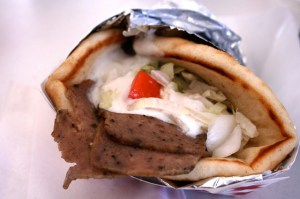
Now THIS is a gyros sandwich!

Now THIS is a gyros sandwich!

The little restaurant opened the same year my wife and I moved into the neighborhood. It specialized in yummy Greek fare like gyros, souvlaki, and Greek salads, but also made terrific hamburgers, subs and pizzas, and quickly became our reflex fall-back when we were too tired to make dinner or wanted a treat for lunch. The place was a family operation: the tiny, spunky middle aged woman who seemed to run the place—taking the orders, filling bags, taking the payment—had a Greek accent that reminded me of my grandmother and all of my relatives from her generation; her husband, silent, imposing, who was the chef; and over time, the two children, both of whom worked there when they weren’t in school.

The food was consistently delicious, fresh and authentic, but it was also satisfying to see an old-fashioned family business growing and thriving. A restaurant consultant would probably have said it was too old-fashioned, for the menu never changed, the faded prints of the Parthenon and the Aegean coast were the only decorations in the place, and it dealt only in cash. Still, the little Greek lady greeted you with a knowing smile when you walked in the door, and you knew you were going to be treated like a neighbor.

Then suddenly, the family was gone. The couple decided to sell the place and retire, and a long-time employee who had worked in various jobs over the years took the restaurant over. I knew him, of course, and we talked often. He’s a nice guy, determined, ambitious, hard working. He threw himself into the job of making the business boom. Now the restaurant accepts credit cards and delivers, is open on Sundays, has daily specials, and sports a newly-painted and (somewhat) less austere decor. He also jacked up the price on everything.

The new owner’s formula for success worked almost immediately. The restaurant, he told me, has almost doubled its business. The problem is, as my family gradually discovered, is that the entirely non-Greek staff, including the owner,  has no idea what their food is supposed to taste like. You know you’re in trouble when the entire staff mispronounces everything on the menu, (It’s GIR -Os, hard G, not, ugh, “JY-row,” like the name of the goose inventor in Donald Duck comics), but it’s worse than that. The feta cheese in the Greek salads, which are suddenly mostly iceberg lettuce, is scant and low quality. The once-marvelous cheese steak subs are bland; the onion rings are charred, and every now and then a carry-out order includes something inedible, like the freezer-burned veal parmigiana I had a few months ago. The owner was apologetic, but his candid “I thought that meat looked funny when I microwaved it” didn’t inspire confidence. Continue reading

Thanks For The Memories, Greta Friedman: This Encore’s For You!

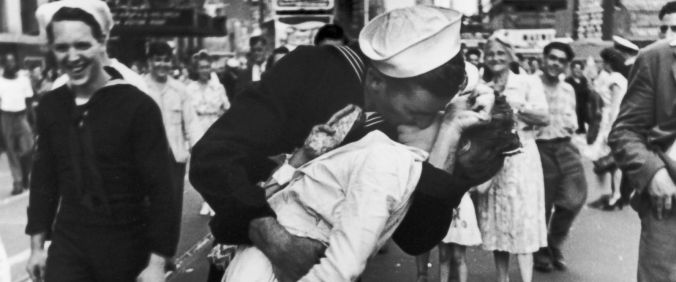
kiss

I was puzzled about why an old 2012 Ethics Alarms post was suddenly getting heavy traffic today, and until I read that GretaFriedman had died. She was the nurse famously kissed by a never-identified celebrating sailor on V-J Day, frozen in history forever thanks to a now iconic  Life magazine photograph.  I had written about Greta, that moment, and the determination of a lot of tunnel-visioned feminists and sexual-terrorists to turn what was a beautiful thing into something ugly and sinister in the distorted world they see through their shit-tinted glasses. The post was called “The Times Square Kiss, and Feminist Blogs’ Fanatic Crime Against Joy.”

I’m always a bit nervous when I go back and read old posts I’ve forgotten about; I’m afraid I won’t agree with them, but thankfully, I usually do. I do in this case. In fact, I really like the post, and am proud of it. On the theory that most current Ethics Alarms readers haven’t seen it before, I’m reposting today, in honor of Greta:

The blog posts at issue make me angry. Usually it is silly to be angry about mere opinions, I know. However, the opinion registered by “Lori” on the blog Feministing, taking her cue from another feminist blogger, is a symptom, a symptom of the scourge of pernicious, political-correctness zealots, who refuse to recognize the important distinctions between malice and human beings being human, and seek to wipe out that distinction by distortion, sophistry, historical revisionism and bullying. Continue reading

The Latest Unethical Tactic: Attacking Journalists Who Don’t Actively Try To Promote Hillary Over Trump [UPDATE: Hillary’s Health]

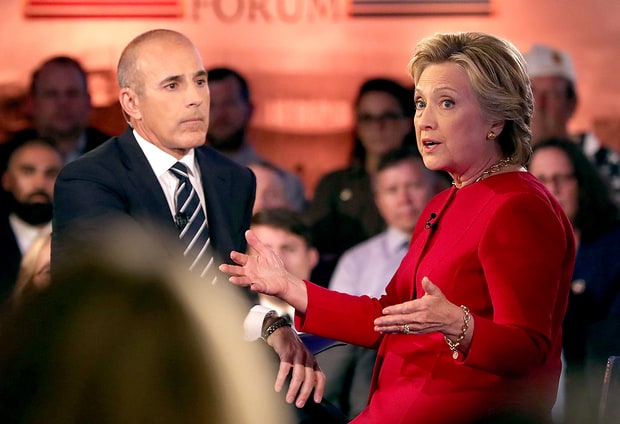
matt-lauer-hillary-clinton

Once the New York Times embraced the rationalization “Ethics is a luxury we can’t afford” and announced that journalists had a duty to bias their reporting to block Donald Trump’s election, this result was foretold. It was really foretold in 2008, when the news media first abandoned even the pretense of fairness and objectivity to ensure the election of our first black President.

Matt Lauer, of all people, became the object of furious invective after he hosted a live prime-time forum with Trump and Hillary. He was accused of unfairness, gullibility and even sexism in his handling of the event. His main offenses: not “fact-checking” Trump, as when he said, not for the first time, that he opposed the Iraq invasion from the beginning (he didn’t), and grilling Hillary about her e-mail machinations.

The only way the transcript supports the latter contention is if one is Bernie Sanders and believes Hillary’s “stupid e-mail” is irrelevant. Lauer didn’t spend an inappropriate time on this issue, given what a perfect example it is of Clinton’s Arrogance, deviousness, lack of transparency, and, apparently, incompetence and recklessness.  I’d say he was easy on Hillary: he didn’t mention her sleazy conflicts with Clinton Foundation donors at all, and she is much less adept at spinning that slam-dunk conflict of interest and ethical violation than with her e-mail, which she has been lying about for more than a year. Pro-Clinton news media, which is to say, news media, howled about Lauer not challenging Trump’s thoroughly disproven claim about opposing the Iraq War, but Clinton already had done this, saying, “Now, my opponent was for the war in Iraq. He says he wasn’t. You can go back and look at the record. He supported it. He told Howard Stern he supported it.” Maybe Lauer thought that was enough; it should have been: Trump’s lie on this score has been well-publicized, including here, on Ethics Alarms.

Meanwhile, he did not challenge Clinton on her obviously false claim that emails cannot be considered classified if they do not contain formal classification markings, and worst of all, he did not challenge her unconstitutional call to ban citizens who are placed on a no-fly list from exercising their Second Amendment rights. This is especially important, because this fact isn’t understood by most Americans, and a Presidential candidate advocating defiance of the Constitution is, or should be, a big deal. Never mind, though: Lauer wasn’t supposed to be tough on Hillary. He was only supposed to be hard on Trump, and because he wasn’t “hard enough,” a.k.a., “harder,” a.k.a. “biased like the rest of the mainstream coverage,” then it means that he was incompetent. Continue reading

Ethics Quiz: Ammon Bundy’s Cowboy Boots

Ammon Bundy. Nice look...that last name is a problem, though.

Ammon Bundy. Nice look…the jury should like it. That last name might be a problem, though.

Jury selection is was about to begin last week  in the trial of Ammon Bundy (Son of Cliven, no relation to Ted) and his fellow defendants who led an armed stand-off on federal lands in Oregon.  First, however, the judge in the case had to rule on Bundy’s lawyer’s motion demanding that the defendants, who are in custody, can wear neckties, belts and boots at trial as requested.

The U.S. Marshal’s Service  emailed  Bundy and the rest to alert them that certain  items of apparel wouldn’t be permitted at their trial: “Ties, Bows, Belts, Handkerchiefs, Cuff Links, Steel toe boots/shoes, Shoe laces, Shirt tie down straps, Safety pins, Shirt pocket pen protectors.” When U.S. District Judge Anna J. Brown Tuesday afternoon asked Barbara Alfono, the deputy U.S marshal in charge of the Bundy trial, about the requirement, she explained that security concerns were the source of the order. Those accessories could be used as weapons against deputy marshals or the defendants themselves, she said. As for the boots, they would interfere with the shackles that are placed around the defendants ankles as they are transported to and from the courthouse. (The shackles will be removed, because prior courts have ruled that they are prejudicial, making defendants look dangerous to the jury.)

J. Morgan Philpot,  Ammon Bundy’s marvelously named lawyer, argued that since his client is innocent until proven guilty, he should be allowed to wear the civilian clothes that he chooses.  “These men are cowboys,” Philpot wrote  in his motion, “and given that the jury will be assessing their authenticity and credibility, they should be able to present themselves to the jury in that manner.” He continued:

“We must consider, when he does so, how will he look? And what are the spot assumptions and impressions will the jury have about him when they see him in the kind of white socks and loafers he was wearing today, with his beltless trousers, and dressed in a formal suit without a tie,Just as significantly, how will the lack of belt, tie, or other apparel compare to others in the courtroom, as he and the other detained defendants are the only ones who will appear that way.”

The judge ruled against him.

Your Ethics Alarms Ethics Quiz of the Day:

Is it ethical for the system to prevent accused cowboys from looking like cowboys during their trial?

Continue reading

Not As Empathetic As You Should Be? Blame Tylenol!

Oh no! Uncle Phil overdoes on Tylenol again, and now he wants to vote for Donald Trump!

Oh no! Uncle Phil overdosed on Tylenol again, and now he wants to vote for Donald Trump!

From Salon, reposting from Alternet:

“Researchers from Ohio State University recruited 80 college students as test subjects. Half were told to drink a solution containing 1,000 milligrams of acetaminophen, while the second half were given a placebo drink containing no drugs. After the medication took effect, the two groups were instructed to rate the pain levels of people in eight different fictional situations — all were emotionally or physically traumatic scenarios. One story involved a person forced to deal with a parent’s unexpected death, another a person with a severe stab wound. Researchers found that students who had taken acetaminophen rated the pain levels of the traumatized story characters lower than those who had ingested the placebo liquid.

In another experiment involving 114 students, half drank the acetaminophen solution and the other half were given the placebo. Both groups were then subjected to brief, loud blasts of white noise and asked to rate the pain levels of a fictionalized participant who had experienced the same. Those who had consumed the acetaminophen solution rated both their own pain and the pain of others who experienced the noise lower than those who drank the placebo solution did. In another study section, subjects were shown short videos depicting a person being socially rejected from a group and were asked to rate the level of emotional pain the rejection caused. Here again, the group that drank the acetaminophen-infused liquid rated the pain lower than those who had only ingested the placebo drink.”

Hmmmm.

A few reactions to this:

1. Many news reports on these weird studies summarize the findings as “Common pain-killers can make you less empathetic.” “These findings suggest other people’s pain doesn’t seem as big of a deal to you when you’ve taken acetaminophen,” Dominik Mischkowski, the study’s co-author and a former Ph.D. candidate from Ohio State University, said in a news release.

Says Baldwin Way, the study’s lead author and an assistant professor of psychology at Ohio State University: “Empathy is important. If you are having an argument with your spouse and you just took acetaminophen, this research suggests you might be less understanding of what you did to hurt your spouse’s feelings.”

I think I know what is going on here. This seems to be one of many ideologically-inspired studies, designed to make the case that those who are privileged and are in less daily distress are naturally less likely to be capable of empathy, and hence have less ethical reactions to the distress of others, including that caused by the conduct of the empathy-impaired. Continue reading

Ethics Dunce: Libertarian Presidential Candidate Gary Johnson

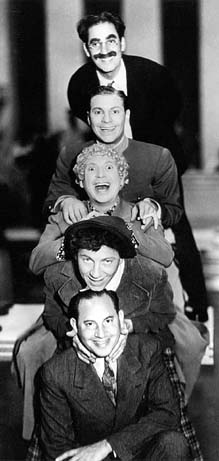
The Marx Brothers: Groucho, Zeppo, Harpo, Chico, and Aleppo

The Marx Brothers: Groucho, Zeppo, Harpo, Chico, and Aleppo

The Presidential nominee of the party whose convention featured a fat naked guy running around on stage found himself being the focus of the news this week, and not in a good way. On MSNBC’s “Morning Joe”—you know, that astute, objective news commentary show with a co-host who says Hillary Clinton is, like “awesome!”— there was this  exchange between Libertarian Party candidate, Gov. Gary Johnson and one of the show’s panelists, Mike Barnicle:

Barnicle: “What would you do if you were elected about Aleppo?”

Johnson: “About…?”

Barnicle: “Aleppo”

Johnson: “And what is Aleppo?”

Barnicle: “You’re kidding.”

Johnson: “No.”

Barnicle explained that Aleppo is a once thriving city in Syria that is ground zero for the country’s civil war. Johnson replied, “Got it,” and provided the wisdom that “With regard to Syria I do think it’s a mess.”

He elaborated, but as CNN’s Frida Ghitis wrote, ” Who cares what Johnson thinks about Syria now? He knows nothing about it. His opinion is meaningless.”

Well, not exactly meaningless. What his failure to have an informed opinion on a major foreign policy crisis like Syria means is that Gary Johnson is lazy, lacks seriousness, and is failing his duty to he party and the nation, which is to provide a realistic, responsible, genuine alternative to the candidates of the two major parties, both of whom are spectacularly unfit to serve, unfit for office, and embarrassments to the democratic process who call into serious question the long term viability of both our form of government and the nation itself.

Did I sugar-coat that too much? Continue reading

From The “When Ethics Alarms Don’t Work” Files: The 9-11 Mattress Sale Ad

How many people were involved with this ad for Miracle Mattress?? How did it get on the air without someone with a brain cell twitching pointing out that it was so offensive that it would spark significant, indeed company-threatening backlash on social media? The company owner has apologized abjectly, but this is a serious management botch. Unless he is lying in his apology and didn’t know about the ad or see it before it was launched, he has hired a bunch of incompetent who are given far too much power.

The woman who starred in the commercial is the San Antonio store’s manager. She, at very least, has proven herself to be an incompetent fool. It might help business recover if in addition to her being fired, her head was placed on a pike outside the store…but that would be wrong.

On the bright side, maybe Colin Kaepernick  will buy a mattress there.

Unethical? Criminal? Stupid? Careless? What The Heck IS This?

Headline:

QUICK! Someone punch it!

QUICK! Someone punch it!

Shopper arrested for punching newborn baby after ‘mistaking her for toy doll’

Well that’s certainly understandable and..wait, WHAT?

In England, Amy Duckers was shopping at a supermarket with her five-day-old daughter in a baby carriage. She was approached by a 63-year-old man who overheard family friends saying, “Come and have a look at this beautiful baby.” The man suddenly punched the baby in the head,  then reacted in horror when the infant burst into tears. He told police that he thought the baby was a toy, and not alive.

Oh! That explains it, then. Everyone punches dolls belonging to strangers in the face. It’s a mistake anyone could make!

The infant is recovering, but I may not. I can’t get my mind around this crazy incident. If he really thought the baby was a doll, you can’t properly charge him with a crime, but how would you categorize what he did? It’s obviously unethical—he has no right to handle someone else’s doll—but how much leeway do we give idiots or crazies, when their handicap causes them to do something like this?

The guy has been arrested, and it will be interesting to see what he’s charged with, and how the system deals with him. I assume that he will be observed for mental health issues. If he’s not, and they release him with a pat on the back and a “next time, make sure it’s a doll before you punch it,” I’m going to be very upset.

Jacoby Ellsbury, Catcher’s Interference, And The Perplexing Ethics Problem Of “Using A Shield As A Sword”

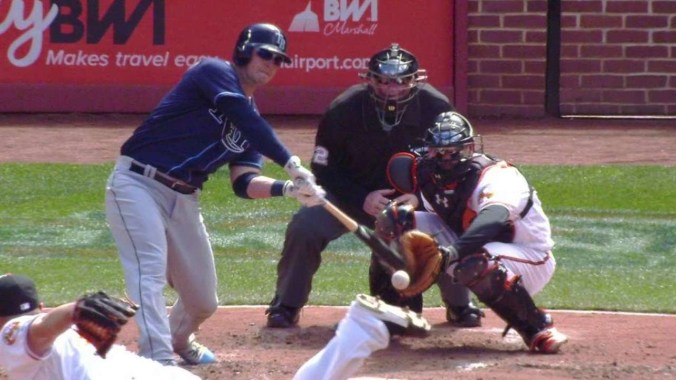
interference

I led two legal ethics seminars for the Oregon State Bar yesterday. For some reason the issue of “using a shield as a sword ” kept coming up.

“Using a shield as a sword” is when lawyers game the ethics rules. Many local bar associations include a pledge within their creeds promising not to intentionally use the ethics rules as a tactical weapon; still, it’s not an enforceable promise. Examples are limited only by a lawyer’s devious ingenuity, but they usual involve one side creating a conflict of interest for the opposing firm or lawyer that will force the lawyer to withdraw from the case. One ploy: a lawyer recruits a key expert witness specifically because she was once a client of the the lawyer on the other side, making it impossible for her to be impeached on the witness stand by that lawyer because he would have confidential information about her that he would be bound to keep secret, even while being required to represent his current client by ripping her credibility to shreds.

What does this have to do with Yankee centerfielder Jacoby Ellsbury? Well, Ellsbury is in the process of shattering an obscure baseball record: number of times reached base on catcher’s interference during a season. Catcher’s interference refers to instances in which a catcher makes any contact with a batter or his bat during a pitch. Usually, this involves the batter’s bat hitting the catcher’s glove, as in the photo above. When that happens, a player is awarded first base. The rule is based on fairness and  designed to protect the batter, but apparently Ellsbury has perfected the weird practice of using it as an offensive weapon.

Jacoby Ellsbury became the single-season record holder in catcher’s interference calls  in July with his ninth instance  getting rewarded for it. The record was formerly held by Roberto Kelly, who did this eight times in 1992.  Since breaking the record, Ellsbury has gotten catcher’s interference called three more times, for a current total of 11 with almost a month  left to the season. He is also second all-time in catcher’s interference with 23. The career record belongs to Pete Rose with 29; since Rose is baseball’s all-time leader in games played and career at bats, we would expect him to hold this record. No one else in baseball history has more than 18. Ellsbury is only five catcher’s interferences shy of Rose’s mark, and has done it in less than a third of the at bats. Continue reading