This goes in the “How in the world does someone get the idea that this is ethical?” file.
Coloradan Kate Criswell’s boyfriend Tom Alexander died over the weekend after having heart problems while the two of them were hiking. Then she had a great idea: why not have the hospital harvest his sperm, so she could be artificially inseminated and have his baby! Unfortunately, sperm viability only lasts 24-48 hours after death, the hospital didn’t have the equipment necessary to extract and preserve Alexander’s sperm, nor was there any legal documentation of his consent for such a procedure.
Criswell doesn’t understand why taking his sperm should be such a big deal. After all, she says, he’s an organ donor. Isn’t that the same thing as being a “give my sperm to any woman who asks for it” donor?
“Tom was amazing,” says his ex-girl friend. “He was always so generous and loved me so much and always made sure that I knew that. He took such good care of me.”
Yes, I would imagine that she needs a lot of taking care of, since she is an idiot. Criswell said she will take up the fight with state lawmakers, so this doesn’t happen to anyone else, “this” meaning ” a couple doesn’t get married, he dies, and the law stops her from unilaterally using his sperm to have his baby without his consent, thus gaining claim to his estate, and maybe even part of his family’s estate.” And what if he had more girl friends? What empowers her to be the only one to with a claim to his genetic material? How many of his babies can she have? Does she want the legislature to declare any dead man’s sperm to be a public resource? What constitutes being a “girl friend”? If he had wanted to have a baby with Kate, why didn’t Tom get her pregnant before he died? Since he didn’t, isn’t there a rebuttable presumption that he didn’t want to start a family with her? If you wanted a baby so much, Kate, why didn’t you two love birds get married? Or are you thinking of Tom’s baby as more of a souvenir?
Based on the fact that this woman thinks “organ donor” applies to sperm, there may also be a public policy argument against this pregnancy based on eugenics.
I am not going to write about the ethics issues in the latest Susan Rice controversy, but I am going to write about why I can’t get an objective enough assessment of what the story is to write about it competently.
Susan Rice, President Obama’s National Security Advisor, sought to “unmask” the identities of members of President Trump’s campaign and transition team who were incidentally mentioned in foreign surveillance intelligence reports. This was first reported over the weekend by conservative conspiracy theorist Mike Cernovich, which meant that no commentators on the Left believed it, but then it was confirmed yesterday by Bloomberg’s Eli Lake.
Many conservatives treated this as confirmation of President Trump’s much-derided claim that the Obama administration “wiretapped” him. The Wall Street Journal’s editorial board issued an op-ed this morning, saying,
All this is highly unusual — and troubling. Unmasking does occur, but it is typically done by intelligence or law-enforcement officials engaged in anti-terror or espionage investigations. Ms. Rice would have had no obvious need to unmask Trump campaign officials other than political curiosity.
“In late December, the administration launched an information campaign designed to depict President-elect Trump as Moscow’s Manchurian candidate. Vladimir Putin had installed Trump in office by “hacking the election,” so the argument went; Hillary Clinton, therefore, was the rightful president.
The claim that Susan Rice was unmasking merely to arrive at the ground truth of Russian behavior would be easier to swallow if the information she gleaned from unmasking had not been used to perpetrate a fraud on the American public. The leak to Washington Post columnist David Ignatius about General Michael Flynn’s conversations with Russian ambassador Sergei Kislyak (which I discuss in this article) is the most egregious example of a senior administration official using material gathered from illicit unmasking in order to tell a very big and very pernicious lie.”
Former national security officials, who spoke on the condition of anonymity, described the requests as normal and said they were justified by the need for the president’s top security adviser to understand the context of reports sent to her by the nation’s intelligence agencies.
Mother Jones’s Kevin Drum mocked the story as pure conservative fantasy regarding a favorite villain:
But! Susan Rice is also a Republican bête noir, the villainess of Benghazi who LIED ON TV repeatedly and tried to get everyone to believe that the attacks were due to an INTERNET VIDEO when we knew all along they were really the work of RADICAL ISLAMIC TERRORISTS, a phrase that OBAMA WAS UNWILLING TO UTTER.Here’s what we can say about the Rice situation at this point.
Sarcasm is used by Drum here to hide the fact that Rice did lie about Benghazi, and was part of an Obama administration effort (that included Hillary Clinton) to blur the fact that it was a planned terrorist attack, not a spontaneous reaction to a video, which would have undermined Obama’s campaign assertions that he had “decimated” Al Qaeda. ( Mother Jones readers will not believe anything negative about Obama, Democrats, or progressives.)
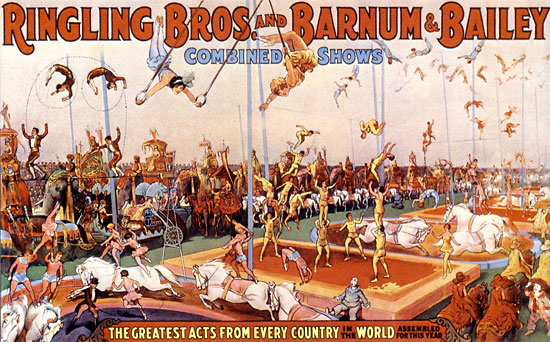
The Ringling Brothers Barnum and Bailey Circus will bring down its metaphorical Big Top for the final time in May. Its business model simply does not work any more, as an executive of the arena entertainment company that owns it said recently—especially since the circus capitulated to animal rights activists and fired its performing elephants. (Ticket sales dropped by almost a third.) This was an iconic cultural institution vanishing, so I had to say farewell, and did so last weekend, when the circus came to Washington, D.C. for the final time.
Observations:
1. It is still an entertaining show, even though the Ringling brothers would never have recognized it as a circus. Several of the acts were worth the ticket price (in our cases, about 75 bucks) all by themselves.
2. The Verizon Center was about a third filled for the final show of the legendary Ringling Brothers Barnum and Bailey Circus. The Center itself was sparsely staffed; it took 20 minutes in line to buy popcorn. Americans, as a group, don’t care about history, culture and significant changes in it landscape any more. The circus and its components gave us imagery, lore, metaphors—“walking a tight rope,” “three ring circus,” (this one is now a two-and-a half ring circus at best), “ringmaster,” “dog and pony show,” “the big tent,” “side-shows,” “clown act,” —and “The Man on the Flying Trapeze.” The nation is a little poorer and less colorful without it.
3. The public also increasingly sees little value in the mass audience experience. Live entertainment, especially family friendly varieties, were traditionally seen as an important and natural way to strengthen community ties, by bonding disparate members of society through a shared experience involving witnessing something transforming and memorable.
4. Assisting in the death of this experience is the trend of making sure all arena and stadium events are filled with loud, never-ending, pounding electronic music that would make Phil Specter grab ear plugs. Once, the circus’s dramatic music consisted of drum rolls, bands and soft calliopes. If you watch the Cecil B. DeMille movie “The Greatest Show On Earth,” you will see spectators talking to each other during the acts, or shouting out to performers. Either is virtually impossible now. Conversation consists of screaming a few words repeatedly until your companion nods. This continues the cultural trend of making meaningful interaction with fellow human beings passe. How can this possibly be a healthy development for society?
I did see a lot of people texting….maybe to those sitting next to them.
5. Almost no venders were walking among the seated. A single snow cone from one of these cost $12.00.
6. This is how unintended cultural pollution takes place. The conglomerate that owns the circus also owns various ice shows, like Disney on Ice. To cut costs, it decided to employ performers from the ice shows in the circus too, meaning that instead of a sawdust path around the rings, the track around the performing areas are ice. Everyone is on skates half the time. It isn’t a bad effect: it’s faster than the old-style parades. But now the circus is an ice show. Continue reading →
I saw an online article that called Bill O’Reilly the “Bill Cosby of Fox News.” That’s not entirely fair: O’Reilly is likely just a serial sexual harasser, whereas Cosby is a rapist. Then again, they are both named “Bill,” and there are other similarities. Both have paid hush money to accusers, both have had a series of accusations made against them by women, the watermark of the sexual harasser (though Bill Cosby, so far, is way ahead in that category), both angrily deny the charges against them, and both have indignant defenders.
Both also are probably sociopaths.
Is it possible that Cosby has been wrongly maligned? Let me think…NO. Of course not. Over 50 women (what is the current count now?) do not accuse the same innocent man of sexual assault. Is it possible that the other Bill is a victim, not a predator? My “no” here isn’t quite as emphatic, perhaps, but…no. The New York Times piece yesterday thoroughly covers the evidence, and the odds against all this being meaningless boggles the mind: Continue reading →
Glenn Logan took off from the post about Paulette Leaphart’s self-promoting breast cancer awareness 1,000-mile walk and CNN reporter Jessica Ravitz’s strangely equivocal exposé to muse on the toxic influence of social media. It’s a great post, as usual for Glenn, and I’m especially grateful because I’m behind on posts today but I have an ethical obligation to watch the Red Sox Opening Day game. (Pirates-Red Sox tied 0-0 in the 5th.)
This is yet another social media-driven disaster. We have proven ourselves unable to handle the medium, either as consumers or producers of content. In the grand scheme of things, social media has probably been the vehicle for more scams, dissociation from the real world, submersion into self-congratulatory alternate reality, fake news, and general mayhem than any innovation in my memory.
I have occasionally referred to Twitter as “the Devil,” and my loathing for Facebook knows no bounds. I still use it once a week or so just to check on friends and family (for which it is at least useful), but 99% of my input to Facebook consists of “Happy birthday, (first name here). Many happy returns” or to message Jack a link. No Luddite I, as I have been using the Internet since the early 1990’s Usenet days, and Linux as my primary operating system since 1997, so technology and I are old, old friends.
But the temptation of social media to generate attention in the name of good causes is, to me, the lesson here besides the obvious ethical wreckage caused by “the ends justify the means.” Many of us see the apparent benefits of fame, and want our 15 minutes of it very badly, usually for entirely selfish reasons. When we can achieve that in the name of a good cause, it becomes all the more insidious as a rationalization for otherwise self-serving and dishonest behavior. Continue reading →
Signature significance, in the context of ethics, is when a single example of conduct or a single episode is sufficient to make a definitive judgment about the ethical values of an individual or an organization. It is something so striking and blatant that the usually valid statistical argument that one data point is meaningless doesn’t hold true. Ethics Alarms refers to signature significance frequently.
The Democratic Party’s behavior regarding the confirmation of Judge Gorsuch is signature significance. It won’t work. It will result in permanent harm to the Senate, harm that will initially most affect Democrats. It is hypocritical, irresponsible, and embarrassing, at least if the party is considering citizens who understand what is going on, admittedly a minority. It is unprofessional. It is dishonest. It is unpatriotic. The conduct is so obviously irresponsible that it is difficult to believe that Democratic leaders don’t realize it. Because it is all these things, the strategy is also very close to insane.
I just watched Senator Grassley’s address to the Judiciary Committee, ticking off l the reasons why the inflammatory Democratic rhetoric regarding Judge Gorsuch ranged from untrue to self-contradictory to ludicrous. He wasn’t exaggerating; it wasn’t a partisan speech. Grassley reminded the committee that Gorsuch had been unanimously confirmed when he was nominated to the 10th Circuit. The Senator correctly explained why the recent mantra that Gorsuch wasn’t “mainstream” was counter-factual, since he has voted with the majority on that court over 90% of the time.
Grassley dismissed as offensive and judicially ignorant (my words, not his; Chuck was appropriately mild in his word choices) the argument that Gorsuch lacked compassion and wouldn’t rule “for the little guy.” Competent and ethical judges—unlike, say, Justice Sotomayor—don’t change their decisions according to which litigant is “big,” “little,” rich, poor, black or white. Their job, duty and role is to clarify what the law is. It is only part of the current progressive delusions, most recently shown in the rulings against the Trump travel halt from terrorist-teeming Muslim nations, that judges should base their analysis on their personal and political biases, when those biases are the “right” ones.
Senator Grassley then moved to the complaint that Gorsuch “refused to answer questions.” “What this means is that the judge wouldn’t say in advance how he would rule on cases that hadn’t come before him yet,” the Senator said. Of course he is exactly right. No judicial nominee has been willing to answer such question since the Democrats politicized the confirmation process forever by voting down Reagan appointee Robert Bork, despite the judge being as qualified and brilliant a jurist as anyone nominated to sit on the Court. No judge should have answered such questions before that, either. Cases are decided on the law and the facts. A justice who has made up his or her mind before even reading the briefs or hearing oral arguments is not judging fairly or competently.
Finally, Grassley pointed out that no Supreme Court nominee has ever faced a filibuster or the threat of one. For Gorsuch to be filibustered by Democrats, despite being assessed by almost every legal expert and commentator as unusually distinguished and qualified (including the left-leaning American Bar Association, which has found conservative judges less than qualified in the past because they were…conservative), is indefensible on the merits. Continue reading →
At one point, profiling the double-mastectomied Paulette Leaphart’s 1,000-mile walk from Mississippi to Washington, D.C….topless…CNN reporter Jessica Ravitz writes,
“If even one woman’s life was saved thanks to a conversation Paulette started, wasn’t that enough? So what if our hero was flawed?”
Oh, no: the “just one child/just one life” rationalization again! (Which, I now notice, isn’t on the Rationalizations List, and it should be.)
Ravitz writes this to begin a long, detailed, infuriating narrative about the well-publicized and much-hyped crusade of Leaphart, whose journey, displaying her scarred chest, was to ostensibly demand more funds for cancer research cure and better and more affordable health care. She said she was a champion for women without breasts “to believe in their beauty and be proud of their strength.”
“By showcasing and embracing her scars, she hoped to inspire others to do the same,” Ravitz writes. “Her journey was bold, visual, moving. It offered a hero to admire and, given Paulette’s audacious decision to walk shirtless in the face of strangers, a rich spectacle to witness. It spoke to African-American women, who face the highest breast cancer mortality rate. It inspired legions of survivors. And it spoke to many who’d lost someone to the disease.”
Ravitz is conflicted, clearly, as she tells the complicated story of the woman whose official cause is admirable, but whose motives are murky, and whose credibility is non-existent. While explaining the mounds of evidence she uncovered that the woman has a record of deception, venality and financial flim-flam, that she sees the long walk as a ticket to fame and cash, and that she has lied and fabricated aspects of her ‘inspirational story” repeatedly while the efforts of journalists to pin her down. Yet Ravitz still ends up by being wishy-washy and equivocal:
“There’s no way to measure how much of a difference Paulette Leaphart made in shaping the conversation about cancer in this country. She touched many minds and hearts, but whether she did so in the most honest and transparent way remains questionable.”
What? There is nothing questionable about whether Leaphart has been honest and transparent—she hasn’t. Ravitz documents her deceptions impressively. She lied about her cancer treatment. She lied about her eligibility for Medicaid and financial resources. She lied to a documentary team that had arranged to follow her, leading them to end the relationship. She lied on her Facebook page, representing her health travails by using the experiences of a friend. Her unguarded comments suggest that she began the walk as a way to make money for herself as well as research. She accepted contributions under false pretenses. Yet the journalist still seems to want to say that all of this doesn’t matter, if some good resulted from it: Continue reading →
Do you still wonder how and why beloved Penn State football coach Joe Paterno and his superiors contrived ignorance while child predator Jerry Sandusky was using their facilities to trap his defenseless young prey? If so, you have a definitive answer in the recent statement of Penn State trustee Albert L. Lord, in an e-mail to The Chronicle of Higher Education. that he’s..
“Running out of sympathy for 35 yr old, so-called victims with 7 digit net worth. Do not understand why they were so prominent in trial. As you learned, Graham Spanier never knew Sandusky abused anyone.”
Spanier is the dismissed Penn State president who was convicted of one count of child endangerment last week for his handling—non-handling, really— of complaints about Sandusky. The verdict was correct: Spanier, like Coach Paterno, intentionally failed to investigate repeated claims that Sandusky was molesting young boys on campus, because he didn’t want to know if the allegations were true, That would have endangered Penn State’s beloved football program, which meant more to him, and obviously Paterno, than crime, truth, education, or harm to innocent children. Spanier probably was certain the Penn State board would endorse his priorities. Based on Lord’s jaw-dropping message, it still might.
Some of the victims of Sandusky, Penn State, and the tactical apathy of Paterno and Spanier have “seven figures” because Penn State is estimated to have paid out about $93 million to more than thirty Sandusky victims over twenty years. Lord—a moron— seems to think they got the benefit of the bargain. After all, what’s a little sexual molesting when you’re ten? Hell, he’d take a little diddling for three million bucks! Who wouldn’t? Go Nittany Lions!Continue reading →
And if you are really just cynical, reckless virtue-signalling grandstanders? How good does that make your cereal?
General Mills, the company that makes Honey Nut Cheerios, launched a creative campaign to raise awareness about declining bee and other pollinator populations in the U.S. and Canada, or, perhaps, to sell more cereal. Which do you guess it is? I’m stumped!
The company gave away 1.5 billion allegedly bee-friendly wildflower seeds attached to its Honey Nut Cheerios boxes. urging consumers to plant the seeds in their backyards and community spaces. More wildflowers, after all, will mean more food and shelter for our stressed honeybee population. There is a real problem to address here: honeybees and the honey industry are threatened. From April 2015 to April 2016, beekeepers lost 44 percent of their honeybee colonies. The U.S. Agriculture Department says that it was the second year in a row that beekeepers lost as many bees during the summer as they did during the winter. Of the 47 species of bees native to the U.S. and Canada, the International Union for the Conservation of Nature says more than a quarter face a risk of extinction from pesticide poisoning, climate change, disease and habitat loss.
But General Mills doesn’t really care about honey bees. If it did, it would have put some thought into its promotion. No, all it was doing, like most companies when they advertise, is counting on the cognitive dissonance scale to do its magic:
It works every time. See, environmental sensitivity is at the top of the scale. So are flowers: who doesn’t like flowers? Below the zero mark for a lot of people are empty calorie breakfast cereals and big consumer corporations. Dr. Leon Festinger, who developed the scale more than half a century ago, showed through his research that when something we place high on the scale is associated or linked to something low on the scale, the low item naturally rises in our esteem. (The higher-placed things will drop, too; the process reduces dissonance, the inate human difficulty of holding two inconsistent values.) This is why candidates for office recruit celebrities and sports figures to endorse them, as if Tom Brady or Rihanna have any more expertise about government and politics than the average 7-11 clerk. This is also why the news media and Democrats keep “linking” President Trump to Russia without any evidence whatsoever—to drive him down on the scale. Continue reading →
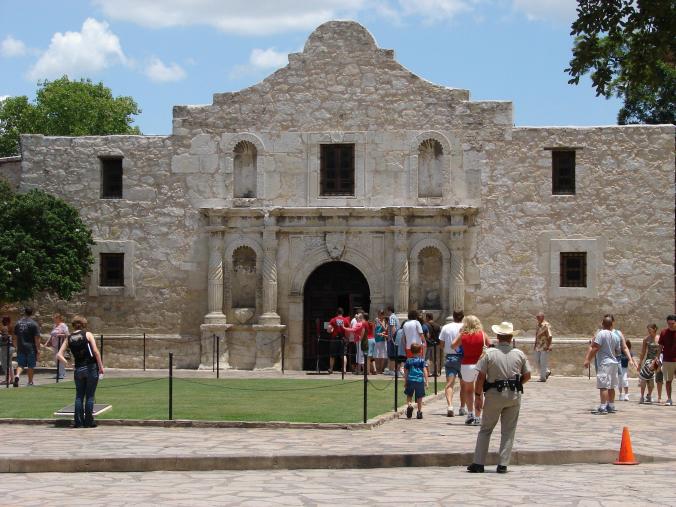
It is now April, and though I vowed at the end of February to finally post a thorough essay on the significance of the Alamo to U.S. culture, ethics, traditions and ideals at some point during the dates corresponding to the fort’s siege and fall on March 6, 1836.
I never did.
I thought I had posted an earlier essay about the Alamo. No, I haven’t. This is as inexplicable as it is inexcusable. The Alamo is by far my favorite historical landmark, and one of the events in American history that most inspires and fascinates me, beginning from when I looked on in horror as Fess Parker, as Davy Crockett, desperately clubbed Mexican soldiers as the last Alamo defender standing, and hundreds more charged toward him, as I heard on the soundtrack,
His land is biggest an’ his land is best, from grassy plains to the mountain crest
He’s ahead of us all meetin’ the test, followin’ his legend into the West
Davy, Davy Crockett, king of the wild frontier!
I learned all about Davy, of course, the real Davy, America’s first pop culture celebrity who created a legend about himself and by fate, irony or justice, inadvertently placed himself in a situation where he had to live up to his own hype—and by all accounts,did. Then there was Jim Bowie. I had seen several dramatized versions of his famous last stand, fighting off soldiers from his cot, finally dispatching one last attacker with his Bowie knife. It is one of the great examples of a scene so good it should have been true, though it wasn’t: Bowie was dead or unconscious by the time the Mexican burst into his sick room. Never mind: that’s how an American hero goes down, fighting. “Print the legend.” Later I learned how Bowie really was one tough, brave SOB, the perfect man for the Alamo, if he hadn’t been dying of cholera.
My impression of William Barrett Travis was biased by Lawrence Harvey’s portrayal of him as a martinet (with a British accent that supplanted his Southern one after the first scene) in the John Wayne film “The Alamo”, my favorite movie as a kid. The real Travis was a pefect example of someone who had failed in everything, including as a father and a husband, but redeemed himself magnificently at the end. His final letter to the world is one of the great proclamations of defiance, dedication and courage in all of history.
I will never forget my first visit to the Alamo, and seeing Texans weeping, openly, proudly, as they read the plaque with Travis’s words engraved on it:
Commandancy of the Alamo Bejar, Feby. 24, 1836
To the People of Texas & All Americans in the World
Fellow citizens & compatriots
I am besieged, by a thousand or more of the Mexicans under Santa Anna I have sustained a continual Bombardment and cannonade for 24 hours & have not lost a man The enemy has demanded a surrender at discretion, otherwise, the garrison are to be put to the sword, if the fort is taken I have answered the demand with a cannon shot, and our flag still waves proudly from the walls. I shall never surrender or retreat. Then, I call on you in the name of Liberty, of patriotism and everything dear to the American character, to come to our aid, with all dispatch. The enemy is receiving reinforcements daily & will no doubt increase to three or four thousand in four or five days. If this call is neglected, I am determined to sustain myself as long as possible and die like a soldier who never forgets what is due to his own honor & that of his country VICTORY OR DEATH.
William Barret Travis.
The story of the Alamo isn’t taught in schools outside of Texas. It wasn’t taught in my school, either: like most American history, I learned about the event though a thick mixture of pop culture, reading (Walter Lord’s “A Time To Stand” was a birthday present in 1961) and ongoing research. I recently completed “Texas Rising,” which was also just broadcast on cable as a mini-series starring the late Bill Paxton as Sam Houston. Historian Stephen Moore is a plodding writer, but he nicely puts to rest the currently popular politically correct slander that the defenders of the Alamo and the Texas rebels were fighting to keep their slaves, and trying to steal Mexico’s land. The Texians were opposing a dictator who had changed the terms under which they had come to the territory, and anyone familiar with the American character could have predicted what would happen when a despot demanded that they submit to unelected authority. The Alamo was a fight for liberty and democracy, and its martyrs exemplified sacrifice for principle and country.
I let them down. The story of the Alamo should be told and retold, with its ethics lessons made clear and bright. Next year, on March 6. 2018, Ethics Alarms will honor Davy, Bowie, Travis, Bonham, Almaron Dickinson and the rest of the 220 or so heroes who died that day, and do it the right way, not as an afterthought.








 Ethics Alarms