JP‘s timely and thoughtful Comment of the Day on #4 in yesterday’s Warm-Up would also be a germane COTD on #3 of this morning’s Warm-up.
Unlike the anti-gun “Do Something!” chorus, JP actually examines the likelihood of two widely proposed gun regulations having any measurable effect on the problem they are supposed to address.
I’ll be back at the end, with quite a bit, frankly.
I think [the “We have to do something!” response] is virtue signaling because it accomplishes nothing and because doing something just to do something can be reckless. Mostly, I have been ignoring these incidents because I have no better solution. Americans have a right to own a gun. However, in the increasingly intense aftermath of the 2016 election, I have been amazed at the number of people who I believe to be intelligent that have thrown logic and reasoning out the window. Therefore, I have decided to investigate some versions of “doing something” to see what they might accomplish.
Outside of total gun confiscation, the most common types of gun control proposed are bump stock bans and closing the gun show loophole. According to CNN (take that for what it’s worth) there were 12 bump stocks found on the weapons used in the recent Vegas strip shooting. For those of you who are not aware of what a bump stock is, it is a device that is attached to the weapon to simulate rapid fire. What it actually does is compensates for the slowness of the user at the expense of accuracy. For example, if you were using an AR-15 you would steady the weapon with your shoulder. If you are pump firing, the rocess involves bracing the rifle with the non-trigger hand, releasing the grip on the firing hand (leaving the trigger finger in its normal position in front of the trigger), pushing the rifle forward in order to apply pressure on the trigger from the finger, and keeping the trigger finger stationary. During a shot, the firearm will recoil (“bump” back) and the trigger will reset as it normally does; then, the non-trigger hand pulls the firearm away from the body and back to the original position, pressing the trigger against the stationary finger again, thereby firing another round when the trigger is pushed back. During this process, it is common for the magazine to be emptied in a quick manner.
Bump stocks cost about $100, though the price depends on the quality. I’ve read that you could do a makeshift bump stock using some rubber bands, making it difficult to regulate. So the question remains, is the bump stock something that should be available to the public? To me, the answer is no. A bump stock is not a feature of a weapon. As such, banning it does not infringe on Second Amendment rights. Furthermore, the bump stocks create a loophole in the assault weapon ban. Finally, since its purpose is to sacrifice accuracy for speed, using the bump stocks are dangerous and irresponsible. A smart gun owner knows the importance of environment, accuuracy, and aiming at a target. While it might be fun to shoot quickly, I can see no way a bump stock could ever be used responsibly (though feel free to contribute one). Continue reading →
1 Yesterday there was a fascinating articleon how the famous opening chord of “A Hard Day’s Night” was (perhaps) made. I have been meaning to make a comment about the new Sirius-XM Beatles Channel, which I had occasion to listen to for many hours while being trapped in traffic jams and construction driving back and forth to Virginia Beach and Richmond, and this is a good time to post it.
I have been getting lousy, dishonest, bait-and-switch service and products with such regularity lately, ranging from an investment firm that couldn’t send the proper forms to give me access to my own money, to Verizon, which has been giving me a six-month runaround while its slooooow WiFi breaks down for days, to Progresso soup, which either decided to put what looks and feels like ground up chicken bones in its vegetable soup, or just the can I bought, that I had despaired of again seeing anything approaching excellence for the sake of excellence from a U.S. business until I returned to Disneyland or Fenway Park. The Beatles Channel makes the grade. It isn’t just the songs, which would have made the channel a hit all by themselves. Sirius-XM includes scholarship, history, musicology, rare recordings, interviews, celebrity and non-celebrity disc jockeys and cultural analysis, around the clock, with new programming every day. I’ve sat through college courses that were less thorough, and too many courses to count, in both college and graduate school, that were less informative and valuable. There are some things worth paying for, and products that are better than you expected!
2. The New York Times headline after a hard day’s night for the GOP in Virginia and New Jersey: DEMOCRATS SCORE TWO BIG VICTORIES IN TRUMP REBUKE.
I’m sure it was the koi.
This is flagrant spin and distortion, and unethical journalism. The New York Times should just put “You hate the President, you know you do” on the banner. The Times didn’t call last November’s across the board rejection of Democrats in state house races and Congress an “Obama rebuke,” though it was, and the results in Virginia and New Jersey cannot be fairly pinned on Trump. The two state governors races went pretty much as everyone assumed they would months ago. New Jersey’s result, from a very Democratic state, was a predictable rejection of its spectacularly failed and detested Republican governor, and Virginia’s election of a moderate Democrat over a Republican who tried to both reject Trump while trying to hitch-hike on some of his better positions was predictable as well.
I would also guess that the Donna Brazile revelations about the Democratic Party’s corruption is not on typical voter’s radar, so the wave of self-hating Democrats staying home that some predicted did not materialize. The Texas shooting, however, probably activated the always vigorous “The Constitution be damned, think of the children!” knee-jerk progressive block to go to the polls.
By now the Times’ routine propaganda tricks are no surprise, but the practice of attaching editorial comments connoting negative implications for the President is neither fair nor objective. But then, the news media knows this: it is attempting a coup by poisoning public opinion. This is the major ethics story—and ethics crisis—in the nation today, and has been so for a year.
3. Now a compliment to the New York Times. Finally, someone wrote an relatively honest article regarding the causes of mass shootings in the U.S. “What Explains U.S. Mass Shootings? International Comparisons Suggest an Answer” is the online version; the print edition headline is “Only One Thing Explains Mass Shootings In The United States.” Both headlines are misleading—the Times has a headline problem—but the article’s main point is correct: “The only variable that can explain the high rate of mass shootings in America is its astronomical number of guns.”
Not inadequate laws. Not enforcement. Not crazy people. Not crime. Not the NRA.
Just lots of guns.
Thank you.
The Times also correctly hints at—it could have and should have done more than hint—why we have more guns than any other country:
In the process of making a comparison between the US and Switzerland, which as the country with second highest gun ownership rate has far fewer shootings (Fun Facts! Switzerland, like Australia, isn’t the United States, and the Swiss, like Australians, are not like Americans), the Times notes,
“Swiss gun laws are more stringent, setting a higher bar for securing and keeping a license, for selling guns and for the types of guns that can be owned. Such laws reflect more than just tighter restrictions. They imply a different way of thinking about guns, as something that citizens must affirmatively earn the right to own.”
Translation: The United States protects and guarantees the inherent human right to self-defense and autonomy, and Switzerland doesn’t. In the U.S., the wise Founders, government doesn’t have to grant you the right to own a gun; you already have it. Or in other words, Switzerland isn’t the United States. (See above.) God bless America.
The Times continues under the heading “The Difference is Culture”:
“The United States is one of only three countries, along with Mexico and Guatemala, that begin with the opposite assumption: that people have an inherent right to own guns.The main reason American regulation of gun ownership is so weak may be the fact that the trade-offs are simply given a different weight in the United States than they are anywhere else.”
“May be”? That’s exactly why Swiss-style “regulation”—as in “We tell you if you can own a gun and what kind of gun you ‘need., Citizen!”—isn’t an option in the U.S. The Constitution also gives the right to speech a different “weight” than other cultures do, and the amount of certainty required to send someone to prison, and when the police can search your home, and many other examples where this nation and this culture insists that individuals and individual rights come first, not government power. The fact that the United States accepts the costs of individual liberty is what makes it the United States.
There are so many guns in the U.S. because Americans like guns, and in this country, people generally can make and get what they like. They should like guns: the United States,more than others, owes its existence to guns. Our most popular entertainment involves guns. Most of all, the #2 mandate in the Bill of Rights guarantees that every citizen begins life with the right to own guns.
Mass shootings are a side effect of the Second Amendment and the core individual right to be armed. The only way to reduce such shootings is to eliminate that right and confiscate guns. Either the currently vocal anti-gun zealots understand this and are lying, or they don’t, and are ignorant.
[The National Review has some legitimate criticism of the Times data analysis, but it doesn’t affect the validity of the Times general conclusion.]
4. Here’s the depressing ethics note of the day, or perhaps the year. On the first day of jury deliberations at the bribery trial of Senator Robert Menendez, a juror asked the judge a basic question: “What is a Senator?”
I guess a necessary voir dire question or two was omitted by the lawyers .
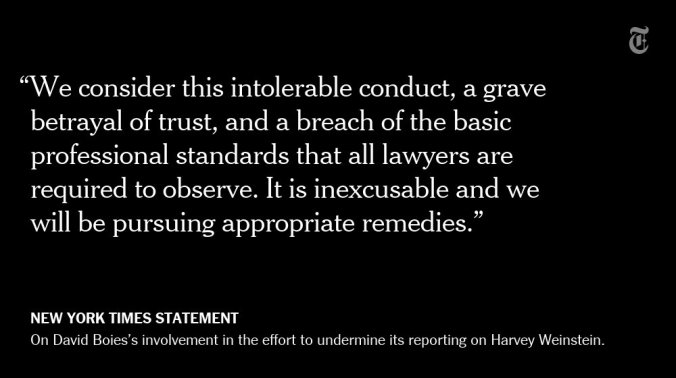
There are a lot of ethics issues, legal and otherwise, flying around in the shocking—this really is shocking—revelation that lawyer Al Gore’s Supreme Court lawyer (and loser) David Boies was working to help Harvey Weinstein intimidate and discredit the women who were preparing to accuse him of sexual harassment, sexual assault, and rape.
The New Yorker reports in an investigative reporting piece that the Boies firm was retained by Weinstein, and on his behalf hired Black Cube, an investigative company run by former Israeli intelligence agents to prevent the publication of abuse allegations by creating profiles on the targeted accusers, often using pretexting–that is, lies— to gain access to proprietary information. Black Cube’s work included psychological profiles and sexual histories of the potential Weinstein accusers. The engagement with Black Cube was presumably run through Boies Schiller Flexner to place the shady matter under attorney-client privilege.
David Boies personally signed the contract with Black Cube, which, according to the New Yorker, was to obtain ” intelligence which will help the Client’s—that is, Weinstein’s— efforts to completely stop the publication of a new negative article in a leading NY newspaper” and to “obtain additional content of a book currently being written [that] includes harmful negative information on and about the Client.”
Did you see “Michel Clayton,” where George Clooney played a law firm’s “fixer”? That’s what Boies was doing here. “Fixing.” And fixing is a dirty business.
That “leading NY newspaper” was and is the New York Times, which, as we now know, was readying its own sensational story regarding the accusations against Weinstein.The New York Times was also a client of Boies Schiller Flexner, though on unrelated matters, hence the statement above. Unsurprisingly, the Times has sacked Boies and his boys.
[Aside: Here’s a lawyer ethics practice tip. If a client asks you to contract with a company called “Black Cube,” “CHAOS,’ “The Legion of Evil,” “The Black Hand,” or “Murder, Inc.”, just say no.]
The second of the Comments of the Day sparked by my musings on Megyn Kelly’s descision to move from a job where she excelled to a completely different assignment at which, at least so far, she is crashing and burning like the Hindenburg. The first, by Extradimensional Cephalopod, was very different, an abstract analysis of the phenomenon that bedevils Kelly, and many of us. The second, a personal account of the dilemma in action, is no less enlightening, but very different.
The comment also reminded me that I have never posted about the Japanese concept of Ikigai, and I should have. There is no English equivalent for the word: ikigai combines the Japanese words ikiru, meaning “to live”, and kai, meaning “the realization of what one hopes for.” Together the words encompass the concept of “a reason to live” or the idea of having a purpose in life. Ikigai also invokes a mental and spiritual state where individuals feel that their lives have value—to them, to loved ones, to society.
Ikigai odes not spring from actions we are forced to take, but from natural, voluntary and spontaneous actions. In his article titled “Ikigai — jibun no kanosei, kaikasaseru katei” (“Ikigai: the process of allowing the self’s possibilities to blossom”) Japanese wrter Kobayashi Tsukasa says that “people can feel real ikigai only when, on the basis of personal maturity, the satisfaction of various desires, love and happiness, encounters with others, and a sense of the value of life, they proceed toward self-realization.”
This topic is close to my heart, so time for some confessions and public reflections.
As I’ve previously mentioned I’m a software engineer, over a decade of experience, and modesty aside, a darned good one at what I do. The main areas of work I’ve been involved in are speech recognition, accessibility and development runtimes (think along the lines of the Java runtime). It was not necessarily world transforming work, but it had an impact and passionate following by our users. Pay was good if slightly low for the experience I had, and as of late I was getting tired of the work and wanted to try something new – also, a reasonable salary increase was not going to hurt.
So I start my job hunt, both internally and externally. At the end it comes down to two very good offers: One working for a social media giant with at a still-to-be-determined role with extremely good pay and no clear route for advancement. The other working closer to hardware (I’m an EE but never worked on it professionally) with lower pay (still an improvement over my previous job) at a clearly defined role with an advancement development plan and with the goal of putting people in space.
Putting it like this it sounds like a home run, but with a family in the line – I’m a single earner with three kids – the financial sides are a big consideration. There were so many things to balance: money, prospects for advancement, happiness, commute time, personal fulfillment, and yes, societal value of my work. It was not an easy decision, there were difficult conversations with my wife and even more than a year later some days I wonder if this was the right call (I went with the space company…Yay!) Continue reading →
Read the post. If this is the way mainstream Democrats are thinking these days, either the country is doomed or the Democrats are. The essay shows that progressives have learned nothing, literally nothing, from Hillary Clinton’s defeat, especially the part of it that emanated from her express contempt for anyone who doesn’t cheer for the au currant leftist cant. If you don’t vote Democratic, you are deplorable—a racist, a sexist, a mouth-breathing moron. Such dehumanization of political and ideological opponents is anathema to democracy; its is the beating heart of totalitarianism. “You are unworthy of making decisions that affect us, the wise and virtuous, but don’t worry, we will use our power over you for the greater good.” Now voting for unremarkable conservative Ed Gillespie is explicit racism.
Just like Donald Trump. You see Gillespie wants to enforce immigration laws—this means he is xenophobic. He objects to NFL players making incoherent, revolving topic protests during the National Anthem, which means he’s anti-black, though many of the Kneelers aren’t black—but then Michael Brown was black, and had his hands up. Or something. All right, maybe he’s not the best person to be protesting over. Ask Colin Kaepernick to explain it. He’s Rosa Parks. Finally, Ed Gillespie opposes tearing down statutes of 19th Cnetiry historical figures because the increasingly radical Left wants to veto the nation’s history as part of its indoctrination strategy. This means, says ThinkProgress, that he’s pro-slavery, you know, just like John Kelly.
Barack Obama and his party were so effective at demonizing political opposition by calling critics racists and sexists that this malignant, democracy-curdling tactic is now a reflex with Democrats. It is unethical, dishonest and destructive. If Ed Gillespie wins, it might just show that smart, principled people are sick of being denigrated for having the ability to resist political correctness groupthink.
2. It’s also election day in New Jersey, where the almost certain election of a new Democratic governor puts an exclamation point on the fall of Chris Christie. A moderate conservative Republican with brains, guts (stop it), and communications skills, Christie might have shown how a balanced governing philosophy built on bi-partisan cooperation and compromise could work in a famously unethical state, and, with success, have led the national Republican Party away from divisive politics and toward responsible leadership. (Bill Clinton once had the same opportunity from the Left.) Christie, however, failed miserably, and it was largely (I said stop it!) a failure of ethics and character, culminating in his unforgivable alliance with Donald Trump. I marked him then as an Ethics Villain, and so he is.
In the end, civilizations flourish or fall based on able and remarkable people rising to challenges and bringing the best of themselves to public service. I’m trying to think of the last time the United States benefited from one of those people. It’s been a while.
3. Now that Koigate has been debunked as fake news, unconscionable confirmation bias, and a new low of manufactured anti-Trump bile from the mainstream news media, the competition is on to top it. Here’s Mediaite on a “juicy” story from a former Trump bodyguard and aide Keith Schiller, quoting Politico:
“…when the White House kitchen staff couldn’t match the satisfaction of a quarter-pounder with cheese (no pickles, extra ketchup) and a fried apple pie, it was Schiller, bodyguard and Trump whisperer, who would head down New York Avenue to McDonald’s on a stealth fast food run.”
Headline: “Trump Bodyguard Went On McDonald’s Runs for POTUS Because WH Chefs Couldn’t Replicate Quarter Pounders.” I’m sure Maxine Waters, Charles Blow, Larry Tribe and Richard Painter will soon explain why this is impeachable. Abuse of power. Bad taste. If Trump owned MacDonald’s, it would be self-enrichment.
Ann Althouse, the now retired law professor and increasingly active bloggress, is a habitual contrarian. That’s why she is such an interesting and politically unpredictable commentator, and why, though generally left of center by instinct, she so often ends up on the opposite side from the news media. Being a contrarian can be a useful tactic for ethicists too: it provides a bias filter. Since lawyers like Ann are trained to be able to argue both sides of any argument with equal fervor and persuasiveness, picking a position you disagree with and arguing for it anyway is a wonderful way to change your own mind, or to find lines of reasoning that might never have appeared otherwise.
It can be a trap, too, especially in the blogging biz. Having an opinion that isn’t already everywhere on the web makes a blog interesting, attracts comments, and leads to increased traffic and links. Especially in areas where one doesn’t have strong opinions, the tendency to disagree with the obvious or popular opinion becomes its own bias, and undermines trust and integrity. I have my own contrarian streak (I inherited it from my father), and I have to watch it carefully. It is not ethical (it’s unkind) to say or write things primarily because you mostly want to make people’s heads explode. I’ve done it a few times on Ethics Alarms.
My post over the weekend, one long in germination, regarding the personal and societal dilemma of balancing one’s duty to oneself, one’s duty to be useful and the infuriating hard-wired human tendency to always seek something different and better, received a gratifying response and at least two Comments of the Day.
This is the first, by frequent COTD auteur Extradimensional Cephalopod, is a marvelous supplement to my post, and I wish I had written it myself, except I couldn’t have.
One of the central principles of Buddhism is “life is suffering”. Clarified, it means that conscious beings inherently have some concept of how they want the world to be that is different from how it actually is. Alternatively, if the world is already how they want it to be, either the chaos in the world will bring it out of alignment with their desires, or they will eventually become dissatisfied as their minds develop further. This is what the bartender in Saroyan’s story is referring to. It’s the existential condition; “condemned to be free”, as Sartre put it.
Having studied desire and motivation from an existential point of view, I’ve codified eight motivations that lead people to form goals. They are based on three dichotomies: experience versus control, greater and lesser quantity, and order versus chaos.
Greed/ambition: the desire for more control or more accomplishment (acquiring more possessions or becoming more important). Gluttony/celebration: the desire for more of an experience (greater intensities or more constant access). Wrath/boldness: the desire to break through limits by exerting control (disregarding rules or doing the impossible). Lust/curiosity: the desire to remove limits on one’s experiences (experiencing the unknown). Hubris/scrupulousness: the desire to impose limits through one’s control (absolute, perfect control over something). Envy/dedication: the desire to impose limits on one’s experiences (obsession or tunnel vision). Sloth/contentment: the desire to have less control (having responsibility or having to pay less attention). Cowardice/prudence: the desire to have less of an experience (avoiding pain or discomfort). Continue reading →
I do want to thank Curmie, our esteemed drop-in commenter who is a drama teacher and chronicler of ethics outrages from the world of education, for ambushing me with this head-exploding story from Brandeis University. And my head had been doing so well.
Playwright Michael Weller had received a Creative Arts Award from Brandeis, and when he wrote a a play, “Buyer Beware,” that satirized the political climate on U.S. campuses the University scheduled it to make its premiere there. The satire concerns a student who discovers the works of iconic 50s era comedian Lenny Bruce, and attempts to stage a production in the spirit of the taboo-challenging comic. The production offends students affiliated with the Black Lives Matter movement, as well as the Brandeis-like university, which worries that the controversy will offend a crucial donor. The script, channeling Bruce (think George Carlin but more abrasive, and not as funny) called for a white character to use “nigger” in several instances. The play quotes Bruce’s famous manifesto against strictures against mere words: “Imagine if we just kept saying these words over and over again, sooner or later they’d become meaningless noise.”
Without reading the script, it appears, so many students protested that Brandeis administrators, proving that their spines and principles were noodle-flexible, capitulated and cancelled the production, when the statements of the protesters should have made it obvious that such a play was desperately needed. For example, Andrew Childs is an Undergraduate Department Representative for the Theater Arts Department and a member of the season’s play selection committee, told the student newspaper,
“The issue we all have with it is that [Weller] is an older, straight…, able-bodied and white man. [ Wait! Isn’t it okay to be white?] It isn’t his place to be stirring the pot.”
What are they teaching at Brandeis? Only certain genders and races can “stir the pot”? Continue reading →
1 I thought the weekend’s violence story was going to only be Senator Rand Paul getting attacked and beaten up by his next-door neighbor, a frustrated socialist, but no. Then we learned that a madman in Sutherland Springs, Texas had opened fire on a church congregation and killed at least 26, wounding another 30 or more.
It now appears that the shooter was not permitted to purchase or own guns, which means that no law, short of gun banning and confiscation—good luck with that in Texas—could have prevented the massacre. Nevertheless, the immediate—can I say hair-trigger?—response from predictable anti-Second Amendment demagogues came in waves. Notable was the country’s #1 demagogue—and yet she persists!—Bay State Senator Elizabeth Warren, who in successive tweets signaled her gun-fearing virtue to gentle progressives, presumably the ignorant ones:
“I’m heartsick for the victims, families & community of Sutherland Springs. But I’m more than heartsick – I’m angry…How many more people must die at churches or concerts or schools before we stop letting the @NRA control this country’s gun policies?…How many kids must die of gun violence on playgrounds & streets every day with no attention at all before we wake up to what’s happening?…Thoughts & prayers are not enough, GOP. We must end this violence. We must stop these tragedies. People are dying while you wait.”
What does this mean? All it means is “Do something! ARRGH!” That is not a mature, rational, professional and responsible reaction from an elected official. The other thing it means is “repeal the Second Amendment,” which is the anti-democratic position of most of Warren’s supporters and followers. Since this episode would not have been prevented by anything but preventing the availability of guns nationwide, except, of course, to the government the public does not trust, Warren is doing nothing more nor less than blaming Republicans and the NRA for a lunatic’s rampage no one could have foreseen or prevented. This, in turn, ramps up the partisan and ideological hatred and division that has been the strategy of Democrats for a full year now, and that leads to Republicans being shot on baseball fields, Senators being mauled by socialist neighbors, and maybe even some mass shootings.
Then we have the muddled and useless “thinking” conveyed by this kind of fatuous commentary, which, to summarize, argues that we need “new ideas” and that a single maniac’s single act from motives nobody yet knows tells us that the rest of the public is devoid of optimism and hope. The author’s candidate for a “new idea”? “Maybe we need to start thinking about guns the way one physician has started thinking about opioids.”
Or maybe we should take a gun apart, put it in a brown paper bag, spin it over our heads and scream like a chicken. Although that’s not exactly new…
On the conservative side, gun defenders are making great hay out of the apparent fact that the killer was pursued and perhaps killed by legally gun-toting church neighbors. That’s moral luck, and nothing more.
2. The Democratic Party really is doubling down on its denials of Donna Brazile’s not-quite-whistle-blowing-since-the game-she-helped-try-to-cheat-in-was-over- a-year-before -she-blew. Amazing. I heard Robbie Mook, Hillary’s incompetent and corrupt former campaign manager, argue that Bernie’s campaign could have bought into the DNC too, so Brazile’s accusation is unfair. The agreement that gave the Clinton campaign control over the DNC was cut in 2015, before the Sanders campaign was anything but a hope, a prayer, a lark and a shadow. Of course Clinton had money: she had been gathering a coronation war chest for years. This was a bright line, classic, conflict of interest by the Democrats, and one that created a terrible appearance of impropriety (because it WAS improper) , except that it was kept a secret. That the Democrats deny this indicates that they don’t know what is inappropriate, and don’t see anything wrong with conflicts of interest as long as they suit their needs.
In other words, the party is corrupt, and likes it that way. Continue reading →
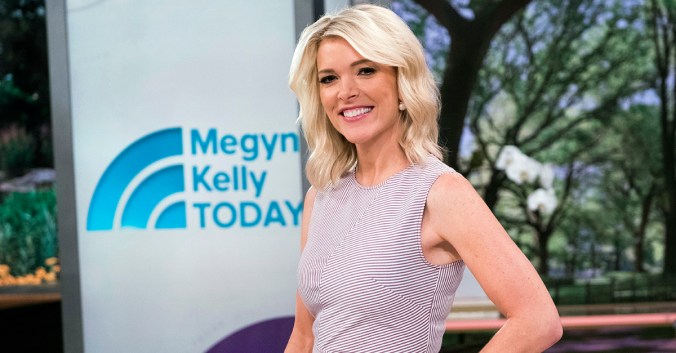
I have been following Megyn Kelly’s ongoing career crash with interest and reflection. She spurned a more lucrative contract from Fox News to jump to NBC, where she was made the star of a “Today Show” shake-up. Critics have been brutal; ratings have plunged. Reportedly celebrities refuse to be booked for interviews with her–they are all progressives, you see, and fear they will get cooties from Megyn, or something. Conservatives are mocking her as a turncoat getting her just desserts, and the Left already hated her. She has no constituency now; literally none.
You never know; Megyn might rebound. Nevertheless, she is a cautionary tale with ethics implications. Kelly has an unusual set of skills and talents. She is actress/model beautiful in face and physique; she is very intelligent; she has a great broadcast voice. She is a lawyer as well as a journalist, articulate, and has guts. There are many paths she could take that would make use of her abilities and achieve fame, wealth, popularity or power.
This is fortunate fortunate, but it also is a trap. Choices involve the risk of error, failure, lost opportunities and disappointment. Those who have a limited number of skills also have a limited number of choices, or none at all. There is some serenity in this. My entire professional life has been spent jumping back and forth, in and out among the many areas that interest and engage me, and in which I have had some measurable talent and success. In the end, and I am far closer to the end than the beginning, mine will be substantially a life of underachievement and waste, in great part because I never made a committed choice, or made the wrong ones.
My heroes have always been those remarkable, versatile people who somehow contrived to make major contributions to culture, society and civilization in multiple fields. Theodore Roosevelt, a historian, naturalist, and political leader. Clarence Darrow, a lawyer, writer, and philosopher. Hedy Lamarr, the sexy actress and pin-up who developed a radio guidance system for Allied torpedoes, a bomb-sight,and whose inventions are now incorporated into modern Wi-Fi, CDMA, and Bluetooth technology. Paul Winchell, the popular ventriloquist, kids show host, and voice actor (Tigger!) who also invented medical equipment. Marlene Dietrich, who acted, sang, spied, and defied Hitler. John Glenn, a fighter pilot, astronaut, and U.S. Senator. Richard Gil, a tenured Harvard Professor of Economics, and a principal bass with the Metropolitan Opera Company. Michael Crichton, a novelist, film director and MD, with the gift of philological insights. Ronald Reagan, a movie star and a President of the United States. But their path is perilous. Continue reading →







 Ethics Alarms