Apparently both the Brooklyn attacker and the man who took him down were homeless.
Observations:
I thought the “knock-out game” was 1) over with and 2) an urban myth. This sure looks like the “game” to me.
I can’t find a single report that notes that, however.
I also can’t find the name of the man who tackled the assailant and held him until police arrived.
Why hasn’t such a good citizen been recognized?
Many of the headlines on this story are like CBS’s, which reads, “Homeless Good Samaritan Saves 2 Elderly Women Attacked By Homeless Man.” That’s fake news. Can’t these hacks get any story right? Watch the video. Yes, the man attacks the the attacker of the two women, but the bad homeless man was trying to leave. The damage to the women he punched was done. By no interpretation of that video can it be said that the “good Samaritan” saved the victims. Indeed, he didn’t interact with them at all.
The video accompanies the headline, and yet the headline is still false!
Tell me again, ye Defenders of the News Media, why we are supposed to trust these irresponsible, undependable, incompetent hacks, much less respect them.
Would you do what the Good Samaritan did here? If not, why not?
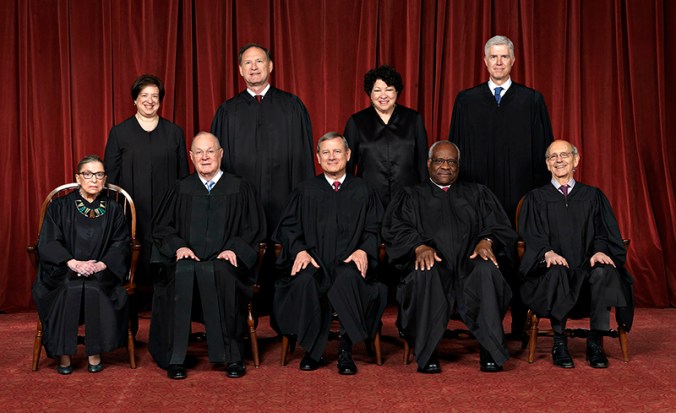
1. Bad Alito, Good Alito. As I briefly noted yesterday (and hopefully will do in detail today), Justice Alito authored an unethical and embarrassing dissent defending a lawyer who deliberately betrayed his client by telling the jury that he had killed someone his client denied killing. Bad Alito. However, the arch-conservative jurist also authored the majority opinion in Murphy v. National Collegiate Athletic Association, in which the SCOTUS majority struck down a virtuous but unconstitutional law, and did so clearly and well.
These are, I think, my favorite Supreme Court opinions, where the Court ignores the motives and objectives of a law and simply rules whether the legislature is allowed to behave like that. I don’t know, but I would guess that most of the majority feel the way I do about organized sports gambling: nothing good can come of it, and a lot of harm is inevitable. One they get the green light, I’m sure that as many states will take over sports gambling for its easy revenue as now prey on its poor, desperate and stupid with their state lottery scams. Everyone involved–sports, fans, athletes, states, the public’s ethical compass—is going to be corrupted by letting the sports betting genie out of its bottle: just watch.
Nevertheless, the Professional and Amateur Sports Protection Act, a 1992 law known as PASPA, should have been struck down decades ago; I’d love to know why it took so long. No, it did NOT ban sports betting, though this is what far too many news reports tell you. Congress can ban sports betting directly if it chooses to, as it is interstate commerce. This isn’t in dispute. What it did in 1992, however, was to order states not to pass laws states have a constitutional right to pass. The distinction matters. From SCOTUS Blog, which is usually the best source for analysis of these things:
The 10th Amendment provides that, if the Constitution does not either give a power to the federal government or take that power away from the states, that power is reserved for the states or the people themselves. The Supreme Court has long interpreted this provision to bar the federal government from “commandeering” the states to enforce federal laws or policies. [The] justices ruled that a federal law that bars states from legalizing sports betting violates the anti-commandeering doctrine…
…In a decision by Justice Samuel Alito, the court began by explaining that the “anticommandeering doctrine may sound arcane, but it is simply the expression of a fundamental structural decision incorporated into the Constitution” – “the decision to withhold from Congress the power to issue orders directly to the States.” And that, the majority continued, is exactly the problem with the provision of PASPA that the state challenged, which bars states from authorizing sports gambling: It “unequivocally dictates what a state legislature may and may not do.” “It is as if,” the majority suggested, “federal officers were installed in state legislative chambers and were armed with the authority to stop legislators from voting on any offending proposals. A more direct affront to state sovereignty,” Alito concluded, “is not easy to imagine.”
…The court also rejected the argument, made by the leagues and the federal government, that the PASPA provision barring states from authorizing sports betting does not “commandeer” the states, but instead merely supersedes any state laws that conflict with the provision – a legal doctrine known as pre-emption. Pre-emption, the majority explained, “is based on a federal law that regulates the conduct of private actors,” but here “there is simply no way to understand the provision prohibiting state authorization as anything other than a direct command to the States,” which “is exactly what the anticommandeering rule does not allow.”
Today the Supreme Court ruled in favor of Robert LeRoy McCoy, who was convicted of three counts of murder after his lawyer refused to follow his instruction and plead not guilty as he directed. I had predicted that his convictions would be over-ruled; I also wrote,
“If the Supreme Court does anything but overrule Louisiana in this case by a 9-0 vote, I may turn in my law license in exchange for a free Whopper at Burger King.”
Well, the vote wasn’t 9-0. I think instead of turning in my license, I’m going to turn in my respect for the so-called conservative wing of the Court. The majority opinion was authored by Justice Ginsberg, with Kagan, Sotomayor, Breyer, Roberts, and Kennedy concurring. Two of the conservatives concurred in a dissent authored by Alito: Gorsuch and thomas.
I haven’t had time to read it as carefully as I have to to do a thorough analysis, but I read it well enough to flag it as an embarrassing collection of rationalizations. While the majority opinion interprets a straightforward case according to what is significant about it—a lawyer pleaded guilty for him when his client demanded that he plead non guilty, thus making the conclusion unavoidable, Alito resorts to desperate excuses. Well, this kind of case isn’t likely to happen again. So what? A man was robbed of his Sixth Amendment rights! His story was ridiculous. So what? If that’s his story, he has the right to tell it. The lawyer was placed in a tough situation by a client whose claims were unbelievable. The jury decides who to believe, and a defendant has the right to let them do that. McCoy’s lawyer didn’t believe him. So what? Welcome to criminal defense work. McCoy was going to be convicted anyway.
What????
I can’t believe a Supreme Court Justice is making these arguments. So what? The principle of the rule of law is that it is vital that the defendant, if he is convicted, is convicted the right way, constitutionally. The conduct of McCoy’s lawyer was indefensible under the ethics rules, and the Constitution.
Reading the whole opinion and the dissent is revealing, and not in a good way. The majority opinion shows us that the Supreme Court can’t say the sky is blue without making the case in the mots turgid way possible. This opinion should have been a few pages at most.
The dissent lets us know that Justices Alito, Gorsuch and Thomas look for minuscule fragments of justifications to avoid doing the right thing.
…where I always feel at home! I’m here for the morning, talking to young, newly minted Massachusetts lawyers about ethics.
1. This is a big deal, though only lawyers will care. Finally, California has ditched its confusing, multi-source (some ethics rules were laws, some were regulations), antiquated legal ethics rules, and became the last of the jurisdictions, including D.C., to adopt the American Bar Association’s template for legal ethics guidance. Yes, in one area, if not the most important ones, California is moving closer to the rest of the country! There is hope!
2. Ally’s lament. Ally Sheedy, whom you might recall from “War Games” and “The Breakfast Club,” is one of Hollywood’s more articulate and thoughtful performers. She recently penned a post condemning Hollywood sexism, and its effect on her career. Essentially the essay amounts to a complaint that Hollywood is obsessed with appearances and, with women, sex appeal.
I like Sheedy, and I was pre-inclined to respect her observations (which are certainly accurate), but I have to admit that unsympathetic blogger Amy Alkon has a point. She writes,
“..professional actress Ally Sheedy takes it upon herself to lament the looks-driven reality of Hollywood — which is kind of like lamenting how in professional baseball, somebody’s always throwing a ball your way. …This is the movies, dear, not the genetics lab. Her entire essay is an example of intrasexual competition — criticizing and trying to change the standards of female competition by one who falls a bit short of them.Because so many people are so ignorant of our evolved psychology and in denial of biological sex differences (and the psychological sex differences that come out of them), they don’t get that there is pressure on men, too, to meet women’s differing mating priorities.As for those differing priorities, well…you don’t see men writing essays about how rotten it is that you can’t get a hot girlfriend (or probably any girlfriend) while unemployed and sleeping on a couch in your grandma’s basement.”
Is something in the etho-cultural air? I wonder. Suddenly hints that patience with the resistance/progressive/Democratic/mainstream media assault on the Presidency, democracy, fairness, honesty, civic discourse and the rule of law is running out even with typically left-leaning citizens are turning up in multiple venues all at once. This is, of course, gratifying here at Ethics Alarms, since I have regarded this as an ethics crisis since 2016.
Fascinating evidence can be found in the comments to a recent post by Ann Althouse, in which she pointed to a res ipsa loquitur piece in Politico, “‘What Happened to Alan Dershowitz?’, which I would summarize as “Whatever could have possessed Alan Dershowitz to make him opt for objectivity, principles and integrity at a time like this?” Ann, as she frequently does, didn’t comment substantively on the essay, deciding instead to make an arch observation while pointing the way for her readers. She flagged what she called “the most obvious quote” in the essay: “Maybe the question isn’t what happened to Alan Dershowitz. Maybe it’s what happened to everyone else.” Of course, nothing happened to Dershowitz. He’s doing what a lawyer, an analyst and a trustworthy pundit is supposed to do: apply the same standards to everybody; not let emotion rule reason, and when all around him are losing their heads and blaming it on him, keeping his own despite temptations to follow the mob.
Ann’s readers distinguished themselves in their reactions. I wonder if the Democrats are paying attention. They are fools if they don’t.
Read as many as you can. Here’s a representative sample:Continue reading →
They both called the cops on someone who was violating a policy. Only one of them, however, was accused of racism.
Bruce Kothmann, a University of Virginia alumnus, read aloud from his Bible on the steps of the school’s Rotunda this week, so university police came make him stop. He did stop, because he didn’t want to be arrested. For such public speech is no longer allowed at the public university. The Rotunda is not one of the places the university has designated for public speech by outsiders.Kothmann was on to campus because his daughter had just finished her sophomore year, but was reading from his Bible with him to challenge the school’s policy limiting speech on campus.
A terse reader comment on the story said, “This is basically what happened at Starbucks.” The comment is correct.
Would UVA have sent the police to silence a black parent? My guess: no, and if it had, the school would be grovelling in the dust right now, begging for forgiveness. Unless the school could quickly point to a white transgressor who got the cops called on him, a charge of race bias would be devastating, and, of course, effective.
You recall the Starbucks episode: I covered it here. Two African Americans were informed of a Starbucks policy that required those using the facilities to be customers. The men refused, the manager called the police claiming trespass, and the rest is ugly, race-baiting history. The two men could have left just as Mr. Kothmann agreed to stop reading, but that’s just moral luck. The reader was right: the episodes were the same….except for the race of the violator involved.
The Ethics Alarms position is that both policies, that of the university and the old Starbucks policy, are reasonable, with the Starbucks policy being the more defensible, since UVA is a public university and has the First Amendment to contend with. Never mind: the news media and the social justice social media mob have little interest in a white man being stopped by police from reading that old rag, The Bible, but if two black men violating a private business’s reasonable policy have that policy enforced against them, that’s intolerable.
We have the birth of a new racial privilege, now extending beyond police shootings (a white cop can safety shoot a threatening white suspect, but not a black one) to other forms of previously justifiable conduct. Continue reading →
(This was definitely the oddest LP in my Dad’s Jimmy Durante collection….And good night, Mrs. Calabash, wherever you are…)
1. Ethics Hero, I guess. A sad one…The Henry Street Settlement , a community charity, was shocked to receive $6.24 million donation, the largest single gift from an individual in its 125-year history, from the estate of the late Sylvia Bloom, a legal secretary from Brooklyn worked for the same law firm for 67 years until she retired at age 96 and died in 2016. When one of the wealthy lawyers she worked for bought a stock as she made the transaction for him (or her; I don’t know), she bought the same stock for herself, in a smaller amount. The woman amassed all this money, which she could have used while she was still breathing to assert some beneficial influence over society, help others, or just to expand her own experiences and life opportunities, but instead delegated the responsibility to a non-profit organization to handle after her death. She spent a lifetime in thrall to a law firm, and never could take the initiative to be free.
I view this story as a strong argument for feminism.
2. Progress: For the first time in The Citadel’s 175-year history, the Corps of Cadets command was awarded to a female cadet, Class of 2019 Regimental Commander Sarah Zorn. This was no affirmative action or gratuitous diversity moment, but an honor well-earned. In addition to her academic record and demonstrated leadership abilities, Zorn can do 70 pushups in two minutes (I’ve done 7 push-ups in two decades) and has three martial arts black belts. This triumph finally eradicates the humiliating beginnings of the South Carolina military academy’s gender integration, when Shannon Faulkner won a lawsuit against the school’s strict male-only admissions policy, became the first female cadet admitted, then showed up out of shape and irresolute, washing out after five days, four of which were spent in the infirmary. I have always regarded Faulkner as the anti-Jackie Robinson, the perfect example of how a trailblazer without sufficient character can make the trail worse than it was before.
3. An ethics inspiration from Europe. 15,000 European 18-year-olds will be able to travel free of charge in Europe this summer, using special free travel passes valid for 30 days. The European Parliament initiative was passed “to enhance a sense of European identity and European values.” . The cost will be about $14.2 million dollars in American currency.
Great idea, and better, in fact, for the United States to try than Europe, since the United States actually has a national culture and one that a majority of young people are neither learning about nor understand. The U.S. version should include tickets to a baseball game, of course.
4. Duh.Imagine my surprise when, after opening the Sunday New York Times Sunday Review section, I found leading off the insert that has been dominated by anti-Trump hate and hysteria since last November an essay that dovetails nicely with this Ethics Alarms post from yesterday.“Liberals, You’re Not as Smart as You Think” by Gerard Alexander, professor of political science at the University of Virginia, was given the front page of the section to make a point, a full year and a half into President Trump’s administration, that has been a theme on Ethics Alarms for all of that time, and should have been screamingly obvious to anyone whose own ethics alarms still had functioning clappers. Alexander writes in part, Continue reading →
I think my favorite Comments of the Day are those where a reader is moved to relate a personal experience. That is what Zoltar Speaks!, currently on an Ethics Alarms sabbatical—I can relate—does here, in response to the Ethics Quiz about the star college who either was, or was not, a child molester in his teens.
Incidentally, the poll results on that quiz revealed tat only 25% of those polled felt that his guilty plea should affectt his college baseball career now.
I’ve been waiting to share this since I read this blog post and I just got the “okay” to share this story about an old friend. If this reveals my identity to people that have knowledge of these events please respect my choice of anonymity.
I can tell you that sometimes the accused get terrible, terrible legal advice, my friend was one that got such terrible advice.
Many, many, many years ago my friend was advised, by his attorney and a prosecutor, to plead guilty to a statutory-rape charge about six months after he turned 18 for having sex with a minor girl. The thing is that he never had sex with her but yet he was being accused of it both legally and he was being smeared in the public. He had actually only been on a few of dates with her when we figured out she was a minor, if I remember right she was about to turn 17 – she looked older. My friend dumped her, it was a public rejection revealing that she was lying about her age and she made quite a scene – I was there.
The attorney that advised him to plead guilty was fired and he got an attorney that would fight for him. In the end it turned out that the girl had proven herself to be a pathological liar and this was just one in a long line of big revenge lies she had concocted over the years. It was really interesting that her mother was the one that got directly involved in this case and due to her involvement it was eventually proven by a medical doctor that the girl was still a virgin. I was told that the prosecutors face fell off the front of his head when the evidence was presented to him. The case was dropped before it ever got to court but the accusation stuck in the minds of the public. It’s amazing how that accusation of raping a minor stuck like glue on my friend, people presented the accusation as some kind of evidence that he was a terrible person even though it was completely false. He ended up moving from the area as a result of having to prove himself innocent over and over again. I’m sure there are still people that would think he is a rapist or worse just because he was accused.
You would think that moving away was pretty much the end of the story; nope, there’s more.
A few years after this took place my friend was in a bar a couple of states away from where this all had taken place and ran into this girl, now an adult, with her boyfriend. He didn’t know she was in the bar until her boyfriend confronted him with the accusation that he was the guy that had gotten away with raping her when she was a minor. My understanding is that it came very close to a physical confrontation but he was able to convince the boyfriend to allow him to prove his innocence with actual documentation that he had saved (his attorney advised him to keep everything related to the case in a safe place). You’ll never guess how he got the guy to allow him to prove his innocence; this pathological liar girl had changed her name and that came out in the confrontation and the boyfriend hadn’t known anything about that. The next day, my friend allowed the boyfriend to read the documents plus he got to see photos of the girl as a teenager to prove it was the same girl. He learned that she was a pathological liar, actually thanked my friend for helping him dodge a bullet, and he dumped her. The last I heard anything about the girl, she was in a prison somewhere out west. Continue reading →
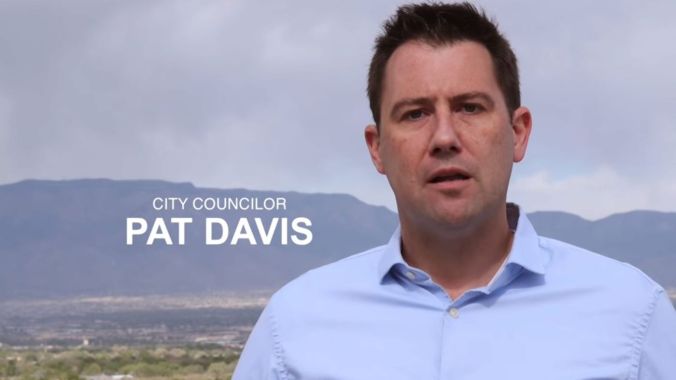
—-Albuquerque City Council member Pat Davis,in a TV ad promoting his candidacy for Congress in the upcoming Democratic Party primary.
Nice.
That’s what we really need more of in the government: more incivility, vulgarity, cretinous rhetoric, and hate-mongering. Go Pat!
I suppose Davis is taking his cues from potty mouth DNC chair Tom Perez and putative Presidential candidate and California Senator Kamala Harris, both of whom have decided to jettison dignity and professionalism in pursuit of the rapidly devolving progressive base. These people are all ethics corrupters. I don’t care who they say to fuck, or what. If this their idea of leadership, they are a disgrace to the nation and whatever office they seek.
Of course Davis’s message is idiotic, regardless of his terminology. He says that the NRA’s ” pro-gun policies have resulted in dead children, dead mothers and dead fathers.” If politicians like Davis want to repeal the right of citizens to own guns, then let them have the honesty and integrity to say so. Blaming the organization that is an advocate for the Second Amendment for crimes committed by those who abuse the right is intentionally dishonest as well as cowardly, like blaming the ACLU for the proliferation of lowest common denominator demagogues who think “Fuck the NRA” is responsible political discourse and not merely the equivalent of a primal scream.
Yesterday I did a pro bono ethics presentation for a local lawyer group. During the lunch, which, as usual in such situations, I never got to eat, I was seated next to a lively, intense, talkative young man, like the rest of my audience, a corporate counsel. The discussion was oddly tentative for a long time, which the lawyer’s body-language suggesting wariness and his verbal choices suggesting unusual care. He was probing for something, and I couldn’t tell what. What was it that they vibe reminded me of? Poker? A job interview? Suddenly I realized what it was: the conversation had the tenor, though not the implied subject matter, of those awkward conversations I recalled from parties and encounters where a new male acquaintance was trying to figure out a) whether I was gay and b) whether, if I wasn’t, he could trust me enough to say that he was.
In this case, however, the young man was probing to see if I hated President Trump. I don’t know which comment of mine put him at ease, but suddenly it all poured out. This lawyer and Haitian-American immigrant was an enthusiastic supporter of the President’s policies and leadership style. Once he was certain that I would not look at him like he was the spawn of Satan for daring to express such a view—which he explained extremely logically and eruditely—we had a fascinating discussion, covering illegal immigration, the news media’s bias, the “resistance,” racism, muscular foreign policy leadership, the 2016 campaign, and more.
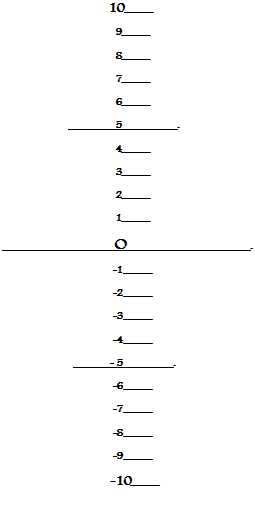
However, the fact that simply expressing support for the elected President of the United States, even limited support, indeed even the absence of affirmative contempt, is considered such a perilous social stance that citizens are afraid to express it among their peers demonstrates the monstrous—I think that’s a fair adjective here—intimidation and speech suppression that has been perpetrated by the Left since the 2016 election. Hate is such a powerful emotion that even when it is unjustified, the threat of it being focused on you now keeps Americans from openly expressing their opinions. This is a thought and attitude control strategy, weaponizing the Cognitive Dissonance scale (above) to achieve power and control. If you have this position, we will hate you. Be warned. The message goes out in a thousand ways, especially on social media, but in face-to-face encounters as well, with family, in the workplace, and in social situations. Some—I think a surprising number–have the strength to resist it as the unethical compelled political conformity tactic that it is. Still, many capitulate, at least in public. The tactic is even turned on experts and analysts with integrity as well, as in this Politico essay about Alan Dershowitz, which carries the message that a good liberal should not be making the case that the criminal law is being abused and civil libertarian principles discarded as the Left attempts to undo an election by any means necessary. The effectiveness and intimidating weight of the implied threat of shunning is acknowledged by what one blogger describes as the “Trump Bump”—“that little obligatory hiccup in which the speaker on any given topic must pause to make a pejorative reference to Donald Trump before going on, in order to establish his or her bona fides as a good person. ” Continue reading →


 Ethics Alarms
Incidentally, the poll results on that quiz revealed tat only 25% of those polled felt that his guilty plea should affectt his college baseball career now.
Here is Zoltar’s Comment of the Day on the post, Ethics Quiz: The Child-Molesting Pitcher: