July 3: Pickett’s Charge, Custer’s First Stand, Ethics And Leadership

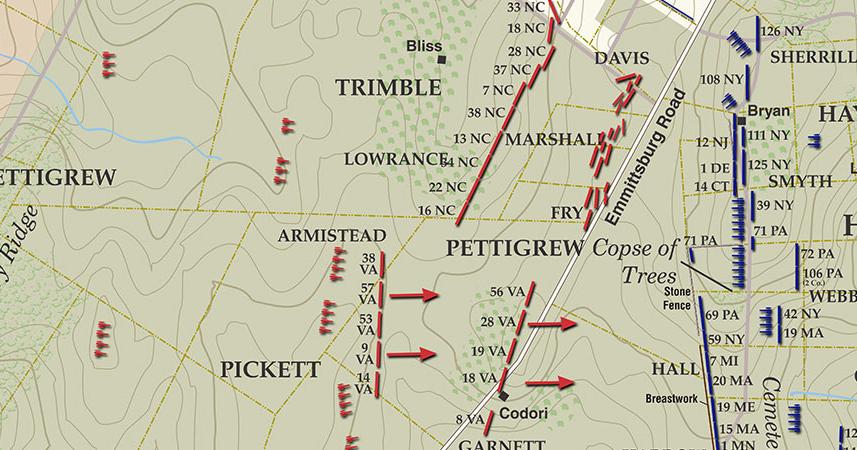
Picketts-Charge--330-to-345-pm-landscape

[I started to write a new post and while doing my research discovered that I would basically be repeating what I posted last year. Thus I am re-posting that July 3 Gettysburg essay as well as the one I attached to it, but with several substantive additions.]

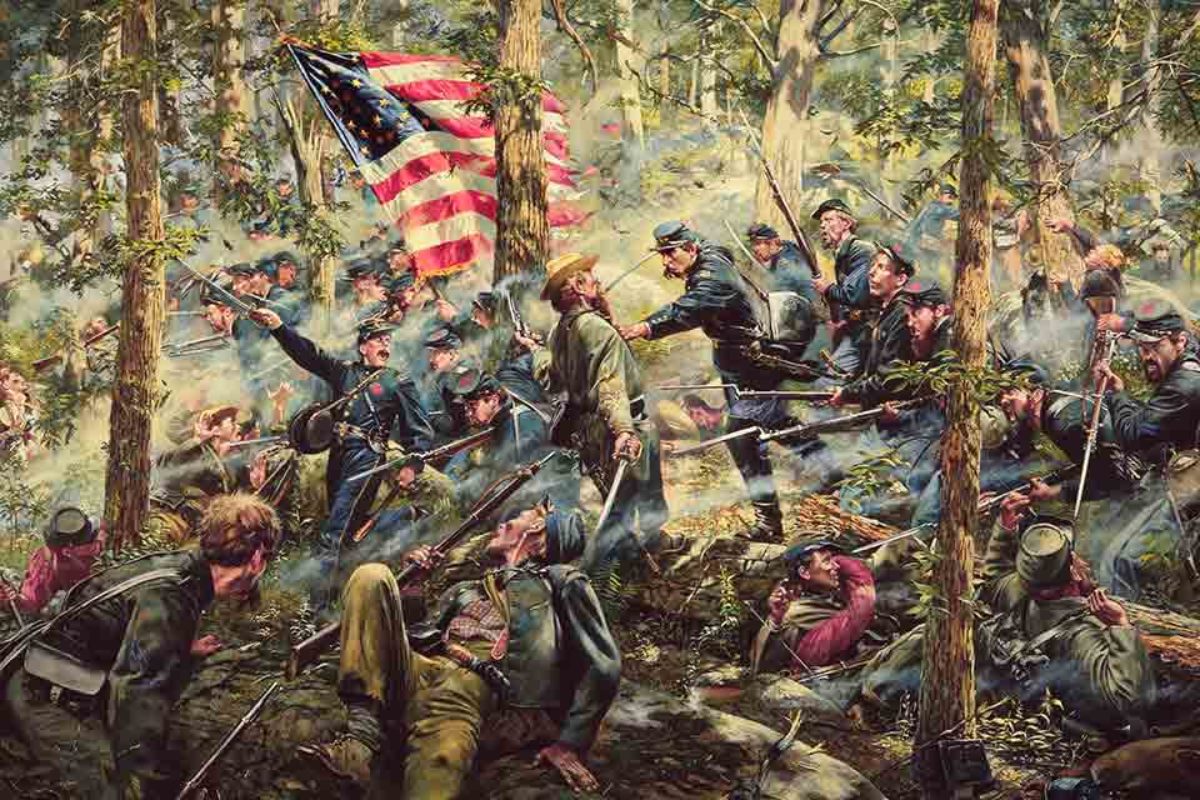
July 3  was the final day of the pivotal Battle of Gettysburg in 1863, reaching its bloody climax in General Robert E. Lee’s desperate  gamble on a massed assault on the Union center. In history it has come to be known as Pickett’s Charge, after the leader of the Division that was slaughtered during it.

At about 2:00 pm this day in 1863, near the Pennsylvania town of Gettysburg,  Lee launched his audacious stratagem to pull victory from the jaws of defeat in the pivotal battle of the American Civil War.  The Napoleonic assault on the entrenched Union position on Cemetery Ridge, with a “copse of trees” at its center, was the only such attack in the entire war, a march into artillery and rifle fire across an open field and over fences. When my father, the old soldier, saw the battlefield  for the first time in his eighties, he became visibly upset because, he said, he could visualize the killing field. He was astounded that Lee would order such a reckless assault.

The battle lasted less than an hour. Union forces suffered 1,500 casualties,, while at least 1,123 Confederates were killed on the battlefield, 4,019 were wounded, and nearly 4000 Rebel soldiers were captured. Pickett’s Charge would go down in history as one of the worst military blunders of all time.

At Ethics Alarms, it stands for several ethics-related  concepts. One is moral luck: although Pickett’s Charge has long been regarded by historians and scholars as a disastrous mistake by Lee, and in retrospect seems like a rash decision, it could have succeeded if the vicissitudes of chance had broken the Confederacy’s way.  Then the maneuver would be cited today as another example of Lee’s brilliance, in whatever remained of the United States of America, if indeed it did remain. This is the essence of moral luck; unpredictable factors completely beyond the control of an individual or other agency determine whether a decision or action are wise or foolish, ethical or unethical.

Pickett’s Charge has been discussed on Ethics Alarms as a vivid example, perhaps the best, of how successful leaders and others become so used to discounting the opinions and criticism of others that they lose the ability to accept the possibility that they can be wrong. This delusion is related to #14 on the Rationalizations list,  Self-validating Virtue. We see the trap in many professions and contexts, and its victims have been among some of America’s greatest. Those who succeed by being bold and seeing possibilities lesser peers cannot perceive often lose respect and regard for anyone’s authority or opinion but their own.
Continue reading

Unethical Tweet Of The Month And Ethics Dunce: ACLU National Legal Director And Georgetown Law Prof. David Cole

foot-in-mouth-header

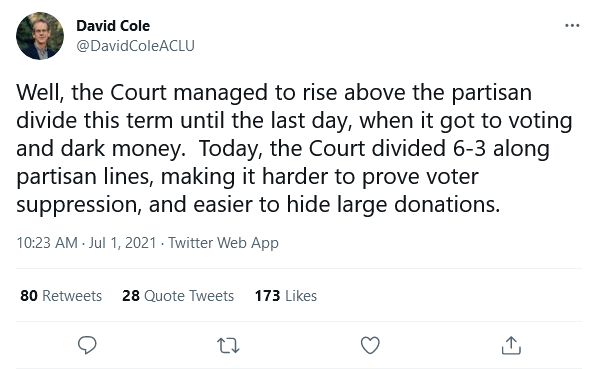
David Cole, ACLU National Legal Director and Professor at Georgetown University Law Center, tweeted in response to the SCOTUS ruling striking down California’s law making it mandatory for non-profits to disclose the names of their biggest donors,

Cole tweet

Gee, that’s funny! The ACLU filed an amicus brief supporting the majority’s decision in AMERICANS FOR PROSPERITY FOUNDATION v. BONTA, ATTORNEY GENERAL OF CALIFORNIA.

Continue reading

For Ethics Alarms, The Controversy Over The Unmarried Pregnant Art Teacher Is An Easy Call

pregnant teacher

I lost an ethics training client over the issue now raising its ethically-muddled head in New Jersey. Several years ago, during a day long seminar I taught for a teachers association, I stated that a teacher who taught grade school, middle school of high school students while pregnant and unmarried was harming her students, and that responsible school were ethically entitled to make pregnancy outside of marriage grounds for dismissal. Literally all of the attendees were outraged (even the two men in the group), though none could articulate a valid argument against what I said. (“The right to choose!” is not a valid argument in this context.)

I was right, they were wrong. The controversy now over a Catholic school art teacher who is demanding that she should have been able to keep her job despite being pregnant is much easier, or should be.

Victoria Crisitello was an art teacher at the New Jersey’s St. Theresa elementary school in Kenilworth. In the course of negotiating for a raise, she mentioned that she was having a baby. Weeks later, she was fired by the principal, a Roman Catholic nun, who explained that she was being terminated “because she was pregnant and unmarried.” “Sex out of wedlock violates a fundamental Catholic belief that the school in this instance felt it could not overlook,” lawyers for St. Theresa’s wrote in a petition to the state Supreme Court. Crisitello’s lawsuit was tossed out by two trial court judges, only to be restored each time when an appeals court sided with the ex-teacher. Now the state’s highest court, acting on an appeal by the school, has agreed review the case, which raises the continuing thorny question about the relationship between the government and religion.

Continue reading

End Of Week Ethics Roto-Rooter…

Roto-Rooter

I was afraid of this: devoting the warm-up to Gettysburg left me with all of these noisy ethics stories hanging around my office and yelling at me. So here are some ethics stories and issues to unclog the drain…

  • The Supreme Court denied certiorari in Arlene’s Flowers v. Washington, letting stand a 2019 decision by the Washington Supreme Court against florist Barronelle Stutzman, the owner of Arlene’s Flowers, for refusing to supply flowers for a same sex marriage. Upon reading the decision of the Washington Court, I was struck by the fact that the plaintiffs were not individuals who had made the request deliberately to force a confrontation with a vendor they knew had religious objections to same sex weddings. Robert Ingersoll had been a regular patron of Arlene’s Flowers for years, so it seemed natural for him to use the shop to supply the floral arrangements for his wedding to Curt Freed. Nor did their truncated conversation involve special requests for any particularly expressive arrangements. Florist Barronelle Stutzman just refused to sell any flowers to the couple for their wedding and reception, and that was it. The case was ruled one of discrimination in public accommodations, and the opinion went to great pains to say that no animus against the defendant’s religion was involved.

SCOTUS turns down cases for many reasons, and in contentious social matters, they often will reject a case that has too much gray, triggering the “hard cases make bad law” principle. Cakes, catering, photographs and flowers at weddings fall in various places along the “commodities/art” spectrum, depending on the specific facts of each case. This one is too close.  The florist wasn’t asked to deliver the flowers or to participate in the marriage in any way. There’s got to be  better case on this topic somewhere. The Court was wise to pass.

And the florist was the jerk here. I don’t have much sympathy for her. Selling flowers to a gay couple doesn’t entail an endorsement of gay marriage, kinky sex, or anything else. Continue reading

In Americans For Prosperity Foundation v. Bonta, Supreme Court Conservatives Again Defend The First Amendment As Its Left Approves Of Chilling Speech And Association

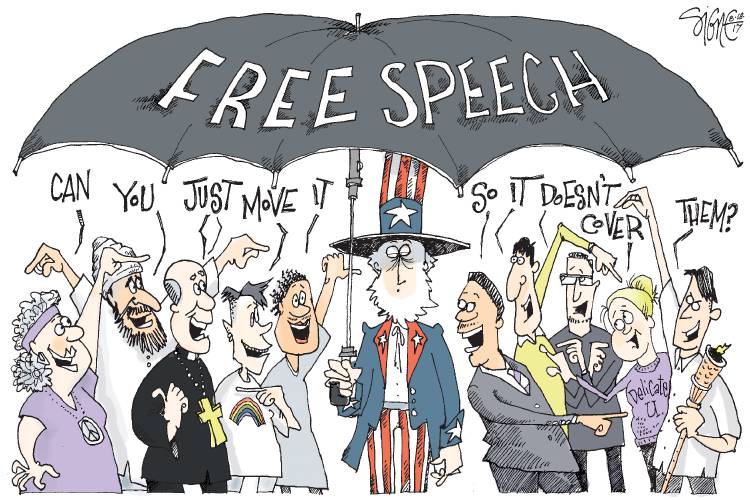
08-18-17 Free Speech

How did we get to the point where “liberals” want to chip away at the freedoms of speech and association while conservatives defend it? It’s weird: I’m old enough to remember when those mean old conservatives were always trying to silence dissent, not to mention vulgarity and violent TV shows and movies.

But in the final day of the Supreme Court’s term, the 6-3 conservative majority ruled that California—from which all terrible ideas now seem to flow— may not require charities soliciting contributions in the state to report the identities of their major donors. The law was opposed by very unconservative voices like those of ACLU to the NAACP Legal Defense and Educational Fund, and one would think that the alleged liberals on the court would immediately recognize how the law could and would chill free speech. Or don’t they pay attention to the incidents where CEOs have been run out of their jobs for contributing money to anti-gay marriage organizations, to name just one example? It would seem not. This is also weird, for the cancel culture has made simply stating an opinion that contradicts the Woke Borg perilous to one’s career, personal relationships and safety. Is it overly conspiracy-minded to suggest that progressives want it that way, particularly with their success at making wiggly-spined Americans who would make Patrick Henry retch grovel for forgiveness.

Chief Justice Roberts neatly summarized the importance of free association, writing,

Continue reading

Morning Ethics Warm-Up, 7/2/2021: Remembering The Epic Second Day Of The Battle Of Gettysburg

Little Round Top

On July 2, 1863, during the second day of the Battle of Gettysburg with the fate of the Union and the United States hanging in the balance, Confederate General Robert E. Lee’s Army of Northern Virginia tried to break through the line of General George G. Meade’s Army of the Potomac at Cemetery Ridge, Culp’s Hill and Little Round Top. More than once that day, only luck and chaos prevented July 2 from marking the end of the nation as we know it, and from preserving slavery at least a little longer.

All accounts of the battle on July 2 are full of the word “confusion.” Robert E. Lee ordered Lieutenant General James Longstreet to attack by moving his troops up the Federal left flank while General A.P. Hill’s corps threatened the center of the Union line. If coordinated properly, General George Gordon Meade wouldn’t be able to move his troops to reinforce the Union left, where Lee instructed Lieutenant General Richard S. Ewell to make diversionary attacks and launch an all-out assault if possible. Lee’s plan, if successful, would force the Union army to surrender the positions it held on the high ground south of Gettysburg after the first day of the battle, and the entire Civil War might have been won by the South in a day.

Continue reading

Friday Forum, Open For Business!

Lots going in the Mad, Mad, Mad, Mad World of Ethics, as usual, so here is the weekly invitation to readers to dive in unfettered by the host’s obsessions and predilections..

Jesus’s Wife: A Depressing Example Of Why American Institutions Are Not Trusted And Don’t Deserve To Be

Who do you trust 3

Most people younger than me don’t know (or care) that before he was the king of late night TV on “The Tonight Show,” Johnny Carson was the young, engaging host of a pseudo-quiz show called “Who Do You Trust?” I think of that show’s title when, as is increasingly the case, I encounter stories like this one, which is described in excruciating detail in a plaintive article in the Chronicle of Hight Education.. The main facts are these:

—A 2014 Harvard Theological Review article by Harvard Divinity School professor Karen L. King purported to have uncovered an ancient papyrus fragment in which Jesus refers to “my wife.” This, coming after the sensational best-selling novel “The Da Vinci Code” by Dan Brown and its subsequent film version starring Tom Hanks, both of which were based on a fanciful conspiracy theory regarding Mary Magdalene’s alleged relationship with Jesus Christ, understandably caused quite a stir in academia, theological circles, and the popular press.

–King’s article was deemed unlikely to the point of absurdity by many scholars from the moment it was published. “Almost everything we know,” one expert wrote, “about the nature of historical evidence points to forgery.”

—King had failed to take basic steps to vet the manuscript, which she’d provocatively named “The Gospel of Jesus’s Wife.” Worse, two of the journal’s three peer reviewers had decided the papyrus was a fake. Only one had not: an acclaimed papyrologist named Roger Bagnall. Bagnall, however, had helped King draft the very paper the journal asked him to review. This is called a conflict of interest, indeed a screaming conflict of interest. Not only had King identified him in the paper as her primary adviser, but Bagnall had been filmed declaring the papyrus’s authenticity for a forthcoming Smithsonian Channel documentary.

Continue reading

A Follow-Up, An Apology, And A “Bite Me, Daily Wire!”

Charliebrown-1-

The previous post was one of the relatively few in which Ethics Alarms was suckered by bad information. As always when this happens, I am awash with regret and shame. Here is how it now begins, in bold:

“This is the revised part. The retraction is that despite the headline and what I wrote below, Twitter didn’t suspend New York Times columnist Bret Stephens account for violating Twitter’s rules with his recent op-ed calling anti-white measures showing up in the Biden Administration and elsewhere what they are: racism. The Daily Wire, a conservative website that was founded by right wing gadfly Ben Shapiro, wrote the post based on “a Twitter user” as its source,” and I foolishly assumed that the site would have checked out the claim before posting on it. It turns out the Stephens’ account says it’s “suspended” because he suspended it himself, in 2019.

Thus I am made an accomplice to this confirmation bias chain reaction, and I resent it. This is the kind of crap I experienced more than once from Breitbart and The Gateway Pundit, both of which are no longer cited as sources on Ethics Alarms, and whose stories I will not believe unless I find a credible source that independently confirms it. Now I’m adding the Daily Wire to that blacklist. There are plenty of left-leaning sites on that list as well, but since it is virtually impossible to ensure that a story that reflects poorly on the allies of progressive propaganda hasn’t been obscured or deliberately distorted by the mainstream media, conservative media has to be trustworthy and professional, and far too often, it just isn’t. Situations like this make it easier for the mainstream media to call every report they wish would disappear “conservative disinformation.”

Continue reading

RETRACTED And Revised: “Scared Yet? Twitter Censors A Times Op-Ed Columnist For Calling Anti-White Racism What It Is”

silence

This is the revised part. The retraction is that despite the headline and what I wrote below, Twitter didn’t suspend New York Times columnist Bret Stephens account for violating Twitter’s rules with his recent op-ed calling anti-white measures showing up in the Biden Administration and elsewhere what they are: racism. The Daily Wire, a conservative website that was founded by right wing gadfly Ben Shapiro, wrote the post based on “a Twitter user” as its source,” and I foolishly assumed that the site would have checked out the claim before posting on it. It turns out the Stephens’ account says it’s “suspended” because he suspended it himself, in 2019.

Thus I am made an accomplice to this confirmation bias chain reaction, and I resent it. This is the kind of crap I experienced more than once from Breitbart and The Gateway Pundit, both of which are no longer cited as sources on Ethics Alarms, and whose stories I will not believe unless I find a credible source that independently confirmed it. Now I’m adding the Daily Wire to that black list. There are plenty of left-leaning sites on that list as well, but since it is virtually impossible to ensure that a story that reflects poorly on the allies of progressive propaganda hasn’t been obscured or deliberately distorted by the mainstream media, conservative media has to be trustworthy and professional, and far too often, it just isn’t. Situations like this make it easier for the mainstream media to call every report they wish would disappear “conservative disinformation.”

Meanwhile, The Daily Wire just notes (a few minutes after I’ve posted relying on its fabricated story) that the post had been “corrected.” It was originally titled, “Twitter Suspends NY Times’ Columnist’s Account After He Denounces Equity as ‘Racism.” NOW it is headlined “NY Times Columnist Denounces Equity as ‘Racism’” which is both inaccurate and not news, since Stephens’ column is three days old. He also never called “equity”racism. That’s like something they would say on MSNBC to distort what was written. I thought the phrasing was strange and sloppy in the first version, but since the topic was Twitter’s censorship, I didn’t bother with it. Now, the misrepresentation is the subject of the whole post. Then, in the body of the piece, it now says, “On June 30, a Twitter reader erroneously claimed that Twitter had suspended Bret Stephens’ Twitter account.” What it should have said is On June 30, a Twitter reader erroneously claimed that Twitter had suspended Bret Stephens’ Twitter account, and we, because we were looking for another reason to bash Twitter, believed him without checking. We apologize to our readers and any other websites, commentators or blogs who were misled due to our mistake.”

But I DO apologize (and thank to JutGory for the prompt alert). Confirmation bias also played a part in my gullibility: I do not trust Twitter, and what was represented is just a bit beyond what Jack Dorsey’s arrogant cyber-creature has done already. The last line of the post is still valid, though the rest was built on garbage: “Boy, am I glad I quit Twitter. But I’m ashamed that I didn’t do it sooner”

Like Bret Stephens.

The rest of what follows, except for that last part, is retracted.

***

I didn’t see this one coming, because I am an idiot.

Two days ago, I wrote in the morning warm-up, (Item #2),

“Today [The New York Times] allowed Bret Stephens , one of the endangered species in their op-ed stable, a conservative, to write an anti-antiwhite racism piece under the Times’ main editorial gaslighting those who see Critical Race Theory for what it is. (On the opposite page, one of the Times’ usual far-left shills has another op-ed defending the teaching of Critical Race Theory in the schools, so the Times makes sure that Stephens is shouted down by his own paper, 2-1.) Stephens’ op-ed is called “The New Racism Won’t Solve the Old Racism,” which one would think is self-evident, but in the Year of the Great Stupid, it certainly is not. His “money quote” comes at the very end:

“Thoughtful liberals who think this is much ado about nothing should spend some time pondering how perfectly people like [ Mayor Lori Lightfoot, who has announced that she won’t be interviewed by white journalists] are now playing into right-wing stereotypes. They should also spend time wondering whether the ideal for which they have long fought — a society that, if not colorblind, can at least see past color — is being jeopardized by progressives who apparently can see only color. Whichever way, it shouldn’t be hard to see that trying to solve the old racism with the new racism will produce only more racism. Justice is never achieved by turning tables.”

Obviously, he’s racist, or so the totalitarianism-enabling censors at Twitter decided. Yesterday, Twitter suspended Stephens’ Twitter account which now just says, “Account suspended.” His opinion, you see, violates Twitter rules, primarily the unwritten one that holds that any statements that in any way undermine the credibility and effectiveness of the Left’s efforts to undermine the Constitution and core American values will be censored so as few citizens get to ponder non-conforming arguments as possible.

Continue reading