Monday Morning Ethics Warm-Up, 8/23/2021: Farewell Everly Brothers And Other Problems

Don Everly has died, and that’s the end of the Everly Brothers (Phil died years ago), one of the most influential and perhaps the most harmonious singing group of all time. The unique sympathetic vibrations that only sibling singers seem to be able to achieve is a marvelous metaphor for the ethical benefits of teamwork and trust.

This date also marks the demise of another famous duo: despite worldwide demonstrations in support of their alleged innocence, Italian-born anarchists Nicola Sacco and Bartolomeo Vanzetti were executed for murder in Massachusetts in 1921 .On April 15, 1920, a paymaster for a shoe company in South Braintree was shot and killed along with his guard. The murderers, who escaped with more than $15,000, were described by witnesses as two “swarthy Italian men.” Sacco and Vanzetti were arrested and charged with the crime. The men carried guns and lied to the police, but neither had a previous criminal record, and they definitely didn’t get a fair trial by modern standards. Prejudice against Italian-Americans was strong, and suspicion of anarchists was stronger. The pair was convicted on July 14, 1921, and sent to the electric chair on August 23.

A TV dramatization of their case, written by Reginald Rose (who authored “Twelve Angry Men”) made a huge impression on me as a child, and sparked the first stirrings of my interest in the law. In 1961, a test of Sacco’s gun using modern forensic techniques proved that it was his gun that killed the guard; he, at least, was guilty, but there was little evidence to implicate Vanzetti in the killing. To make this ethics train wreck complete, Massachusetts Governor Michael Dukakis ignored the evidence of Sacco’s guilt and issued a proclamation exonerating both Sacco and Vanzetti and proclaiming that no stigma should be associated with their names.

Typical of Dukakis.

1. Accountability? What accountability? “Sources”—and I stipulate that un-named “sources” are untrustworthy—tell various news outlets that “President Biden isn’t inclined to fire any senior national security officials over the chaos in Kabul unless the situation drastically deteriorates or there’s significant loss of American life.” That sounds as likely as it is depressing. The reluctance of American Presidents to fire subordinates for gross incompetence has become the norm rather than the exception, and the trend ensures that our government, whoever is the President and whatever party is power, will continue to decline in competence and trustworthiness. Consider President Bush’s refusal to fire any of those responsible for the botched intelligence regarding Iraq’s WMDs, and later Abu Ghraib, or my personal favorite, Barack Obama’s refusal to acknowledge the gross incompetence of Kathleen Sebelius, his Secretary of Health, after her inexcusable reliance on a flawed website to launch the Affordable Care Act.

Dumber still is the qualification “unless the situation drastically deteriorates or there’s significant loss of American life.” Morons. Morons! Whether the situation gets worse or not is pure moral luck; it doesn’t change the utter incompetence of the Afghanistan abandonment. Imagine a babysitter who gives a toddler knives to play with, and a parent whose reaction is, “Well, the kid wasn’t hurt, so there’s no reason to fire her.” That is literally what the reasoning at the White House is…if “sources” are accurate.

Continue reading

Why Aren’t People Ashamed To Ask A Question Like This?

invasion-of-the-body-snatchers-1978--470-75

Kwame Anthony Appiah, aka. “The Ethicist,” received this question three weeks ago. He answered correctly and excessively nicely, as I would expect him to, but my concern is with the question and the questioner. “E.K.” asked,

My husband and I employ a local dog walker….She is an excellent dog walker: reliable, responsible and kind. A friend told me that throughout the fall and after the presidential election, she frequently posted rants on Facebook about liberals and immigrants, pro-Trump messages and falsehoods about how the election was stolen. We are disgusted by the postings and now wonder if we should use her again. On the one hand, we respect people’s right to their opinions and appreciate the good service she provided. On the other, we do not want our money to go to someone who supports viewpoints that we believe are hurtful and detrimental to our democracy.

This is why I’m not an advice columnist, I guess. Here is how I would have answered that question:

Continue reading

No, No, NO, Biden Must NOT “Go”: Biden Must Stay, And All Responsible For Putting Him In The White House Must Be Made Accountable

Joe confused

Over at the Spectator, conservative pundit Dominic Green writes in a piece titled Biden Must Go,

“If Trump had confused his Vice President with a ‘general’ or fumbled with his cue cards because he couldn’t match a scripted question to a scripted answer, as Biden did at his press conference on Thursday; or shown the bizarre callousness and failure of short-term memory in his ‘That was four days ago, five days ago!’ outburst; or spontaneously abandoned the policy of strategic ambiguity on Taiwan in an interview with ABC, as Biden did with George Stephanopoulos on Thursday, the psychiatrists would be lining up outside the cable stations to explain why the 25th Amendment needed to be deployed now. It’s that simple. The buck really does stop with the President. The world has always seen Biden’s incapacity, and now the American people can see it too. He carries direct responsibility for a disaster so undeniable that even a partisan media can no longer deny it. He can neither speak truthfully nor accurately. Not so much the emperor with no clothes, as Lear’s fool on the heath, naked and shivering as the kingdom comes to the ‘great confusion’.”

Oh no you don’t! “The resistance,” progressives, Democrats and the news media can’t be let off that easy. It is essential to restoring the nation’s principles and the integrity of the political process that Joe Biden remain in office to do all the damage and inflict all the embarrassment on the nation he will undoubtedly can and will. It will be painful for him to be sure: good. He was irresponsible and unethical to allow himself to be used by his party when he knew—and I’m sure he knows—that he had become a shadow of his already mediocre self. It will be even more painful for his party and its supporters, which will not be able to blame anyone but themselves for the disaster at the border, the stuttering response to the latest virus strains, the exploding national debt, the creeping inflation and the disgraceful embrace of racial discrimination. And, of course, it will be painful for the public, and again I say, good. They were dupes, fools and incompetent citizens. They deserve to suffer. There are consequences to being lazy, gullible, biased and stupid. They are about to learn them. Hard.The Democrats and media tried to brainwash America with the dangerous idea that when we elect a President that enough people don’t like and the news media decides to destroy, there are constitutional ways to ignore elections and get rid of him. There are not. Impeachment, contrary to the undemocratic plots endorsed by Nancy Pelosi, Maxine Waters and the rest, requires actual “high crimes and misdemeanors,” not mean tweets, contrived violations of dead letter provisions and conduct routinely engaged in by other Presidents that are suddenly repurposed into “crimes” to avoid the trouble of defeating an incumbent at the polls.

Continue reading

Reader Comments Safari: Revealing NYT Reader Comments, And Althouse Reader Comments On Those Comments

Biden meeting

Blogger Ann Althouse has gone full circle and now allows reader comments again. I must confess that the episode cooled much of my long-standing enthusiasm for her blog: her reasoning in banning them was so arrogant and dismissive of the loyal readers who support her that she crashed her cognitive dissonance scale with me. (And I still don’t forgive her for refusing to include Ethics Alarms in her links; eventually she stopped linking to any other sites at all, which, come to think of it, was similar to banning comments.) I assume her traffic was crashing, or maybe someone she pays attention to pointed out that her constantly changing the comment hoops to jump through (“No comments, but you can email me with a comment, and maybe I’ll quote it as a comment…”) did not put the former law prof. in a flattering light. I don’t know, and don’t really care. I just know that I don’t check her quirky posts as often as I once did.

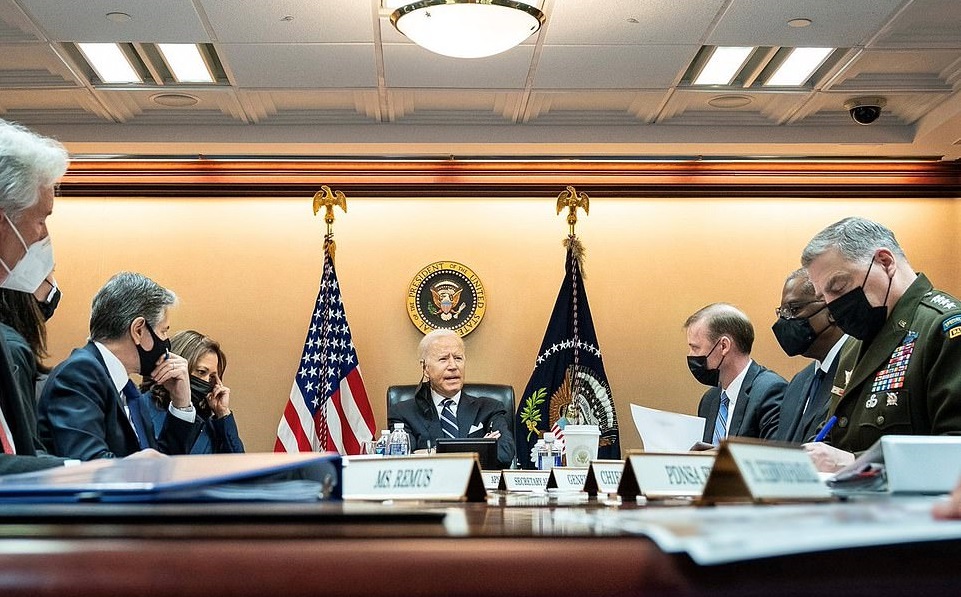
I checked today, though, and Ann posted on “Miscue After Miscue, U.S. Exit Plan Unravels/President Biden promised an orderly withdrawal. That pledge, compounded by missed signals and miscalculations, proved impossible” , a an article that I had already read in the print edition. The Times story describes a disturbing meeting President Biden had with his military and other advisors about the plan to pull out in Afghanistan. Ann read the online comments from Times readers and reported herself,

“If you go into the comments over there at the NYT and you put them in order of “most liked,” you’ll see an unbroken chain of comments supporting Joe Biden: “It seems to me that the media is being less than fair to Joe Biden over this,” “Has it really gone wrong?,” “Did the Trump Surrender Agreement with the Taliban provide for evacuation? If it did, what did it say? If it didn’t, why not?,” “Frankly I’m dismayed that the media is now declaring this a disaster,” “Thanks President Biden for making this brave decision albeit flawed execution. When we end this if there are no US troop live lost and Americans evacuated with as much of our allies. It will be remembered as a very good decision and no one will care about execution like Vietnam withdrawal.”

Good research there, Ann! I would never do that; I detest “likes,” which I regard as lazy substitutes for serious consideration. But her discovery is useful: this is a major reason, along with the biases of its employees, why the Times has abandoned journalism for progressive propaganda. Of course, I could read pretty much the same sad reactions from my own Facebook feed, if my “friends” didn’t block me from reading what they know I’d take apart, ruthless and with glee.

Then Althouse’s commenters had a field day, reminding me again how foolish it was to silence them. Among the best responses,

Continue reading

Comment Of The Day: “Comment Of The Day: ‘….Suicide Ethics’”

Head in the oven

Let’s get away from metaphorical national suicide for the nonce and back to more pleasant topics, like actual suicide. Rich in CT posted an excellent comment last week in the discussion, sometimes heated, of the appropriate societal attitude toward suicide and those who indulge in it.

I ended up banning a particularly obnoxious new commenter in the threads on this topic, and this is as good a place as any to point out some things. First, as is almost always the case, I should have seen what kind of participant I was letting into the fray when I let his first comment out of moderation. This is the kind of mistake you make when you are obsessing over getting more diverse commenters, and it was all my fault. Second, it was clear from the beginning that the commenter never bothered to read the comment guidelines. That’s a bad sign. Third, like so many who are moved to comment on a single issue, never to be heard from again, this commenter was ignorant of basic ethical principles and analysis, and, as with the comment guidelines, didn’t feel it necessary to educate himself on the topic of the blog before issuing his opinion in emphatic terms. Finally, his string of comments were all about how the feelings of suicidal people justified their destructive actions. That statement is signature significance for an ethics dolt. Feelings are based on emotions, and emotions don’t factor in to ethical decision-making. In Reciprocity analysis, the feelings of others may need to be considered, but the process of being ethical requires rational and objective reasoning, and this requires recognizes feelings as impediments to the process. Maybe I haven’t been sufficiently clear on this: one of the mains reasons public discourse on so many topics spins away from ethics is that ascendant view that feelings justify conduct.

But I digress! Here is Rich in CT’s Comment of the Day on David C’s Comment of the Day on the post, Sunday Ethics Picnic, 8/15/2021: Afghanistan Accountability And Suicide.

***

“And yes, as far as I know there is research that suggests that if people are fixated for whatever reason on a certain means of suicide, they will not turn to another method if access to that method is removed.”

It took me a few days to get around to addressing this point for the original post. I’ll include the comment here instead.

“Or is the goal to just make sure they give up and go home to swallow sleeping pills?”

Studies have shown this is not the case. Rather, suicide is an impulsive choice at the intersection of desperation and a particular opportunity. The ideation is often linked to a particular method (jump off bridge, pills, etc). Suicidal individuals don’t systematically engage in various methods until they are successful; rather they fixate, as David C says, on a particular method as the solution; they are at most danger when they are at a low point and their preferred method is readily available.

A famous example occurred in England, the trope of sticking one’s head into the oven to suffocate. Prior to the 1970’s, the island used primarily “town gas” for ovens (as opposed to natural gas or propane). Town gas was extracted from coal in a gasworks plant at the edge of town (hence town gas), and piped to each house. As a byproduct of the extraction process, carbon monoxide was produced, and piped directly to each home along with the hydrocarbons.

Carbon monoxide produces a painless death; one loses conscious quickly prior to suffocation. Carbon monoxide is also nearly 100% effective at causing death. Plugging up the vents in the kitchen, blowing out the pilot light, and turning up the gas became an extremely popular method of suicide between the 1800’s and 1970’s, accounting for about half of all successful suicide deaths in England (I believe these statistics hold up elsewhere, too).

Continue reading

Mid-Weekend Ethics Warm-Up, 8/22/2021: It’s No Longer Illegal To Come Back Here After You Are Deported, And Other Surprises…

betwixt

[I had to get up extra-early to wrote this, since there’s no point writing a warm-up once the thermometer tops 80.] Amusing historical ethics note: on August 21, 1980, animal rights advocates Ingrid Newkirk and Alex Pacheco launched PETA, People for the Ethical Treatment of Animals. In the intervening 40 years, it has become the preeminent animal rights organization in the world, in part because it will do almost anything for publicity. It is also consistently the most ridiculous animal rights organization in the world, and on Ethics Alarms, in a lively battle with Citizens for Responsibility and Ethics in Washington as the most hypocritical and unethical non-profit with “ethics” in its name. The PETA ethics rap sheet is here. When last discussed on Ethics Alarms, PETA was protesting using animals as metaphorical insults because it perpetuates “speciesism.” Jackasses…

  1. From the suddenly overstuffed “Incompetence” Files…Mike Richards, the executive producer of “Jeopardy!” who made himself one of the show’s new hosts in a breathtaking display of conflict of interest contempt, lasted less than a week in his new job. Controversial comments he made on a podcast from 2013 “resurfaced,” officials at Sony Pictures Television confirmed. That means someone who didn’t want him to have the job did a maniacal search to find something that would force him to resign. This is, essentially, the Hader Gotcha, and a rotten, Golden Rule-breaching thing to do to anyone unless they are running for office and pretending to be someone they are not. At least Richards recognized that his duties as executive producer required that he dump himself once he became an anchor on the show he has a duty to protect.

The allegedly cancel-worthy comments Richards made came when he was trying to imitate Howard Stern—imagine that as a life objective—by hosting a podcast called “The Randumb Show.” Naturally, this involved saying sexist and racially insensitive things like Howard and Don Imus, who not too many years earlier were still considered witty and brave in their political incorrectness. He refered to a woman’s “boobies.” He said that he aspired to be a “white guy host” like Ryan Seacrest. Salon, which is always a barometer of just how nuts the far left has become, pronounced l such sophomoric banter “alarming.” I know I was terrified when I read them.

2. If this doesn’t prove that our news organizations are worthless, nothing will. U.S. District Judge Miranda Du, a federal judge in Nevada, struck down as unconstitutional a longstanding statute that makes it a crime to return to the United States after deportation. Here reasoning is that the law is racist and discriminatory against “Mexican and Latinx individuals.”

“The record before the Court reflects that at no point has Congress confronted the racist, nativist roots of Section 1326,” Du wrote in her ruling.“The amendments to Section 1326 over the past ninety years have not changed its function but have simply made the provision more punitive and broadened its reach,” Du wrote.

Continue reading

Which Rationalization Will Apologists And Enablers Of The Biden Administration Settle On To Spin The Afghanistan Disaster?

georgeclooney

The nominations are all in, and boy, there are a lot of them! Before we open the envelope, here are the contenders:

#1A. Ethics Surrender, or “We can’t stop it.”

#1B. The Psychic Historian, or “I’m on The Right Side Of History”

#2A. Sicilian Ethics, or “They had it coming”

#8A. The Dead Horse-Beater’s Dodge, or “This can’t make things any worse”

#13. The Saint’s Excuse: “It’s for a good cause”

#13A  The Road To Hell, or “I meant well” (“I didn’t mean any harm!”)

#15. The Futility Illusion:  “If I don’t do it, somebody else will.”

#18. Hamm’s Excuse: “It wasn’t my fault.”

#19A The Insidious Confession, or “It wasn’t the best choice.”

#19 B. Murkowski’s Lament, or “It was a difficult decision.”

#22. The Comparative Virtue Excuse: “There are worse things.”

#23. The Dealer’s Excuse. or “I’m just giving the people what they want!”

#25. The Coercion Myth: “I have no choice!”

#28. The Revolutionary’s Excuse: “These are not ordinary times.”

#29A  The Gruber Variation, or “They are too stupid to know what’s good for them”

#31. The Troublesome Luxury: “Ethics is a luxury we can’t afford right now”

#36. Victim Blindness, or “They/He/She/ You should have seen it coming.”

#37. The Maladroit’s Diversion, or “Nobody said it would be easy!”

#38. The Miscreant’s Mulligan or “Give him/her/them/me a break!”

#40. The Desperation Dodge or “I’ll do anything!”

#41. The Evasive Tautology, or “It is what it is.”

#49. Ethics Jiu Jitsu, or “Haters Gonna Hate!”

#50. “Convenient Futility,” or “It wouldn’t have mattered if I had done the right thing.”

#51. The Apathy Defense, or “Nobody Cares.”

#51A.  Narcissist Ethics , or “I don’t care”

#52.  The Underwood Maneuver, or “That’s in the past.”

#54. Tessio’s Excuse, or “It’s just business”

#58. The Golden Rule Mutation, or “I’m all right with it!”

#60. The Ironic Rationalization, or “It’s The Right Thing To Do”

#64. Yoo’s Rationalization or “It isn’t what it is”

#69. John Lyly’s Rationalization, Or “All’s fair in love and war”

Some of these have been evoked by Joe Biden directly, others by his desperate defenders. I will not hold you in necessary suspense: the Unethical Rationalization settled upon by the defenders of the completely botched abandonment of Afghanistan, all of its people who relied on our commitment to their sorrow, and the so far undetermined number of Americans currently trapped in the country is…

50. “Convenient Futility,” or It wouldn’t have mattered if I had done the right thing.”

The description on the list reads,

“One of the more pathetic excuses incompetent and negligent individuals try to employ when they have made bad decisions with disastrous results is to argue that a better decision would have not made any difference, so, by implication, it wasn’t such a bad decision after all. It may or may not be the case that the irresponsible or incompetent decision wasn’t the only reason for the related harm, or that other decisions would have turned out just as badly.  That, however, is convenient speculation. If the decision was demonstrably careless, ill-advised, poorly reasoned or foolish and bad consequences follow, the decision-maker is accountable.

“#50 is the reverse of hindsight bias, in which a decision is second-guessed by critics based on information the decision-maker couldn’t have had when the decision was made. With Convenient Futility, the argument is that unknown and untested approaches to the problem or situation other than the one that was used couldn’t have been any more effective. It’s an air-tight, all purpose excuse, reflecting back on Rationalization #8, “No harm, no foul,” as in “OK, it was a bad decision, but since everything would have fallen apart no matter what, it’s no big deal!”

“The rationalization confounds law and ethics. I was once on the jury for a medical negligence lawsuit in which a woman was suing a doctor for causing her to go blind by giving her an incompetent diagnosis. The doctor’s defense was that she would have lost her sight anyway because she didn’t follow the treatment prescribed by another doctor. That defense worked: he wasn’t legally responsible for her blindness due to an intervening cause. Nevertheless, the doctor was still an incompetent, dangerous doctor. He was just lucky that his ineptitude didn’t blind her.

“It wouldn’t have mattered because the same thing might have happened even if I was competent‘ is still an admission of incompetence.

“Like many of the rationalizations on the list, #50 is sometimes fair and true. Those in charge are often held responsible for events that nobody could have foreseen or prevented. That, in part, is what makes the rationalization so useful for a failed decision-maker desperately searching for an excuse.”

Continue reading

Gee, What A Surprise: The FBI Finds No Evidence That The Jan.6 Capitol Riot Was An “Insurrection”

shocked face

There’s the “shocked face” of the once popular commercial featuring a talkative and opinionated infant. (The kid must be 40 by now, but his expression is immortal.)

Yet another Big Lie that the Axis of Unethical Conduct (“the resistance”/ Democrats/ Mainstream media) wielded shamefully for a disgusting amount of time is tumbling down. From Reuters:

The FBI has found scant evidence that the Jan. 6 attack on the U.S. Capitol was the result of an organized plot to overturn the presidential election result, according to four current and former law enforcement officials. Though federal officials have arrested more than 570 alleged participants, the FBI at this point believes the violence was not centrally coordinated by far-right groups or prominent supporters of then-President Donald Trump, according to the sources, who have been either directly involved in or briefed regularly on the wide-ranging investigations. “Ninety to ninety-five percent of these are one-off cases,” said a former senior law enforcement official with knowledge of the investigation. “Then you have five percent, maybe, of these militia groups that were more closely organized. But there was no grand scheme with Roger Stone and Alex Jones and all of these people to storm the Capitol and take hostages.”

Continue reading

This Is How Trust In A Democracy Dies…And When Trust Dies, Democracy Dies

pentagonbrief-1z0wty

I am late getting up the first post of this Saturday—experience shows that if there isn’t at least one post up by 10:30 am, the total traffic for the day will resemble that of Hooterville at midnight in mid-February—because I was watching with my face in a rictus of horror as the Pentagon’s various flacks tried to spin the unspinnable and treated the American public as idiots as well as the news media (but then the reporters are idiots, to be fair.)

The various contrived reports—What a wonderful and heroic job the U.S. military is doing in evacuating people! Teamwork! Coordination! Brilliantly executed planning! It’s a triumph!–were dripping with Authentic Frontier Gibberish like “throughput.” I don’t trust officials who won’t speak plain English. The Pentagon’s mouthpieces kept describing the situation as “fluid and dynamic,” over and over, obviously and deliberately misleading adjectives with false positive vibrations that were carefully chosen to deceive. It reminded me of Phillip Roth’s satire “Our Gang” in which White House spokesmen keep describing the President as “resting comfortably” when he is in fact dead.

When one of today’s liars was asked about one of his assurances last week that turned out to be completely false, his response was, “That was absolutely true at the time I said it.” He also kept repeating, “I’m not going to get into threat assessments at this time.”

How can anyone with sufficient cognitive ability to tie their shoelaces trust people who talk like this ever? How can they ever trust the organizations and institutions they represent? The answer is simple: They can’t.

Continue reading

Return To”Field Of Dreams”

Field of Dreams2

Baseball had a rare PR triumph earlier this month when it held a regular season game between the New York Yankees and the Chicago White Sox in the Iowa cornfield diamond that was the setting for the cult movie favorite “Field of Dreams.” The TV ratings were the best for any regular season broadcast in 16 years. That’s amazing, but maybe it shouldn’t be. Despite rumors of its demise, baseball still has a cultural bedrock of tradition, nostalgia and history unmatched by any other sport, professional or amateur. So many Americans would not tune in to a baseball game if they didn’t still have a flicker of affection for the sport, and if your argument is, “Yeah, but that’s just because of the movie,” the movie wouldn’t have become iconic if a lot of people didn’t care about baseball. As Terrence Mann said,

Now my confession: I’m not a wild fan of the film, nor that scene. The scene in particular is unforgivably stagey and artificial: it’s right out of the (much better) book, “Shoeless Joe,” and not even the great James Earl Jones could make it sound like anything but a recitation. I got annoyed, during the hype for the game broadcast, with “Field of Dreams” being repeatedly called “The greatest baseball movie.” I don’t regard it as that; I think it just barely makes the top five, and I could be talked out of ranking it that high.

For good reasons, many baseball writers, fans and bloggers have criticized the film over the years, and not just because it is shamelessly manipulative. But it is that. Baseball writer Craig Calcaterra, a vocal debunker of the film, writes,

“I will fully admit that a story about a father and son repairing a longstanding rift over a game of catch — with or without the magical realism elements — could form the basis of a MAJOR chills moment in an absolutely fantastic movie. The problem, as I’ve said in the past, is that “Field of Dreams” does not earn its chills moment. It is lazy in that it does not sketch out the dispute between Ray and his dad in anything approaching realistic terms — it’s dashed off in the rushed intro with almost no details — and it does nothing to explain why Ray’s moving the Earth and the Heavens to bring his dad back to that ball field is so important or why it serves as the “penance” Ray must pay for whatever reason. With no buildup or backstory, there’s no payoff.”

But worse, for me and others, is the slipshod handling of baseball history. “Shoeless Joe” Jackson was not innocent of taking a bribe to throw the 1919 World Series, he was guilty. He was not a thoughtful, wise-cracking Ray Liotta, he was just north of being a moron. He batted left-handed, and famously so, not right-handed like Liotta. When Frank Walley’s character, a magically reincarnated and youthened old ballplayer named Archie “Moonlight” Graham, whose single appearance in the major leagues was in 1905, is nearly beaned by a close pitch, he says “Hey ump, how about a warning?” Umpires didn’t warn pitchers for throwing at batters in 1905, and not for more than a half-century after that. Sloppy.

Continue reading