
[ If you want to skip my explanation, you can start with paragraph #5.]
It’s a new year, and the last one had several outbreak of complaints here, some fair, some contrived, and some obnoxious, about Ethics Alarms being an “echo chamber” that either had insufficient diversity of opinion, discouraged diversity of opinion, inevitably favored one political/partisan end of the political spectrum over the other, or artificially tilted its analysis and reader reactions to my personal biases.
The analysis here should be consistent, and I expect readers to blow a whistle when it is not or seems that way. I also furiously reject the concept of ethical relativity, or that “you have your truth and I have mine.” A society needs to settle on its values and objectives, and those decisions need to be based on linear constants, or the result is chaos. It is also important, however, that those values and objectives be subject to constant analysis and reexamination. We learn by experience and debate: that’s the nature of ethics, as opposed to morality. It is also why diversity of viewpoint is valuable on an ethics blog. Different perspectives are invaluable in helping us cut through the underbrush of bias, conventional wisdom and lazy assumptions that impede our ability to distinguish right from wrong.
But there are structural flies in this buttermilk, the prime among them being human nature. People tend to want to see, hear, read and believe things that they find comforting and confirm their world views; being open minded is uncomfortable, even painful. Sometimes, it can be dangerous, or at least scary. One reason I spend the time I do on Ethics Alarms is that it forces me to read and consider opinions and examine topics that I normally would not.
The goal here has always been to promote a colloquy of thoughtful and articulate readers to focus on ethics and sharpen our habits of analysis while avoiding the jargon, excessively abstract navel-gazing and mind-numbing theoretical intellectualizing that has killed ethics as a topic the general public has any interest in or sufficient competence in applying. Whatever the reasons for it, the perceived trend, at least in the comments, for opinions to run in the same general direction (when there are valid and legitimate positions that point elsewhere) is “concerning” (as Prof Turley would say.)
This is all prelude to asking readers to place themselves on the ideological/political beliefs spectrum/world view spectrum. Before WordPress went to a hopelessly complicated system, I would have used a poll for this purpose, but none of the Ethics Alarms polls attracted more than a couple hundred participants out of the thousands that visit the blog every day. Now I’m going to give you a range of choices to answer the question, and I’ll be very grateful to those who take the time to answer it.
You can…
- Just describe where you see yourself fitting.
- Use a ten point scale with #1 being knee-jerk extreme Left on all matters and #10 being the opposite.
- Take this online survey, which is dated but appears to be pretty good based on my own experience.
- Or this one, which is also pretty good, by the Pew people.
- Or you can try this one.
I’d like to hear from more of you than just the regular commentariat, so for this purpose only, I will accept submissions labeled “anonymous” or the equivalent. I will also relent and accept submission from readers who have been banned from commenting, as long as they stick to the topic.
None of the online tests are perfect, and many of the questions or propositions are too general (or specific. But I’ve taken all of them more than once, and have been surprised to find that they were remarkably consistent in their findings, and, at least in my case, perceptive. For example, here is where the Political Spectrum Quiz places me:
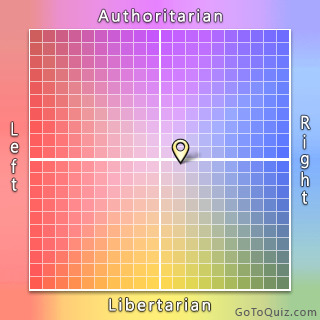
That’s not only where I think I am, it’s where I think I should be, as opposed to where the same survey places the average participant, which is where the green pointer resides:
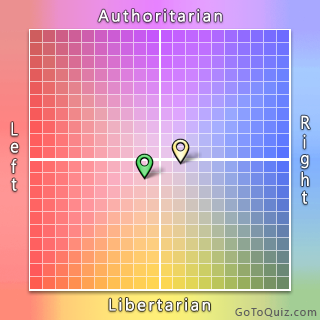
I eagerly await your assistance.
 Ethics Alarms
I took two quizzes and both came out moderate right libertarian. That is fairly accurate, though the questions made me kind of crazy.
jvb
I came out about where you did (right vs left) but on the slightly authoritarian side (<1). I find that odd because I would have put myself further right than either the top or bottom polls put me. The middle one put me in the far right fringe, which also seems a bit too extreme for me.
On Jack’s 1-10 scale I say I am about a 6.
I peg myself as a center right libertarian which is close to the first survey score 3.66 right and 1.18 libertarian. I believe that we should treat people like we want to be treated. I believe government’s role is to provide a common defense, protect property rights, develop systems that fairly adjudicate disputes, and to engage in activities that undergird our economic development. This is what allows each of us to engage in the pursuit of life liberty and happiness. I do not believe government’s role is to redistribute income from those with more to those with less. There is no equitable way to take from one without any exchange of value and give to another. When we define fair share contribution it must demand something from everyone.
The second survey (PEW) pegged me as a Faith and Flag Conservative which in their definition is basically died in the wool racist Trump supporter. Only 2 of my answers tracked closely with their survey data. One was regarding gun rights to which I answered I supported gun rights to provide a check against a tyrannical government. I suppose it was my answers to questions of white privilege put me in the racist category. I answered that I neither think whites have unfair advantages, nor do I believe non-whites are systemically denied access to opportunities. Another answer I gave was that government policies should not reflect religious values. Yet the Faith and flag cohort was deemed to suggest a strong Christian bias. Nowhere in the survey was there any indication of Christian belief structure or any other religion so how do they arrive at Christian bias? How do they know I am not coming from a Hindu perspective? I conclude this is survey is junk science!
I stopped answering question in the last survey when the query was, ~Do I believe that my race has superior qualities to other races? That is a loaded question. Races and cultures are distinct. Ask me if I think predominantly white western Europeans have developed cultures that maximize the human potential at a greater rate than other non-white ethnic groups and I will give you an answer. When the BRIC countries and Africa develop their people to the same educational and living standards as western Europe and the US, I will say that no culture has a monopoly of superior qualities. In my opinion one reason that some members of various demographic groups fail in western societies is they have been indoctrinated into victim culture. This affects every racial group. Some whites and non-whites aspire to great heights and they do what the social order compels them do to achieve that height. Others find the chip on their shoulder is holding them down but are unwilling to unburden themselves of that weight and put aside their racial identity that provides them comfort in their own failure to achieve. Most fall somewhere in between. Not every kid wants to grow up to be the President or the next superstar athlete. We find our comfort zone and settle in. If you ask me if the culture to which I am accustomed which rewards work and responsibility is superior to a ghetto culture where such ideals are deemed “white man’s” ideas and thus antithetical to the group norm, I will say yes, I do think my culture is superior.
1st poll: Right Moderate, Social Libertarian 4,25/1.47
Pew: Committed Conservative.
From the political spectrum quiz:
You are a center-right social moderate.
Right: 1.68, Authoritarian: 0.64
That places me further left than I had anticipated, but I think, as a raging Papist with a deep respect for Authority, it makes sense that I fall more on the Authoritarian than Libertarian side of things.
Pew placed me as “Ambivalent Right”.
Myers-Briggs places me as an ISTJ, if that helps any.
However, I feel too many of the questions asked were too vague. Do I think the government should ensure a minimum standard of living for its citizens? To an extent, yes. But there are a number of questions that should be answered first. What do we mean by ensure? Is it measured by opportunity or outcome? No governmental policy will guarantee that every citizen has some particular minimum standard of living, because there will always be some that fall through the cracks, and some who will take any handout and squander it. What is the minimal standard of living? How can we address the principle of subsidiarity, which to me is crucial? The people closest to the problem should be the ones to handle issue, unless the issue is beyond their ability to address, following some order like family, community, municipality, county, state, nation. So which of these do we mean in the question?
Do I think we should use the military to protect our oil supply? That depends. Is the oil supply we’re defending domestic or foreign? Does the military action fall within the bounds of Just War Doctrine? Who is threatening the oil supply?
Maybe a good quiz would be one that gives 50 questions where all one does is rank a selection of values against each other.
Here is how all the scores that people gave for the Political Spectrum ratings averaged so far:
Right: 2.76
Libertarian: 1.34
Interesting Note: The average for the Political Spectrum ratings came out about 1 point further to the right of Jacks rating and about one point more towards Libertarian than Jacks rating.
You are a right social moderate.
Right: 3.43, Authoritarian: 0.13
Well, add another to the political echo chamber.
Political Spectrum Test: Right 2.9, Libertarian 0.14
Pew Typology: Ambivalent Right
Political Compass Test: Right 1.6, Libertarian 0.26
At least I’m consistent. The pew test gave me 0 questions on gun rights.
Long time daily reader. Ethics Alarms is important to me. I used to be much more Libertarian but no longer feel that’s viable even though I have a strong I don’t care what you do, as long as it doesn’t affect me attitude.
Right Social Moderate – right 4.56, Libertarian .97
Thanks,Tracy.
GoTo put me as a “center-right social libertarian” at 2.34, 5.13. (Beat my libertarian score, I dare you.)
I’m moderately surprised that it scored me as conservative as it did… I hold a lot of what I consider left-of-center views (I like my Canadian healthcare system, for legalization of marijuana, abortion should be legal, if rare) but I think that two things worked against my centrist lefty-isms… First off, a lot of my left-leaning positions are winning or won issues, and so I care about them less than others. And second, I’m something of a free speech purist, and I think that these surveys tend to think of speech issues as a right-of-center issue. Which is either wrong, or right with some really awful connotations for the left.
Political Compass put me at 2.38, -2.87
So maybe that is where I sit conservatively. Still no great surprises.
And Pew put me as an “Ambivalent Conservative”
Although I think that one suffered from being very US-focused. My national pride doesn’t really translate to the faith and flag style answer for “Is America the Greatest Country in The World”
Isn’t it amazing that believing in free speech today marks one as “conservative”?
Not really. Classic liberals as in classic liberalism (Locke, Jefferson, et al) would have conservatives under today’s rules. They would have promoted small, limited central authority, in favor of individual rights, and states rights. But, yeah, in today’s world, a liberal is simply waiting to be told what to do by the almighty hand of the government.
jvb
There is a big difference between classic liberals¹ and 21st century Liberals².
¹liberal: adjective 1. willing to respect or accept behavior or opinions different from one’s own; open to new ideas. 2. relating to or denoting a political and social philosophy that promotes individual rights, civil liberties, democracy, and free enterprise.
²Liberal: noun supporter of political policies that are socially progressive and promote social welfare.
³illiberal: adjective opposed to liberal principles; restricting freedom of thought or behavior.
A liberal¹ would actively promote free speech where a 21st century Liberal² is typically an illiberal³.
Indeed.
Not to get too Alizia-ish, but there’s a disconnect between what we think of as left-right issues and what are historically left-right issues, and I find myself thinking every now and again on what it means to be conservative… What is *necessary* to be considered conservative, and what are the frills and gimmicks? What are the temporary trappings? A lot of the issues that we see as a right/left disconnect are *REALLY* different issues outside of America, and I often have a hard time connecting them to the fundamentals of conservatism.
Speech issues, regardless of whether there anything inherent in conservatism that supports them, should almost by definition be a liberal issue… The base word of liberalism is “Liberty” for Christ’s sake. Speech rights are absolutely fundamental for liberty. And yet… it’s not one of their issues. In fact, I think that the last 20 years or so were the first generation where the American left has actively worked against the enfranchisement of rights and liberty…. Which is why the new batch of Libertarians seem to have such a strong conservative trend… That wouldn’t have been true even a generation ago, when Libertarians were big on issues like gay marriage.
I miss Alizia and her lengthy posts.
jvb
Challenge accepted!
GoTo score: Right: 5.13, Libertarian: 6.2
(I did the test before seeing your post, so this is not me gaming the test.)
I scored farther right than I would have imagined. Perhaps because I have very strong free-market views?
Political Compass has me at Economic Left/Right: 1.13, Social Libertarian/Authoritarian: -3.95, which seems more reasonable.
“Perhaps because I have very strong free-market views?”
And that’s probably where we differentiated, either we marked the questions differently in relative importance or we might have disagreed on a couple… I think some amount of regulation is necessary, if for no reason other than to prevent monopolies and/or deal with anti-trust issues. I don’t feel particularly strongly on most of the issues, although (as with most things) I have an opinion.
Regardless: Alas, our titles are both already shattered, my 5.13 might not have stood up to your 6.2, but we both got shellacked by Rusty’s 7.48 (below). Good company to keep, I think.
“(Beat my libertarian score, I dare you.)”
Challenge accepted! That survey described me as a “right social libertarian”, 6.07, 6.86. Political Compass scored me at 3.63, -4.67.
I’ve taken similar quizzes before that place me off the chart in that quadrant (dependent on the nature of the questions asked, I guess). Other quizzes have classified me with labels like “libertarian anarchist”.
Reading everyone’s scores is interesting. I’m not sure the numerical quantification is super-accurate, but it does seem to track on a relative basis. For example, I always enjoy your comments here, HT, because they usually follow my own thinking pretty closely. When I disagree, it’s most often that my stance is further in the direction of dangerously unrestricted liberty. Perhaps that’s just the difference between a Canadian libertarian and an American one. Americans always have to take things just a little too far into ridiculousness, like monster trucks and 96 ounce soft drinks in styrofoam cups…
Come to think of it, that might be how I’ll describe myself when people ask my political leanings from here on out: a monster-truck libertarian. 🙂
Jack,
Interesting surveys…some of the questions leave a lot of room for interpretation – but I guess most do.
I would put myself as a 7 on your scale.
Center-right moderate social libertarian.
Right: 1.69, Libertarian: 1.23 – I thought I would be further right and more Libertarian.
Pew has me as a Committed Conservative. Hard to argue with that.
Thanks, Bill.
Political Spectrum Quiz Results:
You are a right social libertarian.
Right: 3.38, Libertarian: 7.48
I think I am far more libertarian that most people, and even most people here.
Pew:
Your best fit is…
Ambivalent Right
I have taken the political compass test several times and come about about the same, I find the questions to be nonsensical
For example: “No one chooses their country of birth, so it’s foolish to be proud of it.”
While I agree that it does not makes sense to be proud of it because you are born there, it does make sense to potentially be proud / ashamed of it because we in some sense (ostensibly at least) control the government. A better question would be “No one chooses their country of birth, so it’s foolish to be proud of it just because you were born there.” So I find that one hard to answer
“If economic globalisation is inevitable, it should primarily serve humanity rather than the interests of trans-national corporations.”
Why are these my only choices, what if I think it should not server either, or maybe both to some degree… Again poorly worded.
“Controlling inflation is more important than controlling unemployment.”
How the hell am I supposed to even start to analyze that?
The questions are, many of them, terrible, and yet the whole thing seems to work well. Maybe they are more clever than they seem.
I somehow got enrolled in a periodic survey group with Pew, and they send me surveys to fill out about once a month. The questions are rarely ever the same, which I don’t quite understand if the purpose is to use a static group of people to gauge changing opinions, but whatever, they’re the polling experts, right?
The questions they send are often like this, ambiguously but obviously carefully worded. I suspect they fine-tune the language of the questions pretty well with focus groups and such so that the results can feed their algorithms. Each question on its own may not provide much insight, but aggregated with how you answered other questions, can provide a pretty nuanced and accurate gauge of your thought processes. It’s not just about how you answer the question, but also about how you interpret the phrasing of the question. One thing they always ask is if you thought the questions were politically neutral or not. I think they use that feedback to refine future questions.
Those surveys can drive me nuts, because it’s always agree/disagree with no neutral option. Sometimes, I just don’t care at all about the topic of the question, and resent having to take a stance.
Jack Marshall wrote, “The questions are, many of them, terrible, and yet the whole thing seems to work well. Maybe they are more clever than they seem.”
Jeff wrote, “The questions they send are often like this, ambiguously but obviously carefully worded. I suspect they fine-tune the language of the questions pretty well with focus groups and such so that the results can feed their algorithms.”
Personally I think the questions are intentionally worded in an effort to psychologically trigger both explicit and implicit bias, they want more of an emotional reaction than they do a logical reaction, in other words they don’t want you to critically think about the questions, they just want you to react. Do the questions accurately expose both explicit and implicit bias and achieve the end goal, maybe, but I personally don’t trust them until you get deep into the four corners on the graph; the closer to the 0,0 on the graph the less accurate the result becomes.
Also; I don’t give a damn how I compare to the average on these kinds of pigeonholing questionnaires because those averages can be used as subtle peer pressure propaganda to influence the opinions of others, aka the one rocking the boat, it’s kind of like how getting “likes” on Facebook or Twitter can be influencing propaganda and in turn manipulate behavior.
P.S. Just to test what I wrote above, I just did the political spectrum questionnaire again. On the question “How much does this issue matter?” I answered all the way to the “A Lot” on all the questions. I tried my best to simply react and not question the answer at all and the result was definitely different than my previous result, I forgot to get the numbers but this one ended up on around 2-3 Authoritarian and somewhere around 7 Conservative.
I took the first 2 of the tests and came out as: Pew – Ambivalent Right; Quiz 1 – Center-right social moderate, which are generally quite accurate. The Political Spectrum test by not having a middle category made me crazy in that quite a few of the questions aren’t simply “true” or “false”, so for me it’s a problem with the questions, even though perhaps with many or most people they have a strong feeling one way or the other. But I generally have great difficulty with MOST surveys for exactly that reason.
I 100% hate these quizzes.
And for years I’ve been meaning to do an in depth survey and critique of all of them I’ve found over the years.
As a side note, it has been interesting watching the evolution of these charts over the years. First they began as a single line with obvious “Left” / “Right” implications. Unfortunately for Leftists (in America) the truly horrendous regimes kept popping on the Left end of the spectrum (including the Nazis). Primarily because the American political spectrum is nothing like the European one, especially with terms like “Left” and “Right”.
Somewhere, some left leaning brainiac decided to clean up things and created a “diamond” with “left” and “right” corners, and a bottom corner for “libertarian” and a top corner for “statist” or “totalitarian”. This way, the truly horrendous regimes could be pushed away from the “left side” and could but sort of classified as “right totalitarian” and “left totalitarian”.
Amusingly enough though, over the years, this still wasn’t good enough as pretty disgusting people kept popping up right next to darlings of the left, while there was little co-location between disgusting “right wingers” and run of the mill right wingers.
So, now we’ve developed the political square. Essentially trying to drop mainstream leftists down to the middle line and pulling average right wingers somehow up towards the “authoritarian” horizon.
It’s pretty clever. But pretty stupid also. A desperate gamble to try to make left wingers seem more libertarian than they really are.
You are a center-right moderate social libertarian.
Right: 2.17, Libertarian: 1.61.
Like some others, I’m not happy with the questions and options for responses.
As a long-time lurker but infrequent commenter, I figure I’ll offer myself up as another data point.
I see myself as mildly conservative in most respects, so maybe a #6 on Jack’s scale. However, I also acknowledge that I hold a few opinions that are much further left & right, arranged in such a way that they only average out to something “centrist”.
It’s been a while since I’ve taken a political alignment poll. Several questions irritated me, for if they were phrased slightly differently, I’d have given a different answer. Some of the results surprised me.
Political Spectrum Quiz:
You are a center-left social moderate.
Left: 1.43, Authoritarian: 0.32
Political Typology Quiz:
Ambivalent Right
Political Compass:
Economic Left/Right: -1.13
Social Libertarian/Authoritarian: -2.0
The “Ambivalent Right” feels correct, while the other results are way further left than I would have expected.
For consideration, I’ll put myself out there and provide a set of personal opinions, and you can judge if the above results fit or not. I offer the following without any justification for any of it, and I don’t intend to put up any sort of defense for it either.
I interpret the 2nd amendment as a hedge against tyranny. I also believe individuals have the natural right to defend themselves, their family, and their property with lethal force. If you intend to defend yourself against the government, you’d best have a lot of like minded friends and be prepared for the grisly consequences. I view the Left’s talk of “common sense gun control” with extreme skepticism, even if some regulation would be sensible coming from anyone else. Guns are also scary and dangerous things that need to be treated with respect.
Abortion is the taking of a life, an individual human life, being euthanasia at best and murder at worst. I’m not committed to the idea of an individual life beginning at conception, because the biology can be messy. Fertilized eggs fail to implant, fail to divide, may result in multiple embryos, or even contribute to half an embryo. The law shouldn’t step in until there’s an identifiable, viable individual in addition to the mother. Rape doesn’t justify the taking of another life. If a mother’s life is genuinely at risk, of course an abortion is justified. I can make peace with the idea of euthanizing a fetus with a terminal condition. Liberal word games about abortion are a waste of time. Government spending on social programs that would reduce the perceived “need” for abortion may be a necessary and pragmatic compromise, whether that be in the form of making contraception more available or providing a social safety net for mothers & children, and yes, the exact details of such programs are fraught with potential undesirable consequences.
Gay marriage is fine. Heterosexuals have done far more to undermine the traditional institution of marriage. Both orientations might have been better served by a secular, federally recognized civil union, but that ship has sailed. Generally don’t care about the sexual preferences of consenting adults. Speaking of consent, power differentials may render some consent invalid between two adults, and what’s legal isn’t necessarily ethical.
Some people deserve more wealth than others. Striving to earn more to make a better life for yourself and your family is a noble pursuit. If you’re successful enough, it’s fair for the government to ask for a larger cut. Wealth redistribution should not be the goal of taxation, yet taxation and government spending on the common good can’t be cleanly separated from wealth redistribution either. The ultra-rich are wealthy beyond our comprehension and are not currently paying a sufficient share. When it comes to taxation, what the Left & Right elites have in mind is typically hypocritical and unfair to the middle class.
If a private entity achieves power and influence on par with governments, we should be able to hold that entity at least as accountable.
Free speech is an essential liberty, and the principle of free speech is worth defending above and beyond the scope of the 1st amendment. We need some rationale by which a small forum can choose the content it wishes to host yet enforce some free speech rights on entities such as Facebook and Twitter. I do not currently have an answer to that.
Capitalism is great. Competition, outside natural monopoly, is great. The US ought to do more to break up monopolies and punish anti-competitive practices. There are similarities between the monopolies of so-called late-stage capitalism in right-leaning countries and the state-held monopolies of nationalized institutions in left-leaning countries.
3.91 “Right”
.01 “Libertarian”
Meaningless.
So many questions were two or three characteristics in one. Many questions were contingent on “well what do you mean by *such and such* a condition”? Some were also – “NO the national government shouldn’t have this power, but YES the states should, or YES localities should while other levels shouldn’t”.
I don’t approve of the profanity.
Maybe, just maybe the person that created that graphic was a left leaning authoritarian.
UPDATE ON AVERAGES
Here is how all the scores that people gave for the Political Spectrum ratings averaged so far:
Right: 2.77
Libertarian: 1.55
Not much change in overall average from previous posting of averages.
Steve, since you already have the data compiled, can you calculate and share the standard deviations from the means? (I’m assuming larger standard deviations will imply lack of an echo chamber while smaller standard deviations will imply a more focused echo chamber.)
I used the STDEV function in OpenOffice Calc on the same group of numbers that I averaged above and here are the results…
Standard deviation
Left-Right: 2.35
Libertarian-Authoritarian: 2.04
Hi Steve,
Thank you. Those seem very high, especially for an echo chamber. I may take a crack at it this weekend and see if we get the same results.
It’s only data up to this point in the thread.
Okay, so the first quiz places me at about (-3, -1) on the 10×10 graph, so a bit left and a smaller bit libertarian.
Pew tells me I’m Ambivalent Right.
The classical Political Compass site (though I think the questions have changed since I last took it) has me at (-2.13, -4.87), a bit left and a bit more libertarian on a 10×10 graph.
As expected, they cannot grasp the true form. That said, I can’t say any one of them is technically wrong; it just depends on what issues they focus on.
I don’t think some of these questions are all that useful. (What does “immoral” mean to most humans, functionally? Do people use it to mean “just don’t do that” or do they mean it degrades a person’s character?) Some of them seemed like false dichotomies, lacking a constructive option. I guess that’s because humans don’t think beyond the immediate context of a question so much. No wonder they get into fights over silly issues all the time.
I might just design a quiz myself based on the political compass of liabilities, but that’s more a vocabulary for describing a person’s position on any given issue, not a box to put someone in across all issues.
As far as political alignment paradigms go, as far as I can tell progressivism corresponds to underregulating the material liabilities of scarcity and disaster, erring on the side of wastefulness and negligence, respectively. Progressives reject the status quo because of its problems and so are more willing to risk solutions that bring different problems instead.
Inversely, conservatism corresponds to overregulating scarcity and disaster, erring on the side of austerity and susceptibility, respectively. Conservatives want to avoid the problems that come with change, so they prefer to accept the status quo with its familiar problems.
Libertarians underregulate the motivational liabilities of stagnation and conflict, erring on the side of decadence and turmoil, respectively. They prefer to risk the consequences of people being left to their own responsibilities, rather than interfering with each other and vying for power.
On the flip side, authoritarians overregulate stagnation and conflict, erring on the side of dogma and corruption, respectively. Some doubtless seek power, but others probably just think they can get more done and help more people if everyone follows the same program, and they’re willing to accept the risks to the people who don’t fit into that program, or the risks that people will start manipulating the program for their own benefits.
These alignments aren’t meant to put people in a box; they’re just a vocabulary for helping describe why someone feels a certain way about a particular issue. As such, a person can display two opposite “alignments” for two different issues, or people can have the same position for different reasons, or different positions while making the same tradeoff about two different things. (For example, people who are conservative about the economy and people who are conservative about the environment may disagree on many policy proposals.)
I will go on record as saying that at the moment I don’t trust human governments to make good decisions, so I can’t be an authoritarian, but I also don’t trust the general public to make good decisions, so I can’t really be a libertarian either.
I’m aiming to help humanity move away from these suboptimal tradeoffs by promoting constructive alternatives. They take more effort, but they make it less necessary to make the tradeoffs and take the risks that come with the above political alignments.
For scarcity, investment.
For disaster, preparation.
For stagnation, transcendence.
For conflict, ethics.
If humans don’t move forward by building common ground with these methods, they’ll continue their foolish tug of war and go nowhere fast.
Extradimensional Cephalopod wrote, “Progressives reject the status quo because of its problems and so are more willing to risk solutions that bring different problems instead.”
I disagree.
21st Century “progressives” reject the status quo because they don’t like it and invest everything in changing while completely ignoring logic and consequences; it’s immature, it’s rebellious, it’s change for the sake of change.
Note: Using the word progressive means to gradually change and directly implies progressing which means to move forward. Using the word “progressive” to describe 21st century Democratic Party extremists simply because they desire to gradually change is an oxymoron; the ideology, policies and actions of “progressives” are actually regressive to the point of being culturally and socially destructive. These ignorant 21st century “progressives” and their army of intimidating social justice warrior “brown shirts” have literally become the totalitarian evil they have professed to be against for years. Our 21st century progressives are not progressing.
Look, a follow-on comment if Jack will accept it in the spirit of this post. Yes yes yes, I know I know, the meaning of “liberal” has changed over time, “progressive” can be seen as ironic, the principles of free speech seem to have been ironically lost by some influential people and factions, etc. etc. Personally I find it ironic when partisans proclaim “ha-ha-ha the political party I don’t like is in trouble, is changing in a bad way, etc.” BOTH the Democratic and Republican Party are obviously changing and have internal rifts to resolve. I can hear some of you ready to shout me down on that, it’s only the “other side” who’s got the problem. But see, that’s the point: There is a phenomenon on the Internet where blog communities become too comfortable and these follow-on comments land in a very predictable way in a very predictable pattern, and I believe that THAT is what is truly at issue in this discussion, or should be.
One of Jack’s greatest principles is “Bias Makes You Stupid” and that has to be examined in all directions, including in the atmosphere established in an online community like this if it is to be productive. I hope this helps.
A Friend wrote, “I know I know, the meaning of “liberal” has changed over time…”
I disagree; however, I think the meaning of ²Liberal (the noun) has definitely changed! See my comment above with the words defined.
A Friend wrote, “I can hear some of you ready to shout me down on that, it’s only the “other side” who’s got the problem.”
I think that statement shows your bias and I really don’t think it’s a fair statement for the commentary here. Sure we have strong opinions and are willing to share them, just like you.
I smiled at that response about my bias and my lack of fairness, a predictably short 19 minutes after my comment was posted. Fine, Steve, please post your analysis of the serious rift within the Republican Party, and how they will resolve it in time for the 2024 presidential election. I imagine you won’t, which is my point. Or maybe my point would be that nobody seems to post that analysis here. And I hope you’re not stereotyping me – I’m one of the first in any real-life discussion to note that many far-left Democrats have no idea how or why a number of minorities are moving out of that party.
My intrusion into the conversation is in the spirit of what Jack said this conversation was all about. I also realize that I’m being like the token liberal on The Five or the token conservative on The View, where I’ve repeatedly observed, including privately to Jack, that the token is immediately shouted down and talked over while the rest enjoy their safe space. You all here have to decide whether you really want that on Ethics Alarms. I know what I think!
Seriously?
You’re misrepresenting my reply to you as shouting you down?
P.S. The current rift, as you call it, in the Republican Party is not about core ideology, it’s about how to represent that core ideology. The rift in the Democratic Party is actually about differences in core ideology.
A Friend wrote, “BOTH the Democratic and Republican Party are obviously changing and have internal rifts to resolve.”
I don’t perceive this to be accurate.
I’m not and I never will be part of any political party. Throwing these statistical survey’s out the window as I usually do, I really consider myself to be independent of parties because I literally am. It’s true that I lean a bit more right than I do left. Regardless of me leaning more right than left I consider myself to be a classic ¹liberal as defined in my comment above and I’ll gladly pigeonhole myself in that category. In my opinion, I honestly don’t think the Republican Party is “changing”, as in shifting ideology, other than being a little more in-your-face with their opinions. The Democratic Party has actually shifted far, Far, FAR to the left of where it’s been in my lifetime and in my opinion they’re heading straight into the abyss of totalitarianism and that is anti-American. The totalitarian mindset rooted in social justice activism movement has blossomed like a malignant cancer and they’ve taken over the political left and actual ¹liberals in the political left are being shut down and demonized as traitors. It really has become an all or nothing movement to push the political pendulum completely over the edge for the extreme political left where the political right is simply trying to drag the pendulum back towards the center.
In my opinion, you’re just simply wrong.
Look Steve, I know what you’re doing. You’re engaging in the common argumentation device among political conservatives that people who identify as “liberal” aren’t being authentic to what the word originally means. But come on, people know what in TODAY’s world the labels “liberal” and “conservative” generally mean, just as the meaning and locus of the “Republican Party” and the “Democratic Party” TODAY have essentially nothing to do with what they meant in, say, the Gilded Age. With that rhetorical trick – okay, device – you get to argue that everything is wrong or changing on the other side of the fence while everything is hunky-dory and authentic on your side of the fence. And face it, you’re COMFORTABLE making that argument in that way because there’s rarely anyone here to challenge it. All I’m doing is making you a little uncomfortable to demonstrate that there is validity to the “echo chamber” concern about this website, which after all is called Ethics Alarms, not Political This-and-That. I’ll leave off at that and hope that there are a lot of anonymous readers who get my point. Jack says he wants more of them. Have a nice day.
A Friend,
I’m not uncomfortable at all discussing anything with anyone in a good faith discussion. I’ve presented the exact same kind of arguments in other discussions across the internet regardless of the political leanings of the commentary. Your implications about me commenting a specific way because I’m comfortable in what I think you’re perceiving as a ideological bubble are false.
By the way; did you not catch the fact that I was specifically focused on “in my lifetime”, for the sake of argument let’s call it 50 years, and not all the way back to the Gilded Age etc. You just ripped the goalposts out of the stadium, dragged them out of the stadium and down main street.
I agree with you. What do you think of the results? Will this finally be the proof this blog needs to verify it’s an echo chamber?
Another good question would have been “who here has voted for a democrat within the last 6 years.”
Also, Steve likes to rant and respond to himself multiple times for no reason.
Well, someone said they’re going to do an “analysis” with standard deviations and all. But come on, the results are clear as a bell, as you suggest. Yeah I know, the split in “conservatism” between a libertarian outlook and a more moralistic one – many here would say that’s proof of some diversity of thought. It’s clearly not nearly enough.
With regard to your last comment, let me just say this generically: A risk in any blog like this is the phenomenon of the person with time on his hands who sits on it constantly and predictably drives it somewhere after the blog leader has teed something up. I am not talking about any one commenter here, and in fact, there’s another one who regularly adds an element of white-male resentment even when the topic of the post has nothing to do with anything like that. I find that very tiring, and I say that as someone who does absolutely have concerns about things like Defund the Police, transgender sports participation, and cancel culture generally. Thanks for your comment and question.
A Lib asked, “Will this finally be the proof this blog needs to verify it’s an echo chamber?”
FACT: If Ethics Alarms is an echo chamber then it’s only because those that oppose what’s being written here don’t have the intellectual fortitude to interject themselves into the conversation thus making it less of a perceived echo chamber.
If people disagree with what’s being written all they have to do is present their opposing arguments with the full expectation that others might actually disagree with them and they might tell you so, that’s how debating works, get over yourself. If you don’t have the intellectual fortitude to stand up for your own arguments then don’t complain about a perceived echo chamber that exists because you’re not comfortable participating due to your own cowardice. Intellectual cowards stay out of hot debates and find an echo chamber that they’re comfortable with.
Don’t walk into a debate and expect to come out unscathed, to do so is immature. It’s your choice to be thick-skinned or a snowflake.
A Lib asked, “Another good question would have been ‘who here has voted for a democrat within the last 6 years.’ “
Not that it’s any of your damn business who people vote for or why, but looking back at Federal, State, and Local elections over the last 6 years, yes I’ve voted for Democrats within that time frame. I don’t vote for a party, I vote for a person that I think holds similar opinions to mine about policies I think are important and like everyone else in the last 20+ years, I also try too vote for the candidate who I think will do the least amount of damage.
Look at it this way “A Lib”; people like you, who appear to be mired in their own partisan party politics, seem to think that who they vote for defines who they are and that way of thinking reflects non-critical thinking and cultish behavior, kind of sheeple’ish. If you want to be sheeple’ish that’s your choice, but don’t psychologically project that nonsense on others, it’s unethical. There’s a lot more to people than who they vote for.
A Lib asked, “Steve likes to rant”
Yup, there are days when my comments might seem that way; but so what, aren’t I welcome to share my opinion just like you did?
A Lib asked, “Steve likes… respond to himself multiple times for no reason.”
“For no reason”, what the hell are you talking about?
Are you making up stuff to smear me? This commenting tactic sounds rather familiar.
Please provide some evidence to support your ridiculous claim.
Finally; I get the distinct impression that you and I have some history in Ethics Alarms comment threads and you haven’t necessarily liked the way I’ve replied to some of your comments; is that a fair assessment?
So the debate has begun “A Lib”. You chose to comment here and I replied to you, now you have to make a choice, do you reply to my comment or do you scream “echo chamber” as you vanish into the hillside.
Choose.
Good insights! In my experience, those on the far left can’t stand when there’s real discussion and real points.
However, I have seen that with far right too!
Any extreme is not about the fact but identity. And when one hear facts blowing up a held view, it’s not about changing one’s mind, it’s about LOSING one’s identity.
That’s not easy for ANYONE, and I would assert any of us, who had our identities questioned would fight and kick just as much. We’d have to. We may not have political identities, but we DO have them.
How we identify in life can keep us stuck to what is possible OUTSIDE that identity.
I have been studying this and questioning my own for about a decade and it’s scary til it crosses over to liberating! knowing we ARE in each moment and that we change from moment to moment!
Anyway, great post!! I’m happy to be among those who are open to truth, and open to discuss and don’t run away if someone doesn’t agree.
mine got eaten 😦
It appears to me that “A Lib” is the Ghost of Ethics Alarms Past peering into this wide open Ethics Alarms thread with those ghastly ghostly eyes of yester years to stalk down an arch enemy and share some hit-n-run folly.
Why doesn’t “A Lib” do what ever it takes to interject their opinions into the regular commentary and help make Ethics Alarms a little less of a echo chamber?
Because they are not up to the task.
Why wouldn’t I allow it?
Extradimensional Cephalopod wrote, “Conservatives want to avoid the problems that come with change, so they prefer to accept the status quo with its familiar problems.”
I think that’s only partially true.
I think most Conservatives, not all Conservatives, only prefer to “accept the status quo with its familiar problems” when the foreseeable possible consequences to society of a proposed change is worse (sometimes far worse) than the status quo and the proposed change doesn’t hold to reasonable logic that inflicting worse problems upon society is worth the forced change.
Conservatives are the political and social antithesis to progressive’s irrational change for the sake of change.
Extradimensional Cephalopod wrote, “They [Libertarians] prefer to risk the consequences of people being left to their own responsibilities, rather than interfering with each other and vying for power.”
I think that’s a reasonable statement.
Extradimensional Cephalopod wrote, “[authoritarians are] willing to accept the risks to the people who don’t fit into that [authoritarian] program, or the risks that people will start manipulating the [authoritarian] program for their own benefits.”
For authoritarians it’s all about pure power and control over others in a very totalitarian manner; rules for thee but not for me & liberty for me but not for thee.
Thought you might like this “funny” just don’t take it too seriously!!!!!
The above is used with full permission from the author under the condition that the author remain anonymous.