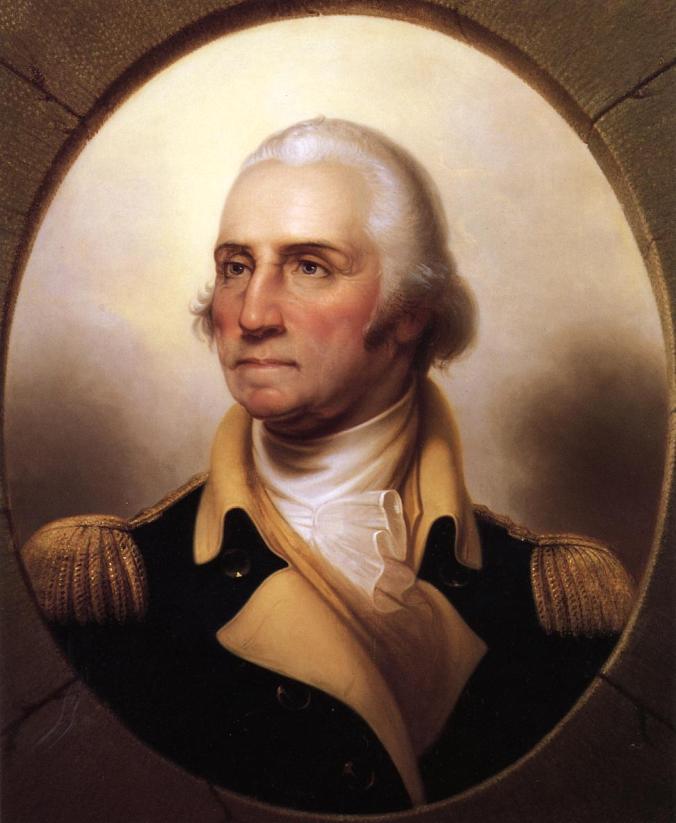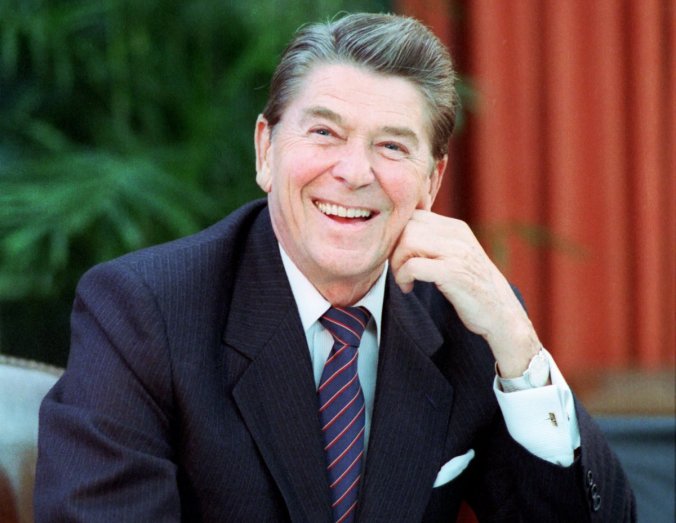
After Dark Ethics Potpourri, 2/21/2022: President’s Day Edition, Or “Mister We Could Use A Man Like Ronald Reagan Again”

In case I haven’t been sufficiently clear, the same ethical principle that I spent four years insisting on during Donald Trump’s administration is equally important during the Biden Administration. Every President, and hence the Office itself, deserves and needs a modicum of respect and deference, or our system doesn’t function. In turn, every President has a duty to work to keep the office respectable by his demeanor, words, appearance and conduct.

Virulent partisanship makes the first requirement unattainable in sufficient degree, and the unavoidable pay-back that any Democratic successor would receive from those who—legitimately—resented the absolute refusal of the “resistance,” Democrats and the media to give Trump the shred of a chance before burying him in ridicule and hate has pushed abuse of the office below levels from which it is unlikely to be able to recover.

I thought the American Presidency was on life support after the destructive parade of LBJ and the hate directed at him over Vietnam, Nixon and Watergate, Ford, whom pop culture treated as an unprecedented boob, and Jimmy Carter, whose disastrous idea of the Presidency was to pretend not to be a leader. Then, as has so often been the case, the exact right type of President for what ailed the nation and the position showed up. Ronald Reagan played POTUS beautifully, and restored the office, substantially though not completely, to its previous iconic status. I’ll never forget that hard-line Democrat and the chief lobbyist for the American Trial Lawyers Association while I was there, who hated Reagan’s policies, telling me, “If his policies weren’t bad enough, he also knows exactly how to be an American leader, damn him.”

Ronald Reagan left the Presidency in far better shape than he found it.

  1. Pop Ethics Quiz: Is this an appropriate activity by the American Bar Association? The “Racial Equity Habit Building Challenge ” has been curated by the ABA Diversity and Inclusion Advisory Council. The ABA’s introduction to its syllabus states:

“The Challenge invites participants to complete a syllabus of 21 short assignments (typically taking 15-30 minutes), over 21 consecutive days, that include readings, videos or podcasts. It has been intentionally crafted to focus on the Black American experience. The assignments seek to expose participants to perspectives on elements of Black history, identity and culture, and to the Black community’s experience of racism in America. Even this focus on Black Americans cannot possibly highlight all of the diversity of experiences and opinions within the Black community itself, much less substitute for learnings about any other community of color. This syllabus is but an introduction to what we hope will be a rewarding journey that extends far beyond the limits of this project.”
Continue reading

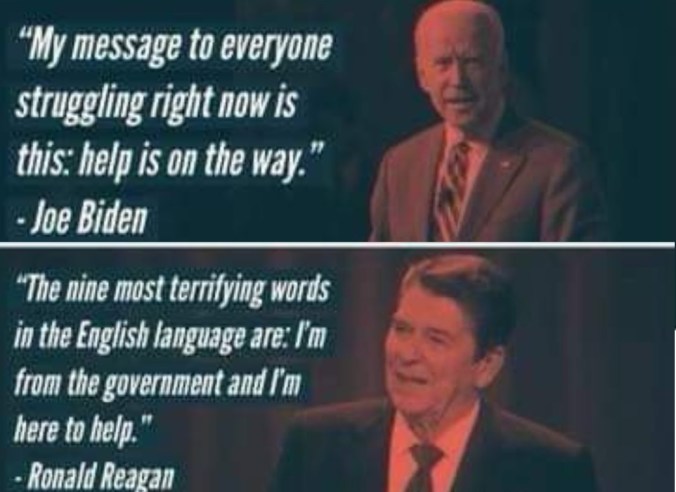
Addendum To The Previous Post: Remember, It Is Foolish Not To Trust The Government…

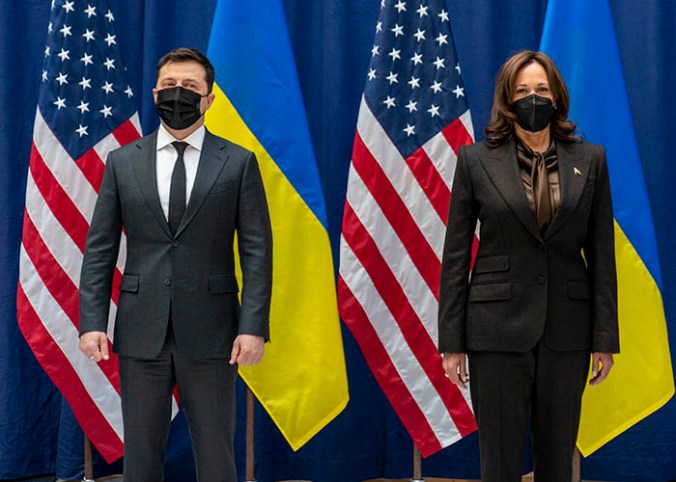
Heeeeere’s Kamala!

“What I made clear in our meeting is that, again, this is a dynamic situation. And depending on what happens in the coming days, we will reevaluate the need that Ukraine has and our ability to support…The purpose of the sanctions has always been and continues to be deterrence. But let’s also recognize the unique nature of the sanctions that we have outlined. These are some of the greatest sanctions, if not the strongest that we’ve ever issued, as I articulated yesterday. It is directed at institutions — in particular, financial institutions — and individuals, and it will exact absolute harm for the Russian economy. And their government… [But] As the president has said we believe that Putin’s made his decision. Period.”

Yes, that was the Vice-President of the United States, engaging in Authentic Frontier Gibberish to simultaneously describe U.S. sanctions as designed to deter the threatened Russian invasion of the Ukraine, designate those sanctions as the “greatest,” and then to admit that deterrence is futile.

Can Americans trust that this word salad is honest and transparent?

No.

Continue reading

Dear American Left, And With All Due Respect, Your Totalitarian Inclinations Are Showing…

The top featured letter to the editor today in the New York Times is from Big Brother-loving Richard Cantor:

Re “The Covid Policy That Really Mattered Wasn’t a Policy” (column, Feb. 7):

Ezra Klein’s insightful column points out that the root causes of our failure to deal with Covid adequately both nationally and internationally were more our lack of solidarity and our mistrust of government than policies. In other words, they were due to our social dysfunction.

That insight has profoundly negative implications for human survival that go well beyond Covid. It indicates that we are incapable of dealing with the much larger threats of global warming and devastation of the environment no matter what engineering miracles we discover, because we lack the solidarity and trust necessary to tackle those threats to continued human existence.

We are doomed not because we do not know what must be done; we are doomed because we will neither cooperate with each other nor support our respective governments to get it done. Mankind is now on its last merry-go-round ride and that ride is coming to an end much sooner than most people realize, not because we lack the knowledge to prevent catastrophe, but because too many people refuse to acknowledge the truth for very selfish and shortsighted reasons.

The most urgent things we need to do are to face facts honestly and start getting along with one another to deal with them.

It is astounding to me that anyone who has watched the last two years unfold could conclude that failure to trust the government was an existential problem, or that a solution to current challenges facing the U.S. is to trust the government more. Putting aside the observation that Ezra Klein, a pure progressive propagandist who eschews objective analysis, who started Vox and was also behind “JournoList,” a select Google group controlled by Klein and limited to “several hundred left-leaning bloggers, political reporters, magazine writers, policy wonks and academics,” has never issued an unbiased column not propelled by a leftist agenda in his life, the failure to see the government’s pandemic response as irrefutable proof that the government can NOT be trusted can only be called a fevered delusion.

Continue reading

President’s Day On Ethics Alarms: The Nation’s Incompetent, Disrespectful, Unethical Treatment Of George Washington’s Birthday [Corrected]

How many Americans of our rich national past have a birthday celebrated as a national holiday? One: Martin Luther King. That surely makes the anti-white racists and the “the most important aspect of the United States is its racial divisions” gang—you know, Democrats—happy, but it is also misleading and ridiculous. The most important single figure, black, brown, white or whatever it is currently acceptable to call Asians and Native Americans (I haven’t checked this morning), is George Washington. He was, as George Will likes to say, “the indispensable man”—no George, no U.S. His birthday absolutely should be a national holiday.

Yet it isn’t, due to a confluence of factors. You can’t call today “George Washington’s Birthday,” because the date is February 21, and George was born on the 22nd. In the just-launched 4th season of Amazon’s clever and brilliantly cast comedy series “The Marvelous Mrs. Maisel,” the heroine, on the road, learns that her parents are having a birthday party for her young son. “The real date wasn’t good for me,” her very weird father (Tony Shaloub) explains. “He’s five! He won’t notice.” “What kind of people change a kid’s birthday?” she protests.

Americans. And worse, we did it to the man to whom we owe the greatest debt of all.

Continue reading

The “Sub-Minimum Wage” Debate

I confess, I was completely unaware of this issue, or the fact that we even have a so-called “sub-minimum wage.” Section 14(c) of the Fair Labor Standards Act allows individuals with Down Syndrome or other intellectual or developmental disabilities to take certain specially regulated jobs at less than the minimum wage. The usual “raise the minimum wage” crowd wants the exception eliminated, and many states are preparing to do so. Advocates for the disabled and Down Syndrome individuals argue that it is important to keep the sub-minimum wage.

I don’t understand this controversy at all.

Opponents of eliminating the sub-minimum wage argue that it will cause many Down Syndrome individuals to lose their jobs. Of course it will, but how is this different from the fate of all the minimally skilled workers without technical disabilities who lose their jobs when the regular minimum wage is raised? Why is their plight less urgent than that of the disabled? If it is acknowledged that a sub-minimum wage keeps those who cannot perform at a level worth the minimum wage in the work force, why limit that rationale to the genetically disadvantaged?

But the opponents of killing the sub-minimum wage rely on the worst possible arguments to support keeping it. Here’s the “Dissenting Statement and Rebuttal of Commissioner Gail L. Heriot in Report of the U.S. Commission on Civil Rights: Subminimum Wages: Impact on the Civil Rights of People with Disabilities. (September 17, 2020).” Heriot, one of the few conservatives on the Commission, writes,

Section 14(c) was adopted in 1938 at the same time as the first federal
minimum wage. Back then it was believedno doubt correctlythat a federal  minimum wage would cause many disabled persons to become unemployable. An exception was thus created.

(There is also a time-limited exception for youth employment.)

Why wasn’t it also believed that the same principle would apply to every other individual, handicapped or not, who was unable to perform a job worth the minimum wage? Isn’t the assumption that Down Syndrome sufferers are less employable than than the ordinary lazy, poorly educated, unmotivated and none-too-bright American low-skilled worker simple bigotry? My experience with Down Syndrome workers is that they are often better at their jobs than their non-Down peers—harder working, more polite, more reliable. If a sub-minimum wage makes sense, then a minimum wage makes no sense. Continue reading

The Women’s Free Skate Disaster Everybody Needed To See

Now let’s see if any lessons were learned. I’m dubious.

As even those, like me, who have the integrity combined with a low nausea threshold that prevented me from watching China’s version of the 1936 Munich Olympics, now know about Olympics darling doper Kamila Valieva choking spectacularly in the Women’s Free Skate long program and falling out of the medal race. One has to feel sympathy for the girl, who was subjected to unimaginable pressures because of a tangle of terrible, stupid, unethical decisions made by the adults around her. Beyond that, the result was perfect, exposing so much of what is corrupt and intolerable about so many things: the Olympics generally, these Olympics, women’s skating, women’s sports, Russia, and more.

We begin with the fact that Valieva should never have been allowed to skate in the individual event after testing positive for a banned substance before the Games. The reasoning of the Olympics powers that holding her to the same standards that adults would be held to in the same events she competes with them is subjecting her to “harm” is unethical, the ultimate “Think of the children!’ rationalization. Gee, you idiots, how did that harm avoidance plan work out for her? In what universe would the 15-year-old skater be more harmed by being doped out of the Olympics as any adult skater would be, than by having to compete with a major scandal hanging over her head, and collapsing under the pressure? Sure, what happened was moral luck, but the best case scenario would have also been terrible: the girl stuns the world with a brilliant program, and every medal remains in limbo for months.

Continue reading

On “Decertification,” Everybody’s Wrong (Or Lying)…

When everybody’s unethical, it begins to be difficult to figure out what “ethical” would be.

In Wisconsin, some Republican officials have launched a serious (though ridiculous) “decertification” effort, an effort to persuade the Wisconsin Legislature to rescind the state’s 10 electoral votes, thereby starting a movement in other states where President Trump lost by a narrow margin and there are reasons to doubt the integrity of the count. In Arizona, a Republican state legislator running for secretary of state, and other GOP candidates for Congress, have also called for withdrawing the state’s electoral votes, which went to President Biden. Last September, Trump wrote a letter to Georgia officials asking them to decertify Biden’s Peach Tree State victory, but there was no response, appropriately.

Continue reading

Ethics Summary Of Stories I Would Have Full Posts On If Today Hadn’t Been FUBAR, 2/19/2022

1. Well this is certainly moronic…NBC senior reporter Alex Sietz-Wald said out-loud on MSNBC that the biggest challenge for Democrat governors ending their mask mandates is that the Left has made mask-wearing such a fetish of their woke identity that they may resist giving it up:

So I think this is going to be a challenge for a lot of Democratic leaders to get their base comfortable with the idea of going back to normal. I mean, for the past two years so much of the identity of what it meant to be a Democrat, to follow the science, was tied up in masking and following these rules and regulations. And if you didn’t do that, you were, you know, a bad person, you were Ron DeSantis, you were a denier. So, now, these Democratic leaders need to get their base comfortable with unwinding all of that.

Follow which science when? The masking has long been virtue-signalling for those who think complying with arbitrary authoritarian edicts is virtuous. It was most appropriate that the first Democrat TV personality to proclaim that “I would wear a mask and I might do that indefinitely. Why do I need the flu or a cold even?” was “The View’s” resident moron, Joy Behar. In a moment of rare self-awareness, she attributed this decision to “the little voice in her head.” Indeed, few have smaller ones, and Joy proved it by being caught just hours later dining out with her friends without a mask. Continue reading

Remembering The Donner Party

On February 19, 1847, rescuers finally reached the surviving members of one of the great ethics challenges of U.S. history, the Donner Party, a group of California-bound emigrants stranded by snow in the Sierra Nevada Mountains that ended up resorting to cannibalism when they were trapped by bad weather.

89 pioneers including 31 members of the Donner and Reed families set out in a wagon train from Springfield, Illinois the previous summer. They decided to try the so-called “Hastings Cutoff,” a supposed short-cut that an ambitious attorney, Lansford Hastings, had mentioned in 1845 in “The Emigrants’ Guide to Oregon and California,” his well-selling book that claimed to be one-stop guide to traveling West.

The book contained a passing reference to a route that would save more than 300 miles over the traditional California Trail that previous emigrants had used, saying, “The most direct route, for the California emigrants, would be to leave the Oregon route, about two hundred miles east from Fort Hall, thence bearing west southwest, to the Salt Lake; and thence continuing down to the bay of St. Francisco.”

Continue reading

Ethics Observations On A Discrimination Enabler’s Confession

Over at Quillette, an American University teacher calling himself “Keith David” (I can’t find a reference for him) writes “A Student Sleuth Found Evidence that Our University Practices Reverse Racism. Here’s Why I Advised Him Not to Publish It.”

It is a long article, and deserves to be read in its entirety even at the risk of having your head explode. I find the author’s approach to the problem both typical and depressing, but before I enumerate my reactions, here are some major points in the article: Continue reading