To be accurate, I do not think there’s any “might” about it. Let’s all be grateful Judge John McBain of Jackson County, Michigan isn’t a black woman, or he might be on the Supreme Court before you know it.
Yesterday Ethics Alarms noted (Item #1) a reversal in Ohio of a case where a woman had been convicted of raping herself, or something, as a way to maximize the penalty for her revolting abuse of her own son, whom she forced to “rape” her with a foreign object. Incredibly, the appeals court had upheld the conviction despite the fact the law simply didn’t support it. (I didn’t mention this, but the prosecutors were unethical to indict her when the law as written didn’t apply.)
Something is apparently “going around.”
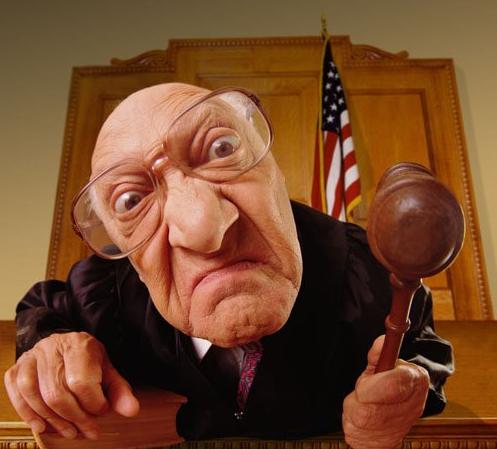
Judge McBain twice sentenced a defendant as if she had been found guilty of first-degree murder. Dawn Marie Dixon-Bey fatally stabbed her boyfriend on Valentine’s Day in 2015, but was acquitted of premeditated murder, and was only found guilty of second-degree murder by the jury. That meant that the judge could sentence her to as much as 20 years in prison, but no more according to sentencing guidelines. Verdict? What verdict?
Judge McBain behaved as if the jurors had found Dixon-Bey guilty of all charges. He said from the bench that she committed “a cold blooded, premeditated stabbing,” even though premeditation wasn’t proven. The first time McBain sentenced Dixon-Bey to 35 to 70 years in prison after saying she “brutally murdered” the victim “in cold blood,” the appeals court vacated the sentence. After it sent the case back to McBain for a sentence that complied with the limits for second degree murder, he sentenced her to 30 to 70 years in prison again.
” It’s extremely important for the editorial board to have a reputation to call balls and strikes without partisanship.
Former NYT editor James Bennet, who was responsible for the editorial now the object of a defamation lawsuit by Sarah Palin.
Wow. If that’s “extremely important,” the Times sure is doing a lousy job achieving its alleged objective. It was just this week when the Editorial slot in the paper was taken up by a piece headlined (in the print edition), “Can the Republican Party Be Saved?” (online headline: “When the Storming of the Capitol Becomes ‘Legitimate Political Discourse.“) The second headline is deceit: as I pointed out in the previous post, the recent GOP resolution condemning the two Republican House members who voted for an illegal Democratic Party impeachment and who are fully participating in a rigged partisan investigation designed to find a way to lock up Donald Trump and as many of his supporters as possible, never asserts that the Jan. 6 riot was “legitimate political discourse.” Never mind: that’s the latest false narrative fad, like the “Trump called white supremacists ‘fine people'” smear that one can still hear one’s Facebook friends cite to this day. Of course the Times is running with it.
It was the print headline that really struck me, though. This week, polls came out showing that Joe Biden’s support had slipped into the thirties with no end to the free-fall in sight, and that the Republicans were surging further ahead in the Congressional mid-terms survey. And the non-partisan Times’ question is whether Republicans can be saved! Only a thoroughly biased group of editors wouldn’t perceive how bad that kind of tunnel vision makes the paper look. But bias makes you stupid. In its most extreme cases, victims can’t even see how biased they are. Continue reading →
This happens to me too often. I’m writing this after less than 5 hours sleep, because I stumbled on this thing while trying to calm down after an early morning errand so I could get back to bed, and found that if I didn’t write about it, it would be like comedian Lewis Black’s story about over-hearing someone say, “If it weren’t for my horse, I wouldn’t have spent that year in college.” As with that snippet of a conversation that he couldn’t stop obsessing over what the hell it could mean for days, this article from “Above the Law” would churn and churn in my brain until it finally killed me if I didn’t get this post up.
1. It’s called ‘the law,’ you ignoramuses. In Ohio, Miranda Smith, a true sicko, was charged with rape involving a two-year-old child, Her conviction was reversed by The Ohio Supreme Court after an appeals court had upheld the trial court. The grounds for the reversal was that her (disgusting and horrible) conduct, which she admitted to, “only” constituted gross sexual imposition under Ohio law. Gross sexual imposition is a lesser charge, and might result in less punishment, though not if the sentencing judge has his head screwed on right.
What did the woman do? Oh, Smith had her two-year-old son insert a ‘sex toy” into her vagina, took a video of the act and sent it to her boyfriend. (Now there’s something you don’t see every day.) How the trial and appeals court allowed a conviction for rape to stand, I’ll never know. The statute defines what the child was made to do as a sex act, but its should be obvious that one can’t be charged with raping oneself. Whatever it was that this mother did to her child, it wasn’t rape. “The state asks us to … conclude that Ohio law requires only an act of insertion and that it does not matter whether it is the victim or the defendant who does the inserting. In other words, the state is essentially asking us to rewrite R.C. 2907.02(A)(1)(b) to make the statute fit the facts of this case. We cannot do that, though.” Oh, I can think of at least one SCOTUS justice who would probably argue that doing exactly that is what “feels” just. Naturally, the “Think of the children! mob” went bonkers. Consider these arguments from activists:
It’s this focus on the language of the law rather than the impact the crime had on the child that troubles those who advocate for rape and sex crime survivors.
Amy Dudley is the director of the only accredited rape crisis center in Montgomery and Preble counties, the YWCA Dayton’s Center for Survivors of Sexual Violence. She said the fact that a defendant’s arguments seemed to matter more in this supreme court case than the long-term impact to the child is why laws need to change.
“If we can say that a 2-year-old was complicit in (Smith’s) sexual conduct, what does that say for older survivors?” Dudley said, after reviewing the case and watching oral arguments.
YWCA Dayton’s CSSV focuses on adult survivors, but Dudley said research supports the fact that child sex crime survivors feel effects far into adulthood, and having to relive trauma or come to terms with it later in life can cause even more issues than the initial abuse.
“They’re becoming these unhealthy adults with mental health issues and other issues that sometimes aren’t addressed,” Dudley said. “(For adult survivors) if the law wasn’t there to protect this child in this case, when will it?”
Seeing a person’s sentence minimized in a crime of this type is something that could have impacts on the entire process of helping survivors, Dudley said. That’s why it’s important that the justice system turn toward a “survivor focus” while giving everyone involved the rights they are owed.
This is the kind of “justice” the ascendant mindset of the totalitarian woke would inflict on us. The actual law doesn’t matter, what matters is giving people what they are “owed,” whether the law used to do it applies or not. Continue reading →
I thought this op-ed, by a Jesuit priest, would have something profound to say about the ethics of schadenfreude. I was disappointed. His grand conclusion:
At this point I could run through a list of philosophers, theologians and wise voices from religions and traditions around the world to prove my point. Instead I will reclaim a word that has been largely lost from our discourse: mean. Crowing over someone’s suffering or demise is as far from a moral act as one can imagine. It’s cruel. Indulged in regularly, schadenfreude ends up warping the soul. It robs us of empathy for those with whom we disagree. It lessens our compassion. To use some language from both the Old and New Testaments, it “hardens” our hearts. No matter how much I disagree with anti-vaxxers, I know that schadenfreude over their deaths is a dead end.
Wow, stop the presses. A Jesuit recognizes the value of the Golden Rule. This is news that’s “fit to print?” Well, the obvious (I hope) conclusion turned out to be device to attack Wuhan vaccine skeptics and opponents on the way to reaching it. “After months of trying to convince anti-vaxxers, anti-maskers and anti-social distancers that lifesaving measures are both for their own good and for that of others, frustration might get the better of people,” Father James Martin writes, finding an excuse for one side of the aisle while condemning without sympathy, for example, Fox News pundit Laura Ingraham, “a commentator who often expresses her belief in “Christian values,” gloating over the news that Gen. Mark Milley, chairman of the Joint Chiefs of Staff, had tested positive despite being vaccinated and boosted.
I expect more fairness and less deceit from the clergy, Lord knows why:
Opposing government mandated vaccinations does not make one an “anti-vaxxer.” That’s a slur on par with calling those who doubt the certitude of over-simplified climate change taking points “deniers.” Many oppose the mandated vaccines as an unconstitutional and unethical violation of personal liberty, and are not taking the shots to stand up for basic rights, not because they necessarily don’t believe in “the science.”
Calling masks, particularly the masks most people wear, “live-saving” is propaganda and misinformation. The CDC’s “experts” have, in sequence, said “mask aren’t necessary,” wear masks; no need to wear masks if you’re vaccinated; better wear masks, and if you don’t like what the advice is now, as they say about weather in New England, wait a bit. I know men of the cloth are suckers for faith, but if Jesus had been wrong as often as the health experts, we might be making offerings to Jupiter and Neptune today.
Don’t get me started on “social distancing.” I’m surprised the good Father didn’t also say we were killing people by touching our faces. Remember that edict?
Maybe that headline is a bit slanted for an ethics quiz. Anyway…
The story in many media sources was about the mean Chinese social media mob attacking Beverly Zhu, a 19-year-old figure skater who was born and raised in the United States but competes for China under the name Zhu Yi. In the same Times story, I learned about another U.S born and raised Olympian, Eileen Gu, a freeskier who also chose to represent in the 2022 BeijingWinter Olympics and won the gold in the women’s freestyle skiing big air event. (As I think I’ve hinted here, Olympic Games held to promote a brutal Communist regime which uses its wealth to corrupt American institutions and was responsible for infecting the world are well down my priority list, below eating slugs and watch Alec Baldwin movies.
However, once I was made aware of the two athletes, my reaction was “What the hell?” If it had any principles, our boot-licking government would have boycotted the ’22 Olympics for real, and not substituted a symbolic and toothless “diplomatic boycott.” If our athletes cared about opposing little things like genocide and slave labor, some of them would have stayed home, or at least defied Nancy Pelosi’s warning not to make Big Chinese Brother mad by, for example, telling the truth.
But Zhu and Gu are in a whole other category. They deliberately joined the Chinese team to defeat the United States of America, where they have been raised and have benefited from all of the freedom and quality of life advantages China does not provide to its citizens. Never mind criticizing the regime, these women are actively assisting it.
My verdict? That is unethical, disloyal, and despicable.
Change my mind, if you can.
Your Ethics Quiz of the Day is…
Do you agree that the two athlete’s decision to compete for China and against the U.S. is unethical?
The current state of our journalism makes it difficult for me to deal with this story. There are other factors as well.
The headline I read two days ago was from the Washington Free Beacon, a fairly reliable conservative news source. I still didn’t believe it:
“Biden Admin To Fund Crack Pipe Distribution To Advance ‘Racial Equity’“
Yet the same day, this headline, which I verified, also appeared: “Heroin withdrawal made woman hallucinate SpongeBob telling her to stab her 3-year-old daughter to death, police say.” We are in the eras of Poe’s Law and The Great Stupid. There was a time not so long ago when the idea of Donald Trump becoming President of the United States was as plausible as us putting Dennis Rodman. in the White House A politician who suggested de-funding the police would be laughed out of public service. Encouraging illegal aliens to cross our borders would be seen as a symptom of a psychotic episode. Advocating teraing down statues of Thomas Jefferson would guarantee pariah status. Allowing non-citizens to vote, as New York City will do now, was incomprehensible. Imagine the reaction just ten years ago if a male college swimmer tried to compete as a woman because he decided that he “identified” as one.
Heck, maybe the Biden administration is distributing crack pipes.
Matthew B. scored a Comment of the Day by raising an issue I had never thought about before: how the misapplication of PowerPoint leads to inadequate training and information dissemination within organizations and bureaucracies. He also references the reluctance of managers to know when to hand over decision-making to subordinates. That is something I have thought about, a great deal.
Two of my favorite movies illustrate how competent leaders and managers know when to delegate a crucial decision down. “Topsy-Turvy,” the superb 1999 film depicting the creation of “The Mikado” by Gilbert and Sullivan, accurately depicts the real incident when, after the final rehearsal, W.S. Gilbert told the “Mikado” cast that he was cutting “My Object All Sublime,” also known as “The Mikado’s Song.” Gilbert was a tyrannical director, and the cast was terrified of incurring his wrath. This time, however, they stood up to him. The cast as one told him that he was making a mistake. The soloist, Richard Temple, they told their shocked and steaming director who also had conceived of the song, should have the chance to perform it in front of an audience. His fellow cast members were certain it would be a hit. Gilbert, recognizing the certitude the cast must have had to risk his fury at being contradicted, decided that his performers might have a clearer understanding of the show even that he had, and relented. Temple would sing about letting “the punishment fit the crime” on opening night.
The song was an instant sensation, like “The Mikado” itself, and is still one of the most quoted of all G&S songs.
The other example is at the climax of “Hoosiers,” the great basketball film based on the true story of the miraculous Indiana state championship won by a tiny school from Milan, Ind. in 1954. During the last time-out before the team’s last chance to score, which would, if successful, give the team a one-point victory over their greatly favored competition in the championship game, the coach (Gene Hackman), who has led the ragtag group this far by emphasizing teamwork over individual achievement, lays out a play in which the team’s superstar, Jimmy Chitwood will be a decoy. He plans for another player to take the final shot, but the team doesn’t move. “What’s the matter with you?” he shouts as his players just stare, looking hesitant. “If I get the shot, I’ll make it,” Jimmy says, after a long pause. So the coach, who has insisted all season that his word was law, makes the same decision Gilbert did. When your subordinates are that sure, trust them. They know better than you.
Jimmy shoots and scores the winning basket as time runs out.
The mail has been favoring “Ethics Villain,” which I have used before, as the proper designation when Ethics Dunce is too mild, and luckily the opportunity has arisen to try it out.
Garrett Epps, a legal scholar of note who has taught at several major law schools, authored a piece for The Washington Monthly with the headline, “Donald Trump Promised He Wouldn’t Nominate a Black Woman to the Supreme Court.” No, this isn’t one of those too-common examples of a publication placing a click-bait headline on an article that doesn’t fit it. Epps himself writes, right up front, “On May 18, 2016—and again in September of that year—Trump promised his supporters explicitly that, if elected, he would not appoint a Black woman to the U.S. Supreme Court.”
That is a lie. Flat out, straight up. And Epps, a lawyer and law professor, unquestionably knows it’s a lie. Later in the same article, he even contradicts his own statement, writing, “Trump said nothing about excluding Black female judges. He just did it.”
Just from casual observation and also from having to comb the news and opinion sites, I think people are going nuts, and there are other people in high, powerful and influential places trying to keep them that way, since they will be all the more receptive to irrational ideas.
February 8 is an appropriate date to remember, not just in Black History Month (we should not have months that favor single races, genders and ethnicities, first, because there are only 12, and second, because it is divisive and discriminatory, and therefor unethical), always. This was the date of the Orangeburg Massacre in1968, when police officers in Orangeburg, South Carolina open fire on a mostly black crowd of youths during a protest against racial segregation. Three were killed and about 30 were wounded; one of the dead was a high school student siting on a curb waiting for his mother to pick him up.
It all began when activists in Orangeburg pointed out that Harry Floyd’s bowling alley was segregated despite the 1964 Civil Rights Act making such a policy illegal. Floyd refused to obey the law, and authorities in Orangeburg refused to enforce it. A protest followed and extended into days. After a window was smashed in the bowling alley by protesters, police responded with clubs and arrests. Then the protest spread to South Carolina State University, one of the “historically black colleges.” (These are also an anachronism and inherently hypocritical.) When a report of a fire on campus set by protesters caused the Highway Patrol to respond, one protester threw a piece of wood at the officers, who opened fire. Several investigations failed to back up the Highway Patrol’s claim that the demonstrators had attacked them with fire bombs and sniper fire.
With everything else that happened in 1968, still one of the most cataclysmic years in U.S. history, the Orangeburg Massacre has been relatively neglected in our collective memory. While researching the event today, I noticed this statement on the History Channel site:
Shootings on college and high school campuses continue to plague the United States, as does police violence against African Americans—nearly 1,000 people are killed by police every year, and Black people are 2.5 times more likely to die at the hands of law enforcement than white people.
It is unethical for a history website to spin and distort facts like that. The campus “shootings” referred to are not police shootings. Since 1968, every campus shooting—I count eight— has been at the hands of someone who was mentally ill. Eight in 53 years is not a “plague.” After mentioning “police violence against African Americans,” itself a loaded phrase, the article jumps to the total number killed by police, which includes whites, and the 2.5 number is deceptive without context: blacks are 2.5 times more likely to have confrontations with the police, and not just because they are black.
These are anti-gun, anti-police, Black Lives Matter talking points, not “history.”
1. Of course they will. The New York Times notes that the tactics of Nancy Pelosi’s partisan witch hunt, the Jan. 6 Panel, will guarantee that Republicans will return the criminalization of politics in kind when they are in power. “The House select committee scrutinizing the Jan. 6 assault on the Capitol is borrowing techniques from federal prosecutions, employing aggressive tactics typically used against mobsters and terrorists…[to] develop evidence that could prompt a criminal case,” the article begins.
What the article doesn’t say, but what is screamingly obvious, is that the primary objective of the 100% biased investigation is to try to stop Donald Trump and his allies from gaining power in 2024. If they can lock him up, all the better. The Times does say that using the House investigative process this way is unprecedented. Wait! I thought defying “democratic norms” was what made Trump a threat to democracy! I’m so confused!
Seeking to find reasons to imprison political opponents is banana republic-style politics, and while Trump audiences may have chanted to lock Hillary up, it is the Democrats who are actually seeking to prosecute an opponent they hate and fear. They are also using a rigged investigation to do it: it’s bipartisan in name only. Republicans are angry, and should be, as should be anyone who is really interested in protecting democracy. The GOP, however, will not take the ethical course and take steps to prevent future House Star Chambers. You know it won’t. It will take that broken norm, and turn it on the party that broke it. Continue reading →







 Ethics Alarms
Matthew B. scored a Comment of the Day by raising an issue I had never thought about before: how the misapplication of PowerPoint leads to inadequate training and information dissemination within organizations and bureaucracies. He also references the reluctance of managers to know when to hand over decision-making to subordinates. That is something I have thought about, a great deal.
Two of my favorite movies illustrate how competent leaders and managers know when to delegate a crucial decision down. “Topsy-Turvy,” the superb 1999 film depicting the creation of “The Mikado” by Gilbert and Sullivan, accurately depicts the real incident when, after the final rehearsal, W.S. Gilbert told the “Mikado” cast that he was cutting “My Object All Sublime,” also known as “The Mikado’s Song.” Gilbert was a tyrannical director, and the cast was terrified of incurring his wrath. This time, however, they stood up to him. The cast as one told him that he was making a mistake. The soloist, Richard Temple, they told their shocked and steaming director who also had conceived of the song, should have the chance to perform it in front of an audience. His fellow cast members were certain it would be a hit. Gilbert, recognizing the certitude the cast must have had to risk his fury at being contradicted, decided that his performers might have a clearer understanding of the show even that he had, and relented. Temple would sing about letting “the punishment fit the crime” on opening night.
The song was an instant sensation, like “The Mikado” itself, and is still one of the most quoted of all G&S songs.
The other example is at the climax of “Hoosiers,” the great basketball film based on the true story of the miraculous Indiana state championship won by a tiny school from Milan, Ind. in 1954. During the last time-out before the team’s last chance to score, which would, if successful, give the team a one-point victory over their greatly favored competition in the championship game, the coach (Gene Hackman), who has led the ragtag group this far by emphasizing teamwork over individual achievement, lays out a play in which the team’s superstar, Jimmy Chitwood will be a decoy. He plans for another player to take the final shot, but the team doesn’t move. “What’s the matter with you?” he shouts as his players just stare, looking hesitant. “If I get the shot, I’ll make it,” Jimmy says, after a long pause. So the coach, who has insisted all season that his word was law, makes the same decision Gilbert did. When your subordinates are that sure, trust them. They know better than you.
Jimmy shoots and scores the winning basket as time runs out.
Here is Matthew B.’s Comment of the Day on “Comment Of The Day: ‘Catching Up: Professional Ethics And The Challenger Disaster’”:
Continue reading →