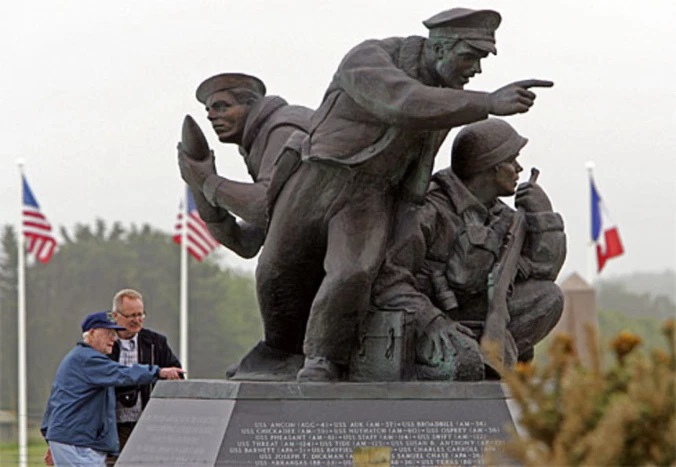
I first posted this essay on Veteran’s Day three years ago, and I re-posted it on the anniversary of D-Day two years ago. The crucial facts of the June 6, 1944 invasion of Normandy that it discusses are still never mentioned, or at least when I’m around to read or hear it, in any news media or historical features about the battle for Omaha Beach.
I don’t understand this, and the ongoing mystery sparks one more “duty to remember” crusade by your windmill-tilting host. So up the post goes again this June 6 and every D-Day anniversary henceforth, until readers start complaining, “Hey! Everybody knows about this!”
***
After all these many years of reading about and watching movies and TV shows about D-Day, June 6, 1944, I discovered how the US Navy saved the invasion and maybe the world after stumbling upon a 2009 documentary on the Smithsonian channel.
If you recall the way the story is told in “The Longest Day” and other accounts, US troops were pinned down by horrific fire from the German defenses on Omaha beach until Gen. Norman Cota (Robert Mitchum in the movie) rallied them to move forward, and by persistence his infantry troops ultimately broke through. Yet it was US destroyers off the Normandy shore that turned the tide of the battle at Omaha, an element that isn’t shown in “The Longest Day” (or “Saving Private Ryan”)at all.
Though it was not part of the plan, the captains of the Navy destroyers decided to come in to within 800 yards of the beach and use their big guns at (for them) point blank range to pound the German artillery, machine gun nests and sharpshooters. The barrage essentially wiped them out, allowing Cota’s troops to get up and over without being slaughtered. I’ve never seen that explained or depicted in any film, and according to the Smithsonian’s video, apparently it is a vital feature of the battle that had been inexplicably neglected. No monument to the US Navy commemorating its contributions on 6/6/44 was erected at Normandy until 2009.
Here’s the relevant part of account from the Naval History website on “Operation Neptune,” the Navy counterpart to Operation Overlord:
“..The success of the invasion seemed most dubious at Omaha Beach, where the American GIs remained pinned down, unable to move forward onto the bluffs from where German troops poured murderous fire. Successive waves of infantrymen attempting to come ashore only added to the chaotic situation. “What saved the day for the Allies was a handful of British and American destroyers,” as historian Craig Symonds asserts. Officially, the destroyers were only to screen the invasion fleet from U-boats and the smaller, faster E-boats. Yet, with the crisis on Omaha reaching a critical point, they were ordered to provide close-in fire support for the troops stuck on the beach. Rear Admiral Carleton F. Bryant, who commanded the naval gunfire support groups, radioed a message from his battle station onboard Texas to the nearby destroyers: “Get on them, men! Get on them! They are raising hell with the men on the beach, and we can’t have any more of that. We must stop it.”
…Under orders not to fire more than half the ammunition they carried in case it was needed for an emergency situation, the destroyer captains decided unanimously that chaotic Omaha Beach was such a situation. Beginning around 0800, destroyers such as Emmons (DD-457), Carmick (DD-493), McCook (DD-496), Doyle (DD-494), Baldwin (DD-624), Harding (DD-625), Frankford (DD-497), and Thompson (DD-627) began engaging German positions…. With smoke still obscuring the enemy guns, the gunners onboard the “tin cans” searched for “targets of opportunity.” Carmick arrived off Normandy with 1,500 shells for her 5-inch guns and in less than an hour, fired 1,127 of them. Her gun barrels, smoking red hot, had to be hosed down in order to keep them firing. Finally, at around noon, the destroyers established contact with spotters ashore.
Two of the U.S. destroyers, Satterlee (DD-626) and Thompson (DD-627), supported over 200 men of the Army’s 2nd Ranger Battalion scaling the cliffs at Pointe du Hoc. The Rangers’ mission involved destroying several heavy guns the enemy could use against the landing forces at both beaches. Joined later by Ellyson (DD-454), the three destroyers provided indirect fire on German positions atop the cliffs, enabling the Rangers to reach the top…
For over 90 minutes, U.S. destroyers pounded the enemy gun positions. Some of the ships were so close in to shore that they received German rifle and machine-gun bullets to their hulls and superstructures. …The Allies put nearly 132,500 men ashore on D-Day. After the beachheads were firmly established, the “primary naval responsibility [was] the landing of men and supplies…
The troops were in trouble on Omaha. Many tanks and artillery pieces, expected to give the infantrymen covering fire, had not made it to the U.S. beaches. The Neptune plan had to be changed. Destroyers were ordered to risk grounding by steaming close to shore and firing their 5-inch guns as supporting fire for the men on the beach. The Emmons and other fire-support destroyers sailed as close as 1,000 yards from the beaches. (Historian Samuel Eliot Morison puts the destroyers within 800 yards of Omaha Beach.) Another close-in destroyer, the Jeffers (DD-621), was shelling a German position when the shrapnel of a near-miss wounded five of her crew.
The Emmons lost contact with her shore-fire control party. Not knowing whether the men had been killed, wounded, or captured, her gunners shot at whatever looked like a good target. A spotter saw some German naval troops marching down Port en Bessin’s main street. She sprayed them with her 40-mm battery, sending them scattering. The Carmick (DD-493) aided tanks that made it ashore on Omaha. As the tanks were trying to fight their way toward an exit called the Vierville draw, Carmick spotters watched for bursts along the edge of the bluff and used these bursts as targets, figuring that whatever U.S. tanks were aiming at was worth shooting at from a U.S. ship.…
Navy gunners, aided by the highly classified top secret Bigot maps, knocked out eight gun emplacements covering Omaha Beach exits. Firing over the heads of troops, a destroyer silenced an 88-mm gun by putting two rounds through the gun shield.
The Harding (DD-625), Satterlee (DD-626), and McCook (DD-496), supported the Ranger assault on Pointe du Hoc, the 100-foot cliff believed to hide long-range German guns that could be aimed at landing craft approaching the Utah and Omaha beaches. As the craft carrying the Rangers neared the shore, the McCook raced ahead and, near the breaking surf, let loose on cannon atop the cliff. Witnesses said they saw an enemy gun fall to the beach. The guns the Rangers sought had been removed, but the strong-point was well defended; of the 250 Rangers who landed, only 90 could still bear arms when the battle for the bluff ended two days later. The Harding put a boat ashore to pick up wounded Rangers—and Germans who had surrendered after a salvo from the McCook.Shortly before noon, Colonel B. B. Talley on Omaha Beach sent a message to Major General Leonard T. Gerow, commander of V Corps on Omaha: “Troops moving up slope of Fox, Green, and Red Beaches. I join you in thanking God for our Navy.”
Well, my father (who was supposed to be an observer during the invasion but ended up in an army hospital instead) was an infantry guy, and never inclined to give credit to the Navy (and especially the Marines) without prompting, so I won’t blame myself for missing this part of the story in my World War II tutoring from Major Jack Marshall Sr. Still, I am astonished that the popular conception of the heroic Allied effort to take the beaches on D-Day have left out such an important aspect of the victory, and humbled that someone like me, who places such importance on the appreciation and knowledge of American history as a crucial aspect of life competence, could have been misinformed for so long.
***
Maybe this is why Ike reportedly walked out of the special screening of “The Longest Day” set up for him. Whatever the reason for the historical amnesia, I place it in the same category as Joshua Chamberlain’s heroics on Little Round Top that probably saved the Union at the Battle of Gettysburg (until the publishing of the brilliant historical novel “The Killer Angels,” that aspect of the battle was barely mentioned) or Custer’s neglected cavalry charge that may have been decisive in turning Picket’s Charge.
I’d like to see every American make sure the next generation is better educated on what really happened on this day in 1944. As King Arthur sings in “Camelot”…
Ask ev’ry person if he’s heard the story,
And tell it strong and clear if he has not…I promise to do my part.
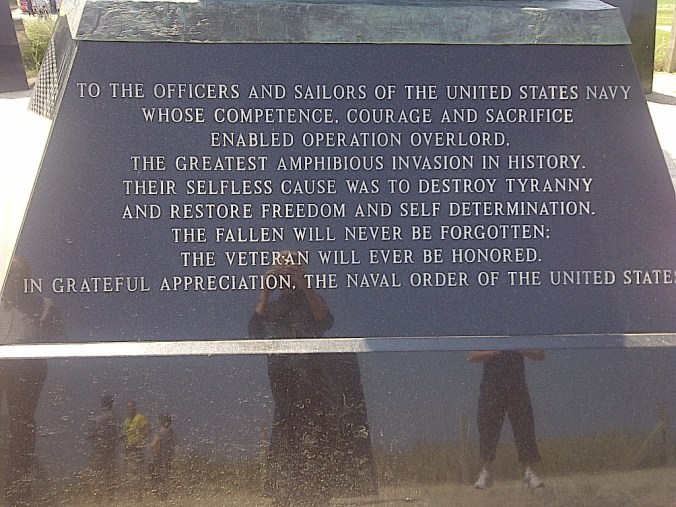
Here is the inscription on the Normandy memorial pictured above:
 Ethics Alarms
Agreed. But why would you post this every January 6th?
I have no idea what you could be talking about…
Jack,
Kind correction: The title makes it sound as though this refers to the capitol riot.
Yup. I just fixed it. This is what the Jan.6 media obsession has done to me.
Thanks for posting this again. It is a great reminder of what the US did to battle the worst tyranny in our history. Keep at it!
Share This: Done
Thank you for this, Jack. I find it fascinating.
I see no parallels to January 6, and hadn’t even noticed the typo until I saw it noted in a previous comment.
The brave young men who fought and died (and survived) at “bloody Omaha”—and so many other horrific battles of that war in both theaters of operation—deserve all the praise we, their inheritors, can muster. Alas much of that is lost on so many Americans, who are taught not to praise America where it’s so deserved.
That was a great reminder. It’s hard to believe that next year will be eighty years since that monumental day. The weather over the Channel was terrible in June of 1944, so much so that Gen. Eisenhower and his staff struggled with the decision to go. They only chose to step off after weather reports suggested a small window of opportunity to go, get those initial troops on land, and (hopefully) establish a beachhead.
Conditions on the sixth were such that aircraft had a very difficult time providing covering fire. Poor visibility and thick cloud meant close air support sorties were extremely difficult. In addition, any observation planes doing target spotting for naval artillery had a hard time locating targets. Without those, the men coming ashore faced deadly exposure. The work of the destroyers was indeed critical. And given their size (roughly two thousand tons and possessing a shallower draft), they were probably the only ship with serious firepower that could get that close without running aground. I’ve read numerous accounts of Overlord over the years, but I recall very little being, if anything, written about their work. In fact, I probably first read anything approaching a detailed account of this part of the invasion on this site when you first posted it. I’m glad you did then…and that you did again today.
One other note:
It’s hard to believe, given the size of the American presence in Overlord, that just ten days later, another massive US invasion took place in the Pacific – the invasion of Saipan.
Jack,
My apologies, but I tried to post a response here and I think WordPress captured it. Actually, I tried twice. If you are able to free one of them, that would be awesome!
Thanks so much in advance.
It’s up. Sorry I was away for so long.
Would love to have the option of posting a photo comment. Went to the beaches, yet again (been many times and always took guests who visited when we lived in France). I remain impressed by the outpouring of positive feelings from the residents of Normandy. Although generations change, the memories are kept alive in the families. That is, no doubt, why the headstones at the American Cemetery have American and French flags planted by volunteers from the region. On one excursion, 13 years ago, Maureen and I encountered the Mad Piper, Bill Millen (watch The Longest Day or just Google him) about a year before he died. He was being honored at the American Cemetery even though he was a Canadian who was the personal piper to the Scottish Lord Lovett. “Pipe is ashore, Billy,” said Lord Lovett. “Can’t sir, it’s against regulations.” “Those are British regulations; we’re Scots. Pipe is ashore.” Don’t know if that story is true, but the scene of the “Mad Piper” piping Lord Lovett across Pegasus Bridge under German fire is. The museum at the American Cemetery is wonderful. The Canadian and British cemeteries are moving in different ways, as they were allowed one-liners on the headstones of their loved ones. The nearby very somber (by design) German cemetery is moving in its own way, dedicated to the mothers of young German soldiers, sometimes several of whom (soldiers, not mothers) buried under a single ground-level marker. Go to Arromanche and its marvelous — if a bit quirky — museum of the building of the artificial harbor that made continuation of the progress into France possible, with a working model of the harbor built by the Scottish engineering company that designed the real one. Visit the 360degree museum above Arromanche, with modern pastoral film juxtaposed on film of tanks going through orchards. Once when we visited that museum there was a German grandfather with his grandchildren, saying “I was right there.” Pointe de Hoc is a must-visit, as is Ste Mere Eglise (a little touristy but still quaint, and the Paratrooper museum is there.). Quaff a cidre with lunch. Top off your dinner with Calvados. Enjoy the many cheeses. All products of Normandy. Finally, a true story from the 50th anniversary in 1994. As returning GIs got off the planes in Cherbourg, they were greeted by a local farmer whom they took to be part of the welcome committee. He asked each GI if they had all their arrangements made. Each said yes, until one former sergeant said that he had decided at the last minute and had not made arrangements for hotel. The farmer said “Then you will stay at my home. I have been waiting 50 years to thank you.” I love revisiting the history of Operation Overlord, meeting the people of Normandy, learning the rich history of the region (visit the Bayeux Tapistry, a 100-yard stitched graphic novel of William the Conqueror, made shortly after he became king of England and remained Duke of Normandy). Then return home with a deeper appreciation of what it took for Operation Overlord to succeed, and fully steeped in history, beauty, and Calvados.
1. Comment of the day.
2. Send me the photo on facebook (or to jamproethics@verizon.net) and I’ll post it.
Sent via Messenger. Please correct my typos!
I’ve been to the American cemetery and I don’t think I can go again. It’s too much to handle.
I haven’t made it yet, although I’ve been to France at least 3 times, but definitely one of these days.
“The farmer said ‘Then you will stay at my home. I have been waiting 50 years to thank you.’ ”
Great, now I’m starting off the day teary eyed.
Jack, what a wonderful post. My father and grandfather served in the Navy and I wish I knew more of their stories.
When I was growing up (born 1950) every adult male family member had served in the military and that gave them and us a perspective that we lack today. Service is an essential part of every well lived life. May our children and grandchildren give back to our beloved country.
As I drove around yesterday, June 6, I heard not one mention of this momentous anniversary. I posted my annual reminder on Facebook. It got no notice. While 79 years is a long time, it is not enough time to forget, yet that is what is happening, It, of course, saddens me but our culture will not allow remembrance because our attention spans are measured in moments rather than eras.