D-Day was always a big deal in the Marshall household back in Arlington, Massachusetts. My war hero father always reminded me that he was supposed to be an observer during the invasion, watching and noting what was happening while not carrying a weapon. Hand grenade shrapnel mangled his foot shortly before they hit the beaches, so Dad ended up in an army hospital, getting out just in time to cram his reconstructed foot into a boots and fight in the Battle of the Bulge. He told me that I probably owed my existence to the fact that he wasn’t part of D-Day.
I first posted this essay on Veteran’s Day several years ago, and I re-posted it on the anniversary of D-Day in 2021. In 2024, I promised to re-post the essay every June 6th, and then being the disorganized, ADD jerk that regular readers here know I am, I whiffed the very next year.
This is a remarkable story, and I do not understand why it is so seldom told that I never learned about it until 2009 (which, ironically, is when my father died). Of course, based on the historical literacy I have been seeing in the past three generations, a depressing number of American citizens don’t know what D-Day was—you know, our big victory after the Germans bombed Pearl Harbor while Woodrow Wilson was President.
***
After all these many years of reading about and watching movies and TV shows about D-Day, June 6, 1944, I discovered how the US Navy saved the invasion and maybe the world after stumbling upon a 2009 documentary on the Smithsonian channel.
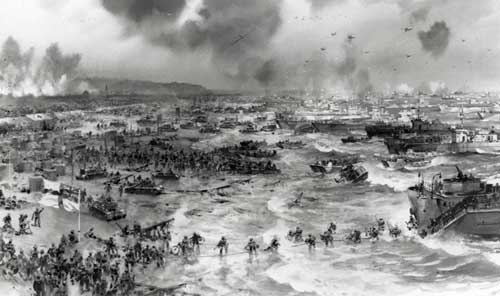
If you recall the way the story is told in “The Longest Day” and other accounts, US troops were pinned down by horrific fire from the German defenses on Omaha beach until Gen. Norman Cota (Robert Mitchum in the movie) rallied them to move forward, and by persistence his infantry troops ultimately broke through. Yet it was US destroyers off the Normandy shore that turned the tide of the battle at Omaha, an element that isn’t shown in “The Longest Day” (or “Saving Private Ryan”) at all.
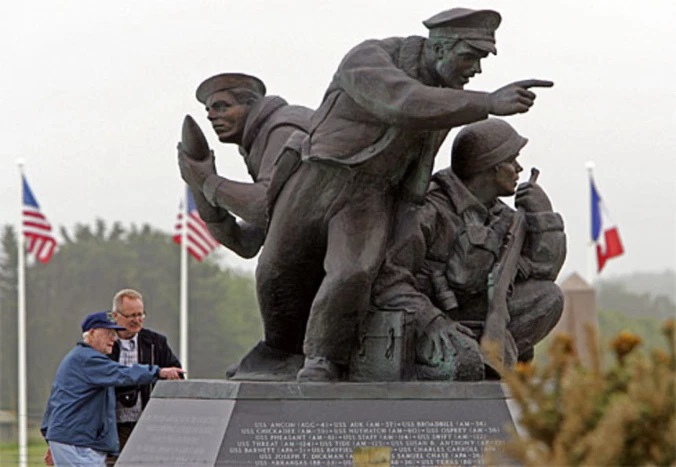
Though it was not part of the plan, the captains of the Navy destroyers decided to come in to within 800 yards of the beach and use their big guns at (for them) point blank range to pound the German artillery, machine gun nests and sharpshooters. The barrage essentially wiped them out, allowing Cota’s troops to get up and over without being slaughtered. I’ve never seen that explained or depicted in any film, and according to the Smithsonian’s video, apparently it is a vital feature of the battle that had been inexplicably neglected. No monument to the US Navy commemorating its contributions on 6/6/44 was erected at Normandy until 2009.
Here’s the relevant part of account from the Naval History website on “Operation Neptune,” the Navy counterpart to Operation Overlord: