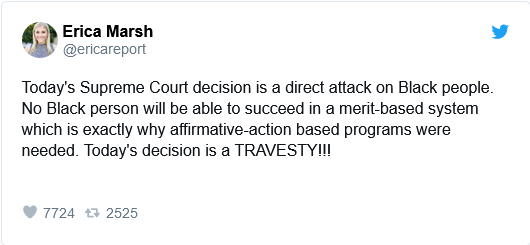
 The tweet above has “gone viral” with its seemingly approving statement of the underlying arguments being raised in protest of yesterday’s SCOTUS decision ending affirmative action in universities. Conservative pundits and wags are using it to mock the hypocrisy and racism of progressives, some apparently believing the tweet is sincere, others believing it is satire but treating is as genuine anyway. The low-IQ quadrant of Woke World like the tweet because its denizens can’t detect its glaring idiocy; the smarter segment is outraged at the tweet’s blood-drawing power, and reacting like this:
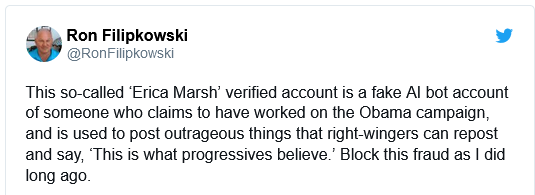 Before I pose today’s ethics quiz question, here are a few things to consider:
1. “Erica Marsh” is indeed a fake name, taken from the teen angst network drama “One Tree Hill.”
2. “Erica” has a fake profile…
 …or maybe she doesn’t. It is not hard to believe that someone with those “credits” would believe what was written in the viral tweet.
3. The statement that “No Black person will be able to succeed in a merit-based system which is exactly why affirmative-action based programs were needed” is essentially the same as the argument made in Justice Ketanji Brown Jackson’s dissent to Chief Justice Roberts’ majority opinion.
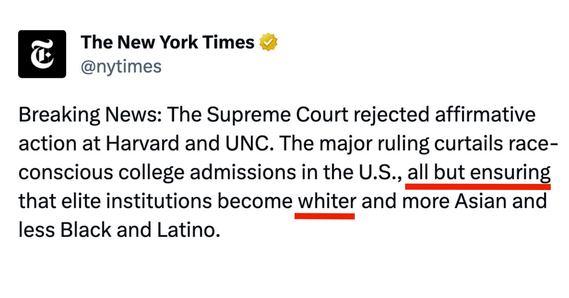
4. That’s the problem, isn’t it? Is this satire, or an unwitting indictment of a deluded progressive’s muddled perception? After all, the New York Times tweeted,
5. It is interesting that so many progressives want to block or bury “Erica’s” tweet. Are none of them capable of thinking, “Hey, wait a minute. Is that really what our position is? Maybe we need to think this through….”
6. The Ethics Alarms position is, and always has been, that ethical satire and parody must be obviously satire or parody. Attempting to fool people into thinking a fake story, opinion or social media post is real and sincere when it is not is unethical, even if it succeeds is exposing hypocrites and fools. Creating satire or parody that is inadvertently ambiguous is incompetence.
With all of that said,
Your Ethics Alarms Ethics Quiz of the Day is…
Is the Erica Marsh tweet ethical?
_______________________
Source: Sportskeeda
 Ethics Alarms
Jack,
With all due respect, I believe the argument is that Black Americans COULD succeed on a level-playing field, but that the system itself creates a disadvantage. In other words, affirmative action isn’t meant to tip the scales, only correct an already-present imbalance.
That is not my argument, only what someone in that position would argue back. Please don’t be mean.
How does one claim to even the scales that are theoretically tipped without tipping them in the other direction?
If the scale sits on a slanted surface, you move it to a flat one. The scales haven’t been tipped, just calibrated correctly.
I realize this is using an imprecise analogy to analyze a complex political issue, but as a principle …
Neil, why shouldn’t all ethnic groups be graded on a curve? Why is it only black people are entitled to special treatment? Why not the Irish, the Italians, the Jews, Catholics? I’ll give you the answer. All those groups sucked it up, dug in, and learned to compete and succeed. They didn’t ask for a larger strike zone or being placed on second base. They just played the game according to its rules. No whining. Stop bitching and get busy. If being successful requires you to act white, do it. When I went to a WASP college as a Catholic kid, did I say, “Hey! All you WASPs, I’m an Irish Catholic kid. Treat me differently. I want to be a partner at Goldman Sachs (nice historically Jewish outfit, by the way) but I don’t want to join a frat or play squash or tennis and get an MBA from Harvard. No sir, I want to be middle class but also want to make millions. Change the rules.”
But you know what, mediocrity has prevailed. It’s over.
Other Bill,
Who are you talking to? You address your comment to me but is unresponsive to anything I said. If you go back and read, I clearly stated the above isn’t my argument. In addition to addressing my comments directly to “Jack”, I also labeled it an example in my introduction, and disclaimed that it didn’t reference personal beliefs at the end.
In other words, you must have meant it for someone else. Perhaps examine your own need to argue and grow.
Just how slanted is the playing field? What exactly tips the scale one way or another? I am interested to know how the black community is disenfranchised by the greater community. Do we not provide the best teachers in low income or black communities? Are free libraries unavailable to the urban poor? Do the urban poor take maximum advantage of the afforded learning opportunities? Given that per pupil spending is higher in urban school systems I have to ask why are the results so abysmal? Are all these kids working to support their families and if so why is youth unemployment so high. I cannot believe that the only thing holding back blacks is an unwillingness to hire them because of their race. If higher ed wants to admit more blacks as they have been we cannot say blacks were discriminated in higher ed. So until someone can explain to me after 5 decades of Head Start programs availability some children are
unprepared to enter school and their caregivers unable to provide adequate pre-k learning.
Let’s just move this from an ethical discussion of slanted playing fields to a practical one of actual results. We have no indications that affirmative action programs are appreciably addressing the issue of racial imbalance with respect to income, criminality, education (e.g., test scores and accurate performance measures), and a host of other indicators, at least according to two SCOTUS justices (and many others). Given that racial discrimination is unconstitutional and illegal, it seems that the exception granted to affirmative action programs is unwarranted, and therefore should be removed, in favor of some other type of remedial effort. In other words, even accepting that the playing field is slanted, this particular form of assistance doesn’t level the field, and is illegal, to boot. So why continue to support it?
Please explain how the system creates disadvantage for black Americans? Has any black American been prevented from applying for a scholarship, had to go to school that was intentionally starved for funds (or was even starved for funds) by the government, been prevented from applying for an educational program meant to boost their preparation or credentials? That would be the system stacked against them.
Now, I experienced all three. No black American has ever experienced systemic racism in decades,I have, though. The number of scholarships not open to white Americans is staggering. At my university, no scholarships administered by the state school were open to white males. Project SEED and many other such taxpayer-funded undergraduate research programs are not available to white students. My university wouldn’t even let me apply for federal student loans because I was a white male. The high schools I went to were funded at about $6000/year. Detroit public schools, at the time. were funded to over $10,000/student. That is systemic racism.
Your points are all talking points that are lies.
Why do I think black students aren’t succeeding? The biggest reason is the black family has been destroyed. You can see schools that eliminated advanced math classes for all students to ‘level the playing field’ (as you put it) and the math disparity remained. White and Asian parents got extra math instruction for their children, black parents didn’t. Research is starting to show the vast importance of a father in the life of a child. There were a few studies that showed the vast increase in childhood preganancies and incarceration of children raised by single mothers. The data hid the fact that the rates were roughly the same for dual parent homes and children raised by single fathers by combining the two categories. The second reason is that people keep indoctrinating black students by telling them they can’t succeed because the system is stacked against them. It is actually the opposite. The system is stacked FOR them, but they have to at least put in some effort.
I will vote unethical.
There are various degrees by which satire can be identified, such as blatantly labelling itself as satire, or making its presentation sufficiently outrageous that most reasonable people would identify it as satire. The next notch down would be satire that some can identify as satire, but only because they are well-versed in the cues the satire uses. Then there is satire which is unintentionally obscure enough that most people won’t recognize it as satire. Fifth would be satire that is deliberately obscure and presented with the intent that many will mistake it as real. Finally, there are the outrageous statements that the author actually means, but when challenged will retreat into saying it is satire. (I can only make it to 6, Jack. I’m not sure how you make it to 10 on your scales!)
I would say that satire in the first two categories are ethical satire. The third category flirts with unethical because something proposed as satire should not be promulgate for board consumption when the audience that understands the satire is very limited. The fourth, fifth, and sixth categories are obviously unethical, the former because it is incompetent, the latter two because they are malicious.
This tweet I’d place in the third category, under the assumption this Erica Marsh is really a conservative mocking the liberal viewpoint. I think the words “merit-based system” are a tell identifying this as satire, but it isn’t clear, and I could be seeing a tell where one doesn’t exist. But it seems to me that genuine progressives wouldn’t call grades-based and test-scores-based admissions a “merit-based system”, because calling it such would legitimize the system, and it can’t be legitimate because it is obviously racist and created to keep the black man down, no matter what his merits really are.
However, I think there are arguments that this is a fifth category satire. In which case, this Erica Marsh could be a liberal trolling Republicans, mocking them by watching them “pounce” on the obviously stupid statement that liberals don’t believe.
But third or fifth category, I think it is fairly accurate to say that since there are liberals clowning themselves over the statement and conservatives pouncing on the statement, it is really unclear who is the butt of the joke. Perhaps it is both sides. And that makes my point, I think, that there are not enough people understanding this joke for it to be a proper use of satire.
I suppose I can think of seventh category of satire, and that is clairvoyance trying to disguise itself as satire, in which I’d place the Babylon Bee. Either the Bee is gaining its ideas from the future, or publishing its satire is giving liberals ideas. Either way, that seems very problematic.
The problem I have with simply dismissing satire which is not so outrageous as to be obvious as unethical is simply that we’ve reached a point in our society where the outrageous IS reality. You can’t turn up the volume to create satire, because the dial is already pegged. Which is also the point when satire is most needed, to help people wake up to their own outrageous behavior and beliefs.
1. Satire that labels itself as satire by appearing on a satire site or announced satire account.
2. Satire that is labeled by the author or speaker as satire.
3. Satire presented by a known figure who is known to engage in satire or parody.
4. Satire that is obvious to all because of its content.
5. Satire sufficiently deft that sophisticated people would identify it as satire, but that others would miss.
6. Incompetent satire that most people won’t recognize as satire.
7. Satire that is deliberately obscure and presented with the intent that many will mistake it as real, making them look foolish.
8. Trolling, in which the “satirist” is seeking to derail a legitimate discussion or debate.
9. Satire that isn’t satire at all, but a false flag designed to harm individuals associated with what is written.
10. Outrageous statements that the author means, but when challenged retreats into saying it is just a joke.
Let’s test the scale: where would you put Roseanne Barr’s recent podcast comment: “Nobody died in the Holocaust. That’s the truth. It should happen – 6 million Jews should die right now because they cause all the problems in the world'”
Barr is Jewish and a comedian.
> 4. Satire that is obvious to all because of its content.
In a sane world the Marsh tweet would fall in this category. If the world is insane, is it the fault of the satirist?
It doesn’t seem to be a fake account. It’s just a horribly written tweet.
Her subsequent argument that “there existed a supposedly merit-based system for Black individuals to gain admission to colleges. However, these institutions employed racial profiling to prevent Black individuals from attending under the guise of this ‘merit’ system” is at least a coherent argument, whether or not one agrees with it.
But this “clarification” helps but little, as she doesn’t take responsibility for what she really did say, explicitly, claiming her statement was “being manipulated for propaganda and misinformation by ULTRA MAGA.” No. She really did say what she said. She may not have meant it, but that’s a different matter.
She’s now being accused of racism, of committing a Freudian slip and accidentally saying what she really thinks, etc. This is probably unfair. All of us say stupid things sometimes–maybe not “No Black person will be able to succeed in a merit-based system” or “Jewish space laser” stupid, but stupid. She’s not the brightest light in the marquee, but this seems more of rhetorical stumble than anything else.
But she has 131,1K followers; I have 14 (not 14K, 14), so what do I know?
Curmie:
How does one argue that colleges used merit as a way to keep blacks out without saying blacks are unable to compete? More to the point, that argument fails because Harvard and others wanted AA upheld as Constitutional. Why does Harvard need AA if it wants to recruit more black students? The ruling allows schools to create decision criteria is experiential which are race neutral. How hard can that be? A student from the hood has a high GPA and a high SAT or MCAT score that could be anyone white, black or Asian. The evaluation factor is being from a low income environment and overcoming the disadvantage. Assign a higher value to the obstacles overcome. Maybe even assign negative values to kids coming from high cost private prep schools.
When I worked at a community college the funding we received was bumped up by our minority enrollment. Perhaps that is the reason colleges want to keep blacks believing they need AA to succeed. It also keeps the institutional racism trope alive.
Auto correct issue should be Curmie not Currie
For what it’s worth, I agree with most of what you say. I’m not arguing that she has a strong case, only that it’s a coherent argument if we grant the underlying premise. I’m nor ready to do that, at least as a sweeping generalization. It is unquestionably true that black students were denied access for decades, but this particular group of students were not, and most of arguments are indeed founded on finances rather than race–it’s easier to do well on the SAT if you can afford the study guides and prep sessions, for example.
I do think that the presence of black students in the classroom is often valuable for its own sake–in my field, that might manifest, for example, in the form of a discussion of a play in which race is an issue. First-hand experience is going to be better than imagining what it must be like. But such considerations wouldn’t apply in a lot of disciplines.
More importantly, what’s good policy in my opinion and what is constitutional are not in strict accord. I recognize that and have no serious problems with the SCOTUS decision.
Curmie:
As a white kid that attended a predominantly black junior high and a high school in Baltimore City from 1968-74 and also having been and administrator of a post-secondary education program at a Maryland Correctional Center. I reject the idea that Blacks have been excluded from equal educational opportunities. Behaviors were the limiting factors of black students then and now. Parental involvement appeared to be limited of non-existent for most. When you come to school believing that education is a “white man’s” thing you don’t apply yourself and the results speak for themselves. I have taught plenty of Blacks in a prison environment and they could rise up academically when the applied themselves. If we want to look for answers for why black students don’t achieve then we need to look for what they are learning outside the classroom.
“. . .most of arguments are indeed founded on finances rather than race–it’s easier to do well on the SAT if you can afford the study guides and prep sessions, for example.”
I have heard this argument before to prove or suggest that racial bias exists. How do we explain the fact that Asian students may have had to overcome language barriers or in the case of Asians from Viet Nam , Thailand, and Cambodia are able to outperform black students on these entrance tests. I would venture a guess that the son or daughter of a Texas shrimper is not coming from a prep school.
Finances may be an issue, but that issue affects most students – black, white, Asian or Martian. If we use the relative distribution of income as a criterion and you want to create a more diverse student body without using race, then simply assign a negative value to those applying from private schools. We know that will not happen so the diversity argument falls flat on its face.
I think diversity is an inherent good. That doesn’t mean it ought to be absolute. The absolute minimum requirement ought to be not merely the ability to do the work, but to do so without slowing other students down. After that, things get a little muddier, but it’s still clear that an excellent student is better than a merely adequate one.
Bringing different skills and attitudes to the university is a good thing. I want students who can argue with me, who can inject different perspectives into the conversation. I’m not saying race is the only way to do that, but in certain circumstances it is. For years, I taught Anna Deveare Smith’s Fires in the Mirror in my Advanced Play Analysis class. It’s her one-woman show (she plays a couple dozen different characters) about the 1991 riots in Crown Heights, Brooklyn, with conflict between black and Lubavitch Jewish residents. Unsurprisingly, the best classroom discussion came when there were both Jewish and black students in the room. That only happened once, alas.
I hear your points about attitude, parental interest, etc. I’ve seen them manifested not infrequently, and probably disproportionately, by black students. Of course, I’ve also seen many examples of the opposite: hard-working kids from great families. Generalizations are what they are: often, but not always, true; often, but not always, useful.
Using race as a key factor in decision-making is a problem. Using it as a secondary factor is, I think, valuable. That is, let’s assume there’s an “objective” point system to rank candidates. Obviously, it’s not really objective, because assigning weights to different elements is clearly subjective, but go with me here.
There are a bunch of students who score in the 90s; they’re in, irrespective of race. Let’s say there’s one spot left. X is black and Y is white. X scores 65, Y scores 80. Easy call: take Y. But if X scores 79, I want to be able to have a conversation. The problem is that there’s no way to prevent a school from choosing X in the former instance without precluding that conversation in the latter. That’s why I think SCOTUS got it right, despite some misgivings.
Erica Marsh is either a racist idiot or she posted one horribly-written tweet. The rest of her stuff is clearly partisan, but no more so than the majority of what I read on this page, just in the other direction. I’m willing to give her the benefit of the doubt. Once.
If real and sincere how could honest expression like this be unethical? Wouldn’t it be ethical to announce yourself as a racist?
If satire, then the tweeter is only pouring gasoline on an open flame… Unethical.
Agreed
Jack asked:
Is the Erica Marsh tweet ethical?
I don’t know how to judge it. I am unsure of the facts — is it a fake account by a true Leftist, or a right-wing “false flag” operation? Or is it neither of those things, a satirical comment intended to demonstrate the stark racism of the essential argument in Justice Jackson’s dissent?
I can’t say. So let’s take them by turns, and judge the possibilities:
1. Fake account by a true Leftist — Judgment: Unethical. Reasoning: even though speaking anonymously is a time-honored and respected tradition, doing so requires more than a vapid controversial comment with grade-school level analysis. Even though it tracks closely with the uber-argument made by Justice KB Jackson, it’s little more than a platitude suited more for a bumper-sticker than actual communications.
2. False-flag operation by a right-wing troll — Judgement: Unethical. No analysis necessary.
3. Satirical commentary — Judgment: Unethical. Reasoning: As Jack points out, satire must not be so opaque as to be difficult to discern as satire. While the fifth-grade level of the sweeping (…”No Black person …) simplistic statement certainly augers toward sarcasm, we see similar things all the time from people and organizations given great weight on the subject, again as Jack points out.
In sum, there is no position I can come up with where this tweet is ethical.
Point of clarification:
You say: “ The Ethics Alarms position is, and always has been, that ethical satire and parody must be obviously satire or parody. Attempting to fool people into thinking a fake story, opinion or social media post is real and sincere when it is not is unethical, even if it succeeds is exposing hypocrites and fools. Creating satire or parody that is inadvertently ambiguous is incompetence.”
However, Poe’s Law states that “without a clear indicator of the author’s intent, any parodic or sarcastic expression of extreme views can be mistaken by some readers for a sincere expression of those views.”
Is a clear indication required? It appears you think so.
But, if I take an extreme position, am I attempting to fool people. The fact that outrageously extreme positions are considered sincere is itself problematic, no?
Was Swift’s “A Modest Proposal” unethical? You might say it was obviously satire, but Poe’s Law would suggest that some might find it sincere.
Is there a conflict between Poe’s Law and “Marshall Law.”
-Jut
Was “A Modest Proposal” originally published with a satire/parody label?
OhWhatFunItIs:
I doubt it, which is what made it so brilliant.
It was outrageous, but, back in the day, it might have passed the smell test for some.
-Jut
fake or not, that tweet accurately captures what lefties/Dems think and why they want to continue using affirmative action indefinitely.
Speaking as a leftie Dem, no, it freaking doesn’t.
Yeah you do, you just didn’t realize it, or you convinced yourself it’s something else. If you believe that after 60 yrs affirmative action is still needed, and you cannot articulate CLEAR criteria for when it will no longer be needed, then you’re basically saying it’s needed perpetually because those benefiting from it will always need it. Alternatively, you just know it’s good politically. It’s that simple really.
If you paid any attention, you’d see that I said in an earlier comment that I pretty much agreed with the SCOTUS ruling. Saying there are still advantages to Affirmative Action is not the same as saying it’s a net positive. Not everyone is an absolutist on every issue just because you are.
I practiced a version of affirmative action in every hiring decision I ever participated in, including the casting of shows. Got in a massive battle over it once, with a community theater group that objecting to me casting a black woman to play a judge in a play where the part was written as a white male. Hiring positions in almost entirely make, white organizations almost compelled an affirmative action approach, in my view.
I also got burned. Over and over again.
By “practiced a version of affirmative action” I mean that if all else was equal, in my view, I’d give the minority applicant the edge.
And by “burned” I mean “sued.”