
Well, there goes my head again, and I really need it this weekend.
Hold on to yours: this really and truly is one of the “Pride” packages for Mars Inc.’s Skittles:
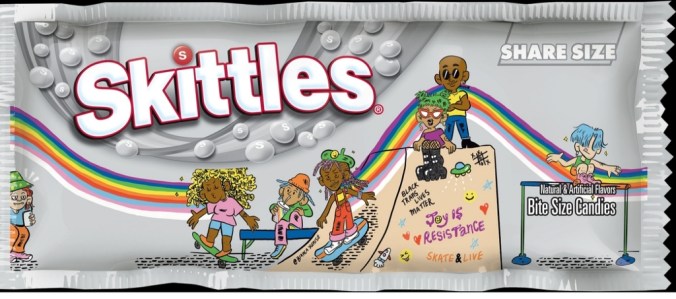
I don’t understand how this could happen in a major corpoation. In a pluralistic society, it is unethical for products and services to deliberately polarize the public, politically, socially, in any way whatsoever. True, the temptation for rainbow-colored Skittles to try to exploit the LGTBQ propaganda for marketing purposes must have been strong for some marketing execs with the cranial depth of a walnut shell, but the fact that sane parents don’t want their kids proselytized by their candy shouldn’t be that hard to grasp.
If the type is too small for you to read, the legends somewhere under the rainbow include “Joy is Resistance” and “Black Trans Lives Matter,” both of which are semi-incoherent, but the intent is clear. (Is the character with the sunglasses supposed to be in drag? What does “skate & live” mean? Is skating on the rainbow a metaphor for embracing an LGBTQ identity?)This is the equivalent of forced political speech, and the force is being applied to children. Holding that package sends an unintended message, weird as it is, and once that political message is associated with the brand, eating Skittles at all becomes a political act.
Again, I detest organized boycotts, because the device is inherently coercive and as easily used for wrongful purposes as good ones. But I’m not at all sad to see Budweiser suffer because of its epically stupid, arrogant decision to turn Bud Light into a flag for pro-transmania fanatics to wave. The boycott of Bud Light cost the company the equivalent of $18 billion in stock valuation, and knocked it off its perch as the #1 beer in the U.S.. Anheuser-Busch has announced that it has begun layoffs, so far firing 2% of its U.S. workforce, primarily in corporate and marketing roles. True, the idiotic Bud Light partnership with a trans performance artist was a calculated affront to its core market, but trying to make innocent children agents of sexual politics is arguably worse.
I really don’t understand how corporate marketers can be so incompetent as to give a higher priority to woke virtue-signaling than responsible and effective marketing. Whatever the reason, they need to be taught a lesson that they should have absorbed in business school.
 Ethics Alarms
“I really don’t understand how corporate marketers can be so incompetent as to give a higher priority to woke virtue-signaling than responsible and effective marketing. Whatever the reason, they need to be taught a lesson that they should have absorbed in business school.”
The people running marketing in companies are all products of woke undergraduate and graduate programs. They truly believe woke virtue-signaling is responsible and effective marketing. These people and their campaigns are not outliers. They are the norm. These people are running companies. They’re all the best and the brightest, to use a ‘sixties term. And they’re not just spear chuckers, they are senior management.
Maybe you should bring out a line of “Bite Me Size” candies.
Morons, then. Coming to that conclusion in opposition to basic marketing theory, common sense, cognitive dissonance, and demographics is beyond incompetent.
A good description for the kids being pumped out of schools these days, and the ones during the last thirty years or so: “beyond incompetent.” They have been gripped by an essentially religious fervor and believe all sorts of irrational things.
Agree.
“…that they should have learned in business school.”
Here’s the problem, colleges and even lower schools have been teaching that concerns of profits are the effects of eeeeeevil capitalism and should be avoided. Instead, they are taught that corporations should have the responsibility of being instruments of social change. We are just starting to see where that leads. Brave New World, here we come.
Get a load of this: Six “not-male” students, half of whom are “of color” reported their conversation with a Hamilton College alumnus who is currently the president of Goldman Sachs to the alleged adults at Hamilton College for his having expressed various opinions to them.
https://news.yahoo.com/finance/news/students-david-solomons-alma-mater-183104748.html
What kind of idiots do these sorts of things and think like that, you ask? But THESE are the very sorts of people who are working in corporations these days. And they want to work four days a week and get a corner office immediately.
What student at a place like Hamilton (a contemporary of mine was a senior manager at GS) would blow the opportunity to have face time with a fellow “Continental” who’s the head of Goldman Sachs and not only act like a jerk but actually “call the guy out” to the administration? If I didn’t know better, I would assume the president of the college would call them in on the carpet and have them apologize to David Soloman and revoke their scholarships before Soloman wisely revoked all his gifts to the college and told his fellows at GS to do the same damned thing. But the president is a confirmed, standard issue, virtue signaling, weenie lefty. He’ll doubtless give these spoiled brats a cash prize.
“ unethical for products and services to deliberately polarize the public, politically, socially, in any way whatsoever. ”
This is an unfair characterization. What they’re really doing is expressing their opinion and showing support of a political and controversial topic they think is important.
People had this same argument during the protests and political upheaval during the 60s. “Oh they shouldn’t be so disruptive and polarizing, they shouldn’t voice their controversial opinions at all”
Polarization happens in a country with free speech where people disagree on important topics, and a company has every right to voice their opinion on a topic they think is important to do so. Even super controversial ones.
It’s not your job to police what companies get to say or promote just because you don’t like the message.
Aren’t you a free speech advocate?
– Kate
“This is an unfair characterization. What they’re really doing is expressing their opinion and showing support of a political and controversial topic they think is important.”
Simply describing unethical conduct while ignoring its effect doesn’t make the description fairer or or more accurate. Manufacturers of a product aren’t in business to express opinions: their function is to supply products to the entire population. If Mars wants to support political views and opinions, there is an avenue for that making contributions. Doing so does not tarnish the product itself.
“People had this same argument during the protests and political upheaval during the 60s. “Oh they shouldn’t be so disruptive and polarizing, they shouldn’t voice their controversial opinions at all”
1) So what? 2) Companies, products and services, in the vast majority of cases, stayed neutral. The most political they got was making positive statements about America, which shouldn’t be regarded as political or divisive at all.
“Polarization happens in a country with free speech where people disagree on important topics, and a company has every right to voice their opinion on a topic they think is important to do so. Even super controversial ones.”
The topic is ethics, not rights. People and company have a right to do all sorts of unethical, harmful things. Saying conduct is harmful does not mean that thee should be a law against it. Using children as political props and dragging them into political controversies they don’t understand is rotten, but legal.
“It’s not your job to police what companies get to say or promote just because you don’t like the message.”
Actually, pointing out when companies are unethical and explaining what they should and shouldn’t do IS my job, and companies pay me to do it.
Aren’t you a free speech advocate?
Irrelevant to the post.
“Manufacturers of a product aren’t in business to express opinions”
I don’t agree with that, hundreds of companies who partake in expressing opinions don’t agree with that, and you don’t have a right to say how a company uses their free speech just because you disagree with it.
It’s not unethical or harmful just because you don’t like what they have to say. There are many people who feel it’s important and ethical to support this cause.
You and anyone else has a right to not buy Skittles anymore if you wish.
– Kate
“I don’t agree with that, hundreds of companies who partake in expressing opinions don’t agree with that, and you don’t have a right to say how a company uses their free speech just because you disagree with it.”
You do realize how self-contradictory this statement is, right? I hope? My job is ethics. I make such judgments because that’s what I do. A company that attached political and partisan positions to its business is using their product or service as a tool of division, just as a bar is that announces that it won’t serve Democrats or MAGA conservatives.
I let your comment out of moderation because I was betting that you understood what we discuss here. This comment is not encouraging.
Anyone want to start a pool on Kate?
O ye of little faith.
-Jut
“Anyone want to start a pool on Kate?”
Heh!
“A company that attached political and partisan positions to its business is using their product or service as a tool of division, just as a bar is that announces that it won’t serve Democrats or MAGA conservatives.”
You say divisive, me and thousands of others say it’s unifying. It’s also important and ethical to speak up for things you believe would make the world a better place.
Any political or divisive upheaval is the price we pay for people fighting for what they think is right and using their free speech to do so.
Laying down, staying quiet, and shutting up on an important issue just because it’s divisive isn’t ethical.
I also dont find your argument convincing that companies don’t have a right or any business in voicing controversial political opinions.
It’s inherent in what makes America great.
– Kate
Kate,
I don’t think the point is that companies don’t have a right to say certain things.
I think the argument is that it is unethical for a company to take positions that hurt the brand.
When you take positions on controversial issues, you run the risk of suffering devastating losses.
Because it is the purpose of companies to sell things, if a message defeats that purpose, it is unethical.
You do understand that argument, right?
-Jut
Thank you for the normal response
“think the argument is that it is unethical for a company to take positions that hurt the brand…When you take positions on controversial issues, you run the risk of suffering devastating losses.”
Do you see all the companies who change their logos to rainbow-colored logos during Pride month? And other brands that support trans or gay rights?
The majority of consumers support these things and agree with what this company is supporting.
I’m sure Skittles believes this doesn’t hurt the brand, but elevates it. Which I agree with.
Sure, Budweiser was stupid not knowing that the majority of their consumers don’t support trans rights. I’ll agree with you there.
.
But Skittles isn’t consumed by white, blue-collar men who don’t support trans people like Budweiser.
I also think the backlash Budweiser faced was hateful and disgusting.
These companies aren’t infallible and maybe they don’t care what people who hate trans people think of the brand moving forward.
Maybe they want to draw a line in the sand and think sending a powerful, supportive message is more important than the bottom line.
-Kate
“ Do you see all the companies who change their logos to rainbow-colored logos during Pride month? And other brands that support trans or gay rights?”
How exactly do you know they support trans or gay rights?
How can you differentiate genuine support from pandering. It’s entirely possible that Bud Light did not care a bit about trans people, but thought it could be cutting edge and make money.
“ I also think the backlash Budweiser faced was hateful and disgusting.”
Why hateful? Cant someone support trans people and still find fault with Skittles for the reasons Jack said without being “hateful”?
-Jut
Bingo.
“ I also think the backlash Budweiser faced was hateful and disgusting.”
A tell. People who used and liked a product suddenly found it being a symbol for a position they did not choose to take. There’s nothing hateful about a former consumer saying, “To hell with that. So now I’m in favor of giving pre-teens hormone blockers by drinking Bud Light? How dare they?”
If Kate can’t comprehend that, she doesn’t understand the issue. It’s unfair to make consumers choose between a product they like, want or need and a political position. Unfair, and stupid.
Kate, read the rationalizations list. You’re making an “Everybody does it” argument. That’s not ethics. That’s what people who are ignorant of ethics THINK are ethics. Companies that provide products and services to the nation are not there to take sides against one part of the public, majority or minority, on behalf of the other. The function of commerce is not political. That is why doing what Disney, Bud Light, Best Buy and others have done is incompetent, but worse, divisive and harmful. Ethics Alarms immediately opposed the NFL kneeling fiasco, because people do not go to sporting events to be propagandized on political matters. This is why Disney has lost money this year on its movies and streaming services: the company’s mission was not to push partisan ideology. The pandering of so many companies to Black Lives Matter in the wake of the George Floyd Freakout was cynical and irresponsible, outside every company’s purpose and mission, and, as it turned out, aided and abetted both a financial scam and the undermining of public safety.
“The majority of consumers support these things and agree with what this company is supporting.”
Maybe they do, and maybe they don’t. It’s for sure that a percentage of their customers are turned off by this sort of thing, and marketing should, at least, be pretty damned certain that they’ll see a net benefit when they go down that path, or they should be answering to stockholders and senior management. It’s a gamble, and a risky one, to assume that this packaging ploy will create more net revenue. Will adherents of the BLM hustle buy enough (any?) extra Skittles to more than offset the almost certain loss of some customers? Even if they do, will it be a sustained effect? Will the other company brands suffer, maybe from a boycott?
There’s a difference between a bland ad campaign that just doesn’t perform as well as expected, and one that has the potential to drive the brand off the cliff (see Bud Lite). It’s unethical for the Alissa Heinerscheids of the world to gamble with other people’s money and livelihoods to stoke their own personal socio-political agendas.
John Kenneth Galbraith wrote extensively about how corporations would enhance their value and prestige by doing good in the public eye, supporting the community, charities, etc. It’s pure cognitive dissonance scale stuff. But taking sides in political controversies was not what he was talking about, and companies never did that. No customer should feel that by using a company’s product of services they were endorsing a point of view they didn’t agree with. Putting a consumer in that position is a breach of loyalty and trust.
You seem to have a very tenuous grasp of the concepts of “rights”, “obligations”, and what Jack has been saying about ethical behavior. Do better. (I have a right to say that.)
“Tenuous”
I do not think it means what you think it means.
-Kate
“…you don’t have a right to say…”
Corporations have a “right” to express (as law allows) whatever they wish. That is not disputed. Their primary obligation is to their stockholders (which can include a certain amount of secondary obligation to their employees), and any actions which endanger this should be avoided by competent management. Prominent engagement in controversial socio-political advocacy is a known landmine, and doing so creates considerable risk of damage for those to whom they have real obligations. That’s unethical.
As a skeptic and a reductionist, I look at this crass commercialism , jingoism, lame marketing, as another puerile attempt to convict Geo. Zimmerman for having offed Trayvon, inasmuch as Skittles is a candy for children, complete with a colorful logo, presumed innocent children . . ergo Trayvon was an innocent man, a sKittle boy, the story attended by a photo of 12 year old, and there but for fate, went Obama. (“If I had a son he’d look like Trayvon.”)
Marshall, stay the course. Connet the dots. Expose the hypocrisy. All this goes much deeper than ethics though. It goes to criminality.
How do you feel about the target shooting company that produced a design that depicted a hoodie holding an iced tea and a bag of Skittles?
Free speech? A ‘no shoot’ training aid? Supporting the constitutional right of armed self-defense?
Or bad taste, divisive, unethical?
I don’t care one lick about sexuality activism among adults. Contaminating products consumed by children with sexuality is simply bad taste and unethical. Take this Skittles bag to the extreme and you get a penis-shaped pacifier.
“How do you feel about the target shooting company that produced a design that depicted a hoodie holding an iced tea and a bag of Skittles?
Free speech? A ‘no shoot’ training aid? Supporting the constitutional right of armed self-defense?
Or bad taste, divisive, unethical?”
Free speech? Certainly. The next three, subjective. Divisive? By its nature, but possibly not by its reach. Will the LuluLemon crowd ever hear of it? Unethical? Maybe. Does the company have shareholders and employees who could be harmed financially if this is a gamble that goes south, or is it a small printshop run by a handful of like-minded guys with a good understanding of their customer base and mutually willing to take a flyer? Could be they got a good return on their Obama targets (if such existed).
Poe’s Law in overdrive here. I had to double check to make sure you hadn’t been taken in by some photoshopped internet meme, but it’s actually even worse: https://www.skittles.com/pride
Shouldn’t someone in the organization have, at the very least, realized by now that BLM is a thoroughly discredited racist scam, and adjusted for that?
BLM has been obliterated as the grift it is. Black TRANS Lives Matter, though, is very much alive and doing great work. It’s true. Really.
jvb
Of course! I completely forgot about the black community’s deep and historic acceptance and support of gay people. It’s only reasonable to expect that black approval of and involvement in the transsexual movement would be at least as solid. How foolish of me.
You owe me a new monitor!
jvb
I’m waiting now for the company to announce, in the spirit of equity and social justice, that they will put “Shoplifting Approved” stickers on all their products, and reimburse retailers for their losses. It’s only right!
It appears that Kate is an adherent of progressive thinking and dogma. While I have numerous disagreements with a progressive philosophy, I particularly find progressive’s lack of critical thinking and blatant double standards repugnant. For example, Kate says in this string:
“I don’t agree with that, hundreds of companies who partake in expressing opinions don’t agree with that, and you don’t have a right to say how a company uses their free speech just because you disagree with it.”
So according to Kate, the company has a right to free speech, but Jack doesn’t have the same right to free speech?
“I also don’t find your argument convincing that companies don’t have a right or any business in voicing controversial political opinions.”
I reread the post and follow-on comments between Jack and Kate. I didn’t see anywhere that Jack said companies don’t have a right to express their opinion about anything. Alleging facts that don’t exist is unethical and a common tactic of progressives.
“The majority of consumers support these things and agree with what this company is supporting.”
Again, alleging facts that don’t exist is unethical and a common tactic of progressives. I will stand corrected if two or more objective studies can be cited to support this claim.
“It’s not unethical or harmful just because you don’t like what they have to say. There are many people who feel it’s important and ethical to support this cause.” “Laying down, staying quiet, and shutting up on an important issue just because it’s divisive isn’t ethical.” “I also think the backlash Budweiser faced was hateful and disgusting.”
Kate is entitled to her opinion just as the consumers of Budweiser were expressing their opinion. They weren’t laying down or staying quiet. Just as Jack and other commentators are expressing their opinions. The tone of Kate’s comments implies that those who agree with her are noble and those that don’t are hateful, disgusting, and unethical. Since everyone is just exercising their free speech rights on divisive topics, aren’t both sides noble? How can only one side be bad?
While companies are legal entities, they have no opinions about anything. The owners of companies hire managers, and workers to generate a return on their investment and conduct business in a legal manner. The actions of managers and workers are obligated to do that and only that. They can take a stand on issues if and only if that stand can increase the owner’s return on investment or if they are following the expressed legal wishes of the owners. Anything the managers or workers consciously do that diminishes return or the brand’s image in the marketplace is irresponsible.
The United States is divided roughly 50/50 on many social issues. I base this supposition on the makeup of the House and Senate. No party has held significant majorities in the recent past. Objectively speaking, a company that takes a position on a controversial topic runs the risk of alienating 50% of its potential market. I suggest that companies taking a stand on controversial issues is irresponsible in today’s environment regardless of which side of the issue they stand.
You get a rare Super Bingo for that.
Excellent comment.
I wonder if the country is evenly split, though. There are only two real choices (on most states): either R or D. I might agree with the Ds, say in taxes, but not on immigration or defense spending, and I might agree with Rs on, say abortion but not on foreign policy issues. My choices in Texas are John Cornin, Ted Cruz, Sheila Jackson Lee and O’Roarke. Not great fans of any of them so I have to choose the ones I dislike less. Most of the country is center right in most issues. Bug cities control the politics of the states.
jvb
“Bug cities control the politics of the states.” The hive mind at its worst 😉
Well, AI at its best.
Outstanding thoughts, Tom. In the case of those behind the Bud Light debacle, they achieved the rare distinction of alienating both sides of a controversial issue. That takes (a) serious (lack of) marketing talent.
Joel thanks for the compliment. You may be correct that the Bud Light could have been caused by a lack of one or more individuals marketing ineptitude. Alternatively, and far more ominous, it could demonstrate the power of indoctrination cognitive bias. In all probability, it was both.
Super Thank You.