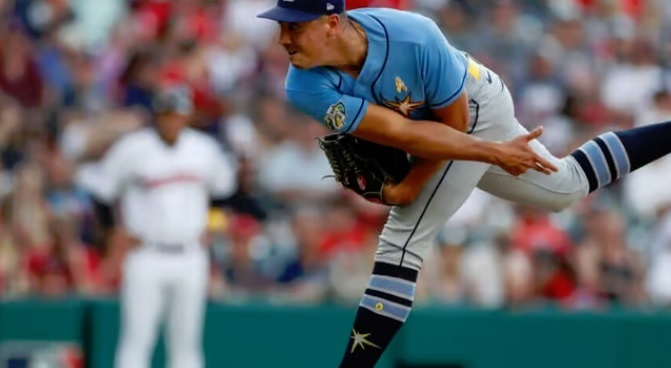
Yes, this perplexing ethics issue arises in baseball, but the principles it involves are applicable in other contexts. Attention should be paid.
Although there is no official definition, an immaculate inning in baseball occurs in baseball when a pitcher strikes out all three batters he faces in one inning throwing only nine pitches. This has only happened 114 times in Major League history, and been done by just 104 pitchers. The first immaculate inning was thrown by John Clarkson of the Boston Beaneaters against the Philadelphia Quakers on June 4, 1889. No-hitters, which automatically get a pitcher’s name in the Major League Baseball Hall of Fame in Cooperstown, are three times more common that immaculate innings. Throwing an immaculate inning is a career landmark for any pitcher.
A week ago, Tampa Bay Rays reliever Robert Stephenson threw nine pitches to three Cleveland Indi—I’m sorry, Guardians batters and struck them all out on three pitches each. But whether or not this constituted an immaculate inning is still being debated. Within the controversy is a welter of ethics lessons and problems.
You see, he performed this feat in the 10th inning, and because baseball has persisted in keeping the stupid “zombie runner” rule originally instituted to keep games from running too long during the pandemic lockdown in 2020 (Wuhan mania ruined everything it touched), Stephenson began the inning with a runner already on second base. This raises a definitional and technical question: Can any inning be justly called “immaculate” when a runner reaches base? True, that runner isn’t the fault of the pitcher; in fact, if and when such runners score, they aren’t held against the pitcher’s earned run average, nor are those runs considered un-earned runs. The stupid rule holds that the runner is real and his run counts even though no pitcher “faced” him.
The ethics lesson here is the danger of making changes in rules and laws without thinking through the possible consequences of those alterations that are neither intentional nor desirable. The “zombie runner,” unlike the rest of baseball’s meticulously evolved rules, is arbitrary and ugly, a classic example of an unethical “ends justify the means” mentality.
There is more. Because the automatic runner on second (he is the player who made the last out in the previous inning, thus being the only instance in baseball where making an out entitles a batter to be safe) immediately raises the threat of a winning run scoring on a single, a frequent strategy is to intentionally walk a batter to set up a possible double play as well as a force-out possibility at third base, none of which are as likely with a runner on second base only. And sure enough, that is what the Rays manager decided to do: order a batter intentionally walked by Stephenson.
Intentionally walked batters are charged to the pitcher, even though they are not really a pitcher’s fault, since it is the manager who puts them on base. However, for most of the history of baseball, a pitcher still had to throw four pitches out of the strike zone to walk such a batter, ruling out any chance of an immaculate inning. In 2017 [NOT 1917, as I originally wrote], though, seeking to speed up games by the minute or so it took to throw four pitches, baseball changed the intentional walk rule so the batter involved could just go to first without any pitches being thrown. (Yes, I regard this as a stupid rule too, though not as stupid as the “zombie runner.”)
Does that mean that the pitcher never “faced” the batter? Are the four balls that constitute a base-on-balls still considered “thrown” by the pitcher—are they “zombie balls”? If that runner does count in the pitcher’s record as a walk and possibly a run, how can an inning with an intentional walk count as an immaculate inning?
Another problem is that the term “immaculate inning” exists nowhere in baseball’s rules. It’s just a thing that someone decided to name, and then statisticians decided to count. There are rules defining no-hitters and perfect games, but not immaculate innings. Definitions aren’t rules, and this mess demonstrates why carefully considered rules are important to an orderly society. (Baseball is a microcosm of society, life….everything, really.) Without agreed-upon rules and laws, all deteriorates into chaos, biases and opinions.
Stephenson argues that he did indeed throw an immaculate inning (yes, he is biased), because the only aspect of the inning that he had any control over were the nine pitches he threw for strikes to the three batters. “And the base runners never advanced,” he adds. There was literally no way he could have performed any better than he did, given the rules and decisions imposed on him. Isn’t that “immaculate”?
The Elias Sports Bureau, however, which compiles MLB statistics disagrees. An intentional walk is still a walk, their analysts decided, so it counts as a batter faced even though it no longer requires pitchers to throw any actual pitches to any actual batters. They also pointed out that because of other new rules that were never subjected to the process of ethics chess, the new pitch-clock rules make it theoretically possible to strike out three batters in an inning on no pitches, if the hitters committed nine consecutive clock violations. Would that be “immaculate?” [Immaculate: “free from flaws or mistakes; perfect.”]
Ultimately, I view this controversy as another example of the Ethics Incompleteness Principle, which holds that no ethics rule or system will work in all cases, and that when a system or rule doesn’t seem to work well when applied to an unexpected or unusual situation, the ethical response is to abandon the system or rule—in that one anomalous case only— and use basic ethics principles and analysis to find the best solution.
Baseball’s haphazard rules changes have made integrity a futile goal in the analysis of immaculate innings, so the default ethical value to be applied should be fairness. Ryan Stephenson threw nine pitches to three batters, striking out all of them. He made no mistakes. He deserves credit for an immaculate inning.
_____________
Pointer and Source: The Athletic
 Ethics Alarms
Erm… “In 1917, though…” 1917?
Baseball was funky during W W I.
The ghost runner, the pitch clock, the IBB without throwing 4 pitches, a relief pitcher having to throw to minimum 3 batters, the regulation of pick off attempts, the restricted mound visits – They are all bullshit. All recent changes designed to speed up the game and for who? Lovers of baseball do not care how long a game takes. That is the beauty of baseball. It IS NOT defined by a clock. There are no 15 minute quarters or 20 minute periods or 45 minute halves. A baseball game could go on infinitely! An inning could go on forever! A tie game could go on forever!
So, in the interest of making more money, in this case, courting the non baseball fan, ] they have sped up the game.
Leave it alone. Ghost runner? What is this, the little league where the players have to get to bed at a decent hour to go to school the net day? How about we make it a true ghost runner, nobody goes out to 2nd, but a hit advances him one base in our collective minds. Like how we played when there was only 3 kids on each side.
I find this immaculate inning to be tainted. An asterisk and that is sad. 9 pitches, 9 strikes. 3 outs. But that IBB is still a BB.
[The fact that you can strike out the side with no pitches is incredibly interesting and something I never thought of. Just shows how nonsensical this rule is]
Unethical.
P.S. Jack, a typo. New IBB instituted in 2017. 1917 would not have put up with that! [Insert smiley face]
Fixed. You know, 2017 still seems like The Future to me. I blame “2001.”
Sometimes I like to make arguments I don’t fully agree with myself, so here goes – he does not get credit for an ‘Immaculate Inning’ since he did not have one. The runner on second is not a factor, especially given that if that runner score a run, it is not charged against the pitcher’s ERA. But, if only the pitcher had been good enough to inspire so much confidence in the manager’s mind that he would not have directed the walk, there would have been no walk charged against him and, therefore, an ‘Immaculate Inning’. But, he did not inspire that kind of confidence, a walk was issued, and therefore, a smidgen of ‘uncleanliness’ attaches to his performance. To credit an ‘Immaculate Inning’ would seem to be a kind of reverse presentism, applying the old rules to a modern event.
Further, on the plus side, one of the major uses of statistics and data in baseball is to provoke arguments and give fans something more than the price of stadium beer to talk about. It’s working marvelously.
Deft analysis!
That is kind of where I came out, pondering the circumstances: the intentional walk muddies the “immaculate” nature. With the walk, it is a 3/3/4 inning, not 3/3/3. Nine strikes/Nine pitches, is still a feat, but 4 batters were dealt with that inning, rather than an immaculate three.
I also agree that the ghost runner is a non-factor, but only by moral luck. If the runner stole two bases and scored, that is hardly a “immaculate” inning, even if the pitcher struck out exclusively three batters with three pitches each to end the inning.
Incidentally, I love these baseball posts, even if I rarely comment on them. The lore surrounding baseball is almost more fun than the game itself, and certainly elevates the game above all others.
Interesting. If, however, the first batter is an IBB, are these balls counted against the pitch count? If not, then the IBB should not count against the Immaculate Inning, only actual “thrown” pitches should count.
jvb
So a player obtains a position via a combination of sequential position in play, failing to win on actual merit, and controversial change in rules that arose from the panic-demic?
I propose instead of calling that player a zombie player, they be called a Biden player.
Hehe, interesting thinking. On the flip side, instead of referring to ‘Bidenomics’ we should be referring to ‘LittleLeagueenomics”.
It’s easy to construct a similar situation without the zombie runner.
Suppose the game is tied in the 9th sometime in 2022, and Aaron Judge comes to the plate. What are the odds a manager would choose to walk him intentionally and take his chances with the rest of the lineup that is not on a historic home run pace? That gives you a cleaner conundrum for the immaculate inning debate.
One of the things that has always puzzled me listening to sportscasts is the idea of ‘true outcomes’ in baseball.
For those who don’t know what that means (and I believe it is a relatively recent phenomenon), a ‘true’ outcome is either a walk, strikeout, or home run.
I have never understood the concept and especially why some sportscasters obsess over it. A strikeout is a true outcome, but a triple is a ‘false’ outcome? I am sure they don’t call it that, but to my mind the flip side of true is false.
One old adage that baseball has been moving away from is: “Doubles are rally makers, home runs are rally killers.” The idea there is that a double keeps runners on base, in scoring position, and keeps the pressure on the pitcher and defense. A home run, on the other hand, does score a run but leaves the bases empty so the pitcher is in a lower stress situation. These days baseball prizes home runs almost above all else, and certainly a grand slam is an important event — but if you have a three run double instead, isn’t that more likely to yield a bigger inning? Somewhat akin to saving for the future, perhaps?
I looked up the term having never heard of it. It’s true outcomes accomplished by the pitcher. The pitcher throws the ball; that is the only thing he personally controls. He can throw a it over the plate or miss the plate; make it easy to hit or very difficult. The pitcher is responsible for where the ball goes, relative to a particular batter. If the batter hits the ball in play, it outside the pitcher’s direct control. It is up to the skill and luck of the team behind him.
This, it is incorrect to see a triple play as a “false” outcome. It is simply not an outcome truly accomplished by the pitcher. Strikes are a true measure of a good pitcher; walks and homers given up of a poor one. Letting the batter hit the ball, it is moral luck whether the team will field the ball well or not.
If 3 batters walk into the first pitch 3 times it is recorded as 3 strikeouts with no pitches recorded.
At the risk of oversimplifying –
9 strikes, 0 hits. It’s an immaculate inning. Nothing in the definition about guys reaching base. Sure it’s assumed the definition doesn’t need that because no one reaches a base without a hit, and 0 hits means no one reaches base. So even though there’s an arbitrarily placed guy on 2nd, there’s still no hits, and he’s not in the definition.
9 strikes. 0 hits.
Immaculate inning.
Don’t forget that a batter can reach base on strike three and a passed ball or wild pitch!
Generally fault of the pitcher, so, not immaculate….?
Wild pitch, definitely. But passed ball? That’s all on the catcher. The pitcher gets credit for a strikeout. Smae thing when a batter swings and missed, and the ball drops out of the catcher’s glove. He has to throw to first, and if he throws wildly, or the first baseman drops the ball, there is no out. Some pitchers have had four or evne five strike outs in an inning that way. If a 5 K inning only took 15 pitches, wouldn’t that be Super-Immaculate?
I suppose though, it all depends on the authority of the intentional walk.
Can a manager just call it and it happens. Or does the manager need to signal the pitcher and it is the pitcher who calls it?
If it’s the pitcher who calls it – then it’s not an immaculate inning – he could have just as well thrown the pitches in defiance of his orders. Otherwise, we need to review the previous 100+ “immaculate innings”. If any of those involved pitchers ignoring their boss who may have wanted them to walk a batter or otherwise “violating orders”, then they come into question. Also need to go back and find all the pitchers who were forced to walk a guy, but otherwise struck out 3 batters perfectly.