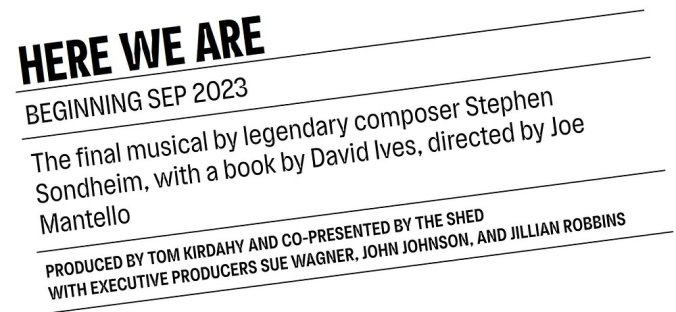
Two years after Stephen Sondheim’s death, “Here We Are” will premiere Off-Broadway in a 526-seat theater. Previously titled “Square One,” the show is based on Buñuel’s “The Discreet Charm of the Bourgeoisie” and “The Exterminating Angel.” The producers are advertising it as “the final musical by composer Stephen Sondheim;” it will open this week and run until January.
Sondheim, however, never finished the musical. In fact, when he announced that he had given up on writing it, Ethics Alarms saluted him, praising the Broadway icon for “doing the responsible thing, quitting….Virtually no composers and very few artists generally do anything but decline after the age of 60, though many try to keep churning out wan imitations of their best work as long as someone will pay them.” Sondheim’s last reasonably successful Broadway musical was “Passion,” in 1994, when the composer was 64. Before “Here We Are,” he labored for a decade over a musical that hit the stage in multiple versions with several titles. None of them were successful. Asked days before his death if he foresaw when his final musical would be finished, Sondheim curtly replied: “No.”
Yet now, mirabile dictu, his collaborators are announcing that the musical is complete. Interesting: Sondheim had said he finished all the songs in the first act, but had been stuck on writing songs for Act II. No problem! The show’s producing team now says that two months before Sondheim’s death, he had agreed to let the show go forward following a well-received reading of the material that existed at that point. That reading, however, contained no music. I’ve directed and organized many readings of new works, and the amount of rewriting, cutting and re-conceiving a show that takes place after that starting point is always massive–and often a show never makes it to production.
The current shepherds of the show set off all sorts of ethics alarms for me. The three collaborators other than Sondheim say they agreed after the informal reading that took place on Sept. 8, 2021, “that Steve’s songwriting for both acts was complete.” Well, in the sense that he had made it clear that he wasn’t going to finish it, the show was “complete,” as in “complete as it was ever going to get” as far as Sondheim’s contribution was concerned. They also say that upon talking with the 90-year-old in his final days, they decided on a concept in which everyone stopped singing in the second act. That’s convenient, when the composer has decided that he isn’t up to composing any more. The living partners in the project now tell the New York Times, “What we are putting on stage now is as finished as any production about to play its first preview. It’s ready for audiences, and very much the musical Steve envisioned.”
That’s ridiculous. Sondheim’s own comments indicate that he envisioned a musical that he was involved in throughout the production process. Sondheim was famous for adding songs during a show’s pre-Broadway previews: he wrote the most famous song in “A Funny Thing Happened on the Way to the Forum,” “Comedy Tonight,” when the show was bombing on the road, for example. Moreover, a new book—that is, dialogue and plot—was written for the show after Sondheim’s death. How could “Here We Are” be what he “envisioned” when what he thought was the show had a different book then?
That’s easy: it can’t be.
Summing up the evidence, we have a musical that Sondheim stopped working on, without second act songs, that is being advertised as a new “Sondheim musical” that was “very much what he envisioned” even though it obviously was not. Yet Sondheim’s estate apparently gave its permission for the show to go on, even though it was being misrepresented.
Of course, the reason is money. There is a Sondheim cult, and they will be enough, even if the show is lousy, to beep box office receipts flowing. But I will also say this: Stephen Sondheim was remarkably willing to allow his works to be part of artistic experiments, unlike most creators of his caliber. Heck, he allowed Tim Burton to cast his “Sweeney Todd” film with badly cast non-singers who made a hash out of Sondheim’s best work. I can imagine him, if contacted via Ouija Board and asked “Can we go forward with what we have, Steve?”, replying, “Oh sure, see if it works, and do what you can to fix the thing if it doesn’t. Don’t worry about me: I’m dead.” But I would also hope he would add—“don’t lie about it.”
The Times headline is: “How Complete Was Stephen Sondheim’s Final Musical?” The answer is “Not very. Ticket buyer beware.”
 Ethics Alarms
Virtually no composers and very few artists generally do anything but decline after the age of 60, though many try to keep churning out wan imitations of their best work as long as someone will pay them.
No kidding. This tendency should be called “Saul Bellow Disease.” He (or someone) put out a book called “Gravelstein” shortly before his death. Foolishly, I bought a copy. It was an embarrassment. It should have been titled, “A Tortured, Evidently Penniless Saul Bellow Pens Something for the Benefit of His Then Current Wife. His Agent, and Publisher.”