It’s come to this, has it?
Tracking the infinite variations of Trump Derangement is alternately entertaining and horrifying, often at the same time. This one is mostly just puzzling.
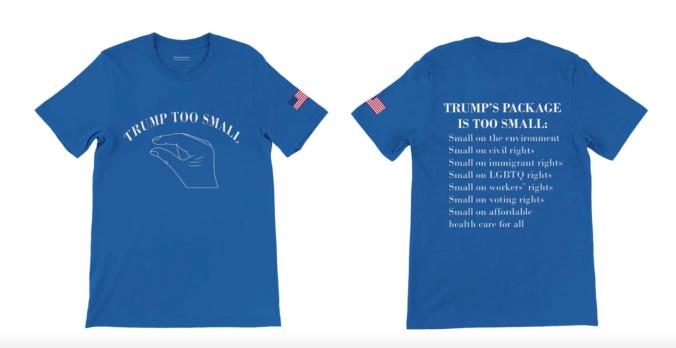
Elster, who is also a lawyer [inject multiple derogatory speculations here] is so impressed with his own wit and convinced that there are plenty of people whose taste is simiarly poor, whose brains are so pureed by wokism and Trump-hate, and whose willingness to proclaim their lack of political sophistication and IQ points is so unwavering, that it is worth going all the way to the U.S. Supreme Court to secure a trademark for what you see above.
The front of the T-shirt wittily <cough> refers to the low point among many low points in the GOP candidate debates that brought Trump the 2016 Presidential nomination, when Marco Rubio, trying to get the mud with Donald Trump (“Never wrestle with a pig. You both get dirty and the pig likes it” ) and stoop to crude ad hominem insults. I wrote about the incident at the time:
…when he appeared to be surging in the polls, though only because his competition was so repellent, Rubio made the decision to go “tit for tat” with Trump’s ad hominem attacks and vulgar rhetoric, making fun of the tycoon’s hair, fake tan, “little hands” and, ugh, presumed penis size. If that wasn’t bad enough, his delivery of the insults was atrocious, as he grinned and snickered while uttering these gutter attacks, looking like nothing so much as a smug 7th grader. With this, Rubio showed that he had as little dignity and respect for the office he was seeking as the disgusting boor people were turning to Rubio in order to reject. He showed that he lacked core values and integrity, and that his judgment, again, was terrible. At that point, Rubio’s support evaporated.
But Mr. Elkins, apparently, saw this sad display and thought, “Ha! Good one! I’ll have to remember THAT!” And so, as the wheel comes around for Trump again, Elkins designed that thing above and tried to trademark “Trump too small” with the drawing indicating a tiny pee-pee. Be proud, legal profession!
Elster claims that when Trump first started his juvenile insult fest that Rubio felt compelled to emulate, he thought it was “far beneath any topic for a presidential debate.” So naturally, Elster wants to put the pee-pee issue into this election. Actually, he started selling the T-shirts to his fellow anti-Trump fanatics in 2018. “If he’s going to make the size of his features a political issue, well that’s now clearly a topic for political discussion,” Elster says. “It shouldn’t be, but he’s made it so.”
Elster evidently has never read the Ethics Alarms rationalization list (his argument nicks 1, 2, 2A, 6, 7, and 8A just in the first ten).
So impressed was Elster with how the drooling, mouth-foaming Trump haters snapped up the ugly things that he sought to register the slogan as a trademark with the U.S. Patent and Trademark Office. But he’s not an intellectual property lawyer, so he didn’t know (I did!) that the 76-year-old statute called the Lanham Act prohibits the registration of trademarks that include the name of a living person without his or her written consent. When his application was rejected, Elster declared his message to be First Amendment protected speech—you know, like shouting “Pencil dick!” in a crowded theater. He hired the firm Gupta Wessler and appealed the final rejection to the U.S. Court of Appeals for the Federal Circuit.
“For the government to deny me the right to a trademark commenting about him in this way seems inconsistent with my understanding of the First Amendment,” Elster said, sounding both like a lawyer and like an idiot.
The Federal Circuit found the law to be unconstitutional as applied to the anti-Trump slogan and the government appealed—the Biden White House doesn’t control all of the Deep State—-to the Supreme Court, which agreed to hear the case. Stupid and trivial as the specific facts are, whether the USPTO can ban the registration of trademarks including the names government officials or public figures is a substantive question.
Thus this ridiculous, gutter level episode of signature significance showing how far political discourse has fallen—“Trump too small” makes “Let’s Go Brandon!” look like Oscar Wilde by comparison—is now headline news, with Elster’s participation making him a free-speech advocate in the eyes of some. And best of all, Elster says he’s selling more T-shirts!
Unlike the court’s 2017 decisions in Matal v. Tam, striking down the Lanham Act’s ban on disparaging trademarks in the case of an Asian American band that wanted to register a trademark for “The Slants,” and in Iancu v. Brunetti, when the Court struck down the law’s ban on immoral or scandalous trademarks (thus approving FUCT as a trademark for an artist’s clothing line—Steve should go into business with that guy), Elster’s witty attire is in limbo not because it’s vulgar, but because it includes Trump’s name without his consent.
Meanwhile, Elster is puffing up his little pigeon-breast with pride. “I’m hopeful that with the election coming up that this, like I said, is an issue that Donald Trump made a political issue at the Republican debate and so it will continue to be a message going into the next election,” he says.
I guess he never heard the encomium declaring that your IQ is inversely proportional to the number of words on your shirt. I’ve found the formula to be almost invariably accurate. Elster’s T-shirt tops out at 40 words.
Oral argument for Vidal v. Elster was today, and SCOTUS appeared unimpressed with Elster’s case. Justice Neil Gorsuch (he’s one of the evil conservatives) referenced a long historical tradition of prohibitions on trademarks that use the names of living people. “Why not just look to the history here and see whether historical evidence comports with this being a First Amendment liberty or not?” he said. Justice Sonia Sotomayor pointed out, “It doesn’t stop you from selling. It doesn’t stop you from selling anywhere as much as you want.” In other words, where’s the infringement on speech? Another liberal justice, Justice Elena Kagan, meanwhile, pointed out that the Court in the past has allowed the government to reject similar speech-based requests as long as it does not favor certain viewpoints. In other words, you can’t trademark “Biden too addled,” either.
***
“Hello! I’m Jack Marshall, and next to me is Steve, once a respectable attorney. Now Steve suffers from crippling Trump Derangement Syndrome (TDS). It causes him to think juvenile penis jokes are scathing witticisms. It makes him want to emulate Marco Rubio. It causes him to waste the court system’s time and resources on trivia. Won’t you give a tax deductible donation to the National TDS Fund to help find a cure for this crippling malady that turns once rational, fully functioning citizens into pathetic fools? Send a hundred dollars or a single buck—any thing to eliminate this national scourge. Help Steve and people like him—Bill Kristol, Liz Cheney, Robert De Niro, Joy Behar, the whole population of the District of Columbia, anyone who watches MSNBC more than once—go on to lead a productive life. We can do it, but only with your help.“
Thank-you.
 Ethics Alarms
Can I just point out that, if anything, GRANTING the trademark would infringe on other people’s free speech? I’m not convinced trademark law isn’t inherently unconstitutional as currently written in the first place, and you shouldn’t be able to trademark a personal name at all. Donald Trump is hardly the only Trump in the country.
“To promote the Progress of Science and useful Arts, by securing for limited Times to Authors and Inventors the exclusive Right to their respective Writings and Discoveries;” should be interpreted much more narrowly than it has been.
That’s what I thought, as well. The right to criticize someone is protected by the First Amendment. Trying to trademark that criticism is not covered by freedom of speech. Trademark is not the same thing as copyright, as I understand it; other people can freely share and discuss trademarked information (by all means, drive up word of mouth!), but they can’t market under someone else’s trademark or use it to describe other products. (Companies also have to actively keep the trademark from becoming genericized by people doing that. I’m not a lawyer, but intellectual property law is relevant to my projects.)
Trademarking is still not covered by the First Amendment. Trade and speech are different, which is also why fraud can be illegal.
Elster is, knowingly or not, actively spreading misinformation about freedom of speech and intellectual property and should be disciplined. As a lawyer, he has no excuse either way.
If he wins someone will trademark “Biden is a flaccid dick.” Or Kamala’s toes are for Palestine.
It will not turn out well for society.
I’m waiting for the video of the TDS appeal. I hope it’s as heart string tugging as those ASPCA commercials I have to switch away from.