
Subhead: “Four progressive teachers in Washington’s Mukilteo School District wanted to protect students from a book they saw as outdated and harmful. The blowback was fierce.”
To begin with, read it all, and to the extent you can stand it, the comments. I included some trenchant quotes below, however.
Now the takeaways:
1. If there is a more vivid and depressing illustration of how far public education, teacher competence and race relations have declined since, oh, let’s say 2008, I don’t know what it could be.
2. The episode was triggered, a black student told the Post, when a white teen read “nigger” while reading “Mockingbird” to the class. The student disobeyed the teacher’s instructions to skip the slur, and “the kid looked at every Black person — there’s three Black people in that class — and smiled.” Well: a) Asking a student to read a passage of any book to the class when she feels part of the text must be skipped is incompetent. b) Of all the passages to have a student read from “Mockingbird,” choosing one that includes “nigger” smacks of deliberate sabotage. c) Presumed facial expression racism? At this rate, we should be back to “separate but equal” in no time.
3. “Freeman-Miller wondered: Did the school really have to teach Harper Lee’s classic but polarizing novel, as was mandatory for all freshmen?” There is no reason for any novel to be regarded as “polarizing,” except to those who regard literature as indoctrination tools. The educational process is to read the novel, discuss its literary merit, its context, its cultural significance, the ideas it communicates, and it why it works (or not) for a particular reader.
4. “”To Kill A Mockingbird'”‘ centers on whiteness,” the teachers wrote in their challenge, adding that “it presents a barrier to understanding and celebrating an authentic Black point of view in Civil Rights era literature and should be removed.” Such a statement is racist by definition, and should disqualify the complaint from serious consideration and the complaining teachers from teaching. Criticizing a book for what it is not about is moronic as well as a sign of attempted agenda-driven government mind-control.
5. “[I]n Mukilteo, the progressive teachers who complained about the novel saw themselves as part of an urgent national reckoning with racism, a necessary reconsideration of what we value, teach and memorialize following the killing of George Floyd.” I wonder how many people today recall or understand that the “killing of George Floyd” has never been shown to have anything whatsoever to do with race, systemic racism, or discrimination. The fact that the mainstream media constantly repeats statements like this without clarification demonstrates the corruption of the field.
6. “The Black hosts of [a podcast] joked that “Mockingbird” ranked with Confederate monuments as something painful to Black people, but which White people adored. Johnson, who grew up loving “Mockingbird,” identifying with White protagonist Scout, felt shaken — and guilty.” Thus Johnson proved herself to be a weak-minded sucker for woke propaganda in its most infantile and ignorant form. She lacked the critical thinking skills to know that comparing a work of literature with a statue of Robert E. Lee is cretinous, and not to be made to feel guilty by a nonsensical opinion. Why should any Post reader care what a teacher so handicapped thinks?
7. “Kamiak English [teacher]Riley Degamo began to question the book’s place in the curriculum…She will never forget one teen’s assessment, scrawled on a homework assignment: “This is [fucking bullshit].” So Kamiak public school students have not been instructed how to use civil language in their assignments and classroom discourse. No wonder the teachers’ don’t know how to teach “To Kill a Mockingbird.”
8. This….
“Kuzmany had studied Black American writers and 19th-century slave narratives while earning a graduate degree in comparative literature from the University of Washington in 2014. After talking to Johnson and Degamo about “Mockingbird,” she began to wonder why Kamiak couldn’t teach literature by Black authors instead.
“I don’t think that White authors and White characters should tell the narratives of African American people,” Kuzmany said. “The usefulness of the book has run its course.”
This offensive sentiment, which comes up more than once in the Post article, is an endorsement of literary apartheid. Only certain races and ethnicities can write about particular people and topics? To quote that eminent Kamiak literary critic, that’s “fucking bullshit.”
9. “Chaitna Deshmukh, a 2022 graduate who was still in school when teachers challenged the book, thinks the novel — while pertinent to the 1960s — fails to address the complex racial problems of the 21st century.” Again: the mentality that if literature doesn’t deal directly with 21st Century attitudes and issues is isn’t worth reading is redolant of programmed meat-headedness. It demonstrates a disastrous lack of comprehension regarding the importance of history and an inability to make vital cross-cultural comparisons.
10. “[T]he teachers pulled up a form headed “Citizen’s Request for Reconsideration.” Across five typed pages, nine neat paragraphs and 1,267 words, using impeccable grammar and citing their sources, they made their case.” Is the fact that it was neat and had impeccable grammar—they are teachers: it ought to have impeccable grammar!—the best the Post can do to legitimize their argument, which isn’t reprinted in the article? How did they “make their case”? The only passage quoted is:
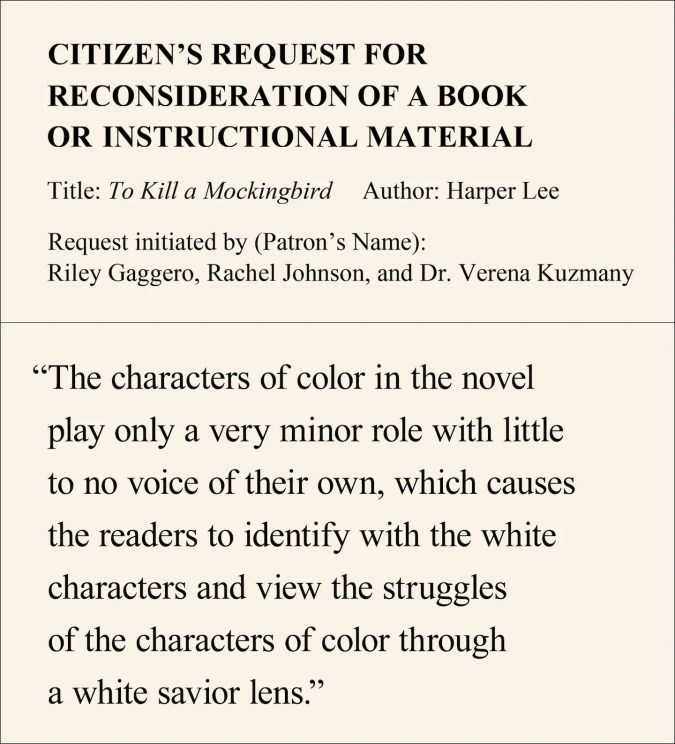
That’s the best they could come up with? F. Again, the framing is racist: a book in which a white character defends a black victim is inherently objectionable. In contrast, all the so-called “Magic Negro” movies (almost any film starring Morgan Freeman or Will Smith, for example) in which an ultra-virtuous, brave and clever black individual rescues white victims presents no problems at all.
Now go back to Take-away #1.
 Ethics Alarms
Since when was TKAM a piece of literature to “celebrate an authentic Black point of view”?
The book exposed how a majority can trample over a disfavored minority and why it is necessary for fair minded people not just be willing the face down the mob without resorting to violence to achieve an equitable end but to instill the ideals of fairness, honesty and integrity in their children.
Something sorely needed on college campuses today
This is really annoying. You can’t teach a book on race because it does not convey the black perspective?
This kind of suggests that every book is read in a vacuum. I read To Kill a Mockingbird sophomore year and Frederick Douglass’s Narrative Junior year. They deal with race from different perspectives. The fact that Mockingbird is not everything to everybody is not an intelligent criticism. No single work creates a well-rounded education. it is not a valid criticism of Mockingbird that it is not Frederick Douglass, or Ralph Ellison, or even John Howard Griffin (the day he is accused of wearing blackface is the day that I give up; however, I am counting on the lack of intelligence of most people to convince me that the dumb ones will not be sufficiently aware of Mr. Griffin to even make such a complaint).
But, this is very ironic: “The characters of color in the novel play only a very minor role with little to no voice of their own.” Are they suggesting that Black people in that time period had much of a voice? Is it not indicative of the time that they had no voice? Thus, is that portrayal not completely appropriate? Especially considering that Tom was accused of raping a white woman and subsequently killed. Outside of Emmett Till and George Stinney, the thought of such a course of events is completely implausible.
I have much more to say on this, but, I will leave it at that for now.
Okay, one more point: those who object to the pronunciation of the word, “nigger,” by white people think it is more important that I not say the word, than that I quote Malcolm X in his “authentic” voice. I have too much respect for him as a person to censor him. On a related note, I have two books entitled, “Nigger.” Whenever I hear about parents trying to ban books, I quietly think that I have two books whose name they could not speak out loud; their self-censorship is far worse than any pretended censorship about which they complain. One of those books is by Randall Kennedy (undoubtedly Black Irish) and is subtitled “The Strange Career of a Troublesome Word.” it is a study of the word itself. The other is an autobiography by the comedian Dick Gregory who writes in the beginning of the book, “Dear Momma—Wherever you are, if ever you hear the word ‘nigger’ again, remember they are advertising my book.”
Oh how much the racial Puritans miss from the human experience by their refusal to explore its many facets!
-Jut
The fact that a major newspaper won’t print a word essential to the news it’s reporting is so insane that it scrambles the faculties. “N-word” is so infantile, like poo-poo and pee-pee. As if saying the word will rip a chunk out of our dimension….
I would not put it past the critics to want to cast Morgan Freeman or Denzel Washington as Atticus Finch.