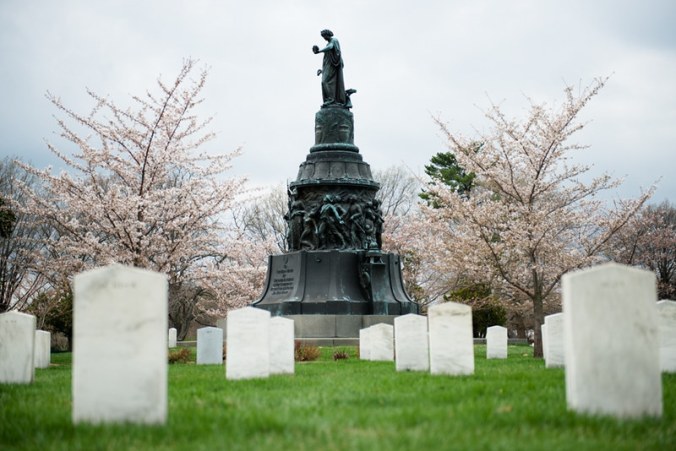
Here is a controversy that I was completely ignorant of, and I am embarrassed to admit it.
One more bi-product of the George Floyd Freakout, ‘The Great Stupid’ that has washed over the land like the Great Molasses Flood of 1919, and the Stalin-esque attempt to airbrush American history, including the toppling of statues honoring certain distinguished Americans who were not sufficiently psychic to absorb the lessons and accumulated ethics wisdom of those with the advantage of a century or more additional history and human experience, was the Naming Commission, established by the 2021 National Defense Authorization Act in the throes of all of the above malign influences. It’s official mission is to recommend removal of “all names, symbols, displays, monuments, and paraphernalia that honor or commemorate the Confederate States of America.” The Commission extended its reach to the Reconciliation Monument at Arlington National Cemetery, which is located in the special section known as Section 16. The monument, which you see above, is scheduled to come down.
Of all the many times I have visited Arlington—my father and mother are buried there, also my grandfather, and Dad loved to take me on tours of the place as he checked out his future residence, especially when he was taking part in the annual Battle of the Bulge veterans ceremonies—I never saw this section. It has a fascinating history.
Arlington was established as a burial ground for the Union military dead. Indeed, Montgomery Meigs, the Quartermaster General of the U.S. Army who was responsible for the burial of soldiers, ordered Robert E. Lee’s Arlington estate to be turned into a cemetery so Lee could never return there. Meigs had his son, an early casualty of the war, buried literally on the Confederate leader’s doorstep as a statement of contempt and defiance. No Rebel combatants were permitted on the sacred grounds.
However President William McKinley, himself a Medal of Honor recipient for his heroism at the Battle of Antietam, announced that the U.S. government would commit to honoring the Confederate dead, saying in a speech in Atlanta that “sectional feelings no longer holds back the love we feel for each other. The old flag waves over us in peace with new glories.” Congress authorized Confederate remains to be buried at Arlington National Cemetery in 1900, and in 1906, the construction of a monument was commissioned to represent the nation’s acceptance of the Confederacy back into the nation, healing of the deep wounds of civil war. 1903 saw President Theodore Roosevelt send a floral arrangement to the Section 16 to commemorate Confederate Memorial Day, and began a tradition that has been regularly observed since, with President Obama expanding the practice to laying two floral wreaths, one at the Confederate Memorial, the other at Washington, D.C.’s African American Civil War Memorial.
This week the Republican Congress has sent a letter of protest to the Defense Department, demanding that preparations to remove the monument cease, and pointing out that the purpose of the memorial is not to honor the Confederacy, but to stand for national unity, reconciliation, and peace.
Your Ethics Alarms Ethics Quiz of the Day is…
Should the Reconciliation Memorial be removed along with the remains of the Confederate soldiers buried in Section 16?
As much as I hate the woke statue-toppling fad, I am torn on this. I am certain Meigs, who is also buried at Arlington, has been spinning furiously since 1900. Including Confederate soldiers is contrary to his purpose in establishing the cemetery. Even though my father, who grew up in Kentucky, had Confederates among his ancestors (and his mother’s family owned a female slave), I am fairly certain he would not approve of Section 16.
Yet reconciliation is important, and forgiveness and grace are ethical values. Removing the monument and the Confederate graves seems like ripping open old scars—a step backward into old hatreds. What the nation needs now is more symbolic gestures of unity, not the re-litigating of our divisions and controversies.
I stand with Section 16.
You should read the letter of protest, and a detailed history of Section 16 is here.
 Ethics Alarms
You should read this.
https://archive.is/fdck4
After such eloquence.
NO
No, it should not come down. The animosity felt between North and South is part of our history and the example of the nation being able to come together in some form within 30 years of the end of the conflict is an important part of our growth as a nation.
Acknowledging the deaths of Confederate soldiers does not harm anyone in any substantive way. Removing bodies from graves is a needlessly expensive, grandstanding move that benefits no one.
Sure, topple the monument. After which, the south should promptly succeed again.
I don’t know, Null Pointer. Why shouldn’t we simply undo the peace at Appomattox and kick the South out of the Union. After all, they used to approve of slavery. They’re tainted. (Never mind that it was “approved” by all of the States, at least implicitly.)
I vote No for many of the reasons Jack outlined. It is a part of the reconciliation process, a process that has been difficult at times. Such monuments serve as historical reminders of the country’s journey. It is not as if the country was born like Athena, who sprang fully formed from the head of Zeus. It has taken time to get to where we are and it is a bad idea to erase those markers.
-Jut
Jack wrote, “What the nation needs now is more symbolic gestures of unity, not the re-litigating of our divisions and controversies.”
That’s makes perfect sense to critically thinking and logical people; however, irrational 21st century woke totalitarians have shown us repeatedly that they don’t give a flying fuck about societal or cultural unity.
In the 21st century, “progressives” must demonize, attack, and divide anything that they think is the status quo. In their delusional minds, leaving the statue and the Confederate soldiers in Arlington National Cemetery would be tantamount to condoning slavery, when in fact it does nothing of the sort. Totalitarian progressives simply cannot accept the status quo, they must change things for the sake of change, which is how progressive is defined “favoring or advocating progress, change, improvement, or reform, as opposed to wishing to maintain things as they are, especially in political matters”. So, status quo is bad and change is good is hard wired into “progressives” even when their so-called progress is socially, culturally and politically regressive; it’s pure adolescent rebellion against the status quo.
Progressives are irretrievably broken with reality.
The following is derived from a profoundly accurate closing paragraph in a comment written by Humble Talent back in July 2022.
Progressives are dismantling our society, and the culture that supports it, one small piece at a time. They will continue to tear down everything that supports our society until there is nothing left and then they’ll try to rebuild it into their delusional utopia. The reasoning used by 21st century progressives is ignorant adolescent nonsense. Why do you think progressives want 16 year old (and younger) children to vote, it’s because the reasoning skills of children and 21st century progressives are equivalent.
Remember Barack Obama’s words calling progressivism activists to action during his Presidential campaign in 2008…
How do you like the “progressive changes” that Obama’s call to action has wrought upon the United States of America?
Oops, I forgot to answer the question…
“Should the Reconciliation Memorial be removed along with the remains of the Confederate soldiers buried in Section 16?”
No.
All these ignorant woke snowflakes need to shut up, grow up and get a life.
Do we learn history better when visiting a local with no markings, only a pamplet in-hand saying you are here where things happened?
Or do we connect better with history when there are markers, monuments and artifacts which play a role in informing us?
When this monument is torn down, what’s next – exhuming all of the confederate remains so the objectioners can urinate and deficate on them and then incinerate it all?
The National Defense Authorization Act needs to be rewritten. The purpose of the act is to ensure that our standing service branches are ready and able to defend against an attack on the United States.
In addition to this addled brained commission, the Senate version includes funding for gender reassignment surgery, and a codicil to reauthorize the section that permits warrantless spying on Americans under FISA. None of this is remotely related to our military readiness.
The NDA act has become a tool the left uses to blackmail the country into acceding to their demands.
Every monument can serve a purpose. It does not matter why you find value in it. The confederate soldiers buried in Arlington owed their allegiance to what they saw as their homeland. For them the land that was Virginia, Georgia, Alabama etc was what they saw as the place where they would be born and die. That was their nation and not this conceptual idea of a nation of many states.
As for the northern soldiers, how many were forced conscripts coming right off the boat in New York. They had no political allegiance one way or another. Other than the fact they were on the winning side, why should they be buried there?
The Civil War was the product of differential politics that the leaders could not resolve peacefully. To denigrate the soldiers who had no role in the decision making is ethically wrong. Every soldier deserves to be honored for his service. Regardless of which side you were on every soldier – Union or Confederate was an American citizen.
As Scripture says, “Let the dead bury the dead.” The Renaming Commission has forced me to edit my curmudgeonly Army tales. All the places I was stationed at have been renamed.
Forts Benning, Rucker, Lee, will always be Benning Rucker and Lee in my memory.
Could they rename Camp LeJeune so that I stop getting emails about lawsuits?
The “Woke” are ignorant of or simply don’t care about the reasons why this nation honored the confederates and their dead by monuments, naming of military installations, ships, and inclusion in Arlington National Cemetery. While not going into detail, the reasons were to bring the nation back together. In the words of Lincoln: to bind up the nation’s wounds. Today, their emphasis is on formulating divisiveness, hatred and the erasing/rewriting of history.
Reconciliation of old hostilities is anathema to the Left. They thrive on resurrecting old grievances, maintaining current affronts and manufacturing new outrage whenever possible.
The article by Mr. Webb has been widely circulated by those opposing the removal of the monument. Webb, a moderate Democrat, speaks with a level of civility and respect that is reminiscent of the general good will shared among Civil War veterans from both sides after the war. It is sad that so many of our contemporaries have not learned the wisdom of reconciliation among countrymen.
All wars eventually begin to fade from public memory, and their old soldiers are forgotten. Unfortunately the lessons that should be learned from war are usually forgotten as well.
The Naming Commission is just one more thinly disguised effort by the Democrats and the Socialist Left -but I repeat myself- to divide Americans and erase our history. We should expect no better conduct from them.
(Full disclosure: I am a member of the Sons of Confederate Veterans, a organization that has been a the forefront of the resistance to monument-toppling. I am also a past member of the Sons of Union Veterans of the American Civil War, which has also spoken out against monument removal and destruction, and against the banning of the Confederate battle flag.)
My longtime Usenet ally, Christopher Charles Morton, put it best.
https://www.thetruthaboutguns.com/a-few-suggestions-for-renaming-americas-military-bases-currently-named-for-confederates/#comment-4538946
No wonder he influenced my own political views for twenty-five years!
When I moved to the South, I could tell something was different, you could just feel it. Eventually, I realized that what I was feeling was living in territory occupied by a hostile enemy. People in the South really do feel like they are not full citizens and they are still under occupation by the North. You can’t really blame them. I mean, in many places, their local schools are still subject to rule by federal judges. Mainstream press and media routinely portray them as backward, uneducated and racist. Want a character to exhibit all those qualities? Give them a southern accent!
Sure, get rid of the reconciliation monument. Let all the people in the South know they aren’t just imagining it.
The part of the Voting Rights law that SCOTUS (properly) struck down was the one that gave the Justice Department the right to step in and block laws deemed discriminatory in any Jim Crow state that had engaged ins systemic racial discrimination in 1964 or before, with no requirement that a state’s more recent policies could remove it from that special category.
Yes, but the school desegregation orders still seem to be in effect. When I was in high school, the Kansas City school system was seriously under the micromanagement of the federal judge, who had a child in the school system. Due to lawsuits, the judge ordered that the Kansas City schools build a model farm, a model UN (with translation facilities), and many other luxuries to benefits a few children (one of which just happened to be his). This type of dictatorial control does make the local populace feel like they are under the thumb of hated conquerors.
https://www.nbcnews.com/news/nbcblk/federal-government-orders-desegregation-32-mississippi-school-district-rcna87296
The absolute and entire purpose is to “re open” old scars.
Race relations from the 1990s to the Obama term have always been pretty much considered resolved- with racist hold out being completely unimportant fringes of society.
But there are enough decent people out there who recognize the absolute wrongness of destroying these monuments and memorials that when the memorial’s are slated to be removed they will protest vehemently and the Left, by design, can re open the race argument-
“See all these closet confederates that hate blacks!!!!!”
The time to protest confederate inclusion into Arlington ended in 1900. It should stay.
“On fame’s eternal camping-ground
Their silent tents are spread,
And Glory guards, with solemn round,
The bivouac of the dead.”
–Theodore O’Hara
The full poem can be found here:
https://www.cem.va.gov/history/BODpoem.asp
those four lines at the beginning of this post can be found somewhere in Mount Hope Cemetery, here in our fair city, Rochester NY.
The poet, Theodore O’Hara, was a soldier in the US Army during the Mexican-American War and later served as a Confederate Colonel during the Civil War.
Wikipedia has details.