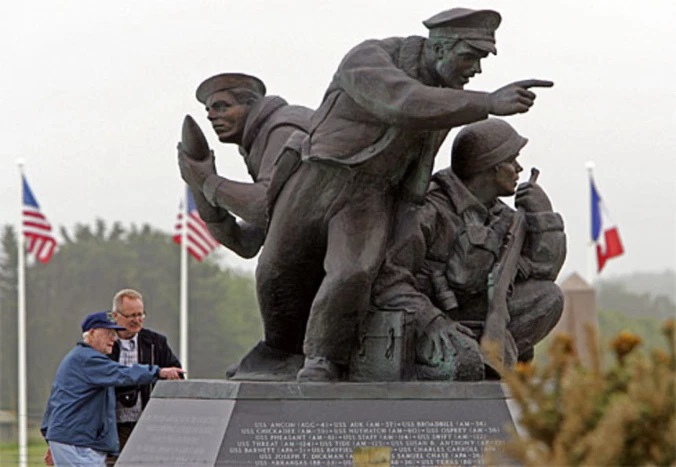
I first posted this essay on Veteran’s Day several years ago, and I re-posted it on the anniversary of D-Day in 2021. The crucial facts of the June 6, 1944 invasion of Normandy that it discusses are still hardly ever mentioned, at least not when I’m around to read or hear it, in any news media or historical features about the battle for Omaha Beach. As I wrote originally and will state now, I don’t understand this. The ongoing mystery constitutes one more “duty to remember” crusade by your windmill-tilting host. So up the post goes again this June 6, as I fulfill my pledge to post it on every D-Day anniversary until this largely untold story is as familiar as the sight of Robert Mitchum, as Brig. Gen. Norman Cota, sicking a fresh cigar in his mouth and saying, as the final line in “The Longest Day,” “Run me up the hill, son!”
***
After all these many years of reading about and watching movies and TV shows about D-Day, June 6, 1944, I discovered how the US Navy saved the invasion and maybe the world after stumbling upon a 2009 documentary on the Smithsonian channel.
If you recall the way the story is told in “The Longest Day” and other accounts, US troops were pinned down by horrific fire from the German defenses on Omaha beach until Gen. Norman Cota (Robert Mitchum in the movie) rallied them to move forward, and by persistence his infantry troops ultimately broke through. Yet it was US destroyers off the Normandy shore that turned the tide of the battle at Omaha, an element that isn’t shown in “The Longest Day” (or “Saving Private Ryan”)at all.
Though it was not part of the plan, the captains of the Navy destroyers decided to come in to within 800 yards of the beach and use their big guns at (for them) point blank range to pound the German artillery, machine gun nests and sharpshooters. The barrage essentially wiped them out, allowing Cota’s troops to get up and over without being slaughtered. I’ve never seen that explained or depicted in any film, and according to the Smithsonian’s video, apparently it is a vital feature of the battle that had been inexplicably neglected. No monument to the US Navy commemorating its contributions on 6/6/44 was erected at Normandy until 2009.
Here’s the relevant part of account from the Naval History website on “Operation Neptune,” the Navy counterpart to Operation Overlord:
“..The success of the invasion seemed most dubious at Omaha Beach, where the American GIs remained pinned down, unable to move forward onto the bluffs from where German troops poured murderous fire. Successive waves of infantrymen attempting to come ashore only added to the chaotic situation. “What saved the day for the Allies was a handful of British and American destroyers,” as historian Craig Symonds asserts. Officially, the destroyers were only to screen the invasion fleet from U-boats and the smaller, faster E-boats. Yet, with the crisis on Omaha reaching a critical point, they were ordered to provide close-in fire support for the troops stuck on the beach. Rear Admiral Carleton F. Bryant, who commanded the naval gunfire support groups, radioed a message from his battle station onboard Texas to the nearby destroyers: “Get on them, men! Get on them! They are raising hell with the men on the beach, and we can’t have any more of that. We must stop it.”
…Under orders not to fire more than half the ammunition they carried in case it was needed for an emergency situation, the destroyer captains decided unanimously that chaotic Omaha Beach was such a situation. Beginning around 0800, destroyers such as Emmons (DD-457), Carmick (DD-493), McCook (DD-496), Doyle (DD-494), Baldwin (DD-624), Harding (DD-625), Frankford (DD-497), and Thompson (DD-627) began engaging German positions…. With smoke still obscuring the enemy guns, the gunners onboard the “tin cans” searched for “targets of opportunity.” Carmick arrived off Normandy with 1,500 shells for her 5-inch guns and in less than an hour, fired 1,127 of them. Her gun barrels, smoking red hot, had to be hosed down in order to keep them firing. Finally, at around noon, the destroyers established contact with spotters ashore.
Two of the U.S. destroyers, Satterlee (DD-626) and Thompson (DD-627), supported over 200 men of the Army’s 2nd Ranger Battalion scaling the cliffs at Pointe du Hoc. The Rangers’ mission involved destroying several heavy guns the enemy could use against the landing forces at both beaches. Joined later by Ellyson (DD-454), the three destroyers provided indirect fire on German positions atop the cliffs, enabling the Rangers to reach the top…
For over 90 minutes, U.S. destroyers pounded the enemy gun positions. Some of the ships were so close in to shore that they received German rifle and machine-gun bullets to their hulls and superstructures. …The Allies put nearly 132,500 men ashore on D-Day. After the beachheads were firmly established, the “primary naval responsibility [was] the landing of men and supplies…
The troops were in trouble on Omaha. Many tanks and artillery pieces, expected to give the infantrymen covering fire, had not made it to the U.S. beaches. The Neptune plan had to be changed. Destroyers were ordered to risk grounding by steaming close to shore and firing their 5-inch guns as supporting fire for the men on the beach. The Emmons and other fire-support destroyers sailed as close as 1,000 yards from the beaches. (Historian Samuel Eliot Morison puts the destroyers within 800 yards of Omaha Beach.) Another close-in destroyer, the Jeffers (DD-621), was shelling a German position when the shrapnel of a near-miss wounded five of her crew.
The Emmons lost contact with her shore-fire control party. Not knowing whether the men had been killed, wounded, or captured, her gunners shot at whatever looked like a good target. A spotter saw some German naval troops marching down Port en Bessin’s main street. She sprayed them with her 40-mm battery, sending them scattering. The Carmick (DD-493) aided tanks that made it ashore on Omaha. As the tanks were trying to fight their way toward an exit called the Vierville draw, Carmick spotters watched for bursts along the edge of the bluff and used these bursts as targets, figuring that whatever U.S. tanks were aiming at was worth shooting at from a U.S. ship.…
Navy gunners, aided by the highly classified top secret Bigot maps, knocked out eight gun emplacements covering Omaha Beach exits. Firing over the heads of troops, a destroyer silenced an 88-mm gun by putting two rounds through the gun shield.
The Harding (DD-625), Satterlee (DD-626), and McCook (DD-496), supported the Ranger assault on Pointe du Hoc, the 100-foot cliff believed to hide long-range German guns that could be aimed at landing craft approaching the Utah and Omaha beaches. As the craft carrying the Rangers neared the shore, the McCook raced ahead and, near the breaking surf, let loose on cannon atop the cliff. Witnesses said they saw an enemy gun fall to the beach. The guns the Rangers sought had been removed, but the strong-point was well defended; of the 250 Rangers who landed, only 90 could still bear arms when the battle for the bluff ended two days later. The Harding put a boat ashore to pick up wounded Rangers—and Germans who had surrendered after a salvo from the McCook.Shortly before noon, Colonel B. B. Talley on Omaha Beach sent a message to Major General Leonard T. Gerow, commander of V Corps on Omaha: “Troops moving up slope of Fox, Green, and Red Beaches. I join you in thanking God for our Navy.”
Well, my father (who was supposed to be an observer during the invasion but ended up in an army hospital instead) was an infantry guy, and never inclined to give credit to the Navy (and especially the Marines) without prompting, so I won’t blame myself for missing this part of the story in my World War II tutoring from Major Jack Marshall Sr. Still, I am astonished that the popular conception of the heroic Allied effort to take the beaches on D-Day have left out such an important aspect of the victory, and humbled that someone like me, who places such importance on the appreciation and knowledge of American history as a crucial aspect of life competence, could have been misinformed for so long.
***
Maybe this is why Ike reportedly walked out of the special screening of “The Longest Day” set up for him. Whatever the reason for the historical amnesia, I place it in the same category as Joshua Chamberlain’s heroics on Little Round Top that probably saved the Union at the Battle of Gettysburg. Until the publishing of the brilliant historical novel “The Killer Angels,” that aspect of the battle was barely mentioned; there is no whisper of it at the Gettysburg Battlefield. Custer’s chance cavalry confrontation with J.E.B. Stuart’s horsemen charge that may have been decisive in turning Picket’s Charge is another example.
I’d like to see every American make sure the next generation is better educated on what really happened on this day in 1944. As King Arthur sings in “Camelot”…
Ask ev’ry person if he’s heard the story,
And tell it strong and clear if he has not…I promise to do my part.
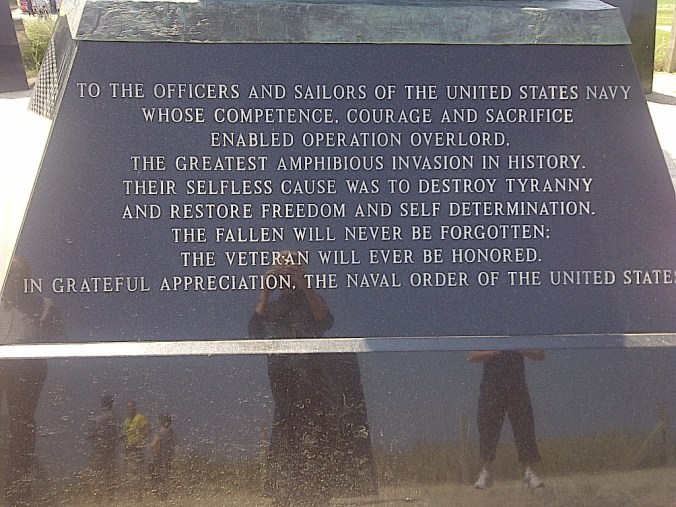
Here is the inscription on the Normandy memorial pictured above:
 Ethics Alarms
God bless our soldiers for their sacrifice. May all the fallen on the beaches of Normandy be gathered together in the Heavenly banquet, and may their names never be forgotten.
Please keep posting this, Jack. It is crucially important and deeply inspiring.
Hey, I promised! If you can’t trust an ethicist to keep a promise, who can you trust?
I reposted the image with some commentary on my facebook. Then it came up in facebook memories that I had doen this in years past.
What I commented on this year was that those same nations who were rescued from tyranny are now banding together to obstruct the efforts of IDF to conquer tyranny.
So in a sense we have forgotten the cause!
I hope you don’t mind but I shared this post to a few Instagram pages, one being the official Instagram page for Sen. John Kennedy. I thought your post was an important addition to remembering/honoring the soldiers who fought on the beaches.
jvb
Heck, I do these things so people will see them and think about them. I’m grateful any time a post is shared.
I posted it to the International Tomato Ranchers Blog I frequent, so you may see some far flung readership.
PWS