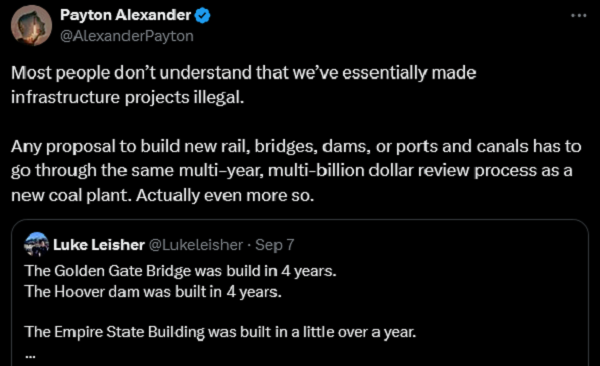
The tweet above illustrates a modern ethics zugzwang phenomenon. I was struck by the tweet because I had recently had an argument with my relentlessly Democratic sister about the Supreme Court’s decision in Relentless v. Department of Commerce and Loper Bright Enterprises v. Raimondo, striking down the landmark 1984 decision in Chevron v. Natural Resources Defense Council that made federal agencies the presumptive lawmakers in matters Congress had not specifically addressed if an agency rule was “reasonable.” She believes that Chevron’s fall will be a disaster.
I wish I had been astute enough to bring up the infrastructure crisis, which has been known about and yet largely unaddressed since Chevron was just a pup. Bridges, roads, railways, pipelines, airports, sewer systems, waterways and more—including the power grid— have been allowed to rot away or become unstable, and the amount of money it will take to bring the national infrastructure back to minimal safety and efficiency is staggering, in the trillions of dollars and rising fast.
The proliferation of state and national regulations is one of the reasons necessary infrastructure projects have stalled or been inadequate from their inception. What, however, is the alternative? It’s fine to wax nostalgic over the good ‘ol days, but a lot of the regulations that make construction projects take longer and cost more are the result of our increased knowledge about safety, energy, pollution, and urban planning. Failing to maintain the infrastructure is irresponsible, and has terrible, though often hidden, economic and human consequences. But launching major construction projects without proper attention to all of the considerations and unintended consequences we have learned about since the Empire State Building was built is irresponsible too.
So is simplifying difficult social balancing problems into tweets like that.
 Ethics Alarms
The problem is, ‘who should decide’? You can’t go with the government ‘experts’. Look at the wildfires in California. They are dangerous and destructive because the experts banned logging and didn’t want to clear the underbrush. The underbrush had been cleared before US citizens got to California. The ‘experts’ were the ones responsible for the largest PCB release in human history in Ohio, and no one was even punished for that. The environmental ‘experts’ caused the horrible metals release from the King’s Mine a few years ago. You can’t go with the ‘environmentalists’, because they are so unreasonable that nothing would be allowed. You can’t go with the companies, because they will do irresponsible stuff and pollute, cause secondary issues, without any care in the world.
So, who can you trust to decide? Since we now exist in a low-trust society, we can’t trust anyone to do the right thing. So, we have decided to do nothing.
I believe the answer is a single federal agency that handles issues that can have an impact within and across state lines because the costs and benefits associated with large scale projects affect the nation as a whole. It makes no sense to have a state environmental agency evaluate a project if the federal EPA has given a go ahead nor should an approved project be canceled by the feds after approval from another administration granted it. State regulators should only have aegis over issues that remain within the bounds of their borders.
The big beneficiaries of the myriad regulatory hurdles are lawyers, environmental groups and politicians who lobbyists seek to curry favor. Every person employed in a regulatory agency is incentivized to find reasons to expand regulations. This adds costs and leads to an inefficient allocation of resources. Similarly, non-profits never seem to ever be satisfied so they too seek new things to critique to preserve there employment.
But if every person employed by a regulatory agency is incentivized to find reasons to expand the regulations, then 1 all-powerful agency will be even worse. It will be the supreme target of lobbying, bribes, and ideological warfare. Look at the FDA.
The only possible answer is to put it up for a popular vote, if we had some kind of mechanism to allow the public to make an informed decision. Perhaps we can invent some way to inform the public of current events. I am open to suggestions.
The official number of deaths resulting from the construction of the Hoover Dam is 96.
Such a number would not be tolerated today.
Safety is expensive and time-consuming.
-Jut
96 over 4 years, is a concrete number. How much injury and death tests from our rotting infrastructure?
Our society is risk averse and responsibility deficient.
This aroused my curiosity…
DIA has three deaths associated wth its construction. Two ironworkers fell when a steel beam’s temporary welds gave way, and the third attributed to the demon horse bronco sculpture that killed its artist while he was moving it in his studio.
Many of those ninety-six deaths occurred IN concrete!
I believe the issue is the years of navigating the regulatory bodies before 1 spade of dirt is turned and before OSHA even has jurisdiction
5 PEOPLE DIED BUILDING THE EMPIRE STATE BUILING OVER 461 DAYS OF CONSTRUCTION. (1930031
THREE MEN DIED BUILDING THE VERRAZANO BRIDGE OVER YEARS OF CONTRUCTION
ELEVEN MEN (10 IN ONE DAY) DIED DURING HE CONSTRUCTION OF THE GOLDEN GATE IN 1936.
JUST SOME FACTS
Safety is one matter, but the big impediment from what I’ve seen is the environmental aspect. Any new project has to undergo studies for environmental impact and proposals for mitigation. Environmental groups regularly sue to prevent any disturbance of natural habitat. They also have a complicit EPA, which will refuse to defend itself in these sue-and-settle cases that continue to add more regulations onto the books that make it even more onerous to get permits to start projects. A new power plant looks at 10 years or more of fighting through permitting issues.
Si! Hoover Dam and Glen Canyon Dam and probably the entire Tennessee Valley system could never get built to day. And never mind any hydroelectric dams in the Pacific Northwest that allowed for the production of all that aluminum during World War II. Would the environment be better served had those dams not been built? Who knows, but the country would certainly be different, and less populated.
Most of the Interstate Highway system would not have been built had these regulations existed before construction started.
It isn’t that the EPA is refusing to defend itself, it is that the lawsuits were created intentionally as a way to fund leftwing activism with taxpayer money. Leftwing organization ‘sues’, the leftists in the agencies ‘settle’, and taxpayer money is ‘legally’ transferred from the taxpayer to a partisan organization.
That’s exactly right, though not the entire picture. Part of the sue-and-settle comes with promises from the EPA to “make things right,” which inevitably means more regulations that the environmentalist groups want, but would never pass through Congress. Even the EPA would hesitate to make those regulations, because the backlash and unconstitutional nature of them, but if they have the veneer of the sue-and-settle, then they get to say, “We didn’t want to do this, but this is now a court order…”
Having lived the past 14 years in the oil-and-gas field, I find that the gall of the EPA always inflames my ire. EPA delenda est.
Another problem with infrastructure is the public monopoly problem. Go to a neighborhood electric pole and photograph the transformer and wires. Make it sepia tone. Now, ask people if the picture is from 2024, 2004, 1964, or 1944. They can’t tell, because there has been essentially no change there. If a company made electrical transmission better or cheaper, their rates would be cut and they would make no additional money. So, there is no incentive to innovate. The equipment can be unreliable, expensive, an prone to damage, but they can get rates raised to cover that. They are allowed to make $X no matter what they do, so why do anything?