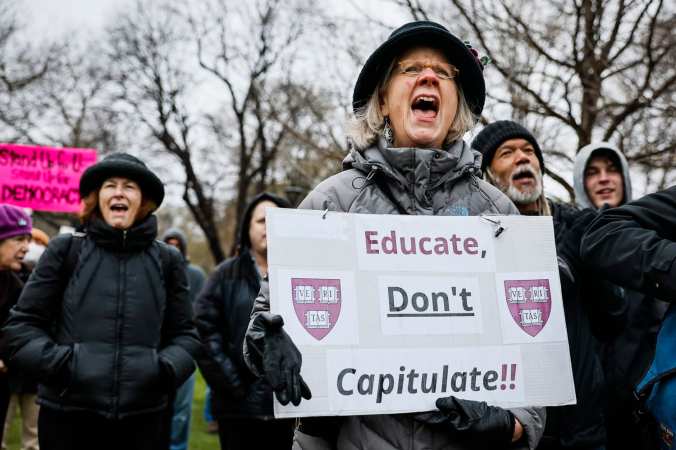
Steven Pinker, a professor of psychology at Harvard University and a conservative, which at Harvard is like being a Stegosaurus in the National Zoo, rose to defend his employers and colleagues with an op ed in the Times with the title above as its headline (but without the question mark). The theory is that since he’s not a typical campus leftist, his arguments should carry more weight when he takes the side of the people who issue his paycheck rather than the President who called the school “an Anti-Semitic, Far Left Institution,” a “Liberal mess” and a “threat to Democracy,” which has been “hiring almost all woke, Radical Left, idiots and ‘birdbrains’ who are only capable of teaching FAILURE to students and so-called future leaders.”
Actually, the op-ed is pretty funny. (That’s another gift link.) It brought to my mind two quotes: “Hitler did some good things too!” (From “Judgement at Nuremberg”) and “With friends like these, who needs enemies?” (Attributed to comedian Joey Adams.) Pinker lists a lot of the same problems (but far from all) at Harvard that I described and condemned long before Trump went after the school. Tellingly, he somehow neglects to mention the whole Claudine Gay fiasco, when Harvard selected a DEI-obsessed dean who had risen to a tenured place on the Harvard faculty with the help of academic plagiarism, then embarrassed the school testifying before Congress, and was initially defended by the Harvard brass even when it was revealed that her scholarly publications were so tainted that the equivalents would have gotten any student expelled. Funny how all that would slip his mind.
Pinker still makes a damning case against Harvard. He writes,
“My colleagues and I have worried for years about the erosion of academic freedom here, exemplified by some notorious persecutions. In 2021 the biologist Carole Hooven was demonized and ostracized, effectively driving her out of Harvard, for explaining in an interview how biology defines male and female. Her cancellation was the last straw that led us to create the academic freedom council, but it was neither the first nor the last. The epidemiologist Tyler VanderWeele was forced to grovel in “restorative justice” sessions when someone discovered that he had co-signed an amicus brief in the 2015 Supreme Court case arguing against same-sex marriage. A class by the bioengineer Kit Parker on evaluating crime prevention programs was quashed after students found it “disturbing.” The legal scholar Ronald Sullivan was dismissed as faculty dean of a residential house when his legal representation of Harvey Weinstein made students feel “unsafe.” The Foundation for Individual Rights and Expression tallies such incidents, and in the past two years ranked Harvard last in free speech among some 250 surveyed colleges and universities…Honest scholarly inquiry is difficult if researchers constantly have to watch their backs lest a professional remark expose them to character assassination, or if a conservative opinion is treated as a crime. In the Sullivan case, the university abdicated its responsibility to educate mature citizens by indulging its students’ emotions rather than teaching them about the Sixth Amendment and the difference between mob justice and the rule of law.”
And…
“According to a 2023 survey in The Harvard Crimson, 45 percent of members of the Faculty of Arts and Sciences identified their politics as “liberal,” 32 percent as “very liberal,” 20 percent as “moderate” and only 3 percent as “conservative” or “very conservative.” (The survey did not include the option “woke Radical Left idiot birdbrain.”) FIRE’s estimate of conservative faculty members is slightly higher, at 6 percent. A university need not be a representative democracy, but too little political diversity can compromise its mission. In 2015 a team of social scientists showed how a liberal monoculture had steered their field into scientific errors, such as prematurely concluding that liberals are less prejudiced than conservatives because they had tested for prejudice against African Americans and Muslims but not against evangelicals. A poll of my colleagues on the academic freedom council turned up many examples in which they felt political narrowness had skewed research in their specialties. In climate policy, it led to a focus on demonizing fossil fuel companies rather than acknowledging the universal desire for abundant energy; in pediatrics, taking all adolescents’ reported gender dysphoria at face value; in public health, advocating maximalist government interventions rather than cost-benefit analyses; in history, emphasizing the harms of colonialism but not of communism or Islamism; in social science, attributing all group disparities to racism but never to culture; and in women’s studies, permitting the study of sexism and stereotypes but not sexual selection, sexology or hormones (not coincidentally, Hooven’s specialty).”
And…
“Universities should set the expectation that faculty members leave their politics at the classroom door, and affirm the rationalist virtues of epistemic humility and active open-mindedness. To these ends, a bit of D.E.I. for conservatives would not hurt. As the economist Joan Robinson put it, “Ideology is like breath: You never smell your own.”
And…
“The most painful indictment of Harvard is its alleged antisemitism — not the old-money WASP snobbery of Oliver Barrett III, but a spillover of anti-Zionist zealotry. A recent, long-awaited report detailed many troubling incidents. Jewish students have felt intimidated by anti-Israel protests that have disrupted classes, ceremonies and everyday campus life, often met with a confused response by the university. Members of the teaching staff have gratuitously injected pro-Palestinian activism into courses or university programming. Many Jewish students, particularly Israelis, reported being ostracized or demonized by their peers.”
This, I remind you, is in an article defending the university. Pinker employs a wondrous series of rationalizations and “but…buts” to counter his own indictment. True, FIRE ranks Harvard the worst university in the nation regarding free speech, but come on, they aren’t THAT bad; after all, Harvard has never threatened him! Similarly, as a Jew, Pinler says that Harvard’s anti-Semitic culture on campus must be over-stated by its critics, because HE has never felt unsafe.
Yes, almost no conservatives teach students there, but students are not that easily indoctrinated. He writes, “…if Harvard is teaching its students to “despise the free-market system,” we’re not doing a very good job.” Ah! So indoctrination by colleges is OK as long as it isn’t successful!
Then Pinker resorts to listing all of the good things Harvard accomplished in the past, the inventions, discoveries, and patents. “For all its foibles, Harvard (together with other universities) has made the world a better place, significantly so,” he pleads. “Fifty-two faculty members have won Nobel Prizes [Me: Don’t get me started on those…], and more than 5,800 patents are held by Harvard. Its researchers invented baking powder, the first organ transplant, the programmable computer, the defibrillator, the syphilis test and oral rehydration therapy (a cheap treatment that has saved tens of millions of lives). They developed the theory of nuclear stability that has saved the world from Armageddon. They invented the golf tee and the catcher’s mask. Harvard spawned “Sesame Street,” The National Lampoon, “The Simpsons,” Microsoft and Facebook.”
Another quote comes to mind: “What have you done for us lately?”
Pinker then says that Harvard is really, really trying to reform and fix its problems. Sure. You could have fooled me: I read the alumni magazine, and the Harvard it paints is one without bias, political agendas or animus toward non-woke policies….which is, you know, a lie. It is also, of course, the greatest university in the world. Harvard is “a legend in its own mind.”
Pinker seems not to know that the metaphorical fish rots from the head down. The Trump administration is absolutely correct to point out the unethical, anti-democratic, biased, culturally destructive conduct at the most famous, prominent and richest university and force it to reform. That is the best and quickest way to address higher education’s toxic influence over American society and politics. Pinker attacks JD Vance calling his 2021 speech: “The Universities Are the Enemy.” JD Vance was right, and so is Trump’s battle with Harvard.
Pinker makes a strong case for both while supposedly arguing the opposite. What should we call that kind of derangement?
 Ethics Alarms
”Microsoft and Facebook” – yeah, both headed by people who didn’t think it was worth continuing and dropped out after a couple of years. I’m not sure it’s the feather in the cap he thinks it is.
Pinker’s article reminds me of the People’s front of Judea wondering what the Romans have ever done for them. “Other than the gaslighting, the course removals, the firings, the blacklisting, … what has the institution done that’s so bad?
I wonder if some of his “defenses” are a fig leaf he used to get it the article published.
The same thing occurred to me.
” JD Vance was right, and so is Trump’s battle with Harvard.”
A couple of weeks ago, we took a trip up to Michigan for a nice weekend away from home. On our way to Grand Rapids (where we stopped at the Gerald Ford Presidential Library to see the museum for the second time and to see Ford’s burial site for the first time), we returned to the Quayle Vice-Presidential Learning Center in Huntington, IN.
If you’re driving through Northern Indiana, the Center is worth a look. It’s housed in an old building that could have been a bank back in the day or a courthouse, but it actually a renovated church. Its two floors house a modest section on Huntington’s most famous son and one of Indiana’s six Vice-Presidents – Dan Quayle – and a larger (but still modest) section with exhibits on each Vice President. It has even been updated to include exhibits on Kamala Harris and JD Vance.
In the Quayle section – near his childhood sweater with “Danny” on it, his wife Marilyn’s inaugural ball and a Huntington high school band uniform – is a framed copy of “The Atlantic” magazine with the cover headlined, “Dan Quayle was Right”.
Those of you who are old enough (and I trust most of us here are) remember when the eponymous fictional title character – single, professional newswoman Murphy Brown – found herself unexpectedly pregnant. One can debate whether or not Dan Quayle chose the right example to make his point, but it created a huge hullabaloo nonetheless.
In a speech that referenced the recent riots in L.A. resulting from the Rodney King beating, Quayle addressed grievances in the Black community. He also pointed to crime and poverty statistics within the community and tied them to a lack of accountability on the part of fathers to support their children. The speech is linked here:
https://voicesofdemocracy.umd.edu/quayle-murphy-brown-speech-text-2/
Then he made a casual remark about how television doesn’t help set a good example when a high-profile character like Murphy Brown, who has the means to raise a child on her own, willingly dispenses with a father in her child’s life.
That became the money quote and it was endlessly panned on the news and even on a later episode of “Murphy Brown” itself. At the Emmy Awards, Murphy actress Candice Bergen addressed the issue by telling the single women viewing that night, “Don’t let anyone tell you you’re not a family”.
The mischaracterization of conservative remarks was going on even then: Quayle didn’t tell any person or group of persons they weren’t a family.
Hollywood has wanted to have its cake and eat it, too, for a long time. It loves celebrating all of the influence it has on the culture. How many times does it clap itself on the back for “bringing us all together” during the Moon Landing and the JFK assassination/funeral? How many times does it laud itself for affecting public opinion about the Vietnam War? (To echo our host: What has it done for us lately?) Yet, it never wants to acknowledge that it can negatively affect the culture, too.
In its April 1993 issue, “The Atlantic” published an editorial by Paul Vathis admitting that Quayle’s point was valid.
I get the same vibes here. Pinker wants to have and eat his cake. He wants to have conservative creds and to please his liberal masters (or, as Phlinn pointed out in his comment, at least allow his article to see the light of day). He wants to showcase all that Harvard has done in the past as if it excuses its dereliction of duty to the culture and the student body today. Harvard is biased against conservative voices, just as Hollywood is. They cannot be trusted to set the bar for intelligent discourse in our culture.
Quayle was right. JD Vance is right. Trump is right.
Nothing has changed since Quayle argued for the involvement of fathers 30-plus years ago. I hope things can change at Harvard and soon.
Excellent review. Eventually even Candace admitted that Quayle had a good point. My late wife Grace used to joke about Murphy’s “invisible baby,” much like Rob and Laura’s invisible son, Richie, whom the writers just ignored unless he had some function in the plot. Murphy had a male nanny, but she was almost never seen with the baby, and its existence didn’t cramp her style at all. Compare that show’s portrayal of a single mother with that of “The Affair,” where innocent, New Age, hippy Sierra wants a baby, and then finds out that she is stressed, panicked, miserable and even suicidal.
Exactly! It’s foolish for Americans to take cues from television characters, but acting is an art form and art can draw out emotion from audience members. Emotion influences people’s decisions, for better or for worse.
Murphy Brown making single motherhood look easy when she is never seen spending all night with a crying baby, when she can rely on some guy who showed up to paint her house and never left to watch her child for free and when motherhood never interferes with her job may be the goal to which white liberal women aspire, but it’s far from the reality for most single mothers in this country.
Pinker is not now or has ever been a “conservative.” His opinions have largely been embraced by those identifying as conservative because (in part) he has been willing to report when his research refutes “liberal” views/opinions.
But…but…HE says he’s a conservative!
That is something that would be VERY recent, as he has described himself as a “liberal Democrat.” I would not believe someone is conservative or liberal (the terms are ambiguous) if they historically characterized themselves as the opposite for the majority of their life. While it is possible to change, it is exceedingly difficult because it would include unlearning triggers and behaviors.
That’s an interesting and, I believe, valid point.
It makes the President an interesting case study as a counter-example. Prior to 2016, Donald Trump talked and acted like a typical New York-style liberal Democrat, including his political donations . . . until he ran for President as a Republican.
I didn’t vote for him in 2016 because I believed that, based on his past, he was really the worst kind of RINO: a life-long Democrat who was inexplicably wearing a tie with red elephants on it thanks to moral luck and a news media who preferred him in the primaries over anyone with an actual conservative record.
To my surprise–and delight–he governed as a conservative. I won’t say I think he did everything right (e.g. he bears some responsibility for what would later be called “Biden-flation” due to the “stimulus” checks that went out during his first administration), but his businessman’s focus on trying to bring the government within its means and reducing the tax and regulatory burden was exactly the sort of thing I wanted to see.
Due to that record as an actual POTUS, I proudly voted to re-elect him twice. (It didn’t hurt that “The Enemy of the People” turned on him as quickly and viciously as they did.)
Is this case a counter-example that disproves the premise…? Is it that fabled “exception which proves the rule”…? I don’t know. While I do still firmly believe that “Actions Speak Louder than Words” (a close cousin to this premise) I do have to acknowledge that people can change.
So yeah . . . I think I’m with you on this one. I have doubts that Pinker is actually any flavor of conservative. But even if he is more “classic liberal” than “progressive leftist”, in a weird way that still makes him an enemy of today’s Democrats.
So, Mr. Pinker, just because you say you’re one of us doesn’t make it so. But since you’re here, why not enjoy the party for a while. You’re more than welcome. You might even want to stay.
–Dwayne