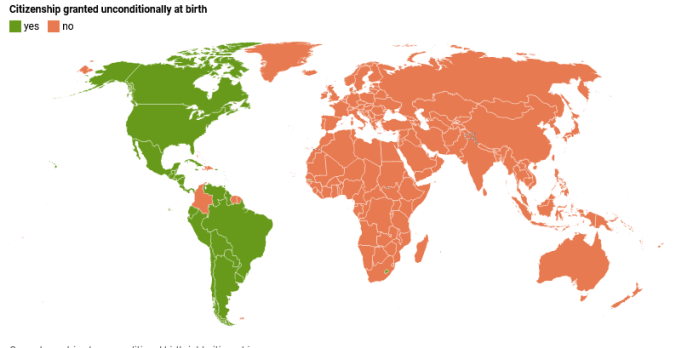
On both MSNBC and CNN today, a big deal was made over the fact that President Trump said that “no other country” confers automatic citizenship on those born within its borders. They were both sneering so hard that I bet they needed a lip massage afterwards, “Of course, 33 nations have birthright citizenship,” said one, with the other making a similar statement.
No question about it, they are right and Trump was wrong. What he meant, however, was “No nations anywhere but the Americas have birthright citizenship, and we are the only major power in the world that does.” Or, “Almost no nations that know what the fuck they are doing have birthright citizenship.” Presidents shouldn’t be that careless, but Trump is, he refuses to change, he’s not going to, and nobody should pretend that they are shocked when he does.
Here’s the list, as represented in the chart above: Antigua and Barbuda, Argentina, Barbados, Belize, Bolivia, Brazil, Canada, Chile, Costa Rica, Cuba, Dominica, Ecuador, El Salvador, Gambia, Grenada, Guatemala, Guyana, Honduras, Jamaica, Lesotho, Mexico, Nicaragua, Panama, Paraguay, Peru, Saint Kitts and Nevis, Saint Lucia, Saint Vincent and the Grenadines, Trinidad and Tobago, Tuvalu, United States, Uruguay, and Venezuela.
Cue up “one of these things,” except substitute “two” for one:
Got it! The two “things” out of place in that chart are the U.S. and Canada, and I’m giving Canada a big break. Again, of course Trump should be more careful when he spouts careless junk like that, but everyone knows he speaks in concept clouds. There is no justification for calling even botches that big “lies”at this point. Just correct him, and explain what he means.
Want a real lie? This is a real lie: Sen. Catherine Cortez Masto (D-Nev.) said in a statement, “The Fourteenth Amendment is clear: if you’re born in the United States, you’re an American citizen.” The 14th is definitely NOT “clear,” and if it were clear, we wouldn’t need the courts to address the issue.
The amendment states that all persons born or naturalized in the U.S. and “subject to its jurisdiction thereof “are citizens. Illegal immigrants and foreign diplomats among some other non-citizens are not fully under U.S. legal authority. I’d be willing to wager that the Senator can’t explain what “subject to its jurisdiction thereof ” is supposed to mean, if she evn knows it is there. If the 14th means and was meant to mean “all persons’ born in the U.S.,” why was the jurisdiction qualification put in there? Some legal scholars and historians maintain that the 14th Amendment was primarily intended to address the status of formerly enslaved people and their descendants, not to grant automatic citizenship to everyone born within U.S. borders.
Whatever the wording means, it is not “clear.”
 Ethics Alarms
The map suggests that all countries with birthright citizenship are in the Americas, but the list includes Lesotho and Gambia, which are both in Africa. A quick review of the topic on the interwebs suggests that the Founding Fathers endorsed birthright citizenship as it was understood at the time. From a 2014 National Geographic article on the topic entitled “How the Founding Fathers understood U.S. citizenship”:
“Federalists like Alexander Hamilton and anti-Federalists like Patrick Henry may not have agreed on much when crafting the Constitution, but they did share a common, practical understanding of English common law—a tradition the young nation inherited from Great Britain. Under common law, citizenship was determined using the principle of jus soli—a Latin term meaning “right of the soil” or birthright citizenship. In general, if one was born on British soil, then one was a British subject. The Founders carried this principle forward in their new government, and jus soli became the “law of the land” for American citizenship.”
Which means that “originalists” are useless in this matter. America was a country that needed as many new residents and citizens as it could get; there were no restrictions on immigration. And, of course, the 14th Amendment wasn’t the work of the Founders, but a post Civil War measure designed, with the 13th and 15th, to clean up the mess after the Civil War.
Correct. And the UK updated its laws in 1948, 1981, and 2002, after the general flood of migration switched from the UK exporting its people all over the globe to members of the former British Empire starting to immigrate to the UK. England in particular is crowded. And immigration was also a hot topic that led to the Brexit vote. Too many Polish people, etc.
It will be interesting to see how laws start to change as the world shifts gears from too many people to too few people (depopulation). The US hasn’t yet faced this challenge because immigration has compensated for below-replacement birthrates.
What would happen with respect to citizenship if a woman were to give birth while lying down perfectly on the American/Canadian border such that half her and the baby were in both countries? What would King Solomon do?
In what way are illegal immigrants “not fully under US legal authority?” To be in violation of the law is not at all the same thing as being outside its authority.
Good question for a court to answer. It would seem strange, though, if a foreign diplomat’s child was not a born citizen but someone not authorized to be here at all could still plant a child.What about a pregnant parachuting alien agent here to blow up a building? Is her child a citizen?
It may seem strange, but it’s a straightforward application of the text. The child of a supplier l diplomat would have diplomatic immunity, and therefore not be subject to the jurisdiction of the United States. A child born to an invading army would likewise not be subject to US jurisdiction, as the US would not have the practical ability to enforce its laws in areas held by the enemy.
But spies and saboteurs, being fully subject to arrest and punishment, would seem to be different. By a plain reading, their children (who despite their parents, we must agree are innocent) would be subject to our jurisdiction and born citizens.
It seems to me, that on a Textualist basis, birthright citizenship wins. Most arguments against it are Prudentialist in nature, arguments that start with the policy conclusion and only half-heartedly attempt to make the wording fit. They sound to my ear much like the arguments used by gun control lobbyists, trying to argue that “the right to keep and bear arms shall not be infringed” actually means some version of “the government shall restrict the keeping and bearing of arms in whatever way it feels proper” because they can’t imagine the Framers really meant what they wrote.
The best Originalist argument against birthright citizenship comes from several quotes made during the debate on the 14th Amendment, where several participants equate the effect of the citizenship clause with language in the 1866 Civil Rights Act that limits citizenship to those “not subject to a foreign power”, several of which are collected at this link.
I was musing yesterday about the similarity between the “militia” intro to the Second Amendment and the “jurisdiction” qualifier in the 14th. I think you’re right, and that SCOTUS will probably agree. It’s one more example of how the Constitution is out of date, and why conditions have changed so much over the centuries that the guardrails are misplaced. The idea that illegal aliens would sneak into the country (or that the party in control would allow millions of such cheaters in the back door) and anchor themselves by having babies here never crossed anyone’s mind in the 1860s or the 1780s.
The only two long-shot arguments to support limiting birthright citizenship to legal citizens I can imagine (absent an amendment) are 1) “The Constitution is not a suicide pact” and 2) context. The 13th, 14th and 15th concerned slavery and were post-Civil War amendments. I can see the argument that nothing in the 14th’s origin suggests a desire to create an unlimited birthright.
But all of that is tangential. Whatever it may be, the 14th is not “clear.”
The citizenship of the person is the final element of jurisdiction.
A citizen can not be deported, whereas a noncitizen could be given the boot.
So, “under” may mean “finally responsible for”.
The obvious problem with attempts to resolve the jurisdiction problem using citizenship, is that we’re trying to resolve issues of citizenship using jurisdiction. It’s a circular.
Just because Jus Soli is a doctrine meaning anyone born on the soil makes them a citizen does not mean that it is unconditional. Many countries require at least one parent to be a citizen and/or prior residency for a significant period of time prior to the birth of the child.
I have no difficulty accepting birthright citizenship but citizenship does not confer a right to live here until the age of majority. All children are subject to the jurisdiction of their parents until such time the law confers rights and obligations upon them. We do not by law hold children under ten (typically) responsible for serious crimes. Children cannot obtain public assistance on their own. No can they vote or participate in economic activity until much later.
If a citizen of this nation is transferred for work or simply decides to be an ex-pat the minor child cannot demand that he or she not move or that the parent can leave them behind on their own.
So if birthright citizenship is ruled the policy it cannot be used to provide the child with special rights of allowing parents to remain here that children born to natural citizens would not have. The child must follow the parents so if the parents are deported the child must follow them. The child upon reaching the age of majority can apply for a US passport to reflect his or her citizenship. Because our Naturalization process requires a renouncement of past allegiances.
“I hereby declare, on oath, that I absolutely and entirely renounce and abjure all allegiance and fidelity to any foreign prince, potentate, state, or sovereignty, of whom or which I have heretofore been a subject or citizen; that I will support and defend the Constitution and laws of the United States of America against all enemies, foreign and domestic; that I will bear true faith and allegiance to the same; that I will bear arms on behalf of the United States when required by the law; that I will perform noncombatant service in the Armed Forces of the United States when required by the law; that I will perform work of national importance under civilian direction when required by the law; and that I take this obligation freely, without any mental reservation or purpose of evasion; so help me God.”
Birth Tourism: 10 Best Countries for Birthright Citizenship
If you read content in the website above. It is obvious that the rationale for getting birthright citizenship is for the benefits that accrue to the child and in some cases the parents. This dilutes the entire concept of citizenship. Citizenship confers rights but also obligations. Dual citizens cannot pledge allegiance to a single country. Therefore, if Naturalized citizens must renounce all fidelity to another government then so too must our birthright citizens.
You cannot have your cake and eat it too.
This is an intriguing resolution that I had not considered before. Is any infant completely subject to the jurisdiction of the US? We hold both the rights and responsibilities of citizenship in abeyance until the age of majority. And our laws do recognize such a thing as being a US National without being a US Citizen.
Imagine a system where nobody is born a citizen, but the US-born (or those born to US parents) may, at any time after achieving their majority, become US citizens by pledging their allegiance, abjuring any fealty to foreign powers. The are obvious issues with this interpretation, not the least of which being that it resembles nothing like what the authors of the amendment described, but it’s food for thought.