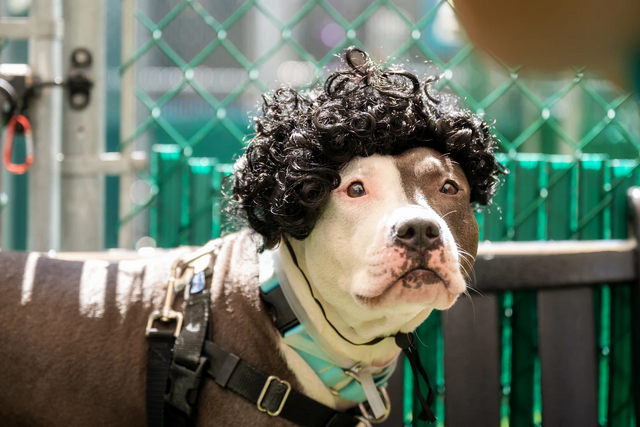
Finding its facilities with a surplus of pit bull breeds and pit bull mixes to find homes for, the Animal Care Centers of New York City hit on a creative solution. It released a video that opens with “We’ve never seen this many doodles at our shelter before.” What follows is a series of photos and video clips of “doodles” that are really obvious pit bull mixes wearing curly wigs.
“Doodles,” for the dog-challenged, refers to the popular designer breeds and other mixes of non-poodle dog breeds with poodles, usually creating digs with hypoallergenic coats. Labradoodles are poodles crossed with Labrador Retrievers, Sheepadoodles are English Sheep Dog-poodle mixes, and Golden Doodles, the most popular of all, are poodles bred with Golden Retrievers.
The video mocks the “doodles” craze while also placing their much maligned (and unjustly so) pit bulls and pit bull mixes in a benign light. And mirabale dictu, it worked! Families who never would have considered adopting a pit bull type dogs came to the shelter and did so, and the staff at the shelters believe that the video is being widely circulated, helping to dispel the wide-spread fear of and bias against these loving, sweet tempered dogs perpetuated by ignorant anti-pit bigots.
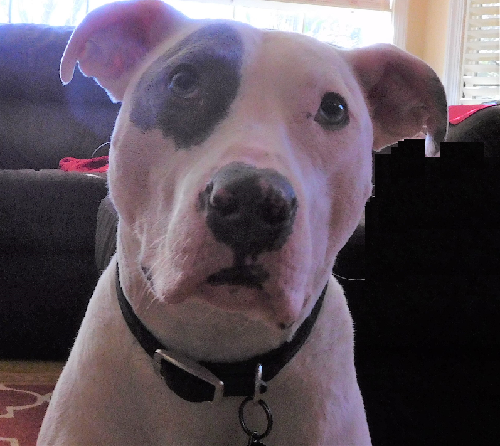
Spuds approves.
 Ethics Alarms
Good boy, Spuds.
Some very good friends of ours have a Staffordshire and it’s one of the sweetest dogs I’ve met…as sweet and calm as Bailey was. Kudos to ACC of NYC for the campaign, and to the families that responded.
Dog stories with happy endings are ALWAYS the best.
Lord Remington Winchester Burger, I, Esq., Dog of Letters, approves. Yes, he does.
jvb
…still the best dog name ever!!
i always thought when one pure breed mixes with another purebreed, the resultant offspring were referred to as “Mutts”. Mutts are good often good dogs but I guess theword was not marketable, thu we have made up “new breeds”.
i always thought when one pure breed mixes with another purebreed, the resultant offspring were referred to as “Mutts”. Mutts are good often good dogs but I guess theword was not marketable, thu we have made up “new breeds”.
Example of how the Golden retriever (now a beloved and established breed that was once “new”) was created:
“Golden” Retrievers were created in the late 19th century by Sir Dudley Marjoribanks, who cross-bred Flat-coated Retrievers with Tweed Water Spaniels, along with some infusions of Red Setter, Labrador Retriever, and Bloodhound. This breeding aimed to develop a versatile and gentle retriever suitable for hunting and companionship.”
When I was in Scotland in 2019, our tour included a visit to the “ancestral home” of this breed in the Scottish highlands. Very cool.
Golden Doodles are goofy, less serious than Standard Poodles, and more lively than Golden Retrievers. They also are big and strong. Spuds loves them.
I’m not a fan of Golden Doodles, though I would never deny one that desires a treat or to be petted. They are more lively, that is true. A neighbor has two Golden Retrievers and they are special pups…just friendly as all get-out and a joy to be around.
Two days ago my wife and I walked outside to get the mail and my jaw nearly hit the pavement. It was almost as though I saw Bailey-brought-back-to-life. A young lady was walking a dog that was nearly Bailey’s twin…in size, in color, and in demeanor. She took a treat with the same gentleness and care that Bailey did. What a moment…I can’t wait to see her again…
thanks for theinformation. I thought the golden retriever was a color varient of the labrador along with the chocoalte, and black coated labrador.
My chocolate lab had AKC papers as a LABRADOR. and we competed with Labradors at AKC santioned shows
I thought “mutt” referred to dogs where the breed ancestry wasn’t easily determined. Wikipedia says it’s essentially synonymous with “mongrel”.
This is, basically, how new breeds are created. Mutts are what results from unsupervised breeding, and DNA tests will often flag multiple breeds as ancestors.
New breeds like the doodles are what result from deliberate human-controlled breeding programs. Crossbreeding (selective introduction of diversity, usually NOT from another strict pure breed) is also a deliberate strategy to counter the type of genetic weaknesses that result from excessive inbreeding within a recognized breed.
https://www.instituteofcaninebiology.org/blog/the-5-most-important-things-to-know-about-cross-breeding
oops, that should have posted as a reply to deacondan86…