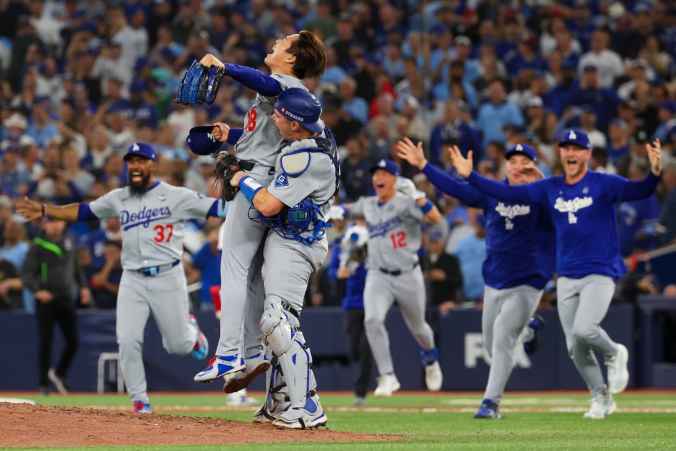
If you missed last night’s Game 7 of the epic World Series just completed, you have my sympathy; if you missed it, or the entire Series really, because baseball isn’t part of your life you have my pity. Let me quote here the late, great Roger Angell, baseball’s Bard, writing about the only better World Series I’ve ever watched, the 1975 edition where the Cincinnati Reds beat (barely) the Boston Red Sox, also in seven games. He was effusing specifically about Carlton Fisk’s famous home run in the 12th inning (I was there!) in his New Yorker essay “Agincourt and After”:
“Carlton Fisk, leading off the bottom of the twelfth against Pat Darcy, the eighth Reds pitcher of the night—it was well into morning now, in fact—socked the second pitch up and out, farther and farther into the darkness above the lights, and when it came down at last, re-illuminated, it struck the topmost, innermost edge of the screen inside the yellow left-field foul pole and glanced sharply down and bounced on the grass: a fair ball, fair all the way. I was watching the ball, of course, so I missed what everyone on television saw—Fisk waving wildly, weaving and writhing and gyrating along the first-base line, as he wished the ball fair, forced it fair with his entire body. He circled the bases in triumph, in sudden company with several hundred fans, and jumped on home plate with both feet, and John Kiley, the Fenway Park organist, played Handel’s “Hallelujah Chorus,” fortissimo, and then followed with other appropriately exuberant classical selections, and for the second time that evening I suddenly remembered all my old absent and distant Sox-afflicted friends (and all the other Red Sox fans, all over New England), and I thought of them—in Brookline, Mass., and Brooklin, Maine; in Beverly Farms and Mashpee and Presque Isle and North Conway and Damariscotta; in Pomfret, Connecticut, and Pomfret, Vermont; in Wayland and Providence and Revere and Nashua, and in both the Concords and all four Manchesters; and in Raymond, New Hampshire (where Carlton Fisk lives), and Bellows Falls, Vermont (where Carlton Fisk was born), and I saw all of them dancing and shouting and kissing and leaping about like the fans at Fenway—jumping up and down in their bedrooms and kitchens and living rooms, and in bars and trailers, and even in some boats here and there, I suppose, and on backcountry roads (a lone driver getting the news over the radio and blowing his horn over and over, and finally pulling up and getting out and leaping up and down on the cold macadam, yelling into the night), and all of them, for once at least, utterly joyful and believing in that joy—alight with it.
…What I do know is that this belonging and caring is what our games are all about; this is what we come for. It is foolish and childish, on the face of it, to affiliate ourselves with anything so insignificant and patently contrived and commercially exploitative as a professional sports team, and the amused superiority and icy scorn that the non-fan directs at the sports nut (I know this look—I know it by heart) is understandable and almost unanswerable. Almost. What is left out of this calculation, it seems to me, is the business of caring—caring deeply and passionately, really caring—which is a capacity or an emotion that has almost gone out of our lives. And so it seems possible that we have come to a time when it no longer matters so much what the caring is about, how frail or foolish is the object of that concern, as long as the feeling itself can be saved. Naïveté—the infantile and ignoble joy that sends a grown man or woman to dancing and shouting with joy in the middle of the night over the haphazardous flight of a distant ball—seems a small price to pay for such a gift.”
Caring is an ethical value.
I’ll get to the other ethics news in Part 2…
 Ethics Alarms
Well, I missed the 16th inning, but otherwise I was there for all of it.
I admit, I could not believe that Yamamoto was actually coming out and pitching last night — and even more that he was pitching effectively.
Ohtani looked tired to me when he was pitching, but the Blue Jays could only get three runs. That was the pattern of the night — the Blue Jays kept threatening, kept getting hits off the Dodger pitchers, but they just could not bring those runs home and wrap up the game.
I also noticed that both game 6 and 7 ended on a double play, albeit wildly different ones.
I trust Yamamato was a unanimous MVP of the Series. He earned it and then some.
It was an exciting, tense World Series — the best baseball could ever hope for, even if the wrong team one. Anyone who had nails going in, probably has none now.
Agree with all of this. Yes, Yamamoto was the MVP. It was when the Dodgers signed him over the winter that everyone started saying they were ruining baseball and were unbeatable. Well, in the end the latter was correct, but they certainly haven’t ruined baseball yet. And the team is old. I wouldn’t bet on a three-peat.
One other thing I’ll say about Ohtani. You could see the enthusiasm just radiating off that man. There was obviously nothing routine about him playing in the World Series. That might have had something to do with his toiling for 40 days and 40 nights in the wasteland that is the Angels…..
“You could see the enthusiasm just radiating off that man.”
This he had in reserve after he GOES YARD THREE TIMES…WITH 10 Ks, as L.A. stomped my horrendously over-matched Brewers.
FWIW, I can truly appreciate a…um…healthy…er…dislike for one’s team’s rivals.
PWS
I should have watched more of this Series, as it turned out to be fantastic. The Blue Jays gave the Dodgers every bit of seven games…eight-games-plus if you count all the extra innings. Yeah, the Dodger ownership spent enough money on payroll to fund a significant government program, but at day’s end, it was still great baseball.
Dad and I are still hoping for that elusive Red Sox / Braves World Series matchup. We came oh-so-close in 2021. Maybe in 2026…
Sorry guys. I’d say better luck next time, but you know . . .