Well, unfortunately I started thinking that it’s beginning to look a lot like Christmas this week, so I’m depressed and miserable.
It’s my favorite time of the year because its the most ethical time of the year, but my wife, who was a Christmas fanatic, is dead; my son, who now insists that she’s my daughter, barely speaks to me though I have been nothing but supportive (because that’s my job); my sister is going to be across country for the holiday; and my mom, who was the center of every Christmas in my life as long as she was breathing, breathes no more. I have neither the time to decorate a tree properly (like I used to) nor the resources to purchase one, and half-hearted decorations will only remind me of 2702 Westminster Place glories past. But I can’t avoid Christmas, just as I can’t avoid ““It’s a Wonderful Life”” as you know. So I’ll be celebrating my favorite holiday here, on Ethics Alarms, with my five loyal readers and the other visitors who drop in, and pretty much nowhere else. That means, among other gifts, I will be bestowing various Christmas-related post from the Ethics Alarms Christmas attic. Like this one…
***
Considering that Christmas is our culture’s ethics holiday as well as a religious one, it is remarkable that only one traditional carol—and no modern holiday songs—celebrates ethical conduct. The one carol is “Good King Wenceslas,” and a strange one it is.
The lyrics are by J. M. Neale (1818-66), and were first published in 1853. Neale is a superstar in the Christmas Carol firmament: he also is responsible for the English lyrics of “Good Christian Men, Rejoice,” and “O Come, O Come, Emmanuel,” both of which you hear much more frequently than “Good King Wenceslas.” One reason is that the ethical carol tells a story in ten verses, and if you don’t sing them all, the story doesn’t make sense. There are very few recordings of the song in which all the verses are sung. Ten verses is also a lot to remember for any song. My elementary school used to teach the whole carol to sixth graders for the Christmas assembly, but let them have crib sheets. This was before it was decreed that allowing children to learn, sing and listen to some of the most lovely and memorable songs in Western culture was a form of insidious religious indoctrination.
Here is the whole carol:
Good King Wenceslas looked out
On the feast of Stephen,
When the snow lay round about
Deep and crisp and even;
Brightly shone the moon that night
Though the frost was cruel,
When a poor man came in sight,
Gath’ring winter fuel.
‘Hither, page, and stand by me,
If thou know’st it, telling
Yonder peasant, who is he?
Where and what his dwelling?’
‘Sire, he lives a good league hence,
Underneath the mountain,
Right against the forest fence,
By Saint Agnes’ fountain.’
‘Bring me flesh and bring me wine,
Bring me pine logs hither,
Thou and I will see him dine
When we bear them thither.’
Page and monarch forth they went,
Forth they went together,
Through the rude wind’s wild lament
And the bitter weather.
‘Sire, the night is darker now
And the wind blows stronger;
Fails my heart, I know not how,
I can go no longer.’
‘Mark my footsteps, good my page,
Tread thou in them boldly:
Thou shalt find the winter’s rage
Freeze thy blood less coldly.’
In his master’s steps he trod,
Where the snow lay dinted;
Heat was in the very sod
Which the Saint had printed.
Therefore, Christian men, be sure
Wealth or rank possessing,
Ye who now will bless the poor
Shall yourselves find blessing.
For one thing, “Good King Wenceslas” has little to do with Christmas Day, and doesn’t mention Jesus or the Nativity. The Feast of St. Stephen is also known as Boxing Day, the day after Christmas, December 26. It is a British Commonwealth tradition that never caught on in the U.S. In some European countries like Germany, Poland, the Netherlands and the Nordic counties, the 26th is Second Christmas.” Americans think “Boxing Day” refers to the post-Christmas clean-up of boxes and wrapping left over from Christmas gift exchanges. No. The term “Christmas-box” dates back to the 17th century, and refers to the tradition of giving tips, gifts, or Christmas bonuses, contained in a box, to postmen, tradesmen, errand-boys, and servants. It was the wealthy citizens’ treatment of servants that spawned the tradition: since servants would have to wait on their masters on Christmas Day, they were allowed to be with their families the next day, and each servant received a Christmas box to take home. Typically the boxes contained gifts, money and sometimes leftover food from the Christmas feast. In the U.S., Christmas bonuses are a vestige of Boxing Day.
Back to the king: nobody is sure where the particular story came from. The star of the carol was Wenceslas I (907 – September 28, 935), also known as Václav the Good, the Duke of Bohemia from 921, when he was 14, until his assassination in 935, when he was just 28. His younger brother, Boleslaus the Cruel, plotted the murder.
[Helpful tip : when your brother is named “the Cruel,” don’t turn your back on him.]
Poor Wenceslas was considered a martyr and a saint immediately after his death, in part because of legends and tales relating to his generosity to the poor. One historian, Cosmas of Prague, writing in 1119, claimed,
But his deeds I think you know better than I could tell you; for, as is read in his Passion, no one doubts that, rising every night from his noble bed, with bare feet and only one chamberlain, he went around to God’s churches and gave alms generously to widows, orphans, those in prison and afflicted by every difficulty, so much so that he was considered, not a prince, but the father of all the wretched.
After several centuries later the legend was accepted as fact, just like in “The Man Who Shot Liberty Valance,” a movie which inspired an even catchier song, a hit by Gene Pitney—
—but that song has absolutely nothing to do with Christmas, and I can’t find any evidence that Gene ever sang “Good King Wenceslas.” Never mind. Where was I? Oh, right, the Wenseslas legends…
After several hundred years, they were proclaimed as fact by Pope Pius II. Among the legends transmuted into fact was one about how a Count Radislas raised an army against Wenceslas, who tried to avoid bloodshed by making offers of compromise and peace. Radislas viewed the duke’s conciliatory stance as a sign of cowardice, and marched his forces into confrontation with the soldiers of Wenceslas. As the two armies faced each other, Wenceslas, to avoid unnecessary carnage, challenged Radislas to individual combat, which the rebellious count accepted.
As Radislas advanced toward the duke on horseback, he saw two angels hovering on either side of Wenceslas. They cried out, “Stand off!” Stunned by the amazing sight and sound and filled with a sudden respect for the duke’s virtue and holiness, Radislas dismounted, fell at the saint’s feet, and begged for a pardon.
Wenceslas killed him on the spot. Just kidding! He immediately forgave Radislas and embraced him. Of course he did! He was Good King Wenceslas!
Another legend, still current, claims that when Czechoslovakia (The Good King is the patron saint of the Czechs) is in existential peril, the equestrian statue of King Wenceslas (or Wenceslaus) in Wenceslaus Square….
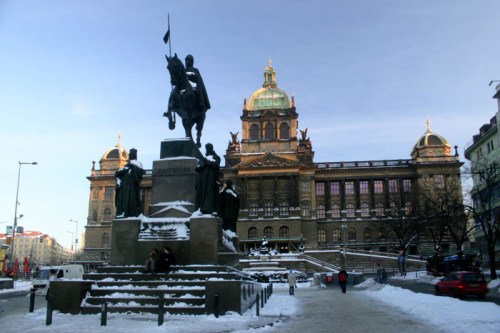
…will come to life, raise a sleeping army of knights, and slay all the enemies of the Czechs, thus bringing peace and prosperity to the land. ( Doesn’t that sound like the plot of “The Mummy”?) Why the statue chose to sit out the Soviet invasion of Prague in 1968 has never been explained. I’d think the Czechs would be still a little peeved about it, though.
The carol itself has its puzzles. Why does the king think a poor man who lives by the forest needs wood? Is the main point of the story that he brings food to a poor man, or that he has the brilliant idea of letting his freezing page re-use his foot prints? And why would there be any warmth in the snow?
Nonetheless, the carol does extol kindness and charity. If only it didn’t spoil the ethical exhortation by promising a reward; ethical acts are their own reward. It isn’t altruistic conduct if you expect to benefit personally. As we know, Wenceslas’s reward was to be killed by his brother before he was 30.
Some blessing.
Take it, Bing…
 Ethics Alarms
One of my favorite carols. It’s heartwarming. I particularly like the Regency College Choir version.
Probably because he was gathering it by moonlight, indicating something was keeping him from gathering it in the daytime.
Make that six loyal readers, Jack.
I can empathize some with you regarding holidays and I’m sorry you’re spending Christmas alone, but as sure as others will repeat, you’re not completely alone as there many people who look forward to reading your posts every single day.
EA is my first stop each morning as I’m drinking coffee and waking up. Regardless of the topic (except baseball) and whether or not I agree with what you or anyone else posts, I know I won’t be disappointed in the content here.
Thank you for continuing to do something out of your love of the vocation even though it’s often aggravating and a time and money pit.
“Why does the king think a poor man who lives by the forest needs wood?”
For some reason I thought “by the forest fence” implied he lived by the king’s forest and cutting down wood there would have been illegal. Gathering winter fuel then meant hoping to find any twigs and branches that had fallen by nature and not man’s effort.
The king, here, presumably sees his subject following the law to no avail in dire conditions.
I also assumed the warmth was not physical as much as it was social/spiritual for doing a good deed.
Why does the king think a poor man who lives by the forest needs wood? Is the main point of the story that he brings food to a poor man, or that he has the brilliant idea of letting his freezing page re-use his foot prints? And why would there be any warmth in the snow?
Thank you for your time. I appreciate your articles and more as someone who had a very poor history teacher your essays on presidents, US and world history and the history of baseball have been educational. I particularly appreciate the holiday essays. I hope you can find some of the generosity you give within your community this holiday season. Perhaps you can create some new traditions. As one of my favorite children’s books called Cheer Up Chicken! my grandma gave my girls. “All gave, and all received and all were blessed.” Many are better at giving than receiving oddly enough. May you receive the gift of friendship and community this holiday season.
Two other rarely-posting-but-always-reading fans here….your words of wisdom, biting humor, and sanity are tops as we start our days. And, we are guilty of sharing your posts frequently with those who need the valuable wake-up calls.
Kudos for the real difference you are making in how others view life’s events…whether the aggravating, joyous, or mundane….we are wiser for reading your take on it all.
Ann and Glenn
PS…..we love this gal’s take on “moving on” vs “moving forward”
https://elizabethkleinfeld.com/2022/04/29/moving-on-versus-moving-forward-with-grief/
I’m sorry you’re going through such a hard time, Jack, and sorry to read about your son’s decisions to transition and estrange himself from you. On both counts, I hope he wakes up soon.
Regarding the “spoiled” ethical exhortation:
The promise of blessings and heavenly rewards for faithfulness and good works appears throughout the New Testament. So, if it can’t be considered altruism if one expects to benefit personally, then I don’t see how practicing Christians can ever be capable of truly altruistic conduct.
“[Helpful tip : when your brother is named “the Cruel,” don’t turn your back on him.]”
That’s why I keep coming back to Ethics Alarms every day: for the life-changing bits of wisdom one finds here.
“…the equestrian statue of King Wenceslas…will come to life, raise a sleeping army of knights, and slay all the enemies of the Czechs, thus bringing peace and prosperity to the land. (Doesn’t that sound like the plot of “The Mummy”)?”
I was thinking Lord of the Rings, where Aragorn raises the Army of the Dead. I wouldn’t be surprised to find this was a common theme in mythology.
I’d also be wondering where was that statue in 1938/39 when the Nazis came calling.
I don’t think I’ve ever seen the lyrics to Good King Wenceslas, although I certainly know the tune. Hearing his actual story was quite enlightening.
I hope your son is able to reconcile with you sooner than later. I wonder if he is mourning his mother’s death and still having difficulty with it.
Actually, isn’t there a Danish legend about Holger Danske, who will return to save Denmark in its extreme need?
I believe it was Poul Anderson who wrote a science fiction story using that theme. The story, of course, was fiction but I assume the legend was real.
I think this is a fairly common theme.
According to legend, El Cid’s dead body was clad in armor, placed on a horse and used to lead the armies of Spain to victory in the Battle of Valencia.
Yep. Three Hearts and Three Lions. Pretty good read. It’s straight fantasy, rather than sci-fi, though Holger’s scientific knowledge helps him out in a few situations.
“The Big Bang Theory” had a funny episode where Sheldon had everyone sing the entire song. It was clever.
jvb
Always liked that song, but never paid much attention to the message before. Thanks for that!
Don’t know what your living situation is but putting up lights outside always helps bring a little cheeriness to me in the winter darkness. I am also grateful to my neighbors who decorate because it helps me figure out where the road is when it is very foggy and dark on my hill, a frequent combination at this time of year.