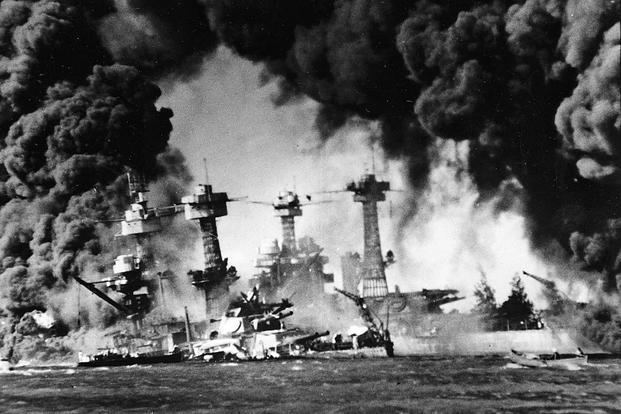
Remember.
I have nothing unique to add about the attack by the Japanese on Pearl Harbor on this date in 1941, except to note that the lack of mention of it in the news media today is disheartening and, I believe, inexcusable. I’m estopped from complaining too much however: to my amazement and shame, Ethics Alarms has never devoted an entire post to the event since I began writing it 16 years ago. I’ll begin my amends now.
Here is the History Channel’s article on the attack, one of the rare, epochal events of which it can be said without dispute changed everything….
On December 7, 1941, at 7:55 a.m. Hawaii time, a Japanese dive bomber bearing the red symbol of the Rising Sun of Japan on its wings appears out of the clouds above the island of Oahu. A swarm of 360 Japanese warplanes followed, descending on the U.S. naval base at Pearl Harbor in a ferocious assault. The surprise attack struck a critical blow against the U.S. Pacific fleet and drew the United States irrevocably into World War II.
With diplomatic negotiations with Japan breaking down, President Franklin D. Roosevelt and his advisers knew that an imminent Japanese attack was probable, but nothing had been done to increase security at the important naval base at Pearl Harbor. It was Sunday morning, and many military personnel had been given passes to attend religious services off base. At 7:02 a.m., two radar operators spotted large groups of aircraft in flight toward the island from the north, but, with a flight of B-17s expected from the United States at the time, they were told to sound no alarm. Thus, the Japanese air assault came as a devastating surprise to the naval base.
Much of the Pacific fleet was rendered useless: Five of eight battleships, three destroyers, and seven other ships were sunk or severely damaged, and more than 200 aircraft were destroyed. A total of 2,400 Americans were killed and 1,200 were wounded, many while valiantly attempting to repulse the attack. Japan’s losses were some 30 planes, five midget submarines, and fewer than 100 men. Fortunately for the United States, all three Pacific fleet carriers were out at sea on training maneuvers. These giant aircraft carriers would have their revenge against Japan six months later at the Battle of Midway, reversing the tide against the previously invincible Japanese navy in a spectacular victory.
 Ethics Alarms
I’ve always been fascinated by The Battle of Midway, probably because Mr. Moore, the father of the seven Moore children in our parish and, by the time we were growing up, a downtown Miami banker, was a Marine pilot at Midway. There’s also the remarkable scene in the movie “Midway” where the Japanese commander states to his staff they have just lost the war. Finally, I’ve always been amazed by what the United States was able to accomplish in terms of industrial output during the four short years the war was waged. The United States simply outproduced the Axis. The Japanese, among others, made a fatal miscalculation.
The following is excerpted from an article by D. Clark, a researcher at a website called Statista:
“The Second World War marked an important development in the history of naval warfare, as it was the time when the aircraft carrier replaced the battleship as the central vessel of the modern navy. Aerial warfare had already emerged in the First World War, but its potential at sea had not yet been realized – the attack on Pearl Harbor was an example of just how destructive air raids from the sea could be, but it was not until the battles of 1942 where the aircraft carrier cemented its position as the most important military vessel. In the war’s early years, the Japanese Navy had the numerical advantage over the United States, but U.S. production would then see this balance shift in the Allies’ favor in 1943.
When the U.S. joined the war in late 1941, Japan had already been at war in the Pacific theater for roughly 4.5 years and had 11 aircraft carriers in its navy – in contrast, the U.S. navy had seven aircraft carriers in its possession, split between the Pacific and Atlantic. When both navies clashed in mid-1942, Japan lost one carrier in the Battle of the Coral Sea, before the U.S. sunk four at the Battle of Midway, at the expense of just one – other U.S. carrier losses were in smaller battles.
In 1943, U.S. naval production was at its highest level in the war, and this year’s output alone exceeded the total wartime output of all other major powers combined. The Allied counteroffensive against Japan was disrupting its ability to reinforce its navy, and heavy losses in the previous two years meant that Japan had also lost a large number of its most skilled pilots and engineers. The Imperial Japanese Navy never truly recovered from Midway and would possess a total of 18 aircraft carriers throughout the war, but 14 of these were ultimately lost – the majority of which fell around the Philippines, with three sunk during the Battle of the Philippine Sea. The U.S. lost just one aircraft carrier after 1942, at the Battle of Leyte Gulf, and it would finish the war with 29 aircraft carriers in its navy, compared to just four for the Japanese.”
And of course, there are USS Arizona displays aplenty here in Arizona. The Arizona’s china and silver service is on display at the state capitol. There’s even a display, including a chunk of rusted steel from the Arizona, at the Nogales historical society where Mrs. OB volunteers. We were in Honolulu a couple of years back and Mrs. OB took grandson number one on a guided tour of Pearl Harbor, including the Arizona memorial. I didn’t go. Couldn’t face it. Too sad.
“The United States simply outproduced the Axis.”
And it wasn’t even our out-production that won the war. If I recall the effects of ramped up industrial production didn’t really kick in until it was obvious the Japanese were in retreat.
What beat the Japanese was a combination of a handful of things we did that they didn’t do:
1) yes the industrialism was important – but probably more so from a small parts / munitions aspect and less so from a “new battleships” and “new destroyers” and “new air craft carriers” aspect.
2) we were repair crazy. It mattered less which fleet won a particular naval engagement- the Japanese won some, we won some. Whatever that really meant, both fleets had to limp away from the scene to repair and refit.
But our fleets went straight into repair- repaired faster and often times repaired on the way back to the front. So even in engagements we lost- our ships were back on the front faster and therefore as a matter of “available” ships we outnumbered them.
3) killing their pilots. This is where the war was won. And this was always on the balance- once either side had a majority of experienced pilots the side would always dominate the air as the lesser side would have to constantly field new pilots to replace the dead and the better side’s experienced pilots stayed alive and would only become more veteran.
We won that balance early on and Japan would never have an opportunity to get equal pilots in the air again.
“all three Pacific fleet carriers were out at sea on training maneuvers.”
Anything to the Conspiracy Theory that FDR knew what was coming?
PWS
The book “Day of Deceit” by Robert Stinnett is still available at Amazon. This book propagates the theory that FDR knew in advance of the Pearl Harbor attack and let it happen in order to encourage USA entry into World War II.
And so is “Target Patton: The Plot to Assassinate General George S. Patton” by Robert Wilcox, which states that General Patton did not simply die as result of a car accident but was in fact assassinated by US intelligence officers.
Both authors have passed away, and can therefore not be interviewed by Tucker Carlson anymore.
I have not read the books, as I do not want to spend too much time on conspiracy theories. Maybe our host Jack knows those books?
I know the books. Dipped into both and decided they were Oliver Stone-level brain poison.
It’s a ridiculous theory. Even assuming that FDR was eager to get into the fight, letting the Japanese attack us to draw us into the conflict would have been catastrophically stupid.
None of this means that we would not have eventually been drawn into the war with Germany, as well. In fact, it’s probable that we would have. But a conspiracy would have required a lot of pieces to come together to work and the lynch pin of that conspiracy would have been correctly guessing what Hitler would do. I know people want to believe that a group of Japanese fliers were let into our airspace, but it would seem that, just like the 9/11 hijackers 60 years later, the successful attack and destruction beyond even what the attackers anticipated was the result of communication and intelligence failures, as well as a possible underestimating of the moxie of the Japanese.
The FDR set up the Pacific fleet to be nearly destroyed theory is only slightly less ridiculous than the “Bush helped bomb the Twin Towers” conspiracy theory, which really says something, since the latter, as Sidney Wang tells us, is the stupidest theory ever.
Luckily, the Germans completely “missed the boat” on aircraft carriers and, for various reasons, never completed a single one. Ironically, their fearsome battleship, Bismarck, was sunk after one of its rudders was disabled by a British torpedo bomber launched from an aircraft carrier. That left it a sitting duck, only able to turn in circles.
At the risk of being subject to the ire of certain occasional commenters, I’m going to reply to myself by adding the note that the British did considerably more than “double-tap” the disabled Bismarck.
One chortle. Two chortles.
The history of European warfare since the age of sail has been one land based power after another seeking hegemony on continental Europe and one peripheral European naval power after another seeking to form coalitions to halt that hegemony.