I really try not to get emotional over ethics stories, but the current Editorial Board declaration in the New York Times headlined, “It’s Time for America to Admit That It Has a Marijuana Problem” makes me want to run screaming naked into Route 395.
The U.S. had a marijuana problem a half century ago, when an earlier wave of The Great Stupid washed over the land and all manner of important lessons a healthy and functioning society needed to remember and institutionalize were deliberately tossed away because a lot of passionate, anti-establishment assholes were sure that they knew better than anyone “over 30.” I fought this destructive development from college, when I watched one of my room mates suffer short term memory loss from getting stoned morning and night; in law school, when the student running my lightboard for a production of “Iolanthe” erased all the light cues that we had taken six hours to set up because he was higher than the moons of Jupiter, all the way onto this blog. I put up with the mockery of classmates and dorm mates over the fact that I would not “try” pot (“It’s illegal” wasn’t a winning argument, so I settled on “It’s stupid and destructive.”). I drew a line in the sand with my addiction-prone wife, a former pot-head who was already an alcoholic. My fellow lawyers quickly learned not to get stoned around me because they knew I regarded buying and selling pot when it was illegal grounds for reporting them to bar authorities and respected my integrity enough to have reasonable doubts that I might not pretend that I didn’t know what I knew.
I carried the battle onto Ethics Alarms as the relentless pro-stoner propaganda was heading to victory, resulting in the legalization of the drug, the inevitable result of which the assholes who edit the New York Times have the gall now to tell us “Oopsie!” about after being a significant part of the mob mentality that inflicted it on the public, probably forever.
Back in 2011, I drafted a post that I never finished titled, “To My Friends the Pot-Heads: I Know. I’ve Heard It All Before.” It began:
“I take a deep breath every time I feel it necessary to wade into the morass of the Big Ethical Controversies, because I know it invites long and fruitless debates with entrenched culture warriors with agendas, ossified opinions, and contempt for anyone who disagrees with them. War, abortion, religion, prostitution, drugs, torture, gay marriage…there are a lot of them, and all are marked by a large mass of people who have decided that they are right about the issue, and anyone disagreeing with them is stupid, evil, biased, or all three. Contrary to what a goodly proportion of commenters here will write whichever position I take, I approach all of these issues and others exactly the same way. I look at the differing opinions on the matter from respectable sources, examine the research, if it is relevant, examine lessons of history and the signals from American culture, consider personal experience if any, and apply various ethical systems to an analysis. No ethical system works equally well on all problems, and while I generally dislike absolutist reasoning and prefer a utilitarian approach, sometimes this will vary according to a hierarchy of ethical priorities as I understand and align them. Am I always right? Of course not. In many of these issues, there is no right, or right is so unsatisfactory—due to the unpleasant encroachment of reality— that I understand and respect the refusal of some to accept it. There are some of these mega-issues where I am particularly confident of my position, usually because I have never heard a persuasive argument on the other side that wasn’t built on rationalizations or abstract principles divorced from real world considerations. My conviction that same-sex marriage should be a basic human right is in this category. So is my opposition, on ethical grounds, for legalizing recreational drugs.”
Instead of finishing and posting that essay, I posted this one, which used as a departure point a Sunday ABC News “Great Debate” on hot-point issues of the period featuring conservatives Rep. Paul Ryan and columnist George Will against Democratic and gay Congressman Barney Frank and Clinton’s former communist Labor Secretary Robert Reich. [Looking back, it is interesting how all four of these men went on to show their dearth of character and integrity. Ryan proved to be a spineless weenie, rising to Speaker of the House but never having the guts to fight for the conservative principles he supposedly championed. Frank never accepted responsibility for the 2008 crash his insistence on loosening mortgage lending practices helped seed, preferring to blame Bush because he knew the biased news media would back him up. Will disgraced himself by abandoning the principles he built his career on in order to register his disgust that a vulgarian like Donald Trump would dare to become President. Reich was already a far left demagogue, so at least his later conduct wasn’t a departure. I wrote in part,
 Ethics Alarms
I can’t stand these headlines that literally require you to take them seriously by ignoring the fact that it was only like 10 years ago that everyone who knew and was blowing the warning signals didn’t exist.
But they did.
They’re all still alive now even.
Reading this headline and pulling their hair out.
I’m always skeptical of these kind of statistical analysis. They ask a limited number of people a bunch of leading questions and then extrapolate that out to HUGE swaths of population.
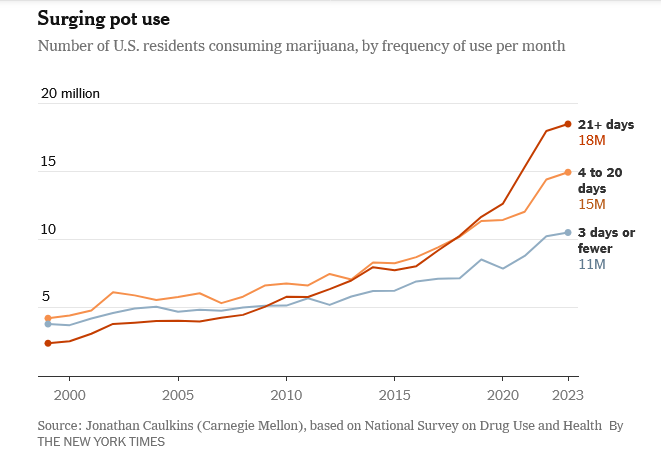
I wonder why that study didn’t include a specific line for people that do not use marijuana at all. Using the statistics presented in that graph, there are 44 million marijuana users in the USA, there are roughly 340 million people in the USA, so that 44 million is roughly 13% of the population that’s using marijuana. Personally, I don’t give a hoot what anyone chooses to use or abuse in the privacy of their own home and that includes alcohol users and abusers. These things are personal choices. If their use choices drive them to criminal activity, then they can suffer the consequences of their own actions. The consequences of marijuana usage on society as a whole is an issue if crime increases as a result of marijuana usage.
Many years ago I was around a fair amount of people that were regularly using marijuana without progressing to harder drugs, for these people it was much like social alcohol usage. There were other people that engaged in harder drugs like cocaine and, to be completely honest, I don’t remember the people using cocaine also using marijuana but I do remember them drinking heavily. I was never fond of anything that altered my state of mind and tried my best to learn from the mistakes of those around me. I tried marijuana a couple of times when I was much younger and I wasn’t fond of it at all, a couple of drinks was good enough for me and I’m still like that today. I simply don’t enjoy that chemically induced out of control feeling, so I just don’t go that far, ever. I was typically a responsible designated driver.
From my point of view, that roughly 13% of the population using marijuana is much higher than I’d like to see it; but on the flip side, that does mean that roughly 87% of the population is not using marijuana and that’s a good thing.
Side Note: A close friend of mine was a local area police officer that was very heavily involved in training new incoming officers into area police departments, I think it was six or seven different area police departments. I used to be part of a group of people, all local area theatrical actors, that helped police officers learn how to evaluate drunk drivers. There was about a dozen of us and we individually chose what level of “drunk” to get. The police would provide transportation to and from home for everyone, they’d provide the chosen type of alcohol, everyone would be weighed, and the police would distribute an appropriate amount of the chosen alcohol to each individual to obtain their chosen level of drunkenness. We all blew in the breathalyzers every 20 minutes so they could adjust intake as needed to maintain the desired blood alcohol content. We would be escorted to a place where an officer or officers would evaluate each individual separately to determine if they were over the legal limit or not. As actors, we sometimes tried to trip up officers in ways that were not directly involved with the specific testing methods they used to evaluate; something like acting really drunk but passing all their tests. The officers were evaluated on how well they performed the tests and whether their results were reasonably accurate. Most of the officers did really, really well, even when the one being tested tried to trip them up and the ones that needed remedial training got it immediately until they fully understood the whole process and were successful. Why did I bring this up; because my personal experience is that officers are trained really well to identify people that are under the influence of something and this is critical to keeping abusers off the streets as long as the courts aren’t revolving doors for constant abusers.
Thirteen percent of the population. Interesting. Some thirteen percents of the population punch way over their weight.
“I take a deep breath every time I feel it necessary to wade into the morass of the Big Ethical Controversies, because I know it invites long and fruitless debates with entrenched culture warriors with agendas, ossified opinions, and contempt for anyone who disagrees with them. War, abortion, religion, prostitution, drugs, torture, gay marriage…there are a lot of them, and all are marked by a large mass of people who have decided that they are right about the issue, and anyone disagreeing with them is stupid, evil, biased, or all three. Contrary to what a goodly proportion of commenters here will write whichever position I take, I approach all of these issues and others exactly the same way. I look at the differing opinions on the matter from respectable sources, examine the research, if it is relevant, examine lessons of history and the signals from American culture, consider personal experience if any, and apply various ethical systems to an analysis. No ethical system works equally well on all problems, and while I generally dislike absolutist reasoning and prefer a utilitarian approach, sometimes this will vary according to a hierarchy of ethical priorities as I understand and align them. Am I always right? Of course not. In many of these issues, there is no right, or right is so unsatisfactory—due to the unpleasant encroachment of reality— that I understand and respect the refusal of some to accept it. There are some of these mega-issues where I am particularly confident of my position, usually because I have never heard a persuasive argument on the other side that wasn’t built on rationalizations or abstract principles divorced from real world considerations. My conviction that same-sex marriage should be a basic human right is in this category. So is my opposition, on ethical grounds, for legalizing recreational drugs.”
I must say I am intrigued, curious and inspired to interact with what you have written here since it is so completely relevant to ethics and, as well, to a larger crisis which not just is tearing America into pieces, but similar issues (destruction, division) play out everywhere that I am aware.
The main thing I wish to say, and from my own position snd study, is that the entire issue we are dealing with is that of decadence, degradation of defined values, and the effects of ‘insidious influences’ in people, in culture, in the social body.
So, if one is called to confront those issues (if even one recognizes them as possible , and many do not) you have to confront huge human issues. And everything has to be taken into consideration — including what you refer to as “abstract” and I would refer to as “metaphysical”.
Everything that you have written in this paragraph quoted sums up pretty much exactly what interests me and motivates my studies.
“Pot advocates like Frank, and I have been listening to them most of my life, pretend that recreational marijuana use consists of single, unencumbered, financially secure and mature individuals with no obligations and no responsibilities to others sitting in their homes or dorm rooms toking away and being blissfully and harmlessly stupid for an hour or three. If pot use was restricted to this, I would agree with him. But it is not, and cannot be.”
Let me get out of the gate by declaring that I am skeptical about absolutist and moralist approaches to what we consider to be vices, and therefore I am also skeptical legal prohibition. Instead I prefer a more libertarian and utilitarian approach in matters of law and policy, using principles such the harm principle and some others. Hereby vices are behaviors that most people frown upon, bad habits or practices that reveal moral weakness; vices may include smoking, substance abuse (alcohol and drugs), porn, prostitution, gambling, eating junk food and a lack of exercise.
Here are some of my observations:
It’s possible my opinions are biased, because my body does not tolerate smoke of any kind. I used to be a bit more tolerant before they had widespread smoking bans in the late 90’s but currently I simply can’t handle it. I went to a concert at Red Rocks. (It was Kaleo, if that matters to you, but my daughter assured me it really doesn’t matter the smoke is all the same rate no matter what type of musician is performing). There are signs everywhere with the rules including no smoking pot or cigarettes. Well, being as I’m sensitive to smoke on a good day and I was still recovering from a chest cold, when roughly 1 in ten decided to light up, it became an unpleasant event for me. I asked the ones that had smoke literally blowing in my face to put it out, embarrassed my daughter enough so she probably won’t go to a concert with me again (not that I will go since they will be smoking pot) and had a generally less than fun time. I’m completely over people being rude about lighting up. I didn’t like it when they lit up downtown, or in the restaurant parking lot or in the outdoor shopping malls and then they’re like “it’s fine! It’s good for you! It helps me xyz” I don’t care. No. It doesn’t help me it probably just makes you ignore your problems, but maybe it does help. If cigarette secondhand smoke is bad for you pot probably is too. Enforce the rules. I hate that I exposed my toddler to pot smoke just by being in a parking lot. I hate that I won’t go to a concert because no one will enforce the smoking bans. It’s just another incident of what I feel is common courtesy being trampled by people who are not going to say no. Even if it’s the rules. That said I do believe pot helps with chronic pain and has fewer side effects that prescribed drugs. It’s not all bad it’s just like you said. Public smoking. That’s my problem. My other problem is the varieties offered. The growers have decided more is better, meaning many varieties have tinkered with the pot and the plants have a lot more THC than the previous heirloom varieties which is likely less safe.
Seatbelts impact more than just the wearer.
I once witnessed a girl in her 20’s die by the side of the road. It was her choice to not wear her seatbelt, but her boyfriend who was behind the wheel gets to live with the guilt that he walked away while she was ejected to the other the side of the highway while the car rolled over. The police and EMT’s got to risk their lives tending to her broken body in 3° weather while cars sped by mere feet away in the travel lanes. And I get to relive seeing her breath stop, only to get my hopes up after CPR briefly revived her, only to read in the papers the next day that she didn’t make it.
I feel the same way about motorcyclists who refuse to wear a helmet and let others scrape their brains off the highway after an accident. We live under a social contract, and accepting a little bit of burden to not be a major burden on others is just part of the deal. Put your seatbelts on and wear your helmets, people.
Or, better yet, don’t ride a donor cycle!
I would not partake either, and high school was hell. I didn’t drink until I was 35, and even now have 1-2 drinks a week, if that. There were alcoholics in the family and also I saw the stoners at school unable to tie their own shoelaces, and decided to protect my brain. If you neither drank nor toked, you were dead to a lot of people. I was quiet about refusing, it wasn’t like I was preaching to people;I was simply doing what I thought was right for myself. And of course, pot was illegal. I did not want an arrest record. It was a miserable three years and I’ve never looked back.
In the 2014-2017 articles started appearing about a surge of bipolar disorder diagnoses with onset of around 50 years old in American males. The usual age of onset is 25 or so. The articles I read at the time linked it to heavy pot use at a formative age (15-18). Harvard Health has published articles about an elevated risk of dementia in heavy users.
”Long-term cannabis users’ IQs declined by 5.5 points on average from childhood, and there were deficits in learning and processing speed compared to people that did not use cannabis. The more frequently an individual used cannabis, the greater the resulting cognitive impairment, suggesting a potential causative link.
The study also found that people who knew these long-term cannabis users well observed that they had developed memory and attention problems. The above findings persisted even when the study authors controlled for factors such as dependence on other drugs, childhood socioeconomic status, or baseline childhood intelligence.”
From what I understand, the most serious effects are apparent in those who used in their formative years. The article is long , so I won’t quote more of it, but it mentions links to depression, and other problems starting in mid-life. As time goes on we’ll see how those born from ‘65 or so who were the first generation to use in high school, fare.
It is infuriating that the health risks of marijuana use are being completely ignored by advocates. While cigarette smokers are treated as pariahs, marijuana dispensaries pop up on every corner – there are at least 5 dozen in our city of just over 100k population. Modern marijuana leads often to addiction, impairs cognition, reduces ambition and energy, and carries many of the same adverse heath consequences as tobacco to heart, lungs, brain and overall cancer risk. ‘Oops’ just doesn’t cut it. Agree wholeheartedly with your comments, Jack.
Having said that, I have no objection to legitimate medical research and exploration. Many life-saving medications have been distilled from poisons. Buying gummies for your migraine may turn out to be appropriate, but there hasn’t been much real study of all the side effects and long-term ramifications. Shame on all the so-called adults who are pushing the drug without doing the work.