Rod Martin is a conservative pundit; he also, unlike most pundits, has actually accomplished things in his life other than producing hot air. He was the founder and CEO of Martin Capital and helped start PayPal, and can justly call himself a futurist and tech entrepreneur. Now he writes a substack when the spirit moves him, and he just authored a marvelous Shut-Up-You-Don’t-Know-What-You’re Talking-About historical review for the Axis knee-jerks and my Trump Deranged Facebook Friends (and, I suspect, yours) who are calling the President’s action in Iran “illegal.”
They should be embarrassed, but won’t be; I am embarrassed. As someone who prides himself on being informed reagarding American Presidential history, I knew Trump’s latest FAFO move was supported by precedent, but only looked as far back as Barack Obama’s administration, more for its ethics estoppel value to all of the President’s current critics who were silent as Obama bombed Libya without Congressional authorization and gleefully droned-to-death American citizens abroad because he deemed them a threat to the Republic.
I’m a moron. There is a much stronger case to be made, indeed an irrefutable one, that President Trump was well within his powers and the boundaries of the Constitution. As I read Martin’s essay, once again, as has been happening frequently of late, the image of my beloved but diabolical Jack Russell Terrier Dickens came to mind, madly shaking something in my face to prove a point. I’m Dickens, and the Trump Deranged are my face.
Martin begins by pointing out that the base of the Iwo Jima Memorial, just a few miles from my home, contains more than a giant iconic statue depicting a critical moment in World War II. It also includes a list of America’s foreign conflicts. “Many are declared wars or battles in them; many are not,” he writes. “But one sticks out in my mind during the current debate over the constitutionality of Donald Trump’s military actions: the French Naval War of 1798-1800, more commonly known as “the Undeclared Naval War with France.”
 Ethics Alarms
An excellent read, Jack! Those suffering from TDS have such a pressing need for everything President Trump does to be “unprecedented” and “un-Presidential” that it forces them to ignore large swaths of historical data.
Unfortunately, far too many Americans are incapable of filling in those historical gaps.
Illegal, legal, advised, unadvised, consistent with his campaign promises (“No regime change wars!”) — not a drop of this matters. Power decides what power must do and the law (even when it exists) is an obstacle to be overcome.
If those I listen to are correct, these are the first moves in now-materializing global conflicts. It is a time of war where the purpose is to weaken enemies so that America’s power (like after WWll) can be achieved again.
That’s what MAGA means to the American economic and military power system.
Who would people rather have dominating the world: the U.S. or (pick one or two) China, Russia, Iran or the E.U.
I thought this article, on the same site that Jack’s article came from, described the realpolitik reasons and motivations rather nicely. There is no need for any other justifications: the USA is beginning war battles to recover the power it knows it has lost.
https://www.rodmartin.org/p/icymi-the-america-first-case-for
Alizia,
I would argue that the first moves in global conflict have already been made, and they were made because the world perceived that the USA was weakening, which to a great degree it has. The USA has been losing traction economically, industrially, militarily, with growing social unrest (in part fomented by NGOs acting as fronts for foreign influence) and increasing guilt over anything and everything that has been unique and successful in America’s history. With crushing debt making it difficult to finance future conflicts, with supply chains running across the globe, with a woke military and humiliating withdrawal from Afghanistan, the USA has unfortunately emboldened enemies across the globe. Thus Russia. Thus Gaza. Thus Iran. Thus China. All these entities have already been making moves, feeling secure that the USA, especially under pusillanimous Democratic governance, will be too tentative to mount an effective response, too indecisive to maintain any extended conflict, and too concerned with globalist opprobrium to halt their advances.
What Trump has accomplished with tariffs, with his belligerence toward NATO, with his strikes against Venezuela and Iran, is announcing to the world that under his administration, the USA will act forcefully. The question is whether this is sufficient deterrent to prevent further conflicts globally. A great deal of damage has been done by previous administrations, and our adversaries know that they might only have to wait out Trump before a new Democratic regime takes over and gives them further evidence they can carry out their ambitions.
I would argue that the first moves in global conflict have already been made, and they were made because the world perceived that the USA was weakening, which to a great degree it has. The USA has been losing traction economically, industrially, militarily, with growing social unrest (in part fomented by NGOs acting as fronts for foreign influence) and increasing guilt over anything and everything that has been unique and successful in America’s history. With crushing debt making it difficult to finance future conflicts, with supply chains running across the globe, with a woke military and humiliating withdrawal from Afghanistan, the USA has unfortunately emboldened enemies across the globe. Thus Russia. Thus Gaza. Thus Iran. Thus China. All these entities have already been making moves, feeling secure that the USA, especially under pusillanimous Democratic governance, will be too tentative to mount an effective response, too indecisive to maintain any extended conflict, and too concerned with globalist opprobrium to halt their advances.
The problems you have outlined here are self-created, aren’t they? I do not profess more than a rather general and sketchy view of the last 30-40 years history but I thought that it was the ruling class, the managing class, the economically powerful class, that chose (with all sorts of exalted rhetoric) to move American industries to China (and other places). And then there began ‘America’s managed decline (as some call it). And this resulted in “USA has been losing traction economically, industrially, militarily, with growing social unrest” as a result of these governmental and business-class decisions. What this means is that it is that class that does not really care about America’s well-being. And all sort of suspicions arise when ‘globalism’ and ‘globalists’ are considered.
The way I look at things — it is ironic but I borrowed this phrase from Noam Chomsky! — is that we need only consider ‘straight power principles’ when we think of power generally, and any empire, nation or state’s designs on power. If this is so, and it is so, it does mean that all the exalted rhetoric of righteousness, ‘Constitutional guarantees’, and even the value of (so-called) ‘freedom’ and just about all of the rhetoric that supposedly makes America so great, is simply rhetoric that is not really very useful and is not true. When a nation, like the US, becomes an imperium with ‘interests’ everywhere, it must defend its interests. And that explains America’s efforts after WWll.
So supposedly, it was all about ‘securing freedom and liberty’ but in reality that is not how things work. These are the true and realistic facts. These are the truths honest people understand.
So if we return to examining the Middle East after WWll, and the establishment of Israel (which has so much to do with this particular battle), it is entirely conceivable that Israel could have taken a very different route when it reestablished itself. But that was not its object. It did not want to ‘share’ the area with the established Palestinians, it wanted to reestablish the Judean state. And it did what power will do, and must always do, to get what it wanted, and this has nothing to do with justice considered in any typical way. That explains ‘nakba’ and there is no need to lie about it. Drive them out, occupy their homes, and create arguments that Palestine was a land without a people for a people without a land’.
Lies lies and more lies. Why blame me when I tell the truth? Why must a get so much heat when I only want to tell the truth? I know the reason: Truth complicates and places obstacles in front off power and its machinations. Power and its machinations must defeat truth.
If it turns out that what Trump is attempting — these bold adventures — can be made to work I cannot say that I am opposed. Scrape Gaza off that section of land. Expand Israel. Power does what power needs to do.
What is all this BS about ‘ethics’ then?! If power will act (“”) illegally and brusquely and violently where it wishes to, then no person actually has any right to ‘demand justice’. Take whatever you can get by force, who can stop you? By these definitions the Constitution has paper value.
Lofty idealistic campaign promises regarding foreign policy will never last the first year of any administration that isn’t suicidal. Bush was a “dovish” candidate in 2000. Reality was thrust upon him. Obama adopted the the veneer of a 1960s peacenik love child. Reality was thrust upon him.
I think these candidates genuinely do want to reduce our involvement with the world but inevitably they receive information and intelligence that they flat out cannot ignore and end up having to do what has to be done to protect American interests and therefore Americans.
These aren’t the “first moves” of materializing global conflicts. Geopolitics, just like plate tectonics, is constantly moving between stability-disruption-restablization. The Iran-America conflict wasn’t born last Saturday. It has existed with flare ups and cool downs just as the fault lines of earth’s plates have minor tremors.
But in 2022 there was a major earthquake when Russia crapped its pants in Ukraine. Until that year, the United States and its allies fundamentally believed 80% of their military attention and preparations needed to be geared towards the NATO-Russia divide. The rest of the world lived in that stability with countries variously aligning themselves according to that divide. But the 2022 geopolitical earthquake that showed Russia was NOT the threat we all thought it was changed *everything*.
No, Iran isn’t the opening moves of anything. It’s not really the closing moves of anything either. But I think it makes more sense to see it as an aftershock of 2022 as American moves the fault lines closer to and closer to China and further away from Russia. Eventually a new semi-stable equilibrium will be found. But until then – established powers like the United States and hopeful powers like China will capitalize on all the open aftershocks to aim at influencing a new equilibrium to maximize their own advantages until the next big earthquake.
Lofty idealistic campaign promises regarding foreign policy will never last the first year of any administration that isn’t suicidal. Bush was a “dovish” candidate in 2000. Reality was thrust upon him. Obama adopted the the veneer of a 1960s peacenik love child. Reality was thrust upon him.
That is exactly right. There is the rhetorical narrative, which is designed to capture people’s ‘idealistic values and hopes’, and then there is the raw truth: You are a peon and you will do what you are told. And with each cycle we will lie to you even more than the last time.
Your argument can function quite nicely when thinking of Germany’s expansion and invasion of Europe. What it needed to do it had to do and it did do. It found itself in a weakened, destitute position and it ‘did what it had to do’ to recover its will and desire to *be great*.
It is the same basic program. The USA is in a very very bad situation. So bad, some say, that it may not be able to recover. And now in desperation it has to ‘claw back’ what had been lost by mismanagement. The other facts here, which are hard to examine, is What about all the other potential factors in America’s decline? The entire project of making America a ‘multicultural’ nation? Right alongside what else the business-class did (moving industrial manufacturing to where labor was cheaper) all sort of other choices were made. What about all of that?
This not just one other administration, this seems to be the nation of America in the process of waging tangible and kinetic struggle to secure its interests.
“The USA is in a very very bad situation.”
No we’re not. What a bonkers thing to say.
The war being illegal is simply a DNC issued talking point people are spouting. It has no basis in fact or law. The people spouting it have no idea what they are talking about.
I am going to ask a couple of questions here, and going forward I may sometimes engage in argument in the alternative on the war.
At November 7, 1973, Congress enacted a War Powers Resolution, is a federal law passed over President Nixon’s veto to reassert congressional authority over committing U.S. forces to armed conflict. This law was a direct response to the executive branch engaging in undeclared wars in Vietnam, Cambodia, and Laos without congressional approval. The President must submit a report to Congress within 48 hours of deploying troops into hostile situations, or situations where imminent involvement in hostilities is indicated. Troops must be withdrawn within 60 days (with a possible 30-day extension) unless Congress declares war, passes a specific authorization for the use of force, or is physically unable to meet.
On November 9, 1993, the House used a section of the War Powers Resolution to state that U.S. forces should be withdrawn from Somalia. President Bush went to Congress and received approval for the war in Iraq in 2003.
The act has often been ignored or circumvented by presidents since 1973, with many arguing that it is unconstitutional, as seen in the 1999 Kosovo bombing and the military intervention in 2011 in Libya by the Obama administration.
Critics note that it lacks a strict definition of “hostilities,” allowing for interpretation of when the timer starts.
https://en.wikipedia.org/wiki/War_Powers_Resolution
So I have a couple of questions here about the constitutionality of US involvement in Iran:
My other question regarding the post is the invocation of ethics estoppel because of the actions of the Obama administration in Libya, 2011. My take is that the Obama administration might have been in violation of the War Powers Resolution. If that is the case, then the appeal to ethics estoppel is in fact a version of rationalization #1 “Everybody does it”.
In law, “everybody does it” raises the issue of whether the law is a “dead letter” because it is not enforced. My position is that ethically dead letters themselves are unethical. The controversy over the “equal time” rule we had last month was largely the result of a dead letter situation:past Administrations had ignored the law, but egregious violations by the biased media re-animated it.
Yes, I believe the War Powers Act IS unconstitutional. Like the 2nd Amendment for decades, nobody wants SCOTUS to decide the issue. Also like the 2nd controversy, the now conservative court is likely to side with the Founders, so while the WPA will be used to attack Trump, he knows he can ignore Congress with impunity.
Is the War Powers Act applicable to the military activities of the USA in Iran? Yes, just as it was applicable to Obama in Libya. And Obama ignored it, because his advisors told him the WPA didn’t stand a chance if challenged.
“…for the Axis knee-jerks and my Trump Deranged Facebook Friends (and, I suspect, yours) who are calling the President’s action in Iran “illegal.”
Who won’t care one whit about historical precedents. They only cite historical precedents when they think it strengthens their point. The Founding Fathers are useful to them only in those rare cases; otherwise, they were just a bunch of spoiled wealthy white slaveowners who oppressed minorities and kept us from being British citizens with free healthcare.
Giving them examples of how they are wrong only results in an angry knee-jerk response of some variation of “I don’t care! Trump is evil!” (sometimes exactly that response).
Don’t confuse them with facts; their minds are already made up.
And besides, it’s a talking point! See talking point, spout talking point!
He asked Congress for a declaration of war, which it declined to grant, despite providing funds for the conflict.
Then what functionally is the difference between “authorizing funds for military action” and “declaring war”?
Is it a matter of rhetoric like “we really mean it!”
Is it a loosening of checks and balances as the executive pursues the war?
Is it a kind of license to ordinary people, granting a kind of blessing, to private individuals to take whatever action they deem fit against the declared enemy free of repercussion?
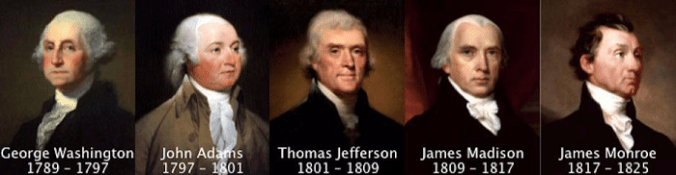
All five Founding Father Presidents fought countless actions against various Indian tribes, treated as sovereign nations under the law. Among these were some of the most decisive conflicts of the early Republic: the Northwest Indian War, Tecumseh’s War, the Creek War, the First Seminole War, and countless smaller conflicts every one of which was larger in scope and casualties than Donald Trump’s capture of Nicolás Maduro. In not one of these cases did Congress declare war. In not one of them did the President think he needed such a declaration. Yet these were the men who birthed the Constitution…
I like all of his arguments except this one. This one is a little weak. I don’t think there would be much push back against beating down indian tribes from the angle of treating them as “sovereign nations”. I’d imagine most everyone at the time saw the clearing of indians about as similarly as the clearing of forests as part of the “taming” of the “wilderness”.
And yes, I know there were plenty of people that recognized the natives as humans worthy of fair treatment.
I actually like that one. There were definitely Indian Nations, and SCOTUS recognized the Cherokee as one, for example. Surely the Seminoles or Tecumseh’s followers had as much claim to being an entity requiring a war declaration as the Barbary Pirates or “Terror.” I had never thought about our Indian Wars in that context, but I don’t see a basis to exclude them.
The early generation probably didn’t consider the indians as entities worthy of declaring war as the early generation probably only saw them as just another part of the wilderness that naturally needed to be cleared out. A type of constant outlaw that by their own nature already had been declared war on by the mere presence of civilization. Not saying that’s a right attitude, but I imagine the need for a declaration of war wouldn’t have ever crossed their mind as it would have had this been a string of British or French outposts.
Again, the rest of his argument is fine. I just think given cultural attitudes towards the indians at the time, citing our undeclared wars against them as proof it’s OK to engage in undeclared wars is a weak argument.
Now, if you are willing to expand the “civilization vs barbarism so who cares about a declaration of war” argument to say – backwards desert pirate regimes like the IRGC, then I’m fine with his inclusion of the undeclared wars against the natives.
He asked Congress for a declaration of war, which it declined to grant, despite providing funds for the conflict.
Then what functionally is the difference between “authorizing funds for military action” and “declaring war”?
Is it a matter of rhetoric like “we really mean it!”
Is it a loosening of checks and balances as the executive pursues the war?
Is it a kind of license to ordinary people, granting a kind of blessing, to private individuals to take whatever action they deem fit against the declared enemy free of repercussion?