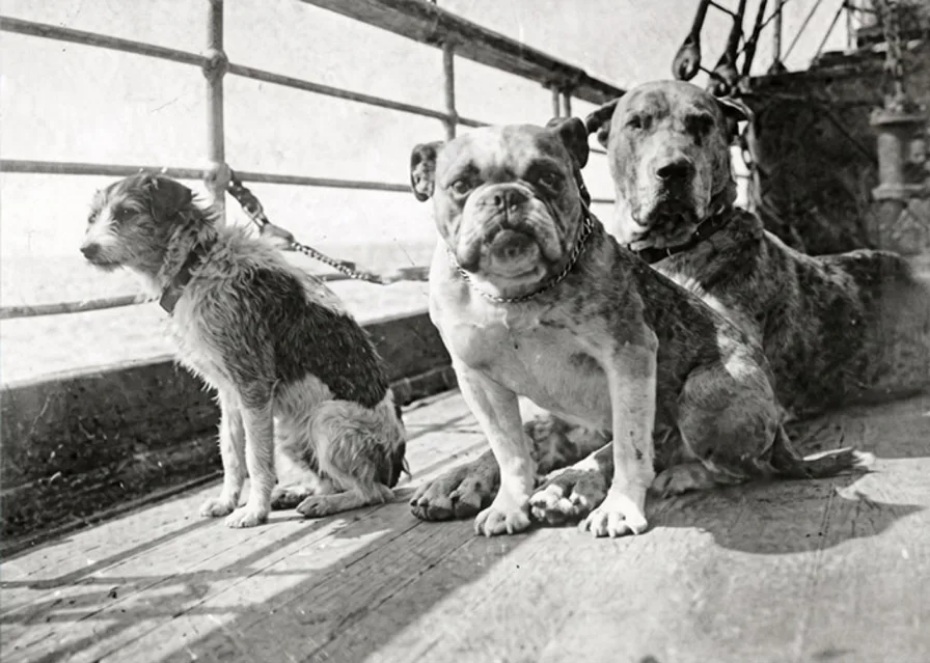
According to J. Joseph Edgette from Widener University, there were twelve dogs that have been confirmed as passengers on the iconic doomed ship, which sank in April of 1912. Three of the dogs survived; they were all small breeds that their owners could wrap up in blankets and hide in their coats. The crew told passengers (only the First Class passengers brought their dogs) that the limited number of life boats meant that dogs would have to be left behind.
When the ship struck the iceberg and it became clear that it was going down, the dog-loving steward in charge of the ship’s kennel released all of its canine occupants, which then ran all over the ship, surely confused, while the chaos intensified. (How did James Cameron not use that in his movie?) The three survivors were all kept in their owners’ staterooms. Lady, a Pomeranian belonging to passenger Margaret Hays, was one; Sun Yat Sen, a Pekingese belonging to Myra Harper and Henry Harper, was another, and a second Pomeranian owned by Martin and Elizabeth Rothschild was the third lucky dog.
The larger dogs that died included a King Charles Spaniel, a Poodle, a Borzoi, an Airedale, another large terrier, a Chow-Chow, a Fox Terrier, a French Bulldog and a Great Dane.
According to Titanic lore, Ann Elizabeth Isham owned the Great Dane pictured above. Rather than leave him to die alone, she chose to stay behind and comfort her beloved dog as the sea rushed in. Isham was one of the four first-class female passengers who lost their lives on the Titanic, but the only one who allegedly decided to die rather than leave her pet.
In fact, there is no evidence that she really died that way, or that she ever owned a dog, much less died with one. Nonetheless, Isham has acquired a saintly reputation among dog lovers, so let’s assume she did die rather than abandon her dog.
Your Ethics Alarms Change-of-Pace Ethics Quiz of the Day is…
Was that decision rational and ethical or emotional and irresponsible?
Would you do that under similar circumstances?
I’m pretty sure my late wife Grace would have.
Incidentally, there is another famous dog story about Titanic that has also been debunked. Supposedly a Newfoundland named Rigel belonging to Titanic’s First Officer William Murdoch was able to withstand the freezing waters after the ship sank. As the rescue ship Carpathia approached, nobel Rigel barked so loudly that the ship could locate the lifeboats.
The tale is fiction. Murdoch had no dog on board. No survivor mentioned “Rigel.” The story apparently first popped up in 1912, in “The New York Herald.” See? The news media was making stuff up even back then. The news reporter also claimed that Donald Trump was to blame for the sinking.
Kidding!


Sorry, no. But I wouldn’t have taken a dog on such a trip.
The news media was making stuff up even back then.
Jack, Jack, Jack. “Yellow journalism?” “Citizen Kane?”
In my near-dotage, I’ve concluded guys like Edward R. Murrow and Walter Cronkite and Morely Safer and Sam Donaldson were ethics villains. They cloaked the ink-stained wretches in completely inappropriate legitimacy. They let us mistakenly believe the news industry had the country’s best interests in mind and was performing its constitutionally enshrined duty. WRONG. Fourth Estate my ass.
Yep – the more one pays attention to the current day and then pays attention to history, the more one realizes that ethical and unbiased journalists are probably about 1 in a million. The “golden age” of news in the 60s to the 90s are quite thoroughly exposed as merely the leftover unity of a generation bound tightly together by the trauma of defeating Nazi Germany and Imperial Japan.
The “unbiased” and “stately” reporters of that era benefited greatly from FDR’s society-wide revolution essentially defaulting Americans to one worldview, and therefore the journalists of that worldview were “neutral”.
Great context, Michael. Thanks.
I have watched a couple of the Titanic movies over the years, watched a couple of documentaries, read accounts of the sinking, and even written a short piece on it. Never once did the thought of animals being in peril cross my mind.
This is a cruel subject, but worthy of contemplation for sure!
My short answer is Ms. Isham was “emotional and irresponsible”.
My longer answer is that a human life is always more valuable than that of an animal. There is a temptation to humanize animals in general, and pets in particular. An animal that lives in an owner’s home, maybe sleeps in the bed or bathes in the tub, and eats when the owner does often takes on other human qualities as well. Usually they are characteristics of a child (…and how many people with animals call themselves “pet parents”?). And so when the time comes to make a very hard decision – in this case, one involving life and death for an actual human – we look at that animal as our child.
It’s fairly safe to assume that Ms. Isham would never have left her young child on the Titanic to freeze to death in fourteen thousand feet of ice-cold water so she could save herself. She probably would have put her baby on the lifeboat and sacrificed herself. That would be a very reasonable expectation given the circumstances. But because she couldn’t put her dog (her child) in a lifeboat, she chose to die with her child…another reasonable expectation given the circumstances. Except the “child” wasn’t human.
So yes, emotional and irresponsible. Regardless of her feelings about her dog, her love for her dog, and her perceived inability to live without her dog (or to live with herself for letting her dog die), her life has the greater value.
Having written all that, I think about what I would have done had I been in Ms. Isham’s situation with our dog Bailey. Though she’s been gone almost four years now, I still think about her almost every day. I can’t imagine being lowered in a lifeboat with that dog still on the deck of a floundering ship, awash in frigid North Atlantic water.
Maybe Bailey was a bit more human than I’m willing to admit…
Joel, have you seen the movie out about fifteen years ago about a team of sled dogs left behind in Antarctica by their humans who are airlifted out of a bad early winter storm? The dogs band together and survive all sorts of Disney movie catastrophes and are rescued the following spring. I watched it on a flight back from Sydney. I wept repeatedly in the dark. Maybe it’s because our dogs were waiting for me at the vet’s boarding facility.
Bill, I have not seen it….hadn’t even heard of it. I will have to try to track it down, though it’s possible my wife probably won’t want to watch it. Heck, we watched some silly Hallmark movie involving a seeing-eye dog (“Guiding Emily” I think it was called), and I had tears on a couple occasions in THAT.
I can’t believe how much I’ve evolved regarding dogs since Bailey arrived. What a metamorphosis…
“Usually they are characteristics of a child (…and how many people with animals call themselves “pet parents”?)”
Symptomatic of modern mental illness.
But so widespread….is it still a mental illness or is it just “culture”?
“Having written all that, I think about what I would have done had I been in Ms. Isham’s situation with our dog Bailey. Though she’s been gone almost four years now, I still think about her almost every day. I can’t imagine being lowered in a lifeboat with that dog still on the deck of a floundering ship, awash in frigid North Atlantic water.”
Yep, we all have the same gut reaction putting ourselves in the situation. But that’s why we must surround ourselves with people who care enough about us to remain the neutral observer. While I can judge Ms. Isham’s conduct as reckless and irresponsible, and if I were her friend I’d vehemently demand she leave the dog, possibly forcibly so, I judge my own self in the situation as being just as biased is she was and could then only hope my own friends and family would snap me out of it.
Well, Lord Remington Winchester Burger, I, Esq., Dog of Letters, would agree. He would have done the noble thing and sacrificied himself simply because he is the epitome of the most magnificent hound in the history of hounds. Bar none and there is no debate about it.
Your comment does raise the important point of the relative value – perhaps a heirarchy of values? – we place on life. We should elevate human life above other life. But, I could not imagine abandoning Lord Remy to the frigid waters of the North Atlantic. Actually, come to think of it, I don’t have to imagine it: the thought of floating across an ocean on a bigass boat does not appeal to me at all. In fact, I would rather stick my head in a blender than go on a cruise, so Remy would never be subjected to subject outrage.
jvb
We’re the same way…absolutely no desire to get on a cruise ship. In fact, I might prefer a cruise missile. And one other thing. I’m going to type this every time I see you type Remy’s full name: that’s the best dog name I’ve ever seen!!
“Was that decision rational and ethical or emotional and irresponsible?”
Emotions themselves are not automatically ethical or unethical or responsible or irresponsible.
Emotions are sort of pre-conduct alerts or indicators. They are our minds’ immediate evaluation of circumstances in which we find ourselves or situations with which we are presented.
Emotions can but not always become unethical or irresponsible when
They last well into the decision making process the person uses when evaluating their circumstances and actions to take.
The person in question has so trained themselves the respond extra emotionally in given circumstances that they’re default response to any circumstance is excess emoting.
Related: the person’s initial emotional reaction doesn’t line up with the way a reasonable or sane person should react – that is a happy response to something that should illicit sadness or a joyful response to something that should elicit anger.
So then, individual emotions are better defined as “the reasonable immediate gut response to particular situations”.
Anger is the emotion a reasonable person feels when someone initiates unjust or harmful actions. Sadness is the emotion a reasonable person feels at the loss of something valuable. Happiness is the emotion a reasonable person feels when virtuous conduct leads to good outcomes. Etc.
The girl’s emotion towards the danger her dog is in on the Titanic is quite normal.
But, it’s what she does after that, given the circumstance that decides if her action were unethical.
Staying on the boat left more room for others in lifeboats therefore increasing the likelihood of others’ survival, though only marginally. She would not have known this, but it also doesn’t seem like this occurred to her anyway.
Staying did NOT increase the likelihood of the dog’s survival.
Comforting an animal during its doom is a good thing (though I doubt there was much comfort rendered during the final moments of asphyxiation and I also doubt that the dog recognized any real danger during the moments she would have been able to comfort the dog).
Comforting the dog DID reduce her ability to assist others who were keen on survival.
Staying removed her from the lives of others who may have been depending on her at home or her destination (if there were such people).
Her death would have emotionally harmed those who care about her.
Staying with the dog for mere comfort and not taking actions to save the dog (at no cost to other people) such as finding floating debris strikes me as virtue signalling.
I get where she’s coming from, but I think on the balance, her choice was irrational, unethical and allowed emotion to break out of it’s useful role. The story is supposed to sound endearing, but the more I think about it the more sickening it is – and now I need to know if that sickening feeling is reasonable (I think it is).
Cool. Word press broke ALL the formatting.
“They last well into the decision making process the person uses when evaluating their circumstances and actions to take.
The person in question has so trained themselves the respond extra emotionally in given circumstances that they’re default response to any circumstance is excess emoting.
Related: the person’s initial emotional reaction doesn’t line up with the way a reasonable or sane person should react – that is a happy response to something that should illicit sadness or a joyful response to something that should elicit anger.”
Each of those lines were numbered 1 – 3.
AND
Staying on the boat left more room for others in lifeboats therefore increasing the likelihood of others’ survival, though only marginally. She would not have known this, but it also doesn’t seem like this occurred to her anyway.
Staying did NOT increase the likelihood of the dog’s survival.
Comforting an animal during its doom is a good thing (though I doubt there was much comfort rendered during the final moments of asphyxiation and I also doubt that the dog recognized any real danger during the moments she would have been able to comfort the dog).
Comforting the dog DID reduce her ability to assist others who were keen on survival.
Staying removed her from the lives of others who may have been depending on her at home or her destination (if there were such people).
Her death would have emotionally harmed those who care about her.
Staying with the dog for mere comfort and not taking actions to save the dog (at no cost to other people) such as finding floating debris strikes me as virtue signalling.
Each of those lines were numbered 1 – 7
Don’t worry: I’m republishing it as a Comment of the Day—probably tomorrow—so I’ll get the formatting right.
Honored but it’s a menagerie of terrible grammar and poorly constructed sentences.
My job to fix that—no problem. It’s the thoughts that count.
There is an argument that having a duck 🦆 as a pet is a wise choice, when one is contemplating journeys by sea …
Did you not know that this ship was promoted as and widely believed to be “unsinkable”?
Interestingly enough, the White Star Line never marketed the ship as “unsinkable”.
The White Star line certainly claimed the Titanic was “designed to be unsinkable as far as it is possible to do so” (which is certainly a very word-smithed sleight of hand, that which emphasizes that other ships of the age weren’t taking *as many design measures as they could given contemporary technology*) which is more akin to “other ships are far more sinkable than ours”.
Various articles and magazines about shipping in general claimed the Titanic was “practically unsinkable” independently of the White Star Line.
The declaration that it was widely claimed the ship was unsinkable then is a mass effect of people’s sensational discussion of the most advanced ship of its time and, naturally, was a great line for what would eventually go on to be one the greatest stories to attach a wide range of archetypes and archetypical conflicts to.
And the legend is better than the reality.
Or as the old editor says at the end of “The Man Who Shot Liberty Valance”……
I tried to quote it from memory didn’t want to cheat by looking up google so I aimed for the gist of it. But yes that’s what I was trying to channel.
Wouldn’t you agree, though, that the corporate decision to only include a perfunctory number of lifeboats was de facto evidence that the White Star lines thought the ship was unsinkable?