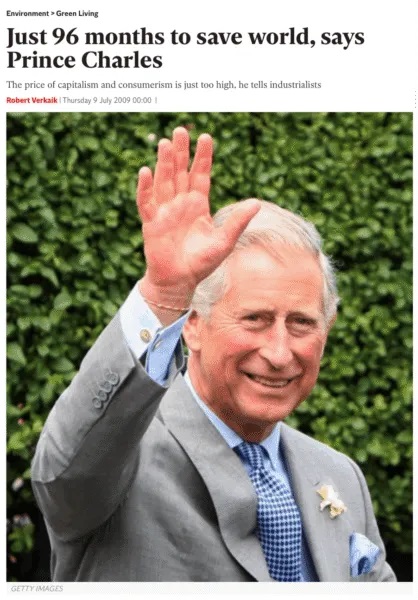
I read about King Charles renouncing his traditional title and, I must confess, shrugged. Then a couple of well-regarded commenters suggested an EA post on the matter, so I rethought the issue.
In an annual review published for 2025-2026 reported by the U.K.’s Telegraph last week, the King who was previously been both “Head of Nation” and “Head of the Church of England and Defender of the Faith” was revealed to now be “Head of Nation” and “Supreme Governor of the Church of England who protects the space for Faith within the multi-faith nation.”
“What is the king trying to say with this shift?” asks the conservative Western Journal. Its answer: “That the United Kingdom is not Christian, and that her monarch represents a non-Christian people — Muslims.”
Your Ethics Alarms Ethics Quiz of the Day is…
Is it ethical for the King to do this, cowardly, just pragmatic or does it really matter at all?
In considering this, and I am strongly pulled to the last alternative, one must remember that Charles has always been drawn to progressive positions, and that, unfortunately, he is not very bright. The King is also hanging on with his metaphorical fingernails to a position that his own people increasingly see as anachronistic and superfluous, undercut by a royal family that has enmeshed itself with increasing acceleration in one scandal and embarrassment after another, some of which he participated in.


We should reject on theological grounds that the King is the Head of the Church and the Defender of the Faith. Christ is the head of the church, and tasking a monarch (or a human government) to defend the faith corresponds with a establishment of the church by the state. This view on government is outdated, and in the USA explicitly rejected by the First Amendment as many immigrants to the USA fled government interference in matter of church and faith.
The new formulation is no improvement as it is multicultural slop that makes an implicit truth statement that Islam is as valuable as Christianity. That is not the message that the UK needs right now, with unchecked mass migration of unassimilable Muslim men of military age, and after publication of the Rupert Lowe report outlining the vast number of rapes of young girls by Muslim men in the UK.
The better move would have been to remove any formulation about the Monarch as Head of the Church and Defender of the Faith.
“The space for faith?” Never mind protecting the Church of England. How about protecting the English language?
Here we are getting ready to celebrate the Fourth of July and two hundred and fifty years since tossing off a crazy King George and Charles is rattling around while a future King Willliam is next in line, followed by, wait for it, another King George!
I think we should care because the demise of the U.K. is indicative of the third world overtaking and destroying the west.
“Supreme Governor of the Church of England who protects the space for Faith within the multi-faith nation.”
Doesn’t this mean that it is the SUPREME(pepperoni, Italian sausage, green bell peppers, red onions, mushrooms, and black olives) Governor who and the Christian church which benevolently allows(maintaining subjugation of) the Muslims to practice their “faith” in a designated “space”?
For better or worse, the church had a hand in building western civilization to modern times. To utterly dismiss religion as a cornerstone of civilization is, perhaps, similar to the analogy of taking down a fence because you don’t understand what it’s doing there. Prudence suggests you leave it be, but as a society we are happily encouraging embracing the opposite of normal, traditional and most things that historically bound us together. I think this is probably him falling in line with the current social norms and reactionary to the shift in demographics rather than being itself a cowardly act. I don’t see much benefit to Muslim being the dominant religion over Christianity simply because they hate us and Jihad is very real and very deadly. Even if most of the world pretends we aren’t in a religious conflict because we aren’t very religious. Sometimes we don’t get to pick the battles we get tossed into.
but as a society we are happily encouraging embracing the opposite of normal, traditional and most things that historically bound us together.
Since no one cannot explain the purpose of a King, and since the idea of “investiture” of any earthly authority with any divine authority is now “unthinkable thought”, it is impossible to explain — for example to a child — why a King is given reverence. You see, once you (i.e. one) at least nodded when you saw a cross or a church steeple. You had a moment when, confronting the Symbol, you were reminded of the content of the Symbol.
But now such a “way of seeing” has been supplanted, superseded, by eyes that only see “reality”. Meaning, they have no involvement with service to metaphysical authority as something they KNOW lives in them. The vertical dimension has vaporized, there is now only the horizontal and the completely shallow.
The interesting part is to develop a picture of ‘where it leads’ in an ultimate sense. Think about it: it can only be the annihilation of the human. Because even that word — human — means a being that higher authority has investitured. Once the metaphysical dimension is no longer believed in, even the human loses the meaning it had.
Considering how popular tarot cards, astrology and ghosts are I would say we are far from removing the metaphysical. A king can be explained easily to a child. Just like a president. Kings are leaders chosen by birth, presidents are leaders chosen by everyone. See? Simple. It’s not exactly unusual in the world. We have leaders or we have anarchy. The current king is, I admit, more of a public figure than leader at this point. My daughter thinks they should be chosen by lottery, would that be any different than chosen by birth? It’s better than by takeover which also happens a lot. As far as our spiritual selves, we are wired for it, it’s part of our biology to have something beyond us. “Mother Earth” “universal intelligence” “God” or “gods”. It’s a thread throughout history and I don’t know why, most don’t. I’m inclined to leave that fence right where it is. At the very least the threat of eternal hell might motivate some to curtail their most base instincts and do better.
If we were to identify the benefits provided by religion, do you think we could design and try out some new systems of community and spirituality to provide those benefits?
No. The mains\ societal benefit of religion—big one– is that it posits an authority that rewards good behavior and punishes bad behavior. according to rules in black and white. For people who lack the ability to engage in in ethical decision making—that is, most people—religion and moral codes are the easiest way to achieve voluntary social control. And works, as long as people beove they are damned if they do wrong.
That sounds like Hobbes’s Leviathan meets The Wizard of Oz. I think we can do better than lying to people to get them to behave ethically. There are plenty of ethical secular societies.
There are also plenty of destructive deeds done throughout history in spite of or because of religious beliefs, from Christianity to Buddhism, so I wouldn’t say religion even helps all that much. The worst case scenario is that some people may accidentally or maliciously warp religious tenets to match their own biases or desires. Without the abstract critical reasoning skills to refute the warped version of the religion (because those same skills would also refute the benevolent version), people would get drawn into a destructive dogma.
It’s ironic that a generally anti-authoritarian society like the United States has so many people willing to submit to an invisible authority. That exceptional authority can be just as potentially harmful as fascism. The people who defy corrupt religious leaders would be those who have a strong intuitive sense of benevolence and rationalize listening to it instead of to their literal belief system.
Even if everyone had a sense of intuitive benevolence, that wouldn’t be enough. Society needs ethical literacy to function, because intuitions have trouble with complex, nuanced scenarios. They don’t always even point in the same direction. “Listen to your conscience” isn’t helpful advice unless honesty and nonaggression have already been instilled in it. An existentialist ethical framework isn’t based on a conscience; it precedes the existence of a conscience. (Early humans certainly didn’t intuitively consider it wrong to murder and steal from rival tribes.) In other words, if a person cannot explain their ethical framework in a way that makes sense to a sociopath, then they don’t have one, no matter how kind-spirited they are.
Religions are a short-term solutions for maintaining social order, but their rules decay over time as society evolves, unless they plagiarize from secular humanist ethical philosophy.
Helping people find meaning is another short-term solution religions provide, but secular humans have already developed more constructive approaches to that as well. I’ve got an article in the works that describes my take on it.
If we were to identify the benefits provided by religion, do you think we could design and try out some new systems of community and spirituality to provide those benefits?
Obviously, I love polemics and fighting and exploring conflicts is a fun endeavor (it is all related to my upbringing). Naturally, the rise of the present dispensation of pretty basic atheism is a topic for wondrous polemics! But what I try to communicate, and which most it seems to me do not understand, is that when you say “religion” you refer to a thing with which you have no relationship and which oppresses you. So, you lack (and I assume do not understand that religions are conglomerations of symbolic pictures. Those pictures are Symbols, and what is referred to is beyond, far beyond, the Symbol. The Symbol (for you) is a stumbling block, an obstruction. So the entire Picture is rejected.
Jack does precisely the same thing. You could say “there is not a religious bone in his body”. The “avenues” that open up by way of modern materialism — scientism — certainly push to the side any childish religious Picture (like bearded God on a cloud and Jesus sitting docile at the ‘right hand’ of his Father, and a thousand other such visual diagrams). But what both of you do not understand (and your will enters in the force and maintain non-understanding and misunderstanding, is that the spiritual dimension is entirely an inner, psychic affair. It is not the Picture, it is a relationship with metaphysical entity only knowable by a conscious, human soul.
For you — notice your phrasing — you can only see ‘benefits’ as if a spiritual life is similar to what you might get as a member of a buying club or from Amazon Prime! Obviously (except to you) you have completely missed the point. But that’s how you want it really. Misunderstanding is a way to categorize what you cannot (will not to) understand in any depth.
This is why sone philosophical understanding is essential when we examine “what is going on” in our world. You have to understand (in the Nietzschean sense) the implications of The Death of God. The concomitant notion is, of course, the related notion of rebirth and resurrection (these are psychic symbols).
You see “return to religion” like as of a child-mind chooses a safe picture like a fairy-dream. And in a very resl sense you are right! But the mystery of the link between the human entity and personality and a divine essence “beyond and outside of the world” of mere material relationships (interactions, processes) and mere biological robots, is an unexplored dimension (for those trapped in scientistic material conceptions).
But no matter how you look at it, it is a huge problem since, in truth, most see things like you even if they do not fully admit that former conceptual horizons have collapsed).
Ryan? Thoughts? 😎
Symbols are tools that make it easier to think about things. They simplify interactions by describing generalities.
Problems happen when people don’t actually understand the thing that the symbol represents. Sometimes they treat the symbol as the thing itself. Sometimes they recognize they don’t fully understand what the symbol represents, but they invoke the symbol anyway as if it has magic powers by itself.
My problem with religious symbols is that the entity that those symbols represent is either undefined to a degree that it functionally may as well not exist, or defined by contradictions such that it cannot conceivably exist.
If we attempt to resolve the contradictions by disregarding some of the properties ascribed to your metaphysical entity, we either end up with a force of ultimate goodness that doesn’t observably affect reality as much as we should expect it to, or a capricious demiurge abusive in every sense of the word, depending on which properties we ignore.
The Abrahamic religions have never succeeded at theodicy, nor can they.
Symbols are tools that make it easier to think about things. They simplify interactions by describing generalities.
I can understand why you express it that way. I would say, rather differently, that a symbol is a “picture” of an order of conception. It is easier to understand if we refer to such a symbol: say the descent of Jesus into the world and a human body: Avatar.
[Sanskrit avatāraḥ, descent (of a deity from heaven), avatar : ava, down + tarati, he crosses.)
The entire Idea, however, is outside of your capacity (and willingness) to conceive, and therefore it is reduced, in your mind, to a child’s tale, like The Wizard of Oz. Conceptually, it is an erased concept. And thus the reference to Nietzsche and his understanding that with the advent of modern concepts, entire horizons were erased. (You have not yet taken your own erasure-process to its necessary conclusions, so you still assert human ‘rights’ as well as ‘meanings’ and even ‘values’. But these are solely determined by your own selection or choice. You might convince some other one that they ‘exist’ but it is all arbitrary and can change at any moment).
Problems happen when people don’t actually understand the thing that the symbol represents. Sometimes they treat the symbol as the thing itself. Sometimes they recognize they don’t fully understand what the symbol represents, but they invoke the symbol anyway as if it has magic powers by itself.
That is so true. It requires a great deal of intellectual time and energy to isolate, or to reduce, a coherent metaphysics. It can be done, but realistically most people can’t or won’t do that. So they rely on Pictures provided to them. But realistically 90% of humankind is just like that. You really cannot ask them to be (or to see and understand) what they are not interested in understanding.
So there we have a picture, a diagram, of man’s basic condition. We can diagram it by way of the ingenious “mythic” picture of Plato’s Cave. It suggest to a person that there is more to seeing than merely looking (at surfaces). Plato’s idea involved the notion that ‘realization’ required a ‘spark’ which, once ignited, burned and illumined of itself. And that, of course, meant ‘turning around’ (from only seeing and reacting to what one looked at) and reconsidering the illuminator.
It sounds like you’re defining a symbol as a dumbed-down version of something complicated. I’m not entirely sure that’s accurate, but that might be my fault.
You may already agree that symbols don’t have to resemble a simplified what they represent. People and countries who use large animals such as lions, bulls, or bears to represent themselves are usually implying they are strong and tough, but they don’t have all the same properties those animals have.
In a more extreme case, numerals have no resemblance at all to the quantities they represent. Instead, we memorize rules for how numerals interact in order to more easily predict and make decisions about the behavior of large quantities and magnitudes of… stuff. I didn’t mention the role rules play in helping us use symbols to simplify thinking, so we might be using an incomplete functional definition of symbols.
I’m not sure the symbols are the real issue here, though.
I can see where you might get that from me saying that the Christian deity is sometimes “defined by contradictions such that it cannot conceivably exist.” I should clarify: I don’t mean that I’m unwilling or unable to imagine an entity with the properties that Christians ascribe to their god. I mean that doing so requires doublethink in order to ignore the internal inconsistencies. It’s logically incoherent, based on abstract ideas like “love” and “glory” and “nurturing” which, if you functionally define them, don’t consistently align with the deity’s purported actions and commands.
Actually, I did erase rights, meanings, and values. I then rederived them from the ground up. They are contextual and gradient rather than absolute and dichotomous. They have to be, because the principles from which I derived them lead to different results when you change global variables like how many people exist, how much each person values their own individual existence, and what options are available to people. That’s not the same thing as being arbitrary. It just means that my principles are functions that require the input of information, rather than static rules that command the same thing regardless of the situation.
If you’ve heard of “precedent utilitarianism”, that’s more or less my ethical framework. Ethics is about building and maintaining trust while helping people get what they want or get into a better position to do so. It’s only “arbitrary” insofar as the answer changes based on what people want, but that’s how math works as well. The total linear momentum within a system is conserved, and an object’s linear momentum is always the product of its mass and its velocity vector, but you need to know those quantities to know how much momentum it actually has. That doesn’t mean you can assign arbitrary momentums to objects.
(If you’re concerned about people’s wants leading to stagnation, and you value promoting intellectual and spiritual growth, that falls under the constructive principle of challenge rather than ethics. How do you feel about Epicureanism?)
Speaking as a person who works very hard to break important concepts into basic building blocks so that they fit inside humans heads, and who uses an alias representing a deeper truth that causes people psychological discomfort, I can empathize with that. Even so, I’m going to be a bit mean here.
I don’t think your metaphysics is coherent. I think you found some words and phrases that provide the illusion of profundity, the simulation of discovery, and the veneer of comprehension, and got hooked on those feelings. The sense of intellectual superiority probably helps as well.
If someone doesn’t understand what I say, I consider what I’m missing. Sometimes my idea is sound but I’m not presenting it effectively. Sometimes the idea itself is flawed or incomplete. The people who push back teach me what I’m overlooking with the idea I’m so excited about. I can only connect with them after I learn from them.
You seem to be saying that people who don’t understand you are too stupid or not trying hard enough. It can’t be that what you believe and what you say sounds like it’s AI-generated. (Well, less so nowadays; AI has gotten better.) If people say you’re not making sense, that’s purely their fault. You just have to keep using the exact same approach over and over and hope that eventually some of them will make a serious effort to understand you and see that you’ve been right the whole time: true meaning can only be found in obeying the rules that the creator of the universe made.
We know these rules through a combination of teleological reasoning and some stories written in a vassal state of the Roman Empire, passed down through persecuted cults until the Romans made it the official religion, after which the empire fell apart and its successor states converted people around the world at swordpoint while enslaving them and stealing their resources.
The rules govern human genitalia and geopolitics. Also something about loving each other and not murdering or stealing. Also something about eternal torment. Every so often people disagree on what the incredibly clear cosmic rules mean, and yet another sect splits off.
It all makes perfect sense when you let go of the idea that human events proceed according to a benevolent, divine plan.
Esteemed Sr Octopus 🐙 You knew (I hope) and I certainly knew, that a discussion between our perspectives would be futile on the whole. I do appreciate though that you have a system worked out and I think you are lucid in expressing it.
My only comment is about “intellectual superiority”. I see it like this: there are people who have spent their lives delving into difficult topics (like the history of ideas which is a very involved domain) and I regard them and their achievements as “superior” if only in the sense of above. Basil Willey and Richard Weaver are two of those, for me.
I do think that the ideas they explore are uncommon and quite difficult. And I also see the time we are in as extremely complex (fraught) and devilishly capable of deception. Getting out of that, even beginning, is an accomplishment in itself. And that is — take it for what it is worth — is how I see myself. It has taken me quite some time to get, at least, to the clarity I think I have.
And just try to say what I think.
Fair enough. I confess not having recognized the humility or appreciation for my coherence, so I appreciate your spelling them out.
I also had not considered the implications of the fact that you have reevaluated your core beliefs, explored alternatives in depth, and changed to ones you perceive as closer to truth. I respect and salute your spirit of independent thinking.
Response below (bottom of page)
If we attempt to resolve the contradictions by disregarding some of the properties ascribed to your metaphysical entity, we either end up with a force of ultimate goodness that doesn’t observably affect reality as much as we should expect it to, or a capricious demiurge abusive in every sense of the word, depending on which properties we ignore.
Valid point, up to a point. In the world as it is there is only the brutal and terrifying struggle of beast against beast. The world is a strange, immoral, and certainly unethical place. (I will submit below how Nietzsche described ‘world’ just for fun!)
So, if you say “God created this world” (following the Edenic picture) you have to explain what sort of insane entity that would come up with such a world. Because here creatures hunt, kill and devour other creatures just to maintain themselves. They are driven to live (there is little ‘will to death’) and the world seen directly, without filter, is terrifying and horrible.
However, the metaphysical definition of Deity is, in truth, that which is described by “avatarah”. The metaphysics with which (by which?) we mold our world is non-related to the true function of our world. It is an ‘imposition’ into our world, into our own selves. We become ‘radical’ to how the world really is: utterly brutal, immoral, driven by survival instinct.
The Abrahamic religions have never succeeded at theodicy, nor can they.
I agree, they offer a pretty weak argument in that area. Which is why, in my own view, we require a fuller metaphysical model.
Some excellent points here.
And the King is a coward.
“And the King is a coward.”
Who’ll rid me of this troublesome coward…wait…what…?
PWS
Is it ethical for the King to do this, cowardly, just pragmatic or does it really matter at all?
In considering this, and I am strongly pulled to the last alternative, one must remember that Charles has always been drawn to progressive positions, and that, unfortunately, he is not very bright. The King is also hanging on with his metaphorical fingernails to a position that his own people increasingly see as anachronistic and superfluous, undercut by a royal family that has enmeshed itself with increasing acceleration in one scandal and embarrassment after another, some of which he participated in.
If one does not actually and say “truly” believe in Metaphysical Authority, then any institution that is, supposedly, based on that principle is, of course, a shell of what it once was. And a shell can be simply collapsed. Some old churches they have made into miniature golf courses.
If you (i.e. one) no longer believe in anything, or if you never believed in anything of a metaphysical nature, what is left for you? You can only revert to sheer materialism. Or think about it: ecologism. Blind movement of matter water, air, continents, planets, galaxies, and then biological beings that are simply biological robots. They have no “rights” because there is no supreme being that guarantees them anything. That was all made up, right? There is no destiny, there is no Providence certainly, and there is no “soul” — so what is a Church for? It is a relic, an empty shell that the mindless wind blows through. You’d get more playing miniature golf, at least you’d get exercise.
You must accept that because there never was any higher meaning, that is all hallucination, that Man (you, your neighbor, your child), are not really persons, but biological mechanisms. Who assigns you ‘rights’? Only some powerful player like the State. And anyway it is all arbitrary.
King Charles, just like any one of you, of us, must bend to the demands and needs of the times. Nations are no longer ‘nations’ they are units (snd mechanisms) that are tied into mechanical systems, and governed by plutocratic powers, by the giant captains of industry who bring you Walmart and all its riches.
You have no rights. You definitely do not have the right to determine your own destiny, because you are too minor a player. You are nothing really.
The true glory has yet to manifest: the rise of hyper-intelligent, hyper-powerful computer systems that will become the agency of governance. You see, if there is no Divine Soul, there is no entity that really can say, know and believe (and live in accord) with higher orders of truth.
The significance of King Charles surrendering his assigned role, the role as guardian of the spiritual life of his nation, is obviously consequential. But wait! You do not believe in higher orders! I almost forgot! He has taken one more inevitable step in relinquishing responsibility because it is expedient that he do so.
We really and truly live now in a Nietzschean world. That is what results when an entire horizon is erased.
In the absence of the Christian deity or any similar theoretical entity, there are still ethical principles like rights, and epistemological principles for identifying truth. There are people, and their lives have meaning. None of these ideas require supernatural experience to derive.
If you assume they don’t exist, though, you probably won’t notice them. You might assume that the people abiding by them are copying off of Christianity, even though there are many things in the field of Christianity that do not overlap with the field of “good human rights practices” and vice versa.
The most basic predicate that you work with, and I could say ‘has been installed in you’ is just how you express it: as a theoretical entity. And theoretical entities are most certainly not ‘real’, right?
So there you have it: that is your model. What I try to point out (with extraordinary, almost painful humility!) is that this model is a contrivance. It is a model that has been “devised” to explain things and it is certainly very good at that. (All of this is related to idea-movements of the Seventeenth century, see for example Basil Willey’s The Seventeenth Century Background.
EC wrote: Fair enough. I confess not having recognized the humility or appreciation for my coherence, so I appreciate your spelling them out.
I also had not considered the implications of the fact that you have reevaluated your core beliefs, explored alternatives in depth, and changed to ones you perceive as closer to truth. I respect and salute your spirit of independent thinking.
I was actually thinking about: Why are the ideas I have seen, generally, as weird and eccentric. In my case it was all occurring around the time I found this site. I was reading people associated with the Dissident Right, and one of their primary concerns is the issue of “metaphysics”. It is logical because Right-tending thinking is conservative and must anchor itself, or seek anchors, in what is universal and ‘constant’. And you probably know that the ancient philosophers saw ‘the world’ as determined by ‘becoming’ (constant, shifting movement) but they sought anchors in ‘being’. And that entire domain is where (my likely slightly juvenile) enthusiasm for the topic arises from: to define constants.
I am sure that you notice that most who participate here define themselves as “Conservative”. In on way or the other that means they seek those constants (most by way of standard Christian outlook and the valuation of American Constitutional principles). They are trying to stand solid but around them the world of people are shape-shifting into really bizarre forms, like people who remodel themselves, their sexuality, their physical selves, and invent a new form. You see? This is the wildness of ‘becoming’ whatever the imagination and the emotions desire. We call it ‘insanity’ because, yes, we are trying to hold to definitions that are part of ‘being’. Like eternal truths, etc. And these definitions are actually found in revealed scripture, especially a good source being the Bhagavad-Gita. Say the 16th Chapter.
Now, you are very polite and thoughtful (I have always noticed this about you) and I get the sense that you have struggled to 1) allow one set of formations to end, and 2) reconstructed your views from the ground up. And you always seem to be aware that it is so easy to conflict with others, but it takes a mature will to choose to go slower and try to understand (one anothers).
The essence of my view and understanding can, I think, be expressed rather simply. It is this: What we are are seeing entities. And I mean seeing with all 5 senses: perceiving beings. And we are part and parcel of a giant consciousness that stands just behind us. We think we are independent but that is avidya (ignorance). In this sense what we are, in this weird and incomprehensible world, are being that have ‘forgotten’ where we come from or more accurately what we are. So, the object (of life, of spiritual life) is to realize that. Obviously, the question “how” becomes accented once the question is defined!
I hope that you will glance at the pdf I submitted (Basil Willey, The Seventeenth Century) because in just the first pages I think you (may) find a great deal about perspectives relevant to the larger struggle and conversation of our time. (We turn over and over and over debates that were predominant in the 17th Century).
Bless you your 8 tentacles and your thousand suction cups! 🙃