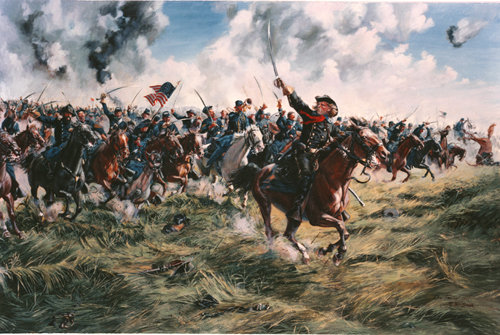
Today, July 3, in 1863 was the date of Pickett’s Charge, when Confederate General Robert E. Lee ordered a desperate Napoleonic advance against the Union line at Gettysburg in what has come to be a cautionary tale in human bravery and military hubris. The same day marked the zenith of the career of George Armstrong Custer, the head-strong, dashing cavalry officer who would later achieve both martyrdom and infamy as the unwitting architect of the massacre known as Custer’s Last Stand.
I have vowed to do all I can, which admittedly isn’t much, to get the story of what I like to call Custer’s First Stand into our nation’s cultural memory. I wrote much of what you are reading now way back in 2011, and have not adequately fulfilled my pledge since, although I have mentioned “Yellow Hair” (as his Native American conquerors called him) periodically over the years. Many historians have opined that Custer may have saved the Union army from defeat at Gettysburg with his bold actions this day, and therefore may have saved the Union itself. That accomplishment is far more important than the blunder at Little Big Horn that defines Custer’s image and reputation.
Custer’s heroics on the decisive final day of the Battle of Gettysburg teach their own lessons, historical and ethical. Since the East Calvary Field battle has been thoroughly overshadowed by the tragedy of Pickett’s Charge, it is little known and seldom mentioned. That is wrong.
Tell your friends and families the story, which has never been portrayed on screen. It is a really good story.
Lee’s plan, along with Pickett’s Charge, was to have J.E.B. Stuart’s cavalry attack the Union line from the rear as the Blues were facing the stunning advance by Pickett’s division. Had the Union forces believed themselves surrounded, Lee’s tactic of attacking with a massed, relentless, attacking line might have had its desired psychological effect and broken the North’s resolve.
Stuart’s mounted force met Union artillery as he approached, so the Confederate general ordered a cavalry charge. Custer’s cavalry, the 7th Michigan, by utter luck–moral luck!— was on the scene and took on the task of foiling Stuart’s advance. The much smaller Union force confronted Stuart’s mounted warriors. Shouting “Come on, you Wolverines!” Custer personally led the horsemen into furious close range fighting. Custer’s own horse was shot out from under him, so he commandeered a bugler’s horse and continued his cavalry’s battle.
General Stuart’s surprised Virginians, who did not expect to run into a Union cavalry behind Union lines, momentarily retreated, but not for long. Stuart called up reinforcements, and pushed the Michigan cavalry back. When it appeared that the Stuart’s horsemen would break through, Custer, badly outnumbered, called for a second cavalry attack, this one at a full charge to meet the charging enemy…a tactic that was as rare as it was considered foolhardy. Horses crashed into each other, sometimes killing both. One stunned witness recalled,
“As the two columns approached each other the pace of each increased, when suddenly a crash, like the falling of timber, betokened the crisis. So sudden and violent was the collision that many of the horses were turned end over end and crushed their riders beneath them.”
Custer had a second horse shot out from under him, but his courageous and reckless exploits broke Stuart’s advance. That crucial element of Lee’s strategy was foiled.
Would Lee’s grand gamble have paid off with victory if Stuart had reached the rear of the Union forces on Cemetery Ridge? No one will ever know. We do know that Custer’s trademark flamboyance and impetuousness, the same qualities that later would doom him and his men at the Little Big Horn, helped ensure the Confederate defeat at Gettysburg.
In many ways, George Armstrong Custer was neither a trustworthy commander nor a good man. After the war, he led soldiers who committed numerous atrocities against Native Americans, and was willing to risk the lives of others to serve his own military reputation and ambition. Custer, however, possessed many of the most useful tools of ethical conduct, which I call “The Seven Enabling Virtues.” While not ethical in themselves, these character traits—courage, valor, fortitude, sacrifice, honor, forgiveness and humility—greatly assist us in behaving ethically, especially under challenging circumstances. Custer did not possess humility. Whether he was forgiving, I do not know.
The lingering trap is that these tools can be used in the service of right or wrong, and can lead an individual to do as much harm as good. They are also prone to leading us to behave irresponsibly or unfairly. Courage can become recklessness; valor can curdle into showboating; fortitude can turn to stubbornness; sacrifice may become callousness; honor may beget vanity; forgiveness to excess encourages apathy and passivity, and humility plants the seeds of submissiveness. Custer’s courage, valor, fortitude and sacrifice served his nation and humanity well on July 3, 1863. On June 25, 1876, they helped get him and the 210 soldiers under his command slaughtered.
Without constant vigilance and a strong and evolving sense of ethics, even the enabling virtues can trigger misconduct and disaster. On July 3, I always reflect on Custer’s grand heroism when his country needed it most, and how strange it is that he is best remembered for his worst blunder, when his greatest achievement may have saved the nation, and, by extension, the world. I also think about how Custer’s life is a cautionary tale, reminding us of how easily our strengths can become our weaknesses, if we fail to understand how best to use them, or recognize when they are leading us astray.
 Ethics Alarms
I read about this battle (endlessly) in some of the threads I see on Quora, and there are a variety of opinions.
I think the main idea I read is that Lee never ordered Stuart to attack in coordination with Pickett, and that he had little chance of success if he did. The Union army was not going to be routed by a cavalry charge. It was too well positioned and dug in.
As well, an excellent point that is made is: What if Pickett’s men succeed in breaking through into the Union lines? The next step is for the exploiting force to follow up and expand the penetration. The catch is that there was no exploiting force. Pickett was on his own, and if they do gain the Yankee line they would look around to see nothing but more Union infantry rushing in to seal the gap.
It would be somewhat akin to the Battle of the Crater the next year, where a Union mine blew a huge hole in the Confederate defenses. Yankee infantry rushed forward into the crater, but they were able to accomplish little before the Confederates regrouped and shot them down.
=======
And yet, and yet I think also of Missionary ridge later in 1863 where Union infantry acting pretty much on their own made a suicidal charge up the side of a mountain into prepared and waiting Confederate troops — and somehow routed the Confederates and carried the day.
The day before we also saw the charges of the 1st Minnesota and 20th Maine that succeeded where they probably should not have.
It was a war when valor and vigor would occasionally accomplish the impossible.
And so, even though I don’t think Stuart would have accomplished much in the end, I agree that we should celebrate Custer’s charge and his regiment’s success in blunting the other Confederate attach on 3 July, 1863.