- A President has immense power and influence, but it is an abuse of both to use these in any matter than has no bearing on national interests, or in any sphere where the President of the United States has no legitimate role.
- Interfering with the World Cup in this manner is just one more bit of evidence for Trump’s enemies who want to frame him as a tyrannical despot.
- The episode is the epitome of “an appearance of impropriety.”
- Trump’s intervention guarantees that anything the U.S. team accomplishes in the World Cup from today on will be tainted. [ADDED: Well waddya know: “Trump’s red card call stirs political storm around World Cup”]
Belgium is, predictably, crying foul:
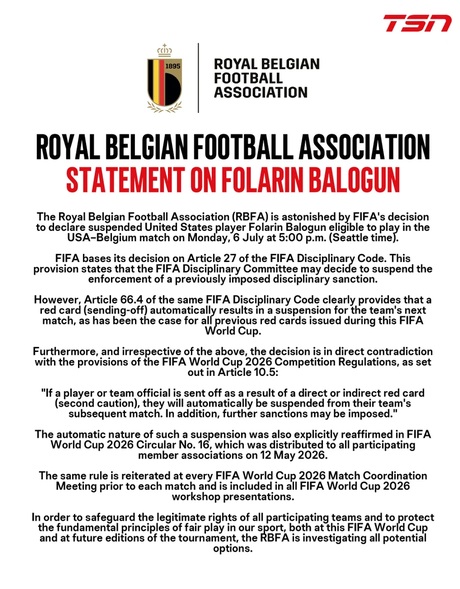
Naturally, many conservative sources are minimizing the inappropriateness of Trump’s phone call. Do you wonder why I have Breitbart on the Ethics Alarms blacklist? Its story on the reversal of Balogun’s suspension doesn’t mention Trump or his phone call! Typical.
The National Review has a good summary of the incident here.
“Thank you to FIFA for doing what was right, and reversing a great injustice!” Trump wrote in a statement on Truth Social. That Trump’s call was unethical doesn’t mean it wasn’t politically astute in a Machiavellian way. He was engaging in pure Cognitive Dissonance Scale gamesmanship. Using Soccer Appreciation Derangement to conquer Trump Derangement is cynical, but probably effective with a significant number of American soccer fans.
That FIFA is infamously corrupt and couldn’t tell an ethical principle from a penalty kick does have some relevance in assessing its role in this mess. FIFA president Gianni Infantino should have refused to discuss the matter with the President. If Trump insisted, he should have said, “One more word and we will not even consider an appeal of the suspension, and I will tell the press that you attempted to interfere with our management of the tournament.” He didn’t, of course, because Infantino is unethical just as Trump is unethical as well as incorrigible. Our President adamantly refuses to learn where his job stops and his actions begin damaging the integrity of other institutions and organizations. He has a flat learning curve on this, as well as in other areas.
As for everything else regarding the World Cup, it is of far less interest to me than the unfortunate chaos in my sock drawer. The day I spend more than three minutes watching a soccer match is the day for me to be permanently checked in to Madam Louise’s Home For The Bewildered.
UPDATE: The U.S. lost to Belgium, so the episode will quickly be filed with all the other times Trump has gotten out of his lane. That, however, is just moral luck. If the U.S. had won with Balogun leading the way, Trump’s attempted interference would have turned into an international uproar.


American president advocates for fairness for Americans on the world stage isn’t unethical.
This was a widely agreed upon reversal of a crap call. That the president joined many others in this observation isn’t unethical.
Agreed. It was a terrible call in the first place and FIFA would likely have reversed it on its own, without Trump’s intervention. In fact, there have been many terrible calls in this World Cup – along with many that should have been called.
I can tell you, objectively, that I cannot wrap my brain around the offisde rule. I get that it is intended to prevent the offense from leaving a guy at the defending goal, but its application seems fairly arbitrary to me. Colombia lost a goal against Portugal in the prelims for some sort of interpretation of the rule that i don’t get at all. It looked to me that Colombia got hosed.
jvb
I finally figured out the offside rule and it does make some sense. But it could be modified to protect against cherry picking but not stifle more athletic play.
Nonetheless, I don’t see how it’s unethical to advocate for fairness just because you have influence. Seems to me like a great deal of injustice would occur if people who could and should speak up don’t.
Either way, an American president advocating for Americans on the world stage seems like literally one of his top 10 job requirements.
Offside is intended to prevent the game from becoming a kicking fest. Without it, players would spread all over the field, stand in place, and simply boot the ball to each other. It can seem terribly nit-picky much of the time as the infractions and the enforcements are so … fractional, but a guy is either onside or offside. End of story. As you can see, the players don’t object to offside calls. They understand. And staying onside is a skill, as is playing a guy offside.
He can observe all he wants. He has no more right to try to change the call than I do.
It is theoretically impossible for Trump to change it, or influence it. The body that made the decision is independent of FIFA itself. Your suggestion that Infantino threaten Trump, however desirable, is also impossible. He does not have influence over that committee, either. At least that’s how it is supposed to work. Having related those supposed facts, I am not naive enough to believe that neither Trump’s nor Infantino’s opinion could’ve affected the committee’s decision.
The foul was a put-up job, in my opinion. The video review system was deliberately misused to generate the foul in violation of VAR protocol. That alone was ample justification for the invocation of Rule 27, even assuming the actual foul could subjectively be seen as worthy of a sending off.
Now, having said that, you are right — Trump should not have involved himself, and doing so is unethical. The Julie Principle is prominent here, but as ethics is your literal job description, you were right to highlight it.
What’s even more unethical is Trump taking credit for getting Balogun’s suspension lifted. We will never know if there is any truth to it or not, but I doubt it very much, and the content of his conversation with Infantino was remarkably restrained for Trump, according to the reports I have read.
Finally, Europe and Belgium’s reaction is absolutely intolerably unethical. They are not put out by having to play the USA at full strength after an objectively absurd red card, especially after Europe benefited from exactly this same situation in regards to Portugal’s Christiano Ronaldo during quals.
They are only interested, in my view, in sticking it to America and Trump, and/or gaining any advantage however unfairly granted. That is anything but sporting. In this country, if you protested the lifting of a suspension under similar circumstances, you would mostly be derided as cowardly — who complains about playing a team at full strength? Scared you might lose? Pathetic and unsportsmanlike.
Frankly, regardless of the outcome, this shows exactly why we should reduce ties to Europe — They have absolutely nothing in common with us anymore. Not in sport, not in defense, and only barely in trade. They have been captured by the third world, and their opinions anymore are those of the third world.
Horrible ref bowing to the VAR official. Preposterous for FIFA not to install an appeal mechanism. Red card rescissions/reductions are common in other organizations, the EPL being one. The situation should never have arisen. Competence ethics.
Again, the fact that it was a bad call, a terrible call, a rigged call, an incompetent call, or not—is absolutely irrelevant to the discussion and the ethics issues.
In 1975, in the third game of the World Series between the Boston Red Sox and the Cincinnati Reds, a home plate umpire, Larry Barnett (may he rot in Baseball Hell), called refused to call interference when Reds Pinch-hitter Ed Armbrister impeded Red Sox catcher Carlton Fisk as he tried to field a bunt in from of home plate. Fist bumped into the batter, causing him to throw wide of second base for an error, culminating in a run that won the game for the Red in extra innings. According to the rule book, it was interference. Jerry Ford was President, an athlete and a sports fan. He did opine on the play (Barnett was already getting death threats) and he didn’t call up the Commissioner of Baseball to try to get the game replayed, like they did with the George Brett pine tar game. Nobody thought it was the President’s job, because it wasn’t, and still isn’t. And I would have been disgusted if Ford’s intervention got the call reversed.
I don’t disagree. I just think the situation should never arisen. There was a series of failures of competence that led to the situation. The referee should have left his call alone and he should not have deferred to the video official’s insistence it was a red card foul. And FIFA should have established beforehand an appeal process to reduce the red card if appropriate. That’s my only point. Frankly, just a point of interest.
If we confine this sub-discussion to the call and not the ethical issues surrounding Trump’s (and others) actions in defense or aggravation, then I would look at it this way:
The head referee did not follow proper VAR procedure. No matter what the VAR official said, ultimately it is the head referee who issues the final decision. The decision of the VAR official to violate established procedure and show slow-motion replays of the worst possible angle rather than a full-speed replay to the head referee was the proximate cause of the wrongly-decided red card.
FIFA needs to consider the following revisions to their rules:
If they merely did these things, opportunities for unethical and corrupt behavior surrounding games would be reduced.
Yes. One of the questions that always pops into my mind when reading EA is: “How could this situation have been avoided?”
It’s one of the questions in the Ethics Decision-making Process.
I assume someone keeps an informal total of what added time should be.
Not that I know of. The head referee keeps the time. When he blows the whistle, the game is over.
I just assume someone, somewhere helps the referee come up with an added time total. He’s too busy reffing the game. Of course, a running time is traditional, I’m sure.
I stand corrected. It’s all in the hands of the referee. Crazy. Tradition!
And we certainly ignore “Yuge!” ironic fact (from Wikipedia):
Balogun was born in Brooklyn, New York, to Yoruba Nigerian parents. His parents were living in London and visited New York when his mother was seven months pregnant with him. Airline staff did not allow her to board the family’s return flight to London due to safety concerns over the advanced state of her pregnancy, and Balogun was subsequently born in New York. He returned to the United Kingdom with his parents when he was two months old and grew up in London.
What’s to ignore? The Supreme Court just declared that the 14th Amendment mandated citizenship if born in the USA, affirming long-standing precedent. Should that be changed? In my opinion, yes, but right now, that’s the law of the land as it was before they ruled. Balogun is a birthright citizen.
Is it ironic that Trump defended a person who may have been declared a non-citizen and thus ineligible to play if the Supreme Court had ruled otherwise? Absolutely. But Trump explicitly accepted the SCOTUS decision even as he disagreed with it, and defending a US player speaks well of his intentions, even if it was an ethics foul the way he did it.
I still think it’s ironic and funny, Glenn. Plus, I doubt the administration has given up on this point. And don’t you think the Balogun set of facts is ridiculous?
Yeah, it no doubt is ironic. Funny? Sure, subjective but okay.
I don’t see anything ridiculous about it. It’s the kind of head-shaking dichotomy we see in the world every day. I guess I would drop it in the “you can’t make this up” category.
And while we’re on soccer and Dems:
Sen. Mark Kelly gets skewered for wearing Mexico jersey at World Cup game
Heh. What a loser that guy is. One usually has to go to Michigan, Washington State or Connecticut to find a loser like that.
I read somewhere that at the World Cup, it is typical of a nation’s politicians to use their clout to challenge red flags and that European nations are well known for doing this. I know so much about soccer in general and the World Cup in specific that I could not tell you if that is true, false, or the square root of purple. However, this leads me to say that, if that were true, it would change this analysis, as that practically becomes the rule of the game. Not following the unwritten rules then becomes a sign of weakness and inadequacy, not good leader material.
Even outside soccer and Donald Trump, this raises an ethical question in my mind. “Everybody does it” is a rationalization, no doubt, but there are many times where “Everybody does it” becomes a rule for society and those who do not follow that rule are left behind and typically called unethical for figuratively placing Marquis de Queensberry rules in street fights where they and those they support end up knifed.
For example, if women are to be successful upper managers and CEOs, they are supposed to be able to talk sports, play golf, and enjoy or at least tolerate cigars and brandy. Why? Because “everybody does it.” These items are not necessary for management, have nothing to do with skills, talents, or organization of human resources, and because upper managers have to be on call 24-7-365 and have to drop life to deal with unexpected events, are actually detrimental to doing a good job. The “good ol’ boy’s club” is almost always extremely prone to corruption. However, it is part of the rules of the game and so it is the way we have to do things. People who do not follow these unwritten rules are considered by society to be bad managers, even when they do everything else with perfection.
A different example is that of speed limits in the city. I hate driving in the city, but I have learned that the basics in good driving are very different than on the wide open Wyoming roads. Denver, my most commonly visited metropolitan area, has a 55mph speed limit that is only briefly passed by on the way up or down. If you drive 55 mph on any of the roads that are marked there, you are obstructing traffic and causing conditions likely to lead to wrecks. Apparently you can get pulled over and warned for following the law. 65 is a minimum practical safe (ish) speed on most of these, and even then people are tailgating you because you are going too slowly, typically even in the rightmost lane. Chicago, as far as I can tell, is even worse. Florida may not be that bad, except everyone seems to think that lanes are optional. Houston is all about death defying stunts at flight speeds. Somehow, the idiots are never pulled over and the people following the official laws are the hazards.
As someone who follows rules and tends to be very data minded rather than socially adept, unwritten rules confuse me. When does “Everybody does it” turn from a rationalization to a part of the rules for working with a situation? How do we tell if we are using the rationalization for an unethical act or just adapting to conditions that are set up despite written, but ignored, rules to the contrary?