Guest Post by James Rogers
[Note: I am abashed that over the years Ethics Alarms has neglected formal ethics theory far more than it has focused on it. Thus I was thrilled to receive this excellent guest post, submitted by faithful Ethics Alarms reader James Rogers. JM.]
It is evident to many, perhaps even a majority, that we have been living through and are still in a substantially unethical period in US and world history. How can we objectively determine if this is true? The multiple ethics train wrecks highlighted by our blog host is certainly one. Another reasonable and slightly less subjective method would be to consider how an eons-old founder of our civilization measured ethical people and behaviors generally and in the realm of politics.
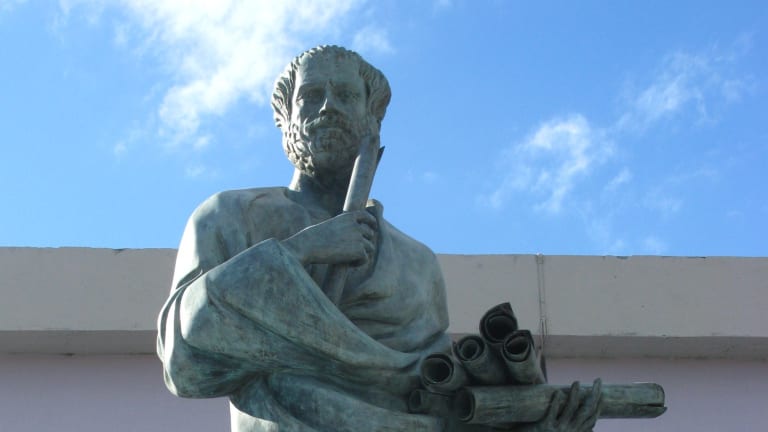
Recently, I took the opportunity to read two books on the matter by Aristotle (4th Century BC), ‘Nichomachean Ethics’ and ‘Politics’. In those readings Aristotle directly addressed both the individual and societal perspectives on ethics and ethical government. This perspective has additional appeal as it isn’t tinged by modern religious biases.
Since we are humans, tackling individual ethics seems foundational as societal ethics comprises humans behavior and interactions regarding governance and broader economic and social commerce. Starting there, Aristotle points out there are three essential reasons for human action:
- Pleasure (personal gain or goal achievement),
- Honor (public recognition, affirmation, or reputation), and,
- Virtue (for the benefit of another or others though it may also benefit you) without expectation of any recompense or acknowledgement.
These are universal in our human motivations, regardless of a person’s status, wealth or education.
Finding a truly or purely virtuous person or people to interact with is more than tough to find. In fact, it is fairly certain that person or set of people do not exist. Potentially someone independently wealthy, who needs nothing, who simultaneously is pursuing virtue is possibly out there, but it would be more than challenging to find and identify them. If this is an accurate assumption, the human race is likely facing tough choices individually, as they strive to be virtuous themselves while finding others to engage with who will behave, at least in part, virtuously. As a result, we often make our own personal ethical compromises and also in our associations.
This is not promising.


This might be the best comment I’ve read on EA.
Then encourage James to comment more! He’s been visiting for a long time.
Really excellent summary of Aristotle.
“It is evident to many, perhaps even a majority, that we have been living through and are still in a substantially unethical period in US and world history.”
[Oy vey, not this nonsense again…]
Compared to actual chattel slavery and Jim Crow? State-sanctioned eugenics? Wiping out Native Americans and pushing the survivors onto reservations? Denying women the right to vote? The Holocaust?
Claiming our era is somehow uniquely unethical misses a few wee tiny miniscule things.
Every generation thinks their time is the worst because we’re living through it in real time. Now might be a good time to realize how that works.
Ancient ethics were mostly about personal character traits for a handful of elite guys, whereas today we measure ethics by systemic harm and actual scale. NOT THE SAME FRAMWORKS!
Third, picking an ancient standard as some ideal baseline completely ignores that thinkers like Aristotle literally defended slavery and thought women, workers, and non-citizens had less rights (well, he may have been right about that last one…) FLAWED BASELINE!
I’ll leave the rest of this monstrosity to the EA intelligentsia…
“Compared to actual chattel slavery and Jim Crow? State-sanctioned eugenics? Wiping out Native Americans and pushing the survivors onto reservations? Denying women the right to vote? The Holocaust?”
The original statement wasn’t a comparison. Writing that we are living in a profoundly unethical time period isn’t saying that there haven’t been other times and places that have lacked ethics and where that lack of ethics has resulted in terrible things. We simply have the benefit of knowing that those terrible things were because they are in the past.
It remains to be seen what the consequences will be of our current lapse.