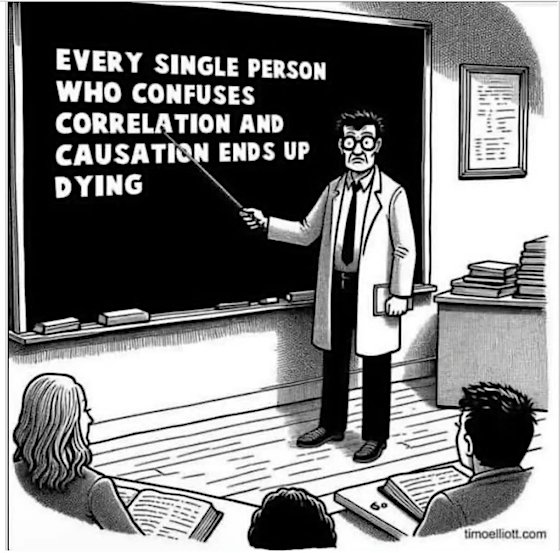
Ironically, I had posted this cartoon on Facebook yesterday:
The CNN headline is a wonderful example of the Axis deliberately blurring correlation with causation. Apparently, it was too deceitful even for CNN. Later, the now totally untrustworthy “Most Trusted Name In News” network pulled the headline, explaining via tweet,
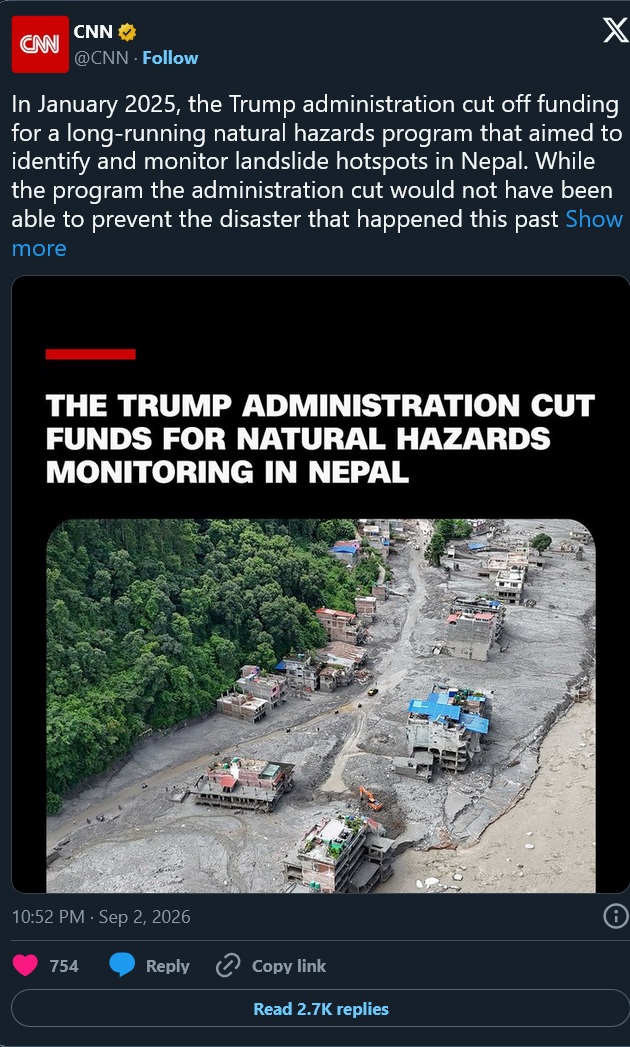
Full tweet: “In January 2025, the Trump administration cut off funding for a long-running natural hazards program that aimed to identify and monitor landslide hotspots in Nepal. While the program the administration cut would not have been able to prevent the disaster that happened this past week, it represented a first step towards making those kinds of protections possible in a future where they are going to be needed more.
“CLARIFICATION: This headline and story have been updated to better reflect the extent of the Project SERVIR-Hindu Kush Himalaya program.”
That tweet is deceitful and unethical too:
1. CNN uses “long-running” to imply that the program was valid, necessary, and a good use of funds. The fact that it has been going on so long—I’d love to see the total expenditures from the beginning—doesn’t prove the program was something the U.S. should have spent taxpayer funds on. This is a variation on Rationalization Numero Uno: “Everybody Does it“: “We’ve done it for a long time, so it must be good.”
2. “While the program the administration cut would not have been able to prevent the disaster that happened this past week..” Full stop. Then the Trump Administration shouldn’t have been mentioned in the story at all, much less in the headline.
3. “…in a future where they are going to be needed more.” Of course: more climate change fearmongering and propaganda! Oh, are they? Prove it. Then tell us when “they are going to be needed more,” and why Nepal should get such speculative funds from the U.S. rather than have them spent on our hypothetical climate change apocalypse needs.
4. And the revised headline still connects the Nepal disaster to the Trump Administration.
5.”This headline and story have been updated to better reflect…” Utter equivocation. The new headline isn’t that much better than the first one, either.
Commenter JDkazoo, a relatively open-minded George Mason prof, abandoned EA in January because I wouldn’t swallow the Left’s attempts to demonize I.C.E., so I don’t feel bad about chiding him. He actually wrote once that he didn’t think the news media is biased, back before I concluded that I would ban anyone who asserted that on the grounds that it was gaslighting. If JD is still out there, I’d challenge him to explain CNN’s coverage of the flooding in Nepal as anything but flagrant bias.
Oh, I know what he’d say, because I get the same answer whenever I confront a Trump Derangement sufferer with similar Axis misconduct: “Okay, that may have been bad, but…“
There are no buts about it. CNN and its Axis fellow travelers are working hard to rig this national election as they tried to rig every national election since 2008.


Having just completed a long nautical journey, I complained to my children how poor wind and wave forecasting had become. Their immediate response: NOAA was “gutted” by DOGE.
So I looked it up. NOAA had its appropriations cut 6%. Wow!
Then I looked up articles to discover various media using the term gutted for the NOAA budget, found three in just a minute or two.
Propaganda has real impact.
The Trishuli 3A hydropower project was commissioned in 2019, so it doesn’t appear that this “long-running” intervention to identify landslide hotspots did anything to prevent Nepal from building several hydroelectric stations in the path of the latest disaster.
“… Yeah, but Trump!” is Trump Derangement’s primary symptom. The media are simply pandering to the Trump Deranged. They’re all simply saying, “Right on!”
Yes the CNN is biased. And water is wet. Is there still any point in complaining about the bias of CNN, if can simply watch Fox News instead?
It seems to be a law of nature that the press is biased. In the Netherlands were I grew up newspapers had a certain signature; there were socialist newspapers, Protestant Christian news papers, Catholic newspapers, and liberal newspapers. This was most clear in their opinion pages, but also in which news they reported and how. As long as there is a good variety of newspapers with different signatures that are clear to the public I do not think there is a structural problem. Variety in programming of radio and television in the Netherlands was similar to that of newspapers.
In Great Britain we see a similar variety in newspapers (Guardian for the left, Telegraph for the conservatives) but not on television as this is dominated by the BBC.
In the USA television was dominated by three networks (CBS, NBC, ABC) who all pretended to be neutral but in time developed a more and more progressive slant. (As did public education by the way.) This means that slanted editorialized news is presented to the public as neutral and objective. And that is a problem.
Happily in the late 1990s Fox News came along, plus talk radio to provide some counterbalance, and now we have various sources via the Internet. I have to admit that I have not watched CNN (or MSNBC, NBC, CBS, ABC) at home for ages as I think the reporting and presentation is sickening (I accidentally pick something when I am traveling at an airport or in a hotel).
So my argument is that we are not dependent on CNN for news, we can obtain the news from other sources. That being the case, is there still a point in complaining about the bias of the MSM? It gets tiresome and repetitive. It starts sounding like the boy in the “Someone is wrong on the Internet” meme from XKCD.
Incredibly, the same progressives who want the U.S. to pay to save lives everywhere in the world (you can’t get much more remote than Nepal) also are trying to make the National Debt a Democratic issue. The two positions are completely incompatible, but never mind. The party thinks the public is stupid, and issues messages accordingly. Or Democrats are stupid. Or both.
Would it be possible that the Democrats are correct in assessing the intelligence of the average American voter? The midterms will show how stupid the Democrats are.
Yes. Because it has to sink in sufficiently that when ABC, CBS,CNN and the rest say that Trump’s claims about the 2020 election are “baseless” it is seen for what it is. A lie. Fox News is, by its own admission, biased in the other direction. That doesn’t make it any more ethical than the rest.
I am wondering whether the law of diminished returns applies to point out Trump Derangement Syndrome and bias by the MSM. I am getting jaded when somebody is pointing out another example of TDS and bias, there comes a point where pointing out more of the same barely adds value. Snark and ridicule may be more effective than a detailed rebuttal, as I believe that the MSM cannot be taken serious anymore.
Fox News’s bias offers a counterbalance to the bias of the main stream media. That is why I am less bothered by it. The law of averages applies here, if the majority of the media has a hard left bias, and there is only one news organization claiming to have no bias, is fair, balanced, objective and neutral (claims that I distrust by the way), then on average the media is still hard left. The bias of Fox News balances the ship a bit. So does talk radio, and newspapers like the NY Post, Epoch, and Washington Examiner.
Re: explain CNN’s coverage of the flooding in Nepal as anything but flagrant bias
With regard to point 2, CNN has to consider whether viewers and readers will be interested in a story when deciding whether to run it. They presumably ran this story now rather than in January 2025 because the recent disaster made the story more relevant to the average viewer.
Revealing that the Trump Administration was the Administration that cut the funding is standard journalistic practice. Revealing who did something allows the viewer to know who deserves the credit or blame for the action.
With regard to point 1, the CNN article doesn’t draw any conclusions from the fact that the program was “long-running.” Obviously, the fact doesn’t prove the program was something the U.S. should have spent taxpayer funds on. On the other hand, readers may infer that a program that has been around for a while (including the entirety of the first Trump Administration) deserves a bit more benefit of the doubt than, say, a program initiated under the Biden Administration. I don’t see this as a reason for CNN to obfuscate the length of time the program was in existence.
I’m not sure what to make of point 3. An uncharitable reading is that the author wants to pretend that climate change isn’t real, but will try to take it seriously and address the specifics:
The demand to “prove it” overlooks the fact that CNN wrote a news article, not a scientific paper. CNN does link to another CNN article which discusses the mechanisms. Melting ice can form glacial lakes which can then cause flooding when they burst their banks. Ice helps hold the mountains together. “Think of the high mountains like this as shattered bedrock glued together by ice-filled joints,” explains Richard Waller. So warmer temperatures are a recipe for flooding and avalanches.
The article would have been more informative if it had addressed the ”when“ question, but I don’t see how addressing it would make the article less biased.
The demand that CNN should tell us, “why Nepal should get such speculative funds from the U.S. rather than have them spent on our hypothetical climate change apocalypse needs,” appears to call for CNN to engage in explicit advocacy. I should note that the tradeoff described here is basically illusory. The Nepal program cost on the order of one million dollars per year. Adding that to the billions of dollars per year that the United States already spends to address climate change isn’t going to make a difference.
I can’t comment on points 4 and 5 because I’ve only read the current version of the story.
The challenge was “to explain CNN’s coverage of the flooding in Nepal as anything but flagrant bias.” It seems reasonable to ask what CNN could have done differently. The changes suggested in points 1 and 2 both involve leaving out information which is true and not misleading. The changes suggested in point 3 don’t seem designed to reduce bias at all. So we are left with the possibility that CNN could have decided not to cover the story at all.
The decision to report and run the story could have been influenced by the fact that the story was unflattering to Trump, but we can’t establish that just by looking at the story. CNN has probably run negative articles about every presidential administration. So flagrant bias is a possibility, but not the only possibility
Thanks for the gallant effort. I appreciate it.
This sentence, however, destroys your credibility: “The Nepal program cost on the order of one million dollars per year. Adding that to the billions of dollars per year that the United States already spends to address climate change isn’t going to make a difference.”
The Kelly Morrison for Congress FB page (it came up on Reels) claimed that in July of 2025, ‘the CDC quietly cuts tracking of food borne pathogens’, talked about the Cyclospora outbreak, then concluded that “this is what happens when you take away public health programs that keep people safe”.
What was pared down was FoodNet, active in 10 states. They will track salmonella outbreaks and STEC instead of all 8 tracked pathogens. It was not a nationwide drastic cut. The tracking FoodNet does is carried out already in all 50 states. FoodNet covers 16% of the U.S. population. News articles make it seem as if al pathogen tracking has been pared back.