1. I am wrestling myself to the ground to avoid making any assumptions about the shooting this morning (about three miles from my home in Alexandria, Virginia) of two Republican Congressmen and an aide while the GOP baseball team was practicing for tomorrow’s annual Congressional baseball game for charity. When Rep. Gabby Giffords was shot (and a judge killed, among others) in Tucson, Arizona, the news media, pundits and Democrats leaped to blame Sarah Palin and Rush Limbaugh for so-called “eliminationist rhetoric,” defined in Palin’s case as using cross-hairs on an electoral map to indicate which Democrats could be defeated in 2012—you know, as in “he’s in my cross-hairs.” This was a transparent effort to stifle political speech. In 1995, when a Federal building in Oklahoma City was blown up in a domestic terrorist attack, “violent anti-government” rhetoric from the Right was also blamed, though there was no evidence that Timothy McVeigh would not have done exactly the same thing if political discourse had been all John Lennon and rainbows.
The Giffords explanation was cynical and contrived; the Oklahoma City response a bit less so, but in neither of those cases were violent imagery and hateful language (no party officials and member of Congress used “fuck” back then, late night TV hosts were largely apolitical and couldn’t call Presidents “cockholsters” without being fired, the “resistance” in 1995 consisted of fringe militia groups, not recent unsuccessful Presidential candidates with a large following, and nobody was giving standing ovations to Central Park theatrical productions showing a doppleganger of the President of the United States being assassinated. In other words, if Rush Limbaugh had held up a prop bloody head of Barack Obama prior to Giffords’ shooting, I would not have derided the critics who argued that irresponsible partisan rhetoric was at least part of the cause. But he didn’t. Nobody did. Nobody would have thought of doing so. Then.
So when my wife told me, the second I woke up, about the shooting this morning, my immediate thought was, “I wonder who the shooter is, an illegal immigrant, a Muslim, or a member of “the resistance?” This was unfair, and I knew it. The shooter might have been, as it was in Tucson, a wacko. It might have been moral luck that it was the Republican baseball team that was attacked and not the Democrats, just as it was moral luck that nobody was killed. Continue reading →
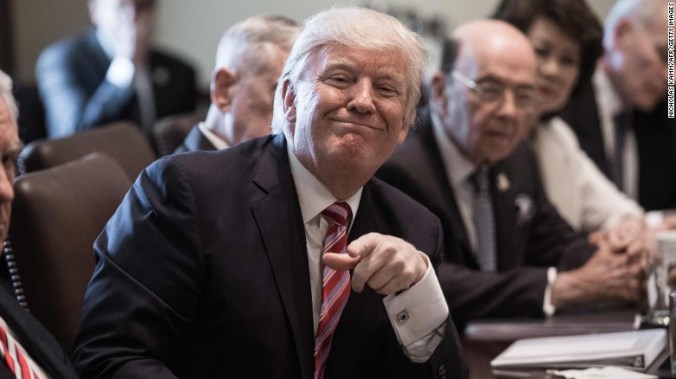
Yesterday’s weird, televised segment of the Cabinet meeting was troubling in many ways. If you missed it, and I am envious if you did because it will haunt my nightmares for a long time, here is what happened:
Trump began by giving a positive assessment of his first 143 days and said,”Never has there been a President….with few exceptions…who’s passed more legislation, who’s done more things than I have.” Bad start. Trump, in fact, has signed very few bills. “Never—with few exceptions”—is classic Trump-speak, aka gibberish. This is also the kind of statement Trump’s Furies call “lies.” This was not a lie. In some convoluted way, the President thinks its sort of true. THAT’S the problem, not that he’s lying.
This was just the appetizer, though. The full course was the Cabinet officials, one by one, around the table, taking turns praising their boss. This could not have been spontaneous. It reminded me of “King Lear”s” opening when the old, fading monarch requires each of his three daughters to tell him how much they love him as the price for getting a piece of his kingdom.
The charade began with Vice President Pence, who called it the “greatest privilege of my life” to serve in the Trump administration. Then Attorney General Jeff Sessions said it was an “honor” to serve Trump, and the rest of Trump’s Cabinet more or less aped what Pence or Sessions had said. Maybe they had all been given talking points. As a final inducement to projectile vomiting, Lackey-in-Chief Reince Priebus gave us a suck-up for the ages:
“On behalf of the entire senior staff around you, Mr. President, we thank you for the opportunity and the blessing that you’ve given us to serve your agenda and the American people And we’re continuing to work very hard every day to accomplish those goals.”
And may I fellate you here, sir, or later?
Disgusted and depressed observations:
1. This is exactly the kind of self-destructive fiasco a top Chief of Staff who has a proven record running successful government operations on the state or national level could and would prevent. Instead, Trump has a Chief of Staff who actively made it worse. In February, Ethics Alarms featured my post calling for the appointment of such a figure as “the single most ethical thing President Trump could do.” That was four months ago, and this is more desperately needed now than ever.
2. Since this horrible display did happen, we now can say with certainty that none of the President’s inner circle has the influence, guts or common sense to stop him when he yields to his worst instincts.
3. We can also conclude that not a single member of the President’s Cabinet possesses sufficient integrity, courage, principle or self respect to be trusted by the American public. These are billionaires and generals, and not one said to Trump, “I’m sorry, Mr. President, but this will make you look weak and me look like an ass-kissing yes-man. I won’t do it, nor will I remain in a Cabinet stocked with lapdog sycophants who would debase themselves and their high offices by doing it. Do you discard this idiotic charade, or do I resign now?”
1. The controversy over the Central Park “Julius Caesar” casting Donald Trump–his stage clone, really—as Caesar continues to be ignorantly argued. What’s worse, Fox News constantly calling the Shakespearean classic an “assassination play” (it’s not, not even close), or people who really would love to see Trump assassinated arguing that there’s a double standard because some professional productions of “Julius Caesar” in recent years cast a black actor as the targeted emperor? Does anyone for a second believe that if a high-profile theatrical production depicted a character as clearly intended to symbolize Obama as the New York City production styles its Caesar as Trump being assassinated in a scene like the one below, there would not have been equivalent, indeed greater outrage?
The most cited production with a black, modern business-suited Caesar had an actor with a shaved head playing the role, clearly signalling that this was NOT Barack Obama. This, however, is “Donald Trump”:
My question is: Does the audience cheer? I bet they do, and I bet that’s exactly what the director wanted. I support the production, and reject efforts to pressure donors into pulling support. Theater is often political, and outrageous, and should be. But the play’s defenders who cite versions that evoked a black leader as equivalent are arguing that people are more upset at a faux Trump assassination than they would have been if “Obama” were slaughtered in Central Park, and that is absurd.
2. Another looming boycott is the effort to punish NBC’s Megyn Kelly for interviewing InfoWars’ Alex Jones, the professional conspiracy theorist and right-wing liar. Because he famously suggested that the Sandy Hook massacre was a hoax—an instant IQ test for anyone deciding to ever pay attention to this jerk again—Sandy Hook parents and their allies are condemning NBC and Kelly for “giving him a platform,” and have succeeded in getting one sponsor, JP Morgan, to drop its ads. How long before both ends of the political spectrum start routinely pushing boycotts of any journalists who “give a platform” to someone their “side” has pronounced as evil? The Sandy Hook victims’ families continue to abuse the sympathy their tragedy evoked by using it to attack core rights using appeals to emotion and little else. Some quotes from the Washington Post story:Continue reading →
Like Title IX, like Obamacare, like so many well-intentioned laws and regulations designed to assist and protect vulnerable citizens or traditionally oppressed groups, the Americans with Disabilities Act (ADA) opened the door for abuse, absurd taxpayer costs, and unanticipated consequences. The ADA was rammed into law by activists compassion bullies who proclaimed that any attention to proportion and cost-benefit analysis was mean and heartless. Here is an example of what else came in that open door:
ADA lawsuits are now as common as sex-discrimination lawsuits, with more than 26,000 new claims filed against employers each year. The latest litigants have their sights on the most innovative segment of our domestic economy: e-commerce.In this trend, people sue businesses because their websites aren’t sufficiently accessible to the disabled — because the websites lack assistive technologies for the blind or hearing-impaired, say. It began in 2000, when Bank of America became the first entity to settle a web-accessibility lawsuit. Safeway and Charles Schwab soon followed suit. In 2008, Target paid $6 million to settle a class-action suit brought by the National Federation of the Blind, and nearly $4 million more to cover the plaintiffs’ attorney fees and other costs. More than 240 businesses across the country have been sued in federal court over website accessibility since the beginning of 2015. Similar litigation has been brought against universities on the grounds that the free online courses they offer aren’t captioned for deaf users, and against ride-sharing services because their smartphone apps lack text-to-speech capability for blind users.
…According to the demands of disabled users, in order for a website to be accessible, it must use fewer pictures, present text in a format that is compatible with text-reading software and employ design that allows for easy navigation. But the features that make a website more accessible for one disabled group are bound to be objectionable to another.
They may also conflict with other needs. Consider bank websites, which often employ timers that will shut down an online session for security reasons after a particular time period is exceeded. Such “timeouts” could present problems for some disabled users, but eliminating them in the interest of accessibility could impair security for all.
In the process of making a website accessible, questions invariably proliferate. Do certain color combinations violate the ADA because they confound the colorblind? Are certain layouts inaccessible if they’re confusing to users with a limited field of vision? Do the accessibility requirements apply only to the websites themselves, or do they also apply to Web content, such as advertising on a third party’s website? Will website hosts be responsible for the compliance of third-party sites? Must archived Web content be revised to comply? What about mobile apps? Do temporary technical bugs in an otherwise compliant website constitute a violation? What physical and mental conditions will require accommodation? So far, Web accessibility lawsuits have concerned the vision- and hearing-impaired, but future cases could be brought on behalf of plaintiffs diagnosed with dyslexia, ADD/ADHD, narcolepsy, cognitive impairments, paralysis and many other conditions.
The game is to sue deep pockets website owners and extort settlement pay-offs. That’s fine for the Bank of America, but not for, say, Ethics Alarms. This blog could be put out of business by such a lawsuit, and so could hundreds of thousands of others. Continue reading →
In New York City, Public Theater’s free Shakespeare in the Park festival this summer begins with a version of “Julius Caesar“, in which Caesar is played by an actor made up and costumed to look like the current President of the United States, and Calpurnia (Caesar’s wife) is portrayed as a runway model with a Slavic accent. Some of the costumes include Anonymous masks and the infamous pussy hats. When Caesar/Trump is assassinated in the Senate, the murderers are women and minorities.
Oooo! Subtle!
The production has been in previews since May 23, and opens tonight at the Delacorte Theater in Central Park. Criticism of the concept, theater and its financial supporters has been roiling all week, and many have compared the play to Kathy Griffin’s severed Trump head stunt. Fox News reported that it “appears to depict President Trump being brutally stabbed to death by women and minorities.” Well, yes, that’s right. Now some prominent corporate sponsors have publicly withdrawn their financial support, including Delta and Bank of America.
Delta’s statement:
“No matter what your political stance may be, the graphic staging of ‘Julius Caesar’ at this summer’s free Shakespeare in the Park does not reflect Delta Air Lines’ values,” Delta said in a statement on Sunday night. Their artistic and creative direction crossed the line on the standards of good taste. We have notified them of our decision to end our sponsorship as the official airline of the Public Theater effective immediately.”
Bank of America:
“The Public Theater chose to present ‘Julius Caesar’ in a way that was intended to provoke and offend. Had this intention been made known to us, we would have decided not to sponsor it. We are withdrawing our funding for this production.”
Other sponsors, such as Time Warner and the New York Times, have stood fast. Said the Times:
”As an institution that believes in free speech for the arts as well as the media, we support the right of the Public Theater to stage the production as they chose.”
Ethics Observations:
[Do remember that I am a professional stage director, previously the artistic director of a professional theater for 20 years, and that I dealt with donors, individual, corporate, non-profit and government, all that time.]Continue reading →
1.Senator Diane Feinstein redeemed some of the Democratic Party’s integrity by stating that James Comey’s revelations regarding Obama AG Loretta Lynch’s directive that he lie to the news media and the American people so they wouldn’t think Hillary Clinton was being investigated warranted hearings and its own investigation. This was easily the biggest story to come out of Comey’s testimony, as the U.S. government using its power to influence a Presidential election by spreading misinformation is far more serious than a foreign power influencing an election by allowing the public to see what a candidate and her party have been covering up. (I have stated the issue this way before, and will continue to do so, since it is accurate and true.) That this damning account was mostly buried by the New York Times, the Washington Post and the broadcast media is yet one more smoking gun (as if more were needed) proving just how partisan and untrustworthy the news media has become. It also should focus more attention on the still-percolating IRS scandal, speaking of subordinates interpreting a leader’s expressed desires as directives, as well as Barack Obama’s repeatedly demonstrated belief that the ends justifies the means in the 2012 campaign, the passing of the Affordable Care Act, the Iran deal, and more.
2. NY Times op-ed columnist Charles Blow, a smoking-gun himself since the Times’ refusal to discipline or can him when he repeatedly used anti-Mormon slurs to attack Mitt Romney, has become the loudest shill for “the resistance” at the paper–quite an achievement, since the whole paper is a shill for “the resistance”—reveals that 43% of the public (according to polls, remember, and we now know how reliable and unbiased they are) believe that Congress should commence impeachment hearings. Blow finds this tragic, but the only two interpretations of the data is that 43% of the public is civicly, legally and historically ignorant, that 43% of the public has been completely misled by the biased reporting of the news media, or that 43% have embraced the anti-democratic view of impeachment being pushed by progressives and “the resistance,” which is that it is a legitimate device to undo elections and ensure that the Left achieves permanent rule over us all. Writes Blow, sniffling,
“I know well that the very real obstacles to removal injures the psyche of those worn thin by the relentless onslaught of awfulness erupting from this White House. I know well that impeachment is one of the only rays of hope cutting through these dark times. I’m with you; I too crave some form of political comeuppance. But, I believe that it’s important to face the very real possibility that removal may not come, and if it does, it won’t come swiftly. And even a Trump impeachment would leave America with a President Pence, a nightmare of a different stripe but no less a nightmare.”
It should bother everyone that a man like this has a regular, high-visibility platform for his corrosive views. Impeachment is national convulsion that good citizens only hope for when a President has engaged in impeachable acts. Blow and other like him, who hope for those impeachable acts to justify removing a President they object to on ideological, personal or other grounds are just people with busted ethical alarms, bad citizens, bad neighbors, and dangerous to our democracy.
3. Here is an ethics train wreck from academia.A white professor at the University of Tennessee asserted via a multiple choice quiz ( Colleges use multiple choice quizzes?) that the statement “Black family bonds were destroyed by the abuses of slave owners, who regularly sold off family members to other slave owners” was wrong. A black student vehemently disagreed and challenged the teacher, who then threatened to “get” the student on Facebook. After the professor was pressured into resigning by the university, she emailed the class with a further attack on the student, without using her name. Naturally, the student has decided that this single incident shows the lurking perfidy of white social justice warriors, or to put it bluntly, “Can’t trust whitey!” How do people like the professor get hired? Since when is a professors position “unacceptable’ because it disputes conventional wisdom? Is race immune from non-conforming academic views? And why are college courses using multiple choice quizzes? [Pointer: Fred]
4. Also from Ethics Alarms Super Scout Fred: this study, showing that Oakland police officers “tend to speak less respectfully to black people than to white people during traffic stops, using language in these everyday interactions that can erode community faith in the police, according to a first-of-its-kind study of body-camera footage released Monday by Stanford researchers.” Ugh. Now that’s “ microagression,” and maybe not so micro.
Ethics diagnosis: incompetent training, negligent oversight, and dead ethics alarms.
5. CNN has a lot of work to do before it can claim to be a professional and trustworthy news source, and one obvious step is to fire Brian Stelter, the network’s alleged journalism ethics watchdog. His predecessor Howard Kurtz was pretty bad, but Stelter is pure flack, seeing his main function as defending CNN and his secondary function as denying media bias, since he is so shockingly biased himself.
Yesterday on his ironically-named show “Reliable Sources,” Stelter and guest Jeff Greenfield blamed President Trump for polls that show a steep decline in public trust of the news media. Greenfield said, “I think that has served that relentless campaign on Twitter and in his comments, fake news, fake news, fake news has been to convince that group of people that there is no such thing as a set of facts independent of your politics. And that has certainly served to continue and accelerate what you’ve talked about as a long process of declining trust in news.”
The downward trend will continue until prominent members of the news media admit that the reasons trust in journalism have declined precipitously are
That the mainstream media’s partisan bias is obvious and palpable,
That has proven itself untrustworthy, and
Arrogant hacks like Stelter and Greenfield make it clear to all willing to see reality that the news media thinks that there’s nothing wrong with its reporting.
As for President Trump, he has an ethical and professional obligation to focus attention on the news media’s shift into a partisan political force, both to prioect his administration and to ensure that the public isn’t deceived. The previous President was happy to ignore this dangerous development, because Obama foolishly thought he benefited from it. In truth, he and the nation would have benefited more by journalism that held him to higher standards and criticized him when he deserved it, which was often.
I’ve been reading a lot about Abraham Lincoln of late. A book by William Hanchett called “The Lincoln Murder Conspiracies” reminded me that while President Jackson is the closest historical match for the populist, outsider aspect of Donald Trump’s rise, the startlingly close match for the antipathy and hatred Trump has faced from the moment of his election eerily traces the experience of Abraham Lincoln.
Like Trump a minority President, Abe won only 39.8% of the popular vote but was still comfortably elected by the Electoral College. As with Trump, his opposition refused to give him a chance to govern or unify the nation, although in his case, the Democrats divided the country literally, seceding from the union before Lincoln took the oath of office. Today’s Democrats are without that option (thanks to Lincoln!), but are doing everything else in their power to undermine the elected leader. (And California, the most Democratic state, is saber-rattling about seceding.) Also like Trump, Lincoln did not concede that his lack of a popular vote majority in any way robbed him of a mandate to govern.
From the moment the election results were known, many Democrats proclaimed the election of Lincoln itself to be an act of aggression, a “declaration of war.” Many in Lincoln’s own party—even his own Attorney General—accused him, with some justification, of engaging unconstitutional measures. The Governor of New York evoked the Revolutionary War generation, saying that they would not stand for such incursions on their rights. Constitutional expert George Ticknor Curtis of Massachusetts predicted that the Lincoln Presidency would “be an end to this experiment in self-government.”
Meanwhile, pundits and critics heaped personal abuse on Lincoln, calling him grotesque, a barbarian, ” gorilla.” Diarist George Templeton Strong, whose words are so often quoted by Ken Burns in his documentary about the Civil War, called him a “yahoo.” It was said that fashionable New Yorkers would be ashamed to be seen in the presence of someone as boorish and uncultured as Lincoln; it was rumored that he rejected handkerchiefs and “blew his nose through his thumb and forefingers, frontier-style.” As late as 1864, a New York editor wrote,
“[The President] is an uneducated boor. He is brutal in all his habits and in all his ways. He is filthy. He is obscene. He is vicious.”
Somehow, despite this cruel barrage of ad hominem rhetoric, arguably more successful then that it would be now since the public has more knowledge of the President and can make their own observations, Lincoln persevered to meet the greatest challenges any President ever faced.
While still pondering some of the parallels with today’s relentless attacks on our current President, I watched again the 2012 Stephen Spielberg-directed film “Lincoln,” which was almost unanimously praised when it was released, and which I enjoyed a great deal when I first saw it. This time, however, “Lincoln” revealed itself as an ethics corrupter. Continue reading →
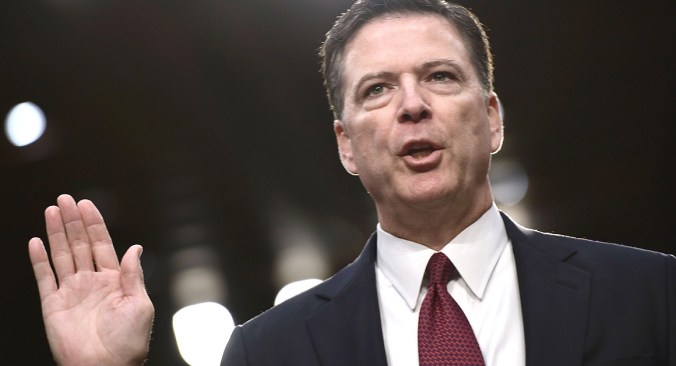
1. “Even though I was appointed to a ten-year term, which congress created in order to underscore the importance of the FBI being outside of politics and independent, I understood that I could be fired by a president for any reason or for no reason at all. And on May 9th, when I learned I had been fired for that reason, I immediately came home as a private citizen. But then the explanations, the shifting explanations, confused me and increasingly concerned me. They confused me because the president that I had had multiple conversations about my job, both before and after he took office, and he had repeatedly told me I was doing a great job and he hoped I would stay. And I had repeatedly assured him that I did intend to stay and serve out the remaining six years of my term. He told me repeatedly that he had talked to lots of people about me. Including our current attorney general. And had learned I was doing a great job. And that I was extremely well-liked by the FBI work force. So it confused me when I saw on television the president saying that he actually fired me because of the Russia investigation. And learned, again, from the media that he was telling privately other parties that my firing had relieved great pressure on the Russian investigation. I was also confused by the initial explanation that was offered publicly, that I was fired because of the decisions I had made during the election year. That didn’t make sense to me for a whole bunch of reasons, including the time and all the water that had gone under the bridge since those hard decisions had to be made. That didn’t make any sense to me. And although the law required no reason at all to fire an FBI director, the administration then chose to defame me and more importantly the FBI by saying that the organization was in disarray. That it was poorly led. That the workforce had lost confidence In its leader. Those were lies, plain and simple. And I am so sorry that the FBI workforce had to hear them and I’m so sorry the American people were told them. I worked every day at the FBI to help make that great organization better. As a help, because I did nothing alone at the FBI. There are no indispensable people at the FBI. The organization’s great strength is that its value and abilities run deep and wide. The FBI will be fine without me. The FBI’s mission will be relentlessly pursued by its people and that mission is to protect the American people and uphold the constitution of the United States. I will deeply miss being part of that mission, but this organization and its mission will go on long beyond me and long beyond any particular administration. I have a message before I close for the — for my former colleagues of the FBI. First I want the American people to know this truth. The FBI is honest. The FBI is strong. And the FBI is and always will be independent. And now to my former colleagues, If I may, I am so sorry I didn’t get the chance to say good bye to you properly. It was the honor of my life to serve beside you, to be part of the FBI family and I will miss it for the rest of my life. Thank you for standing watch, thank you for doing so much good for this country. Do that good as long as ever you can. And senators, I look forward to your questions.”
Observations: This entire statement is unworthy of the emphasis that has been placed on it by the wildly spinning news media, The key piece of information to frame the entire episode is “I understood that I could be fired by a president for any reason or for no reason at all.” Comey also presumably understood that a sub-fact within that understanding is that he could be told some of the reasons he was fired, no reasons, or the reasons the President felt like talking about. He was told he was doing a great job and then fired? Welcome to the work force. Telling an employee that he is doing a great job when he isn’t may be good management, usually isn’t, but is still well within the range of management discretion, and certainly not illegal.
Comey said that he also concerned that the President was saying that firing “had relieved great pressure on the Russian investigation.” As we learn later, the President was not being targeted in that investigation, and we know that he regards it as a politically motivated effort to distract and derail his administration and its agenda. There was nothing sinister about the President’s desire that the investigation go away as quickly as possible. I would argue that he has an obligation to do whatever he can to speed it along. If he didn’t trust Comey’s judgment—and who would?—seeing his exit as a plus is reasonable. Naturally, Comey wouldn’t see it that way.
It is amazing to me that a fired employee saying that his superior’s assessment that his organization was in disarray, that he was a poor leader and that his staff had “lost confidence In its leader” is given any weight at all. What fired employee doesn’t think his firing is unjust and the criticism of him is unfair? Comey calls it a lie: how does he know what Trump had been told or heard? How does Comey know what his agents say behind his back?
Your opinion that someone’s negative opinion about you is wrong and based on erroneous information does not make that opinion a lie. As a lawyer, Comey should know that, and should not have thrown the word “lie” around to be misunderstood by people who don’t know what a lie is—that is, most of the public. Continue reading →
1. Mainstream media bias has been such a frequent topic on Ethics Alarms that I hesitate to focus on it even when, against all odds, what passes for American journalism has another rotting chunk fall off. The reaction of most of the media to the Comey testimony was a huge chunk, once again shocking me when I didn’t think my regard for this unprofessional profession could sink lower. Some commentators yesterday (they were conservative, but there is no reason a fair and objective liberal wouldn’t and shouldn’t come to the same conclusion) said that we are witnessing the birth of a mainstream media-progressive fusion political party. This is not a hysterical analysis. The New York Times coverage of the Comey hearing, for example, was so misleading and dishonest as to eliminate that paper from ever being regarded as a reliable political analyst again, at least until it cleans house and issues an abject apology to the nation. Ethics Alarms reader Greg did an excellent job detailing the Times’ disgraceful anti-Trump/pro-resistance spin in the thread on the Comey testimony post, as did journalist commenter Tippy Scales.
The Times knows its first take was untenable; you can tell by its editorial today, in which it already is changing the subject. If Comey had laid a glove on Trump (and he didn’t) regarding impeachable conduct and a route to removing him—which was the Left’s fervent hope and the resistance’s confirmation bias-driven fantasy—the Times would have been shaking its fist and demanding action in it Sunday pronouncement. Instead, it offered an extended whine about how Paul Ryan excused Trump’s clumsy handling of his communications with Comey by citing Trump’s inexperience, but that he had condemned President Obama for his inexperience, as if the two positions are inconsistent. First, they are not: Ryan did not support Trump’s nomination, though political inexperience was the least of his disqualifications. Second, the President’s cluelessness is directly relevant to the weaker than weak argument that he was obstructing justice by having the kinds of conversations with a subordinate that is commonplace in a business setting. The Times, as it has been doing a lot lately, simply assumes away an insuperable obstruction to its “resistance” position, , saying that “The president obviously knows that it’s wrong to interfere in an investigation.”
Like Hillary Clinton, apparent cyber-dolt, “obviously” knew that using a private server for State Department business violated classified communications law?
The same logic that Comey himself used to give Clinton a Stay Out Of Jail pass applies to Trump’s statements to Comey, but far more reasonably. Not only was he not, as Ryan said, “steeped in the long-running protocols that establish the relationships between D.O.J., F.B.I. and White Houses,” the President wasn’t interfering in the Flynn investigation by telling Comey he hoped it would end, and he couldn’t interfere in the Russian investigation by firing the FBI director. The Times editorial reveals the real impetus behind the paper’s determination to bring down the President who dared to be elected by “deplorables” who don’t march to the Times’ ideological lock-step: Trump “[struts] about at the head of the party, insulting everyone and everything in sight: staff members, allies, laws, diplomatic decorum and common sense.”
Yes, for once the Times is reporting accurately, but that’s not grounds for removing an elected President, and it does not justify misrepresenting facts to create a public groundswell based on bias, hate, fear and ignorance.
2. And when it is clear that the news media and the Democrats are coordinating in an “Anti-Trump” party, what is a responsible stance for the Trump Administration regarding news organizations who wave the anti-Trump banner at the expense of fair reporting? Continue reading →
The post about John McCain’s troubling performance during the Comey testimony inspired this thoughtful comment by dragin_dragon, a self-professed senior citizen (although I had no idea), on the related topic f officials knowing when age and/or infirmity create an ethical obligation to step down and retire in the interests of society.
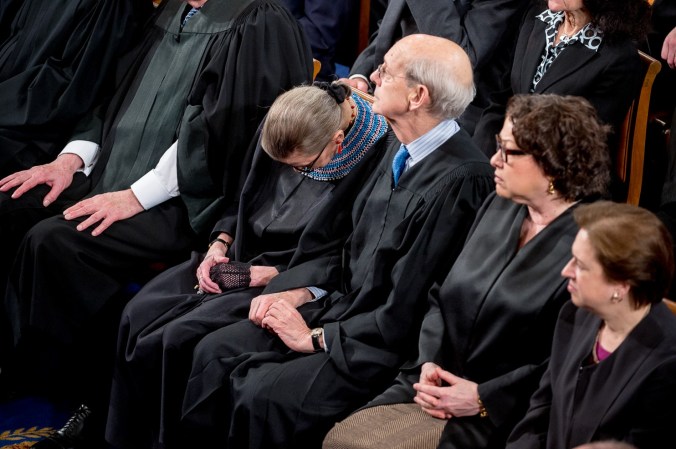
The confounding factor, and one that becomes a powerful rationalization for those who want to stay on in important positions long after their metaphorical pull-date, is that many of them can truthfully argue that their age-ravaged abilities are still better than most of the younger alternatives. Or, as my sister said during a discussion on this topic, “I’d rather have Justice Ginsberg with half her marbles than anyone Trump would nominate.” I bet that’s how Justice Ginsberg is thinking too. Then there was that attorney with a drinking problem who everyone in the firm agreed was twice as good as any attorney in the firm when sober, and 50% better when drunk as a skunk.
Does that mean the firm should be satisfied if he’s drunk all the time? Isn’t this the same as the age diminished once-brilliant judge?
There comes a time in anyone’s life when it should be obvious that it is time to “Hang up the guns”. In my own life, I am but 71, and I am seeing numerous anomalies in my behavior (walking into a room and wondering why I am here) and in my rational thought (I suspect most who have read my comments sometimes have the same question). I am getting to where I lose debates to my wife on a regular basis (she’ll tell you I’ve always done that). More to the point, I am AWARE of the beginning deterioration. I am wondering if John McCain and Ruth Ginsberg are.
Another thought had occurred to me, however. After realizing that there was some slippage, I have refused an opportunity to run for Alderman and for Mayor of our little newly-incorporated city, because I honestly did not feel I would be able to do the job, either of them, justice, either mentally (what’d you say my name was again?) or physically. I’m winded some mornings after tying my shoe-laces. However, I am reasonably certain that narcissism plays little part in my personality. I suspect it is a BIG part of most elected officials (city, county, state, national) personalities. The idea being “Nobody but ME can do this job properly”, or in some cases, “Nobody but me can do this job, period, well or poorly.” Continue reading →