Sadists With Guns and Badges…Also Knives and Shovels

I don’t know what kind of a person Darren Wilson is, and I don’t know if he was justified in shooting Mike Brown. But it there is increasing anecdotal evidence that a lot of police officers have a cruel, vicious and callous streak as evidenced by their attitudes toward animals, and to me, this suggests that are a lot of people in uniform with the authority to use deadly force who should not be police officers at all.

Jonathan Turley highlighted two nauseating cases in recent days.

The first unfolded in Baltimore, when Nala, a young Shar Pei,  escaped from her owner’s  yard over the weekend  and a neighbor tried to check the dog’s tags. Don’t try this with unfamiliar dogs that might be stressed, everyone: Nala snapped at her, causing a minor wound. The neighbor then summoned police to deal with the dog, though she has acknowledged that the bite was her own fault, and Nala was just frightened.

The police and took control of Nala using the long dog-control pole. The neighbor reported that the two police officers abused the dog without cause in the process, twisting its neck and hurting her. One officer kneeled on Nala’s chest, causing her to whimper in pain.

They were just warming up.

Officer Jeffrey Bolger then said, according to multiple witnesses, “I’m going to fucking gut this thing.” As the neighbor and others watched in horror, Bolger pulled out a knife and slit Nala’s throat  while Officer Thomas Schmidt held her down. Witnesses say that the dog was already immobilized against the ground and was posing no threat. Animal cruelty charges have been brought against both Bolger and Schmidt.

So you see, that animal control officer who shot the wild kittens as children watched wasn’t so bad after all. Continue reading


Greyhound Racing Is Dying. Good.

greyhound racing

The Washington Post informs us that greyhound racing, a  once popular form of gambling that as recently as 1991 brought in $3.5 billion and was operated at more than 50 tracks in 15 states, is in freefall and headed to oblivion. Betting on the dogs netted only $665 million in 2012, and just 21 tracks remain in seven states, with some of them already on borrowed time. Any decline in state sanctioned gambling is good news (yes, I am shedding no tears over the closing of one casino after another in Atlantic City, even the ones not owed by Donald Trump), but dog racing was always a particularly unsavory and unethical breed of the malady. Good riddance. The sooner that last greyhound has chased his last mechanical rabbit, the better off we are.

I have a bias here, it is true. My uncle, the youngest brother of my mom, was addicted to dog racing in Massachusetts, where the “sport” was banned in 2010, but not in time to save Uncle Charlie. He had a wife and two sons, and worked hard as a truck driver, but threw away an unconscionable percentage of his limited resources betting on racing canines. Maybe he would have crippled his prospects and harmed his family by finding other ways to waste his money if there had been no greyhound racing; probably he would have. Nevertheless, it was this corrupt, ugly, stupid gambling industry that wrecked his life. I hate it.

Dog racing was initially linked to allowing slot machines, another evil beast, to become legal, as little by little—first lotteries, then casinos—the states abandoned their ethical duties to embrace the cheap income that could be made by enticing the poor and the stupid to blow their paychecks on false hopes of a big jackpot. One they were hooked on the instant gratification of video poker and credit card one-armed bandits, however, greyhound racing became too slow a method of losing money. “It’ll take you half an hour to lose $50 at a racetrack. You can do it in five minutes sitting in front of a slot machine, ” said an insider interviewed by the Washington Post. This is called progress. Continue reading

Our Untrustworthy Public Schools, Part 2: The Fool and the Indoctrinator

When Alex met Kendra...

When Alex met Kendra…

There are bad apples in every barrel, but no apple barrel should contain poison apples. When it comes to teachers, these two make me regard the entire barrel as a bad risk.

The Fool

At Summerville High School in Summerville, South Carolina, a teacher caused a 16-year-old student named Alex Stone to be arrested and suspended because he wrote a passage on his Facebook page, as part of an assignment, that described using a gun to kill a dinosaur. Never mind that dinosaurs are extinct: guns are real; the teacher, a hysteric, a child abuser and a fool, notified school officials, and the school notified the police. They in turn,  searched Alex’s  book bag and locker for the dinosaur murder weapon, and came up empty. Police said that when Stone was asked by school officials about the his post, he became “very irate” —as would I—and so they handcuffed and arrested him.

Look at the bright side: at least they didn’t shoot him. Then Stone was suspended for the rest of the week. Continue reading

Ethics Quiz: The Macaque’s Selfie

Macaque

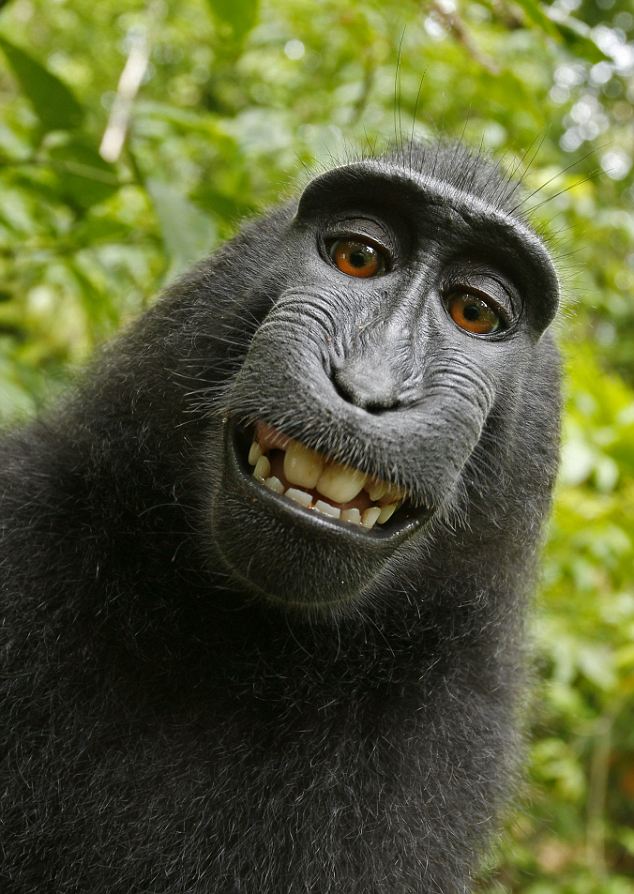
The wonderful photo above has gone viral on the web, and is also causing serious debate among intellectual property lawyers. The weird tale is as follows:

Wildlife photographer David Slater was visiting a national park in North Sulawesi to photograph the wildlife. His subject was a group of crested black macaques, and when he left his camera unattended, the primates took advantage of the opportunity. Apparently attracted by the reflection and the noise the camera made when activated (the implications of the macaques doing this because they were interested in photography are too disturbing to contemplate, so I won’t),  one macaque took hundreds of photos of itself. Most were blurry and out of focus, just like the pictures my dad took, but a few were superb selfies that would have Ellen DeGeneres eating her heart out.

Wikimedia took the clear images off of Slater’s website, adding them to its collection of royalty-free graphic, and sending them all over the web as a result.  Slater now demands that the images be taken down or that he be paid for them. While Wikimedia argues that either the monkey owns the copyright for the photos or nobody does, the photographer claims that being the owner of the camera, and the artist who created the circumstances under which the macaque was inspired to release his inner Richard Avedon, he alone is the owner of the photographs.

As you might expect, copyright law is unclear on the issue of lower primate selfies, an art form that was not anticipated as the law evolved. I don’t care about that: today’s Ethics Alarms Ethics Quiz is about fairness:

Should Slater have full ownership of the macaque’s creations?

Continue reading

KABOOM!* Kitten-Shooting By The Police…In Front of Children

kittens

(Normally a story like this would make my head explode, but my head is apparently too disgusted to blow.)

This incident sounds like a sick joke in “Policy Academy 6” that ended up on the cutting room floor, but unfortunately, it really happened.

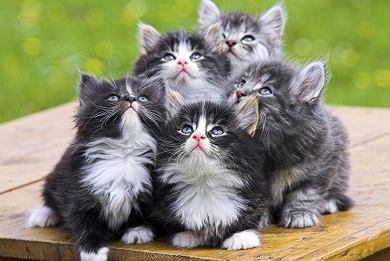
Dispatched to a home to deal with a feral mother cat and her five adorable kittens discovered in the yard, Bob Accorti, the Humane Officer for the North Ridgeville Police Department, told the homeowner that the animal shelters were full but that he would make sure that the cats went to “kitty heaven.” He then too out his revolver and shot the five kittens, estimated to be between 8 and 10 weeks old. The homeowner’s children, aged  5 months to 7 years, watched in horror from inside the house.

The mother cat escaped during the slaughter.

After a complaint of animal cruelty was raised by the Ohio Society for the Prevention of Cruelty to Animals, NRPD Chief Mike Freeman responded that no discipline was necessary or appropriate, as he reasoned that “animal organizations accept shooting as an acceptable means of euthanasia.”

The chief did concede that Accorti could have communicated better with the homeowner about how the kittens would be killed.

Ya think???

Be thankful for small mercies: Accorti was the Humane Officer. I assume one of the non-Humane officers would have stomped the kittens to death.

Let’s see…

Was shooting the kittens necessary?

Continue reading

Animal Abuse, Law, Ethics…And More Cognitive Dissonance

Gothic pets

Some animal abuse issues are ethics slam dunks, some should be, and some are more complicated than the wo people posture over them seem to think. Here are three examples from the news:

1. Tattooed Kittens?

A law about to be passed in New York, S.6769, will make it illegal for pet owners to inflict tattoos or piercings on their pets except for medical purposes or when a tattoo is used strictly for identification purposes. Violations would carry fines of up to one year in jail and a $1,000 fine.

“I believe that if given the choice, animals would decline to having themselves undergo a painful procedure of being either tattooed or pierced,” said New York State Senator Mark Grisanti, a Republican who is supporting the measure introduced by Democratic Assemblywoman Linda Rosentha in 2011.

Ya think? The fact that a law would even be necessary to articulate that tattooing or piercing a pet for the owner’s amusement is horribly wrong and obvious cruelty foretells the approaching apocalypse.  That such a law would take three years to pass also tells us something bad about, oh, New York, politics, partisan warfare, human intelligence…just about everything. The problem, was brought to public attention by the prosecution of this idiot.

2. The Opossum Drop Continue reading

Ethic Dunce: California Chrome Owner Steve Coburn*

horses-assAs you probably know by now, California Chrome attempted to become the 12th horse and first since Affirmed in 1978 to win the Triple Crown and join a fabled group that includes such esteemed equines as Gallant Fox, Whirlaway, Citation and Secretariat…and fell right on his long face, finishing fourth. The  winner of the Kentucky Derby and Preakness lost the Belmont Stakes to 9-1 long-shot Tonalist, who did not run the opening two races of the series. Ah, there’s the rub. Part of the challenge of the Triple Crown, a not insubstantial part,  is that it is an endurance test. CC lost to a fresher horse.

Well, you know, that’s why winning the Triple Crown is so special and the horses who achieved it are the sport of racing’s four-footed immortals. It’s hard. When your horse loses the final and most difficult (it’s longer) of the three races after winning the first two, as many horses have, the correct, classy and ethical response is well established. It doesn’t take any imagination. You say that you congratulate the winning stables, the owners, the horse and the jockey, that of course you are disappointed, that your horse ran the best race he could but on this day it was not good enough. Then you shut up, and let sportswriters make excuses for the loss, if there are excuses to be made. Continue reading

Birding Ethics vs. Education Ethics: One Applies Common Sense, The Other Doesn’t Apply It, Or Sunscreen Either

"Don't worry, Mr. Sapsucker---the birders are looking out for you. Just be grateful you don't go to public school in San Antonio."

“Don’t worry, Mr. Sapsucker—the birders are looking out for you. Just be grateful you don’t go to public school in San Antonio.”

In the intense avocation of bird-watching, a code of ethics reminds practitioners of common sense. In public school education, there is no accepted code of ethics. And there is precious little common sense.

Cornell University’s Macaulay Library contains more than 200,000 bird call recordings, and 150,000 of them can be downloaded onto smartphones and other electronic devices. This allows canny bird-watchers to play the calls in the wild, attracting rarely-seen species.

Unfortunately, these realistic calls, experts say, can stress birds, including endangered species. Thus there is a code of ethics for the recreation of birding, The American Birding Association’s Principles of Birding Ethics, and it states,

 “Limit the use of recordings and other methods of attracting birds, and never use such methods in heavily birded areas, or for attracting any species that is threatened, endangered or of Special Concern, or is rare in your local area.”

It’s a well-conceived code that gives behavioral guidance where guidance is needed.

Now let’s look at a profession where most of us would say common sense is essential, and where the lack of it leads to  unethical and unacceptable conduct born of institutionalized incompetence. No, this time I’m not talking about our government. I’m talking about the educational profession, and the public schools. Continue reading

Kids On Leashes: Final Hypotheticals

kids on leashes2

Not to beat a dead dog, but while conversing about this surprisingly contentious issue (here, and here) on Facebook with the ever-thoughtful and provocative Lianne Best (Ethics Alarms congratulations go to Lianne for being honored by NARAL as an Outstanding Advocate For Choice), I realized that I should have posed one more hypothetical for the enthusiastic child-leashers to chew on, to wit:

“Have you ever seen anyone in public with both a kid and a dog on leashes simultaneously?”

Would you do that? And if you wouldn’t, why would having a child on a leash without the dog be any better?

To which Lianne countered with an even better hypothetical:

“How about a parent walking in public with the child on a leash but the dog walking along without one?”

____________________

Spark: Lianne Best

Graphic: Baby Cottage Gifts


On Liberals, Dignity, Dogs, Signature Significance and Toddlers On Leashes

But they LIKE it!

But they LIKE it!

The damndest essays ignite furious debates here. I raised CNN’s mid-day quiz about parents walking children on a leash-–did I mention it featured a video of one mother dragging her prone harnessed child through a store like the kid was a sack of potatoes? I should have—-primarily because 1) it reminded me of “The Simpsons,” 2) because I was struck by the fact that ethics was never brought into a conversation that I would deem as concerning an ethics issue, and 3) because it was notable that CNN wasn’t talking about sunken Malaysian airplanes.

Still, I have been enlightened by the unexpectedly lively discussion, if not encouraged. In particular, this never struck me as an ideological issue, but it certainly seems to be one. Upon reflection, I should have predicted it, though this is not flattering to liberals.

I’ll return to this in a bit.

The defenses of the demeaning practice have been mostly pragmatic, which involves a utilitarian argument: “It works, and the ethical violations either don’t exist, or are too small to care about.” The most annoying defense so far has required  intentionally taking a statement in my post literally that also has an important figurative message, as well as misstating even the literal meaning, all to make it easier to dismiss the intended point. That’s some kind of record for straw men. Or would that be straw dogs? No, I think that’s something else.

The phrase in question was “whether it was fair, kind, respectful or right to treat your child like a cocker spaniel…” To make it easier to attack, my critic has changed that to “…to treat your child in a manner associated with the treatment of dogs.” Sneaky. It is true that dogs are typically kept on a leash, but that is only half the message, as fair readers will acknowledge. The term “treated him-her-them like a dogs/dogs” means, and has meant for a very long time, treating a human being in an inhuman, demeaning, humiliating, unkind, unfair fashion showing a lack of respect and making the human being in question miserable. The description has been used to describe both treatment that is seen in the treatment of actual dogs—such as substandard living conditions, lack of autonomy, domineering oversight, feeding of food not fit for human consumption, and in this case, use of a leash in public, as well as used to describe treatment that would never be literally possible with real dogs, such as too many typing assignments, refusal to give credit or bonuses for effective research, not allowing a family member a sufficient allowance, forcing a child to dress in old, outdated or unattractive clothes, etc. In the current case, both meanings apply, and focusing on just one is intentionally misrepresenting the issue.

As to whether the use of leashes on human children is demeaning, try this thought experiment: Would any white nanny dare to walk in public with two black children on a leash? How about the mother in a mixed marriage, in which the mother is blonde and the children are black? Would not the imagery of whites leashing blacks be inherently distasteful, regardless of the age of the African-Americans involved? Continue reading