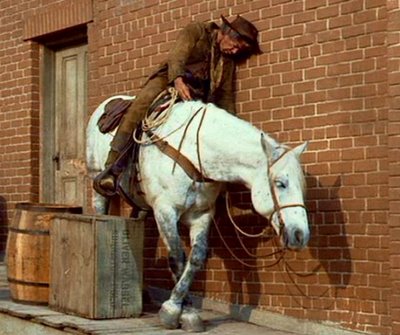
It is generally believed that Lee Marvin’s drunken horsemanship (as well as the comic appearance of his horse, which also appeared to be drunk) greatly assisted his winning the 1966 Academy Award for Best Actor. In case you are considering riding your own horse or mule while in a state similar to Marvin’s “Kid Shelleen,” this article may be of interest. While it is undoubtedly unethical to ride a horse while intoxicated (irresponsible, reckless, and dangerous to both the horse and anyone near it), it may not be illegal, because a horse is not a vehicle.
Animals
The Second Annual Ethics Alarms Awards: The Worst of Ethics 2010 (Part 2)
The final categories in the Worst of Ethics 2010. Coming up: The Best of Ethics, 2010.
(If you missed Part 1 of the Worst, go here.)
Worst Ethics Presentation: “Ethics in Politics: An evening with Former Governor Rod Blagojevich” (Presented to its students by Northwestern University) Continue reading
Hero, Villain or Hypocrite: The Dilemma of the Undercover Dog-Fighter
The limits of absolutism and the drawbacks of utilitarianism both come under scrutiny in assessing the strange saga of Terry Mills, whom the ASPCA recently appointed as its Animal Fighting Specialist.
Beyond question, this is a job he is uniquely qualified to hold. In 2008, Mills worked for the FBI’s domestic-terrorism task force, and went under-cover for more than a year to expose and break up a national dog-fighting ring. His efforts resulted in many arrests, and the rescue of more than 500 animals. Accomplishing all of this, however, required Mills to become part of the culture he was attacking. He trained and fought his own dogs, engaging in the very cruelty he was working to prevent. Continue reading
The Final Proof That Michael Vick Doesn’t Get It
In the finale of “Animal House,” after the expelled Delta House members have sabotaged Faber College’s parade causing wanton destruction, mayhem, panic and riots, the fraternity’s president approaches the dean (who is lying in the ruins of the stands toppled by the Delta House “Deathmobile”) and hopefully asks for “one more chance.”
I thought of this classic moment when I read that Michael Vick, the serial dog-abuser now seeking redemption by winning football games for the Philadelphia Eagles, had told an interviewer that he really missed owning a dog and hoped to have one as a pet some day. Continue reading
Ethics Heroes: White Sox Pitcher Mark Beuhrle and His Wife Jamie
This isn’t an earth-shattering story, but a nice one, especially if you need more than Philadelphia Eagles touchdowns to help wash the Michael Vick episode out of your brain. Some pro athletes are actually kind to dogs.
Mark Beuhrle, the Chicago White Sox pitching star, learned about a Shetland Sheepdog that was shot with an arrow, and badly injured. Beuhrle and his wife have agreed to pay any unpaid medical bills for the wounded animal, which has undergone extensive surgery. He seems to be out of danger, too.
You can read the whole story of Shelby the Sheltie here.
When the “Everybody Does It” Excuse Works: Police Dog Cruelty in North Carolina
In January, Ethics Alarms named the North Carolina State Personnel Commission an Ethics Dunce for reinstating North Carolina State Trooper Sgt. Charles Jones, who had been fired for abusing one of his police dogs. He had been videoed as he hung the dog, Ricoh, and kicked him for not releasing a chew toy on command. The Commission heard testimony from officers regarding the brutal training methods routinely used by the police, and ruled that by practice and law, what Jones did was not what they call “abuse” in North Carolina, at least when it is done to police dogs. “Though disturbing, the treatment of Jones’ animal does not rise to the level of ‘abuse,'” the ruling reads, and even if it did, the Commission noted that the Wake County, N.C., animal ordinance specifically exempts police dogs.” In other words, abusing police dogs is acceptable conduct for K-9 trainers.
The ruling came after the testimony of other dog handlers had prompted the Highway Patrol to suspend all use of dogs, anticipating public outrage. Governor Easley also pushed for Jones’s dismissal after the video surfaced, and he made certain that the Commission’s reinstatement of Jones was appealed.
You’re not going to like the result. Continue reading
False Redemption and the Michael Vick Fallacy
Michael Vick was once a star quarterback for NFL’s Atlanta Falcons. Then it was discovered that he was secretly in the illegal dog-fighting business, breaking the law and being brutally cruel to dogs in the process. This lost him his job, his contract, his freedom, and many millions of dollars. Now he’s a star quarterback again, leading the Philadelphia Eagles. Last Monday night, he had what some have called the best game any quarterback has had in the NFL in forty years. Many are celebrating his return to stardom as an inspiring example of rehabilitation and redemption. After all, he’s a hero again.
Not to me, he isn’t.
It well may be that Michael Vick is a changed man, but the jury is out on that; it’s just taking longer to get a verdict than it did for his dog-fighting charges. There is absolutely no nexus between Vick’s resurgence on the football field and his character. Continue reading
More Unethical Anti-Dog Slander by The Daily Beast
It is odd that a news website called “The Daily Beast” is engaging in an ongoing effort to misinform and frighten the public regarding dogs. Someone—publisher Tina Brown perhaps?—in The Daily Beast’s lair must have been badly frightened by a puppy at some point in his or her life, leading to an irrational fear of dogs and mind-blowing ignorance regarding them. Earlier this year, the site published two unhinged calls for the eradication of anything resembling a pit bull by a writer whose pet was attacked by one. At the moment, The Daily Beast features a gallery with the ominous title “39 Most Dangerous Dog Breeds” that had to be assembled by some one who has seldom seen a real dog, much less owned one. On the home page, the feature is placed under the heading, “Beware of the Dog.”
The criteria for the ranking is completely mysterious—several of the breeds listed, for example, have exactly one attack attached to them. The gallery itself is riddled with errors and is actually quite funny, if one knows anything about dogs at all. In addition to being careless and incompetent, the feature is dishonest, and seems to be calculated to make people irrationally frightened of dogs, when in fact the relationship between human and canines is one of life’s great and fortunate pleasures. Continue reading
One Joke We Can Do Without
Recently “Jimmy Kimmel Live” showed a video of a “Candid Camera” style prank pulled on an unsuspecting woman at her workplace. As a loud siren blared, everyone around her started hurling themselves on the floor, losing their balance, reeling and staggering as if the building was shaking. It wasn’t, but the woman was understandably alarmed (even conspiracy theorists don’t instantly assume that they are really surrounded by actors that Jimmy Kimmel has paid to behave like the sky is falling), though the commotion ended as suddenly as it started. Then it started again..then a third time. The woman ended up on the floor, hiding her head under a metal folding chair.
Hilarity ensued. Continue reading
Wildlife Documentary Deception
Great. CNN and NBC weren’t enough: now we can’t trust the National Geographic channel and Animal Planet.
Chris Palmer, a veteran wildlife photographer, recently went on NPR to talk about his new book. In Shooting in the Wild: An Insider’s Account of Making Movies in the Animal Kingdom, Palmer reveals the secrets of his trade, which apparently include renting trained animals when the ones in the wild won’t cooperate and putting M&M’s in the carcasses of prey, so the predators eat with gusto. He also expound on the use of a sound-effects technician to simulate sounds of animals breathing, chewing, drinking and flying. “You can’t get close enough to a bear to record his breath or his splashing in the water. If you got that close, you’d be in great danger,” he told NPR.
Although Palmer attributes the increase in the use of staged and fake footage in nature films to tighter budgets and shooting schedules, surely we had an inkling that this went on from the very beginning. The inventor of the form, Walt Disney, used animals as documentary actors in movies like “The Incredible Journey,” and I always assumed that Disney’s “true life adventure” nature films like “Jungle Cat” and “The Living Desert” included staged scenes, including battles between animals that were far from spontaneous.
Disney, however, is in the entertainment business. When wildlife documentaries announce themselves as real, they should be real, and if the producers staged sequences, rented animals, or used M&M’s, they have an ethical obligation to tell the audience. This goes for sounds as well. After all, there are people who think big snakes make the roaring sound the CGI villain makes in “Anaconda”; the fake sounds in nature films mislead many more. Real life footage is supposed to teach us something, not stuff our heads full of more misinformation.
That’s the job of CNN and NBC.
There is a lot of amazing wildlife footage that is not staged; the question now, in light of Palmer’s book, is how we are supposed to identify the fakes. The sound effects are a good clue. I will say this: if I find out that the story of Christian the lion was faked, I’m going to be angry.
But there is always “the battle at Kruger.”
[Thanks to Lauren Larson for the tip.]