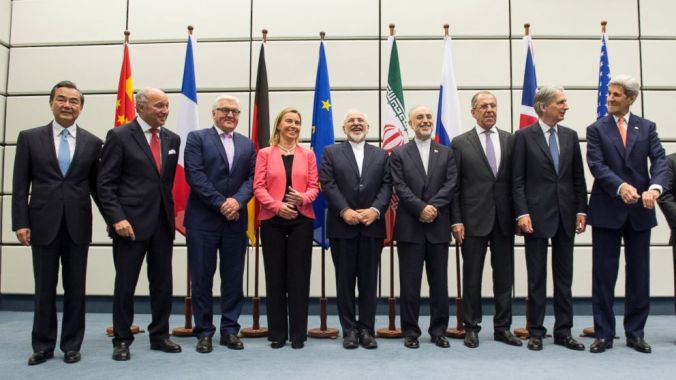
Rare Species, Previously Believed Extinct, Sighted: A Balanced Analysis Of The Iran Nuclear Deal

On a matter of as much significance and complexity as the Iran nuclear deal, it is depressing to see that almost all commentary in the news media begins with a partisan bias, a “team” mentality, and the typical talking-point orientation that makes genuine public understanding unattainable today. People choose the position that already aligns with their friends and their loyalties, and adopt it uncritically. As a result, public discourse is useless.

This is no way to run a democracy.

Elliot Cohen is a prominent Never-Trump neo-con and foreign policy scholar, writing in the Atlantic, a generally “resistance”-favorable progressive publication. His analysis of the current contretemps involving the Iran deal is the closest I have seen yet to a fair and balanced one. That doesn’t mean I think he is right on all counts, especially ethically. The second half of this statement, for example is as  troubling as the first half is refreshing:

“The Iran deal was, in truth, a very bad one. It did nothing to inhibit Iranian behavior in the broader Middle East, did nothing to stop its ballistic programs, and opened the path for a resumption of the nuclear-weapons program in a decade or so. Some of us said so at the time. Walking away from it, however, will make matters worse not only because success is unlikely, but because this shredding of an earlier presidential agreement further undermines the qualities that those who look to American leadership have come to value—predictability, steadiness, and continuity. Even when American allies have doubted the superpower’s wisdom, they usually felt they could count on its constancy.”

They also have to be able to count on its competence, courage, and ability to change course when a current course is disastrous. It is unethical to make policies that are careless, expedient and dangerous in a setting where there is no recourse once the course is set.  Leaders have to undo mistakes and take new directions even when it means future distrust and present anger.  The previous President took unseemly joy in declaring previous Presidential policies wrong-headed, and reversing them forthwith. True: this is a bad habit, and all leaders should respect previous decisions and commitments by their predecessors, except in extraordinary circumstances. The standard should be similar to the Supreme Court’s rule of stare decisus, which means that previous SCOTUS rulings have the presumption of permanence, unless they are sufficiently bad for law and the nation. I am satisfied to move the Iran debate from the Obama-Kerry mythology to “it’s a bad deal.” The question is then whether it is sufficiently bad to justify a variance from the general rule that Presidents ought to leave agreements made before their election stand if at all possible.

To his credit, Cohen displays almost equal contempt for the Obama administration and President Trump. Some notable excerpts: Continue reading →

Morning Ethics Warm-Up, 5/16/ 2018: The Fake Moussaka Edition

Gooood morning Pyongyang!

…and everyone else too, of course.

1. ” Winning.” How many in “the resistance” and the news media are rooting, secretly or openly, for the North Korean talks to fail? Based on the tone of some premature gloating on social media and news reports after North Korea threatened to pull out of talks, I think “many” is the fair answer. Other recent headlines and news stories also point in this direction, like “Improving Economy A Problem For Democrats.” (No, an improving economy is not a problem for any Americans, unless they care about their own power more than their country.)

This is especially revolting ( and hypocritical) from the same people who 1)  falsely attributed Rush Limbaugh’s indefensible statement in 2008 that he wanted Obama to fail to the entire Republican Party (I condemned Limbaugh’s statement at the time) and 2) used it to feed the narrative that conservatives who opposed that Presidents left-ward policies were doing so out of personal and racial antipathy.

A President’s success–as in “being proved correct” or “getting lucky,” it doesn’t matter which— makes it more likely that policies you don’t like will be continued? Suck it up and cheer like the good citizen you are. His accomplishments make it less likely that your favorite politician will get elected? Cry me a river: your duty is to care about your nation and fellow citizens first. That you are on record that—okay, still think that—this Presdent has crap for brains and you wouldn’t shake his hand without gloves makes you look less wise and prescient than you would have if he fell flat on his face? Cue the world’s smallest violin, have some integrity, and grow the hell up.

2. Ken Burns ethics, and FDR. In this post earlier this year, I scored documentary whiz Ken Burns for the hagiography of Franklin Roosevelt that marred his otherwise superb “The Roosevelts.”  “The smoking gun for me,” I wrote, “is that despite ten and half hours, Burns somehow never found time to highlight FDR’s internment of American citizens solely because they were of Japanese ancestry. The civil rights outrage is only alluded to in passing, as part of a list from a biographer preceding the nostrum, ‘All great leaders make mistakes.’” That critique stands, but it is slightly unfair, I subsequently discovered. Burns covered the internment of Japanese Americans extensively in an earlier, also excellent, PBS series, 2007′ s “The War.”  Even that section, however, avoided laying proper accountability for the debacle at President Roosevelt’s feet.  I watched the documentary over the past two days, and the deceit is really extraordinary.  The narration keeps referring to Executive Order 9066, without specifically saying whose order it was, like the thing appeared on its own. Here, Ken, let me fix this for you:

‘President Franklin D. Roosevelt ordered the imprisonment of tens of thousands of American citizens of Japanese ancestry and resident aliens from Japan in concentration camps (“internment” is a euphemism and a cover word, like “pro-choice”) with towers and guards with loaded rifles. Though some German-Americans and Italian-Americans were imprisoned as well, far fewer were taken. The risk they posed was not considered as great, because they were white.’

Executive Order 9066 wasn’t rescinded, incredibly, until February 19, 1976, by President Ford. The Supreme Court decision upholding the order, Korematsu v. United States, 323 U.S. 214 (1944),has never been overturned. In that case’s 6–3 decision approving the abrogation of American citizen rights with fear as the justification, six of FDR’s eight appointees—you know, the liberals—  sided with Roosevelt, and against the Bill of Rights. Continue reading →

Morning Ethics Warm-Up, 5/15/2018: Alito Gets One Right, Ellison Deceived, And An Ancient, Unethical Tactic Works Once Again…

To a glorious morning, Ethics-Lovers!

1. Bad Alito, Good Alito.  As I briefly noted yesterday (and hopefully will do in detail today), Justice Alito authored an unethical and embarrassing dissent defending a lawyer who deliberately betrayed his client by telling the jury that he had killed someone his client denied killing. Bad Alito. However, the arch-conservative jurist also authored the majority opinion in Murphy v. National Collegiate Athletic Association, in which the SCOTUS majority struck down a virtuous but unconstitutional law, and did so clearly and well.

These are, I think, my favorite Supreme Court opinions, where the Court ignores the motives and objectives of a law and simply rules whether the legislature is allowed to behave like that. I don’t know, but I would guess that most of the majority feel the way I do about organized sports gambling: nothing good can come of it, and a lot of harm is inevitable. One they get the green light, I’m sure that as many states will take over sports gambling for its easy revenue as now prey on its poor, desperate and stupid with their state lottery scams. Everyone involved–sports, fans, athletes, states, the public’s ethical compass—is going to be corrupted by letting the sports betting genie out of its bottle: just watch.

Nevertheless, the Professional and Amateur Sports Protection Act, a 1992  law known as PASPA, should have been struck down decades ago; I’d love to know why it took so long. No, it did NOT ban sports betting, though this is what far too many news reports tell you. Congress can ban sports betting directly if it chooses to, as it is interstate commerce. This isn’t in dispute. What it did in 1992, however, was to order states not to pass laws states have a constitutional right to pass. The distinction matters. From SCOTUS Blog, which is usually the best source for analysis of these things:

The 10th Amendment provides that, if the Constitution does not either give a power to the federal government or take that power away from the states, that power is reserved for the states or the people themselves. The Supreme Court has long interpreted this provision to bar the federal government from “commandeering” the states to enforce federal laws or policies. [The] justices ruled that a federal law that bars states from legalizing sports betting violates the anti-commandeering doctrine…

…In a decision by Justice Samuel Alito, the court began by explaining that the “anticommandeering doctrine may sound arcane, but it is simply the expression of a fundamental structural decision incorporated into the Constitution” – “the decision to withhold from Congress the power to issue orders directly to the States.” And that, the majority continued, is exactly the problem with the provision of PASPA that the state challenged, which bars states from authorizing sports gambling: It “unequivocally dictates what a state legislature may and may not do.” “It is as if,” the majority suggested, “federal officers were installed in state legislative chambers and were armed with the authority to stop legislators from voting on any offending proposals. A more direct affront to state sovereignty,” Alito concluded, “is not easy to imagine.”

…The court also rejected the argument, made by the leagues and the federal government, that the PASPA provision barring states from authorizing sports betting does not “commandeer” the states, but instead merely supersedes any state laws that conflict with the provision – a legal doctrine known as pre-emption. Pre-emption, the majority explained, “is based on a federal law that regulates the conduct of private actors,” but here “there is simply no way to understand the provision prohibiting state authorization as anything other than a direct command to the States,” which “is exactly what the anticommandeering rule does not allow.”

Got it.

Good decision. Continue reading →

Morning Ethics Warm-Up, 5/14/2018: Another Rushing Around In A Hotel Room Getting Ready For A Seminar Edition…

Good morning from Boston...

…where I always feel at home! I’m here for the morning, talking to young, newly minted Massachusetts lawyers about ethics.

1. This is a big deal, though only lawyers will care. Finally, California has ditched its confusing, multi-source (some ethics rules were laws, some were regulations), antiquated legal ethics rules, and became the last of the jurisdictions, including D.C., to adopt the American Bar Association’s template for legal ethics guidance. Yes, in one area, if not the most important ones, California is moving closer to the rest of the country! There is hope!

2. Ally’s lament. Ally Sheedy, whom you might recall from “War Games” and “The Breakfast Club,” is one of Hollywood’s more articulate and thoughtful performers. She recently penned a post condemning Hollywood sexism, and its effect on her career. Essentially the essay amounts to a complaint that Hollywood is obsessed with appearances and, with women, sex appeal.

I like Sheedy, and I was pre-inclined to respect her observations (which are certainly accurate), but I have to admit that unsympathetic blogger Amy Alkon has a point. She writes,

“..professional actress Ally Sheedy takes it upon herself to lament the looks-driven reality of Hollywood — which is kind of like lamenting how in professional baseball, somebody’s always throwing a ball your way. …This is the movies, dear, not the genetics lab. Her entire essay is an example of intrasexual competition — criticizing and trying to change the standards of female competition by one who falls a bit short of them.Because so many people are so ignorant of our evolved psychology and in denial of biological sex differences (and the psychological sex differences that come out of them), they don’t get that there is pressure on men, too, to meet women’s differing mating priorities.As for those differing priorities, well…you don’t see men writing essays about how rotten it is that you can’t get a hot girlfriend (or probably any girlfriend) while unemployed and sleeping on a couch in your grandma’s basement.”

Yikes. And they say I’m tough… Continue reading →

Comment Of The Day: “Ethics Dunces: Jeremy Lam And The Cultural Appropriation Police”

Huh! I didn’t know this was traditional Chinese business attire! Imagine: This is what Marco Polo must have seen!

The most amusing reaction to the apotheosis of progressive silliness that was the attacks on Utah high-schooler Keziah Daum for wearing a Chinese-style prom dress came from China, where the South China Post’ s Alex Lo, who authored a column titled, “Go ahead, appropriate my culture.” He wrote in part,

If anyone thinks social media is harmless, this incident should prove otherwise. A person called Jeremy Lam apparently first tweeted about her transgression, which is now being called “cultural appropriation”. “My culture is NOT your goddamn prom dress,” he posted…I apologise in advance for contributing to the silliness, but just needed to get it off my chest.  A publication as esteemed as The Independent of London ran a column supportive of the criticism.“The debate her prom pictures have prompted is justified,” the columnist wrote. “Cultural appropriation is about power, and to many she is the embodiment of a system that empowers white people to take whatever they want, go wherever they want and be able to fall back on: ‘Well, I didn’t mean any harm’.”

I would argue those who scream loudest about cultural appropriation are themselves after power…Why does Jeremy Lam think Chinese is his culture? Is his the same as mine? Is it some kind of property like an inheritance? If so, where is the will, written in our DNA, perhaps? And is it taxable or payable, and by whom? Why did Lam write in English? Isn’t he inappropriately appropriating English-speaking culture? …SJWs turn culture into some kind of finite asset, a zero-sum rather than a growing-sum game. They are oblivious or ignorant of how human cultures actually work: culture is cultural appropriation.

The topic sparked many excellent comments here, including this Comment of the Day by Alexander Cheezem…on the post, Ethics Dunces: Jeremy Lam And The Cultural Appropriation Police:

It’s worth noting the issue of what I can only call — with much irony — aggregation bias here. There _has_ to be a term for it that doesn’t rely on punning off a statistical concept, though…”

In reflection, I suppose that what’s going on is technically a variant of the ecological fallacy — but it’s manifesting as a form of bias (in the non-statistical sense) based on the aggregation of behavior… so the term isn’t quite right, leading me right back to punning off of the statistical concept. I can’t explain the issue without a massive amount of technical language (e.g. “the emergent nature of many features of a complex system”).

And that is a huge problem with modern liberalism. Continue reading →

Morning Ethics Warm-Up, 5/9/2018: Iran Deal Exit Edition

Gooooooooooood Morning Tehran!

1  Goodbye to an illegal—hence unethical— treaty. To get the pure ethics issue out of the way at the start, the argument from critics of President Trump’s rejection of the Iran nuclear deal that, as MSNBC partisan-hack-disguised-but-none-too–well-as an-objective-journalist Andrea Mitchell wrote,

“So no matter what happens now, what they have basically said to the rest of the world is that we are not obeying an agreement that we signed. Now the United States of American under one administration can sign a deal, but it may not be accepted by future presidents.”

What was always the most undebatable objection to Obama’s deal was that it was a treaty that bypassed the Constitutional requirements for treaties. Such a significant agreement with such major risks and implications should have been submitted to the Senate as the Constitutional process demands. Thus it was illegal, as with so much of what the weak previous President foisted on the nation, the theory was that wrong and illegal or not, once “the deal” was in place it was a fait accompli. Note the irony of Obama’s worshipful congregation expressing fears that Trump is autocratic. All Trump could do was to submit the already established deal to Congress to un-do, and despite a majority in favor of doing just that, a filibuster by Democrats blocked it.

Verdict: This time President Trump has the Constitution on his side, and when the Constitution doesn’t suit Democrats, they ignore it.

2. An Ethics Hero for candor: Blogger Ann Althouse concluded her comments about the big news yesterday by saying, “I’m just looking at the public theater, of course. I have no idea what is really going on.”

Brava! And neither do I. And neither do you. Moreover, whether President Trump’s gambit turns out to be regarded as a brilliant masterstroke or a tragic blunder is entirely moral luck, just as his apparent success with North Korea is. All sorts of consequences, good, bad, and currently unimaginable, are possible.

3. Bias makes you CNN. This morning both CNN and CNN’s HLN were fearmongering with viewers, flogging the likelihood that Trump’s rejection of the Iran deal would raise gas prices, and also lose jobs because U.S. airline sales of passenger jets to Iran cannot be completed. Think about the ethical nature of that argument for keeping the deal in place. Lifting sanctions on Iran has allowed the nation to fund terrorism across the region, but its all worth it to Americans if gas prices stay low. Nice.

Then there was CNN’s openly partisan White House correspondent Jim Accosta, who tweeted this:

“Obama policies dumped by Trump: Iran deal, Paris Climate Agreement, Trans-Pacific Trade Deal, DACA, Obamacare Individual Mandate.”

Accosta apparently really thinks that this is res ipsa loquitur for how bad Trump is. A journalist so isolated by his political biases from reality can’t be a competent political reporter. I’m not a Trump supporter, but with the possible exception of the trade deal, I view all of the rest as positive developments, or at least arguably so, especially since most of them were examples of Obama skirting the Constitution or governing by edict. Continue reading →

Ethics Heroes: Good Trump, Bad Trump

Integrity among professionals and journalists is in short supply in the Trump Era, as  bias, especially partisan bias, increasingly rules the loyalties, judgment  and minds of all but a few. Here are a couple recent examples of those few…

Ethics Hero: Ian Bremmer

Foreign policy expert and Eurasia Group President Ian Bremmer, often a harsh critic of President Trump,

…Unequivocally credited the President for the major diplomatic breakthrough with North Korea.

…chided those refusing to give him proper praise for the achievement, and

…did this on MSNBC, where fairness to President Trump is as welcome as an evolution lecture on the “700 Club.”

Bremmer told a shocked Stephanie Ruhl:

“But we have to give him credit. Look, as you know, I’ve been critical of President Trump probably 90% of the foreign policy decisions he’s made since he’s become president. Not the whole administration, but certainly stuff he said. But on this issue, on North Korea, the only way you say that Trump isn’t part of it is if you’re just a partisan, if you’re just being illogical. And that’s not – I mean, I understand that that’s good for eyeballs, but it’s not good for our country.”

Wow! What a concept! Continue reading →

Morning Ethics Warm-Up, 5/5/2018: “Why We Can’t Have Nice Things” Edition

Good Morning!

(I’m happy to report that my Clarence Darrow ethics program for a lawyer group yesterday in Annapolis was received wonderfully, in no small part due to actor Paul Morella’s moving and powerful recreations of Darrow’s courtroom oratory. As is often the case, attendees said that they didn’t realize a legal ethics presentation could be so interesting. If fact, there is no excuse for any kind of ethics NOT being interesting…)

1. I call this “cultural defacing.” At 10:30 last night, I watched the end of “The Princess Bride,” and was thrilled to arrive just as the final showdown between Ingo Montoya (Mandy Patinkin) and Count Rugen (Christopher Guest). Here is the scene, a classic one, which begins with the Count apparently fatally wounding Inigo with a dagger:

Inigo Montoya: Hello, my name is Inigo Montoya. You killed my father. Prepare to die.

[Inigo advances on Rugen, but stumbles into the table with sudden pain. Rugen attacks, but Inigo parries and rises to his feet again]

Inigo Montoya: Hello, my name is Inigo Montoya. You killed my father. Prepare to die.

[Rugen attacks again, Inigo parries more fiercely, gaining strength]

Inigo Montoya: Hello! My name is Inigo Montoya! You killed my father! Prepare to die!

Count Rugen: Stop saying that!

[Rugen attacks, twice. Inigo avoids and wounds Rugen in both shoulders. Inigo attacks, bellowing:]

Inigo Montoya: HELLO! MY NAME IS INIGO MONTOYA! YOU KILLED MY FATHER! PREPARE TO DIE!

[Inigo corners Count Rugen, knocks his sword aside, and slashes his cheek, giving him a scar just like Inigo’s]

Inigo Montoya: Offer me money.

Count Rugen: Yes!

Inigo Montoya: Power, too, promise me that.

[He slashes his other cheek]

Count Rugen: All that I have and more. Please…

Inigo Montoya: Offer me anything I ask for.

Count Rugen: Anything you want…

[Rugen knocks Inigo’s sword aside and lunges. But Inigo traps his arm and aims his sword at Rugen’s stomach]

Inigo Montoya: I want my father back, you son of a bitch!

[He runs Count Rugen through and shoves him back against the table. Rugen falls to the floor, dead]

Except “you son of a bitch” was cut!

We settled this when the TV showing of “Gone With The Wind” let Clark Gable’s iconic exit line, “Frankly my dear, I don’t give a damn” remain uncensored, and later,when John Wayne as Rooster Cogburn uttered the words, “Fill your hand, you son of a bitch!” before charging Ned Pepper and his gang. It is unfair and disrespectful to wreck the best work of writers and actors for the few remaining people on earth who take to their fainting couches when rude language meets their ears. You don’t edit Rhett, or Rooster, or Inigo, or even John McLane when he says, “Yippee ki yay, mother fucker!” Show the movie, or don’t show the movie, but don’t ruin the movie for the most easily offended in the audience. Continue reading →

“Cultural Appropriation” Indoctrination From Gonzaga University

From Campus Reform, one of two useful websites that peers into the sick culture of many indoctrinating left-wing educational institutions (the other is Campus Reform) comes the release of this jaw-dropping memo sent to students at Gonzaga University:

That Facebook entry links to a website listing “6 Ways To Celebrate Cinco de Mayo Without Appropriating The Mexican Culture.” The Gonzaga Facebook page includes a graphic with such advice as “don’t you dare put on that ‘sombrero,’” “acknowledge the stereotypes you have internalized and discover why they are problematic,” ““donate to organizations working for immigrant rights,”  and  “support AUTHENTIC Mexican businesses,” although “CHIPOTLE DOESN’T COUNT.”  “Try a family-owned restaurant run by actual Mexican people (They have better food anyway. We promise.),” the graphic says. “Maybe even enjoy some authentic Mexican music.”

My immediate reaction to this ham-handed, bigoted message would be, after the obligatory “Bite me!,” to have lunch at Taco Bell, pull out those old Bill Dana comedy albums,  and to watch “The Three Amigos.” Oh, and I will put on a sombrero (I own a great one, as well as an authentic Sioux headdress, three cowboy hats, a fez, a Viking helmet (not so authentic), a beret,  and Kaiser Wilhelm helmet, and a jester’s cap), because I will wear anything on my bald head that I goddamn please, and if my attire offends someone, that’s their problem. I don’t wear any of those costume pieces as insults, and as a member of the world community, I will borrow, honor, emulate and appropriate whatever part of it that appeals to me. For I am a free citizen of the United States of America, and don’t order me to express myself as you would prefer. Continue reading →

Morning Ethics Warm-Up, 5/2/18: Dictators, Wizards, Liars and Abusers [Updated]

Good morning!

1 Housekeeping matters. For some reason, I know not what, there was an outbreak of contentious discussion regarding Ethics Alarms administration in a couple of threads yesterday. I think everything covered or complained about is covered in the Comment Policies above, but just for the record:

  • I handle the moderation here. Only me.
  • Though it might appear otherwise to some, I do not spend my day glued to Ethics Alarms. Thus on days like yesterday, when I had an early morning CLE session to teach in D.C., followed by one  law firm client emergency after another, I did not see any comments at all from 1am to 6 pm. Thus the hysterical and indignant “Why did you delete my comment?” outbursts and the “How dare you allow that rude comment to stay on the site?” and the ultimata springing therefrom were especially silly, unfair, and ill-informed.
  • I am not your Moderation Monkey. Don’t command me on how to police my own site. Thank you.
  • As I have written many times, occasionally a comment from an approved participant gets spammed for no good reason. Sometimes WordPress, for no apparent provocation, starts spamming the comments of visitors here who have been commenting for years. Sometimes such commenters have had to change their screen names as a result. None of this has anything to do with me: I can’t control it, or predict it. The calm, reasonable commenters faced with this crisis generally e-mail me, then I search the spam archives, find the lost post, send it to moderation, and approve it.
  • I do not delete posts from approved commenters. The exception is when I ban a commenter permanently, or give one a time out, which is a temporary ban or suspension, in which case the commenter is always warned in advance.
  • I expect discourse here to be civil, but will excuse momentary and periodic lapses and outbursts from veteran commenters (and me, of course), in direct proportion to their time here, level of participation and constructive value to the mission. Individual quirks will also be taken into consideration.

2. Remembering the David Manning Liar of the Month: A commenter who hails from the old Ethics Scoreboard days recently referenced the feature there called the David Manning Liar of the Month. A David Manning-style lie is a statement that the speaker or writer can’t possibly expect anyone to  believe, thus raising the question of whether it is a lie at all. (Sony spawned the award by excusing its use of a fake film reviewer it named David Manning to rave about terrible movies in ads,  claiming that nobody believed such excerpts anyway.) If Ethics Alarms had the same feature, President Trump would obviously dominate it, as I was reminded this morning. The President’s ex-physician, Dr. Harold Bornstein. bitter over his ejection from the Trump Court, revealed that Trump himself had dictated the absurd letter in which the doctor attested, Continue reading →