The pop culture site Vulture has published a long and wide-ranging interview with actress Angelica Huston. It’s a great interview from a reader’s point of view, candid, funny, revealing. It is also an interview given either by someone with no ethics alarms at all, or someone so steeped in an unethical culture that she no longer comprehends such concepts as loyalty, fairness, confidentiality, kindness, decency and the Golden Rule. That’s not all: the rationalizations also come thick and fast.
Huston reveals private, unflattering and uncomplimentary facts about friends, relatives, colleagues and ex-lovers, living and dead. The interview could be used in an ethics course to illustrate how you don’t talk about people behind their backs. Here are some of the many points that made me wince… Continue reading →
I’m ticked off at myself this morning for being cripplingly anxious. I have a looming appointment with a specialist later today regarding a medical issue that could be minor or, in a worst case scenario, could be “curtains.” My father taught me better than this: my anxiety is completely irrational. If I dropped dead tomorrow, I would have no basis for complaints; as Clarence tells George Bailey, I’ve had a wonderful life. Regrets? I’ve had a few, but then again, too few to mention….
1. About the cultural literacy test...To be fair, I’m going to put up a second test that requires recognizing the name and significance of various figures rather than identifying photographs. They are indeed two different kinds of knowledge, although some of those in the current test are also iconic images. I tried to include some visual clues when I could: the guy with the cigar was famous for his cigar, and that basketball player is an iconic basketball player. The complaints about the figure holding the gun are fair, but literally every other photo I could find of him gave his identity away. Commenter Zoltar’s scoring method of taking half the points when he knew why the person was famous or important but couldn’t fetch the name was justified.
I checked the score of the photos I felt culturally literate Americans ought to be able to identify, and the total was 40. Let’s check the most recent poll…ah! 21 of the 46 results so far met that benchmark. And someone score a perfect 125! My score was only 118…
I felt a little guilty about including the old movie star, but she was the inspiration for the test. Her Academy Award-winning turn was on TV, and she has always been a favorite of mine, as well as legendary with film buffs for her comic technique. I wondered how many Americans recognize her today, for once she had one of the best known faces in the nation. And what a face it was! Continue reading →
Pardon if I sound distracted—I’m still giggling about Kate Smith.
1. Kate, Robert E. Lee and the King of Pop. It’s ironic that this comes up as I am debating on Facebook with rabid Robert E. Lee statue-topplers, because this episode perfectly illustrates why they are wrong, and not just wrong, but stupidly and obnoxiously wrong. No historical figure is honored for everything in his or her life. They are honored for their importance, influence, good deeds, finest moments and best traits. The growing totalitarian mob on the Left wants to erase the memory of anyone who failed to meet their current standards of virtue decades or even centuries before those standards existed, when many of the standards are unreasonable even now.
Great achievers are, with the tiniest sliver of exceptions, flawed, strange, obsessed and abnormal people, and those who would hold them to impossible levels of perfection guarantee a hollow culture, a sanitized and boring history, and a shallow society.
Thus I found myself surprising myself by sympathizing with the decision of an elementary school in Hollywood to keep Michael Jackson’s name on its auditorium, despite the growing likelihood that he was a child molester, as the Los Angeles Times reported. The majority of parents and staff of Gardner Street Elementary School, which Jackson briefly attended, voted to keep his name above the auditorium. Ick, but maybe that was the right decision. Jackson was a great and influential performer, and that’s what he’s honored for. Continue reading →
I should begin by noting that there is no way I’m going to see this movie, unless I’m in the hospital, it’s on TV and my best alternatives are “Ellen” and Don Lemon. I’m sick of CGI movies, sick of super-hero movies, and have never been enamored of the genre since Christopher Reeve took Margot Kidder flying. As for this particular super-hero movie, the fact that it is 3-hours is a minor problem, overwhelmed by the fact that I would have to watch the previous long Avengers movie, “Infinity War” to have a prayer of knowing what the hell’s going on.
However, many fans of such films are annoyed by the fact that “End Game” is so long yet has no intermission. They should be. One should be able to see the entertainment one has paid for without having to miss a chunk because nature calls. Movies don’t have intermissions any more, but that doesn’t mean there’s a good reason for them not to. Continue reading →
Weekends, unfortunately, are only a rumor when you run a business out of your home…but I’m still HAPPY!
1. “To Kill A Mockingbird” ethics. I asked an old friend and talented director to give me her review of the controversial “To Kill A Mockingbird” on Broadway (previously discussed here, and here…). What I was most interested in was whether the new version (by “The West Wing” auteur and liberal political advocate Adam Sorkin) actually meets the contractual requirement insisted upon by Harper Lee’s estate, that “the Play shall not derogate or depart in any manner from the spirit of the Novel nor alter its characters.” Well, I knew it would not be; Sorkin and the producer held out for being able to make a “woke” “Mockingbird” reflecting “current sensibilities,” and Lee’s greedy relatives wanted the money more than they cared about what Harper Lee might have wanted, like preserving the integrity of her novel.
Sure enough, my friend reported that the play was full of anachronisms and felt nothing like a story set in a small Southern town in the 1930’s. Most jarring of all, she said, was the oft repeated message that the racially prejudiced individuals in the town were “bad people.” This is the exact opposite of what Atticus Finch tells his daughter in the novel.
2. The GDP. Today the New York Times had the good and unexpected GDP news on its front page, so I’ll retract yesterday’s criticism of the Times for burying that important news, and evidence of some Trump success. Instapundit pulled out this LA Times article from 2017. It begins, Continue reading →
“Porgy and Bess,” the now iconic opera that premiered in the United States in 1935, tells the tragic and heroic story of a Southern African-American ghettoemploying some of the most memorable music in the musical theater canon. Composer George Gershwin denied licensing rights to companies that wanted to use white performers in the opera (requiring black make-up) and his estate still stipulates that the work be performed by an all-black cast, or rights will be denied.
It will not shock anyone who has read much here to learn that I oppose Gershwin’s all-black edict, just as I oppose objections to actors of any race being prohibited from playing characters of different races. The only question should be whether the production and artistic version is fair to the work and to the audience. Prior restraint of any vision is antithetical to the spirit of the performing arts. I happen to think that a white version of “A Raisin in the Sun” would be ill-advised, but how do I know for sure? I’ve been proven wrong before, and more to the point, I’ve proven others wrong with my own productions.
The inevitable result of Gershwin’s grandstanding, for I believe that’s what it was, is that most people never have a chance to see a full production of “Porgy and Bess.” Yet there is no reason why the cast would have to be all black. Let’s even put aside the inflammatory issue of “black-face.” Some characters in the show, like the snake-like hustler Sporting Life, could be portrayed as white without distorting the show one bit. Non-traditional casting principles would argue that the whole cast could consist of whites, Asians and others playing the black characters. It would be fun—yes, I think of this kind of principled fight as fun—to cast the show with light skinned African-Americans and mixed race performers who identify as black. What would the Gershwin estate do about that, I wonder? Continue reading →
Depressed and discouraged today, about many things…time for Jimmy…
1. Another angle on the the topics here...arrives courtesy of Michael West, who pointed me to this article. about the psychology of unethical behavior. Mostly, it frames in slightly different packages familiar themes on Ethics Alarms, beginning with who people often don’t speak up and actively oppose unethical conduct that they witness or are a part of. Ethics Alarms has examined this phenomenon (and will continue to) many ways. One example was a two part post in 2015 on the duty to confront. (Part II is here) Other posts can be found by clicking on the tags below, such as the duty to lead, the duty to oppose evil, the duty to warn, and the duty to fix the problem.
The wonderfully named author Merete Wedell-Wedellsborg identifies several concepts in her essay, including omnipotence, cultural numbness, justified neglect, and looking out for signs of moral capture.
Ethics Alarms uses different approaches: omnipotence is essentially “The King’s Pass” and “The Saint’s Excuse” in the rationalizations list. Cultural numbness describes how “the Big Yellow Circle’s” gravitational pull influences the Green Circle, encompassing personal values and conscience. Justified neglect isn’t really justified: she is talking about how non-ethical consideration freeze ethics alarms. “Looking out for signs of moral capture” is the topic of Philip Zimbardo’s “rules” to avoid being corrupted by peer groups and organizations. I would assume that the author has studied these, since “Dr. Z” is one of the leading writers and researchers in the area.
Inevitably, the article delves into leadership, concluding,
“The reality is that, for many leaders, there is no true straight-and-narrow path to follow. You beat the path as you go. Therefore, ethical leadership relies a lot on your personal judgment. Because of this, the moral or ethical dilemmas you experience may feel solitary or taboo — struggles you don’t want to let your peers know about. It can sometimes feel shameful to admit that you feel torn or unsure about how to proceed. But you have to recognize that this is part of work life and should be addressed in a direct and open way.”
I disagree with that description of leadership technique, and I’m tempted to say that its the claim as someone who has not done much leading. It does seem typical of so-called “female leadership models,” which emphasize consensus and transparency. Traditional leadership theories hold that a leader’s followers don’t want to know how conflicted a leaders, and learning that a leader is “unsure” is the last thing they want to know. Effective leaders learn to keep their doubts and insecurities to themselves—one more reason leadership isn’t for everyone. Continue reading →
“NCIS” starring Mark Harmon and an ensemble cast, is the second longest running scripted drama on television at 15 full seasons (trailing only “Law and Order: SVU,” which will apparently continue until Mariska Hargitay drops dead of old age) and the seventh longest running such show since television began. A breezy procedural that records the adventures of the Naval Criminal Investigative Service, it depicts a diverse team that demonstrably idolize its leader, the enigmatic and tragic Jethro Gibbs, and support each other like a family.
As with all series that run this long and go into syndication while the show is still being produced ( “Criminal Minds,” “The Simpsons,” “NCIS LA,” and “Blue Bloods” is getting there), I eventually got sick of “NCIS” and hadn’t watched it for several seasons. However, last night’s Red Sox game was so dispiriting that I gave up for an inning or so, and peeked in to see how Gibbs and the gang were doing in Season 16. Almost immediately, I witnessed Harmon’s character planting a kiss on the face of the team’s new forensic specialist, Kasie Hines (Diona Reasonover, who appears to be about 18) just as he had often kissed Hines’s predecessor, Abby Sciuto (now departed Pauley Perrette), as you can see in the clip above. I gathered from Kasie’s reaction that this was the “new kid’s” first kiss from Gibbs, and she behaved as if it was both a surprise and the thrill of a lifetime.
For God’s sake.
A leader, manager, or supervisor should not, cannot, and must not kiss (or hug, or in my view, even touch) subordinates, particularly when the supervisor is male and the subordinate is female. This conduct was never appropriate, but beginning around 1980 the law began flagging it as potentially discriminatory, and once sexual harassment law crystallized—and Joe Biden’s memory to the contrary, that was a long time ago—such kisses, touches and hugs could be actionable. Continue reading →
1. A cultural note: there is no discernible Easter programming anywhere on TV, cable or network. Oh, TCM is playing “Easter Parade” and “King of Kings” in prime time, but that’s it. ‘Twas not always thus.
2. Speaking of TCM…Bravo for the classic movie network’s teaming with Fandango to offer big screen presentations of John Wayne’s “True Grit” in May. They could have justifiably chosen many other Westerns equally worthy or more so, like “Shane” or “High Noon.” I like to think that choosing the Duke’s Oscar winning performance is an intentional rebuke to the recent attack on Wayne’s legacy by the social media mob, a true “Fill your hand, you son of a bitch!” to the cultural airbrushers and statue-topplers.
I’ll be there, cheering Rooster on.
3. Other than journalists, have any other professionals debased themselves and their professional integrity more flagrantly that lawyers and law professors in their determination to Get Trump? This article in Slate by a law professor argues that asking or telling one’s lawyer to do something that the lawyer refuses to do—like firing Robert Mueller—can be criminal obstruction of justice. By this theory, every time a client says that he wants the lawyer to assist in an illegal act, it’s a crime. But that’s not how attorney-client relationships work. The attorney is obligated to say, when appropriate, “No, you can’t do that, and I won’t do that for you, and here’s why.” In the end, it is indistinguishable from the client asking the lawyer’s advice, because clients only have the power to order a lawyer to do a very limited number of things, like accepting a settlement.
The professor’s argument also assumes that Trump firing Mueller would be obstruction of justice. Not only is this unprovable—that would have to be his intent—the President had a perfectly good reason to fire the special counsel, just as he had good reason to fire James Comey. Mueller’s investigation had been tainted many ways, and since Trump knew he was innocent, he saw the exercise as a calculated scheme to make it impossible for him to do his job. Firing Mueller and ending the investigation would have been really, really stupid politically, but it wouldn’t be obstruction.
This, however, is how desperate “the resistance” is to bootstrap some kind of impeachment theory. Continue reading →
For some reason, the question about which sports movies are the “best” or individual favorites has turned up in all sorts of places this week, I have no idea why. When it turned up during tonight’s Red Sox broadcast, I decided it was time to give my list.
(The Red Sox and Rays are tied in the 7th, 4-4.)
Most sports movies are ethics movies, and my favorite five all fit that description.
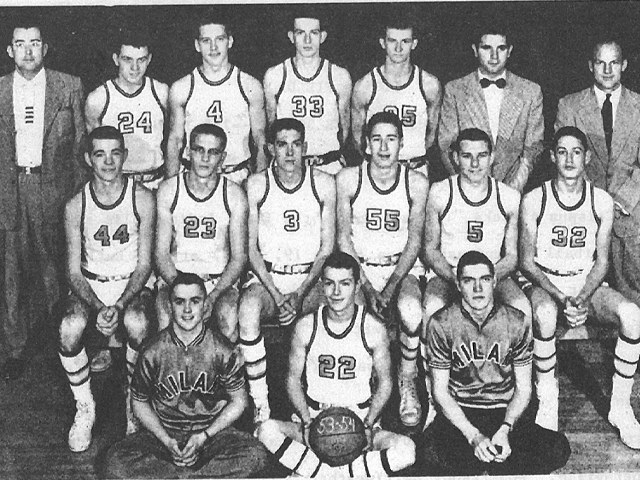
1. ” “Hoosiers“(1986) The Gene Hackman movie about a tiny Indiana town’s surprise victory in the state basketball tournament (the actual 1954 team is above), covers many ethics themes, including leadership, integrity, sacrifice , redemption, learning from past mistakes, and moral luck. The basketball games are surprisingly realistic, and Jerry Goldsmith’s score, evoking bouncing basketballs on a court, is one of my all-time favorites. Favorite ethics moment: after training the team to obey him without question, and teaching them to play as a team, not individuals, coach Hackman tells his players with one play left in the championship game that they will use their star, Jimmy, as a decoy, and let another player take the final, game deciding shot. After a long pause, Jimmy tells him, “I’ll make it.” And like all good leaders, Hackman knows when to trust his subordinates. He let’s Jimmy countermand his order, and Jimmy indeed wins the game. Continue reading →