For some reason, the question about which sports movies are the “best” or individual favorites has turned up in all sorts of places this week, I have no idea why. When it turned up during tonight’s Red Sox broadcast, I decided it was time to give my list.
(The Red Sox and Rays are tied in the 7th, 4-4.)
Most sports movies are ethics movies, and my favorite five all fit that description.
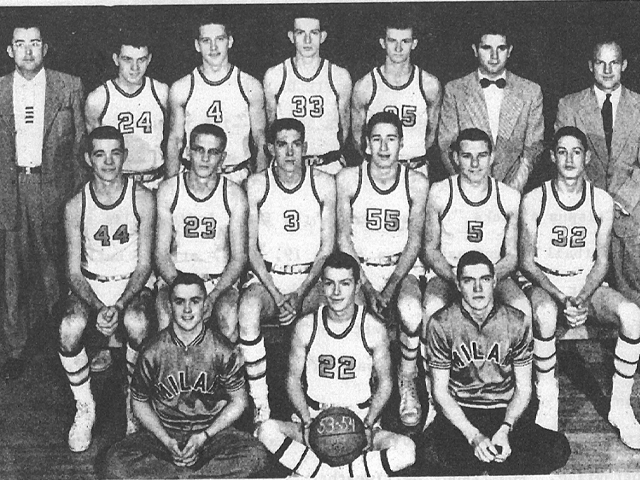
1. ” “Hoosiers“(1986) The Gene Hackman movie about a tiny Indiana town’s surprise victory in the state basketball tournament (the actual 1954 team is above), covers many ethics themes, including leadership, integrity, sacrifice , redemption, learning from past mistakes, and moral luck. The basketball games are surprisingly realistic, and Jerry Goldsmith’s score, evoking bouncing basketballs on a court, is one of my all-time favorites. Favorite ethics moment: after training the team to obey him without question, and teaching them to play as a team, not individuals, coach Hackman tells his players with one play left in the championship game that they will use their star, Jimmy, as a decoy, and let another player take the final, game deciding shot. After a long pause, Jimmy tells him, “I’ll make it.” And like all good leaders, Hackman knows when to trust his subordinates. He let’s Jimmy countermand his order, and Jimmy indeed wins the game. Continue reading →
My father hated Kate Smith. Hated her. The jumbo alto radio star from the Thirties and Forties was still showing up on TV variety shows in the Sixties and Seventies, and my father always made us change the channel when she appeared. Smith had made a virtual career out of belting her four-square rendition of Irving Berlin’s “God Bless America,” and Dad regarded it as patriotic pandering and exploitation. Thus it seemed appropriate that two teams we all hated in Boston, the New York Yankees and the NHL’s Philadelphia Flyers, periodically used the recording of Smith—and sometimes Smith herself— singing the song during games. Once 9-11 caused baseball to add the song during all games at the Seventh Inning Stretch (time to end that, by the way), Kate’s immortality seemed assured, especially in Yankee Stadium, where her rendition was rotated with a few other versions.
Then some enterprising social justice fanatics and “Hader Gotcha!” masters decided to do a deep dive and find something on Kate Smith. What they found was that among her hits in the Thirties were two songs that make Stephen Foster seem like Snoop Dog. One was “Pickaninny Heaven,” which described a “colored” paradise with “great big watermelons,” and the momentarily famous “That’s Why Darkies Were Born,” which we will look at in some detail later. These presentist censors—remember, presentism is the fallacy of judging conduct from the past by the updated ethics and values of the present—protested to the Yankees, and that’s all it took to get Kate banished, presumably forever. (The Flyers have also banned Kate.) The mighty Yankees whimpered in a public statement,
“The Yankees have been made aware of a recording that had been previously unknown to us and decided to immediately and carefully review this new information,. The Yankees take social, racial and cultural insensitivities very seriously. And while no final conclusions have been made, we are erring on the side of sensitivity.”
This would have a KABOOM! tag, but my head is all exploded out today.
But think about it as you read: Haberman has been the primary reporter for the New York Times on “Russiagate,” and she is obviously Trump Deranged, infected by crippling confirmation bias, and to be crude because sometimes crudity is called for, a total dumb ass.
New York Post reporter Nikki Schwab tweeted today, “Edelweiss” was being played as we walked into the @WhiteHouse”
The woke and culturally literate Haberman responded in horror, “Does…anyone at that White House understand the significance of that song?” Yes, Haberman, who has been crippled by the “resistance” narrative that the President is a Nazi, thinks “Edelweiss” is a Nazi anthem, because, well, see the descriptors above.
No, you lazy, biased, musical theater-challenged moron, “Edelweiss” is the anti-Nazi anthem sung by Baron Von Trapp at the climax of “The Sound of Music,” the artistic creation of two Jews, Richard Rodgers and Oscar Hammerstein, Jr. The paternal head of the singing family defiantly sings the song as a sentimental salute to Austria before the Nazi’s took over, as the Austrians sing and the Nazis scowl. It’s a scene much like the famous Marseillaise scene in “Casablanca.” Maybe Maggie also thinks the French national anthem is pro-Nazi. Why not? It’s no more ridiculous than her misunderstanding of “Edelweiss.”Continue reading →
Note the names and employers of the pundits and reporters who opine on the 400 page report (to be released today around 11:00 am) before they could possibly read it. [Althouse this morning: “What can they do, once 11 rolls around, to avoid continuing to analyze the Barr presentation (which will include denouncing his decision to do a press conference and dominate the news in advance of the release of the text)? You can be cynical and say the text won’t affect the media, and everyone will keep saying what they were already saying, and that is, in fact, my baseline assumption. The TV news is awful.” Yes, it certainly is.]
The New York Times and others are incensed that the Justice Department briefed the President on the report before it was released to the public. This is Trump Derangement, pure and unadulterated. The President has a right to see the report, and the Justice Department is part of the executive branch, which the President oversees.I’d want to be briefed ahead of the release if I were President, especially with a biased news media and a crazed “resistance” preparing to make it look as bad as possible no matter what it says. The complaint is one more entry in “Journalist making the public dumber.”
Ken Starr, also indulging in “future news,” says that he is concerned that the report will read like an anti-Trump manifesto. I will be surprised. It is true that the Mueller had some questionably aggressive prosecutors on the team, but the report has Mueller’s name on it and it is his historical legacy. He is regarded in D.C. and in legal circles as professional and fair. I would expect him to keep the report as factual and non-political as possible.
In Attorney General Bill Barr’s (completely appropriate) press conference this morning, he said in part,
1. Notre Dame fire ethics: Michael West, whose rare (of late) comments are valued as pearls, offered a proposed poll regarding the proper response to the destruction of the ancient cathedral’s spire. Here it is, with a few tweaks from me:
At the risk of tainting the voting, I have a pretty strong opinion about this. The structure should be left as it is. Did they repair the Great Sphinx’s nose? Did they cover up the crack in the Liberty Bell? Once a part of an ancient structure or monument us gone, it’s gone. Replacements and restorations are ersatz and deceptive. The fire is part of the cathedral’s history, and what remains should reflect it. There are far better—and more ethical– uses for the many millions it will take to restore the spire.
2. Thanks for all the kind comments in light of Ethics Alarms hitting two major milestones on the same day. In commemoration, the blog will launch a new series, Ethics Alarms Retrospective (EAR), focusing on one or more of the 10,000+ posts I have immodestly placed here, most of which even I have forgotten.
For the first installment of EAR, I offer “The Unethical Humiliation of Sister Rita X”from August 10, 2010. The topic was Sean Hannity’s practice of allowing clearly deranged progressives to have extended exposure on his radio call-in show, so he could engage in cheap mockery with the implication that they are representative of the Left generally. The comments are especially fascinating, almost all of which were Hannity fans who concocted all manner of distortions and rationalizations to justify what was the equivalent of exploiting the mentally ill for laughs. Comment highlight? This:
Again- I don’t expect you to respond- because you already said you would cut this conversation off. Again- typical lib. And I have facts. What have you got besides a hollow ideology and kool aid?
That’s me, all right: a typical lib! By the way, that (minor) post was shared 4 times on Facebook, where as the last several hundred or so have received none.Continue reading →
1. Record ethics. Kansas City Royals second-baseman Whit Merrifield is a fine young rising star, but the nation will never turn its lonely eyes to him.Playing against the Mariners this week, Merrifield beat out a squeeze bunt that not only tied the game, but also extended his hitting streak to 31 games. That set a new franchise record, beating Hall of Famer George Brett’s 30 game consecutive hitting streak set in 1980. That seems unfair, you say? Most of Merrifield’s streak was last season, you say?
I agree with you. Baseball takes the position on consecutive game streaks of all kinds that the six months between seasons don’t matter or count. I see the logic, a bit: why should a player’s chance at a record be arbitrarily ended because the season runs out? I also have the answer: tough noogies. There is a material difference between hitting in consecutive games over a single grueling season and doing so with a vacation in the middle. I guarantee that if Merrifield’s record got close to Joe DiMaggio’s iconic 56 games, set in the single, famous season of 1941 (when Ted Williams also hit .406), Major League Baseball would have rushed in and disqualified Merrifield for the consecutive game record because it wouldn’t be set in a single season. THAT, of course, would have been redolent of the controversial asterisk put after Roger Maris’s 61 home runs in 1961, which broke another iconic record, Babe Ruths’s 60. (Maris’s record was set in a 162 game season, Ruth’s in a 154 game season.)
Fortunately, Merrifield’s record chase was stopped at 31 the very next day.
This is as good a time as any to mention that the player who got me hooked on baseball, former Red Sox shortstop Eddie Bressoud, whose 87th birthday is coming up (May 2), had a knack for hitting streaks at the start of season. he hit in 15 straight in 1962, his first with the team, and set the team record for a consecutive streak at the start of the season in 1964, with 20.
2. “Don’t be evil” a distant memory. R. Emmett Tyrrell, Jr. , the founder of mainstream conservative magazine “The American Spectator” announced that the publication had been blacklisted by Google, following an investigative report by The Daily Caller that revealed, Continue reading →
1. Psst! HLN! It’s called “stealing,” you morons. According to a recent survey, 14% of Netflix users share their passwords to the streaming service. That’s about 8 million people. I just watched giggling news-bimbo Robin Meade on HLN and her sidekick Jennifer Westhoven go on about how they hoped Netflix didn’t “crack down” and how this was like “ride-sharing.” No, it’s not like ride-sharing at all. If you want your friend to have Netflix and they can’t afford it, pay for their subscription. This is theft. Talking heads that rationalize dishonest behavior on TV is one of many cultural factors that incapacitates the ethics alarms of a critical mass of Americans.
And Robin? Being beautiful doesn’t excuse everything.
2. The Alternate Reality solution to race relations! Professor Chad Shomura of the University of Colorado at Denver has banned discussions of any white men in his course on American political thought. No Locke, no Jefferson, no Rousseau, no Madison, no Hamilton, and no President before Obama . Such an irresponsible approach to his course’s topic can’t be prevented by the university because of academic freedom, of course: if a professor thinks he or she can teach physics by playing with puppies, that’s up to them. I would suggest, however, that any student incapable of figuring out that such a course is an extended con is a fool and a dupe. What’s the equivalent of this? Teaching the history of baseball without mentioning Babe Ruth?
3. Pop Ethics Quiz: Is this fair? After legal analyst Jeffrey Toobin said on CNN that outgoing Homeland Security Secretary Kirstjen Nielsen ” will forever be known as the ‘woman who put children in cages,” conservative pundit and ex-Justice Department lawyer T Beckett Adams tweeted, “I doubt it. People have short memories. There’s a reason we don’t call Toobin the “married man who knocked up a former colleague’s daughter and had to be taken to court to pay child support.” Adams’ description is fair, but is using it in this context ethical?
I would give you all a big hug, a squeeze, and maybe a sniff, but that’s not me...
1. This is fake news, you know. Today’s headline on the Times front page: “Barr Understated Mueller Findings, Some on Team Say.” Naturally, “some” are never identified. All this headline means is that some involved with the Mueller investigation wouldn’t have summarized the report as the AG did, and some had a different opinion, and, presumably, some disagreed with them. Who didn’t assume this? This isn’t news. This is just pot-stirring and innuendo in service of a political agenda. Now if the Times’ sources went on the record and explained what findings they are referring to and why, that would be news. This isn’t.
2. Maybe just Ick, not ethics, but still, ICK! Kendall Jenner, who is famous exclusively because her half-sister sister bared all in a sex video that launched the Kardashian reality show empire, made $26.5 million for just 53 sponsored Instagram posts, according to Captiv8, a marketing firm that connects brands to “social media influencers.” Let’s see: is there anything wrong with Jenner letting companies pay her to send out social media hype? As long as she isn’t lying in her posts, I guess not...but if she becomes part of a fraud without doing her due diligence, its not just unethical, it’s illegal. Is there anything unethical about paying a narcissistic waste of space who would lose a game of Scrabble to a sea sponge millions to promote a company’s product or event? No, if it works. Is there anything unethical about trusting a barely-educated celebrity because of her looks? Unethical, no…stupid, but not unethical.
3. On the suspension of ethics during wartime. Freddie Oversteegen, who died September in her native Netherlands, was just 14 when she joined the Dutch resistanceTogether with her older sister Truus and their friend Hannie Schaft, she murdered as many Nazis as she could, using a firearm hidden in the basket of her bike. The women had a method: first approach a Naz in bars, seduce them, ask if they wanted to “go for a stroll” in the forest (wink-wink, nudge-nudge) and then, shoot the bastards, or as Freddie put it, “liquidate” them.
“It was a necessary evil, killing those who betrayed the good people,” she told one interviewer. When she was asked how many people she had killed or helped kill, she demurred: “One should not ask a soldier any of that.”
Freddie also blew up bridges and smuggled Jews out of concentration camps, so she was more than a black widow assassin. Is she justly regarded as a hero?
4. “The Highwaymen” My wife and I watched this new Netflix release starring Kevin Costner and Woody Harrelson as the real life aging Texas Rangers who were handed the assignment of “stopping” Bonnie and Clyde’s deadly rampage through Texas in 1934. We liked it a lot, but then it’s an ethics movie, raising and debating the question—see #3 above—of how far one can ethically go to fight evil. Bonnie and Clyde were evil despite their folk hero status at the time, and despite the sick glamorizing they received in the 1967 film starring Faye Dunaway and Warren Beatty, which made them the romantic rebels fighting a corrupt establishment—you know, like the arrogant creeps who shut down my college a year later.
The Highwaymen barely shows the two psychotic love-birds until they are being riddled with bullets, focusing on the real heroes of the saga, the law enforcement officials who hunted them down.
The two ex-Rangers break quite a few laws in the pursuit of the greater good, and it is odd that there seems to be a resurgence in sympathy in the entertainment media for brutal police methods. In Dick Wolf’s “Chicago PD,” for example, Sergeant Hank Voigt (Jason Beghe) regularly threatens, extorts and beats people up to solve crimes–and he’s the moral center of the show. Is law enforcement more like war than we like to admit, where the ethical rules can be, are, and maybe need to be suspended?
Best line in “The Highwaymen”: Kathy Bates, as Texas Governor “Ma” Ferguson—I’ll tell her weird ethics story tomorrow—tells reporters that she is making sure that Bonny and Clyde are hunted down, and one of them references their image as Robin Hood figures. “Did Robin Hood ever shoot a gas station attendant in the head for four dollars and a tank of gas?” she asks.
5. Now THIS is weird…Twin ethics! In Brazil, when identical male twins refused to say which one of them had fathered the child (DNA test proved inconclusive because they their were identical twins) assuming they would then be able to escape having to pay, a judge ordered that they both had to pay child support. Each twin was ordered to pay 230 reais; ($60; £45) a month, or 30% of the minimum salary in Brazil. Judge Filipe Luís Perucaalso ruled that the names of both men would be on the girl’s birth certificate.
The twins had used their resemblance to impersonate each other and date as many women as possible, and then defend themselves from allegations they were cheating on girlfriends. Ah, memories! I see a reboot coming!
But they’re irresponsible illegitimate fathers!
Identical illegitimate fathers, and you’ll find
The look alike, deny alike, they go in court and lie alike!
1. If anyone cared, this would do in Rachel Maddow. The fact that so many of my otherwise intelligent and reasonable liberal friends insist that Rachel Maddow is God’d gift to journalism was a mystery to me when she first brought her perpetual smirk to MSNBC. It perplexed me greatly as she so obviously hyped and twisted her commentary, and once she became the #1 Russia-Trump conspiracy theorist on TV, I admit that I have lost the edge of respect for anyone who still watches her. Rachel Maddow bottomed out, I’d say, yesterday, when she was saying this last week:
“It’s hard to believe that they’d leave the newly appointed Attorney General William Barr to himself to personally pick through the [Mueller] report to try to figure out which mentions in this 400-page report might pertain to an open case”They wouldn’t leave that to Barr to do that. Mueller would have done that!
Mueller’s team would have done that as part of producing anything that they handed over outside their own offices. They’ve done that with every other document they have produced in the course of this investigation. You’d assume they’d be able to do that for this document too. But William Barr says, [exaggerated sigh] it’s taking him a really long time because he’s having to do all that himself.”
While was saying that it was suspicious that Barr wouldn’t seek Mueller’s assistance with the redactions, the chyron underneath her read,
“Barr: Special Counsel Is Assisting with Redactions”
Unlike the much-mocked Fox News gaffe, in which the talking heads were correctly reciting the story while the chyron said that Trump was pulling aid from “three Mexican countries“, this time the chyron was right, and the talking head was wrong. It might just be me, but I’d rather the actual reporters to be telling the truth, and graphics be messed up. Continue reading →
I’ve been thinking a lot about my Dad for some reason, and that was his favorite hymn. It’s an Easter hymn, but our church always had the choir sing it on the special spring service. My unusually musically talented friends knocked it out of the park at my father’s funeral service at Arlington National Cemetery. It also has the advantage of being composed by Arthur Sullivan, just like “Onward Christian Soldiers!” and “Tit Willow.”
1. Fill out your brackets, and enable corruption. It’s the NCAA tournament again, and again, helping the schools and the NCAA and the networks make money off of the destructive and corrupt culture of big time college basketball is ethically indefensible. The New York Times wouldn’t go so far as to say that, but it did recently write about the dissonance, beginning,
Every March, millions of Americans fill out brackets (more than 40 million people, by one count), cheer the underdogs and tune in on television. Others buy tickets to the games, wear jerseys of their favorite teams and let wins and losses dictate their mood. Yet fans who follow college basketball closely know about the game’s intractable relationship to corruption. Even many who come just for March Madness must know that the real madness is not always on the court.
A wide-ranging and fear-inducing F.B.I. investigation into college basketball recruiting continues to ensnare big-name colleges and little-known crooks. It is why Louisiana State, for example, is playing without its head coach, Will Wade, and why Auburn recently had an assistant coach suspended and a former assistant plead guilty of conspiracy for accepting bribes.
This week, the lawyer Michael Avenatti was charged with trying to extort up to $25 million from Nike in exchange for concealing information he had about illicit payments to recruits. He has since revealedsome allegations on Twitter….
The Times doesn’t bother to go into the related problem of how basketball distorts academic goals, sucks away resources that should be used for education, and usually leaves its athletes no better educated than they were when they arrived. As you might expect, the Times’ writer is too ethically incompetent to provide and enlightenment. For example, he quotes one ethicist as saying, “…Someone thinks, ‘Gosh, this is unethical, but I love it so much, and my friends and I have such a good time rooting and cheering that I’m going to participate anyway.’” That description could also be used to justify gang rape. Can we have a little nuanced clarification? Then the Times writer, John Branch, offers these ill-devised analogies:
“Such internal debates permeate our culture. Is it O.K. to dance to a Michael Jackson song, to laugh to a Louis C.K. joke, to watch a movie produced by Harvey Weinstein? To cheer for football knowing what it may be doing to players’ brains?”
Let’s see: wrong, wrong,wrong, and…right. 1 for 4.
A Michael Jackson song isn’t corrupt, or unethical: it’s art. He’s dead: dancing to the song does not enable the misconduct. A joke is a joke regardless of who tells it, and again, laughing at a C.K. joke doesn’t make it more or less likely that he’s going to masturbate in front of a female colleague. Workplace misconduct doesn’t taint the work product, and nobody has claimed that movies themselves are culturally corrupting, or that Weinstein’s films harmed the actors in them. Cheering for football is a legitimate comparison, because the sport itself is the problem, just like college basketball itself is the problem.