“But I don’t think it’s necessarily antiwoke to tell an all-white story or to relegate nonwhite characters to the margins, if that’s where they fit the creative intentions.”
—Former Washington Post theater critic Naveen Kumar in the paper’s “Whitewashing ‘Wuthering Heights.'”
Oh, well that’s really big of the critic, don’t you think? How generous of him! He is willing to concede that a director might still be regarded as a good person if he or she doesn’t cast actors “of color” (you know, like the critic) to play characters written as white, visualized by the playwright as white, in a story obviously about white people!
Yes, this fatuous, offensive statement came late in an essay that was already obnoxious, with the biased and reductive headline, “Whitewashing ‘Wuthering Heights’.” [Gift link!] The Post post was defending, sort-of -but- not-really, Emerald Fennell’s “Wuthering Heights” film, in which Heathcliffe, Emily Bronte’s hormonal romantic anti-hero, is played…
…by a white actor. Never mind that previous film adaptations have cast Heathcliff as white, notably the classic starring Lawrence Olivier in the role, probably because he was the best actor alive at the time.
Yes, it is true that the ethnicity of Heathcliff has always been a matter of debate: with Bronte describing him as “dark-skinned,” a “gypsy,” and a “little Lascar,” a term for South Asian sailors. The idea is that he is an outsider and at the bottom of the social ladder; that certainly would justify casting a black, Indian or other non-white actor, but certainly doesn’t mean he has to be played that way. (I would not think that casting Heathcliff as Swedish would work, but you never know: I could see one of the Skarsgaard boys pulling it off.)
I finally watched the critically praised Netflex series “Death By Lightning” last night. Friends, knowing my obsession with Presidential history, had urged me to watch it. I had hesitated because I dreaded exactly what I witnessed last night. The limited series, based on Candice Millard’s best-selling history “Destiny of the Republic,” managed to both make me angry and break my heart.
Putting on my director’s hat and my film critic hat (kind of like Chester A. Arthur in the series wearing three hats on top of another during a drunken spree—one of many made-up scenes that completely misrepresented our 21st President), I’ll grant that the series was entertaining—especially so if one knows nothing about the events it alleges to portray—and well-acted by a strong cast. I also give it credit for portraying relatively accurately one of my favorite moments in U.S. political history. James Garfield, a brilliant but obscure Ohio Representative, was asked to deliver the Presidential nomination speech for fellow Ohioan Senator John Sherman, General Sherman’s brother, at the 1880 GOP National Convention. Garfield’s speech was so passionate, eloquent and inspiring that when he concluded, “therefore, I nominate the next President of the United States…” a couple of delegates shouted out, “Garfield!” before he could get out “John Sherman of Ohio!” Garfield was stunned, and as the convention descended into a deadlock, objected strenuously while over 35 ballots, rogue delegates began consolidating their support behind him until finally, on the 36th ballot, he was nominated against his will.
That does not, however, make up for the series’ worst omission and distortion of history.
I have posted several times here the remarkable, uplifting, ethically-enlightening story of Julia Sand, most recently on this past Presidents Day. She was the crippled spinster who wrote private letters to Vice-President Chester A. Arthur, then hiding in seclusion as President Garfield was being butchered by his doctors after being shot by lunatic Charles Guiteau. Her letters told Arthur that he could not only do the looming job he felt unfit for, but also that he had the inner resources to do it well.
She told the terrified political hack that he could muster the courage and character to do what so many other great figures in history have done when fate thrust them into a position where they were challenged to rise above their previous conduct and priorities. Arthur did in fact meet that challenge when President Garfield died, earning recognition as the “accidental” President who most surpassed public expectations.
I love the story, and I regard Julia Sand as the perfect example of how seemingly powerless, ordinary people can make a difference in our society, government and culture. Maybe she is the best example. Few could be more irrelevant to national affairs in the 1880s than an unmarried, middle-aged woman confined to a wheelchair. Yet Julia Sand probably changed history with her wit, commons sense, writing ability, wisdom and audacity. As an ethicist, I saw the story of Sand and Arthur, which I had never had encountered even in Arthur’s biography, the most important event related in “Destiny of the Republic.”
Yet “Death by Lightning” not only cut Julia out of the story, it gave her words to the dying Garfield and his wife, neither of whom spoke to Chester A. Arthur after Garfield was shot. I can only describe the snub as cruel. Here, at last, was the opportunity to let the public know about the amazing Julia Sand, and instead “Death by Lightning” uses her story to enhance the character of Garfield’s wife, Lucretia.
Lucretia was one of our most literate and influential First Ladies and deserves attention, but not at the cost of erasing Julia Sand.
I used to complain about how much of Northern Virginia winters were spent in the rain, but the deluge overnight here, which is going to restart any minute, could not be more welcome. My neighborhood has been iced-over for weeks, with snow on the ground longer than any time during my decades long residence. (Naturally, this is just more evidence of climate change and global warming, “experts” say, and they know best.) The warm rain is ending that, meaning that walking my over-enthusiastic dog, Spuds, will no longer be life-threatening…at least not as life threatening.
I have too many things I want to write about, and as always, I am hoping to find some guest posts (as in “you write about it so I don’t have to” posts) here today when the dust settles. Olympics ethics stories will be especially welcome, because I refuse to watch the hypocritical spectacle or read about it unless someone sends me a tip. I am very tempted, however, to write about Elaine Gu, the all-American super-star skier who competes representing China in this Winter Olympics. According to the Wall Street Journal, Gu and Zhu Yi, a fellow American-born figure skater who now competes for China, were paid a combined $6.6 million by the Beijing Municipal Sports Bureau in 2025 for “striving for excellent results in qualifying for the 2026 Milan Winter Olympics.” In all, the two were reportedly paid nearly $14 million over the past three years. The payments were revealed when the Beijing Municipal Sports Bureau budget was posted online with the names of Gu and Zhu. Their names have since been scrubbed from the public report.”
Nice. Gu is revolting, and it also proves how far the Olympic have come from their original roots of extolling amateur athletic competition. Gu still is paid by some American corporations to be their sponsors. They are also revolting. Gu’s betrayal of her own nation raises the ethical issue of dual citizenship. She’s a great walking, talking, greedy, ethically-inert example of why we shouldn’t allow it.
Proving that the Washington Post wasn’t recently gutted by its Gazillionaire owner Jeff Bezos to make it more fair and objective but just to try to save money while keeping it dishonest and partisan, the paper’s Editorial Board published a disingenuous, politically motivated and deliberately misleading editorial [gift link!]explaining that the Trump Administration’ resuscitation of the long dormant—but still on the books—FCC “Equal Time” rule is simply a pretense for using the regulation for political censorship. You see, as the Post editors “explain,” the rule is no longer needed! here is how they frame the current controversy:
“Passed by Congress as a part of the 1934 Communications Act, the equal-time rule says that if a broadcast station features a candidate for public office, it “shall afford equal opportunities to all other such candidates for that office.” The FCC is charged with enforcing it. On Monday, Colbert said that CBS prohibited him from airing an interview with Texas Senate candidate James Talarico (D). He claimed the network’s lawyers were worried about clashing with the FCC.
“CBS told a different story. It said Colbert wasn’t prohibited from airing the interview, but rather warned that it might “trigger the FCC equal-time rule for two other candidates, including Rep. Jasmine Crockett.” Talarico, a state representative, and Crockett are the leading contenders for the Democratic nomination in the 2026 Texas Senate race. The network claimed it presented Colbert with “options for how the equal time for other candidates could be fulfilled.”
“On Tuesday night, Colbert rebuked the network again, but the finger-pointing misses the point of how a zombie regulation created this mess in the first place.
“The government shouldn’t be dictating the political content of late-night television — or of any other entertainment Americans choose to consume. But that’s exactly what the equal-time rule does. It is rooted in an entirely different technological landscape; in the early 20th century, scarce radio frequencies meant that the means of mass communication were limited. That’s why Congress saw fit to try to mandate that all candidates got a hearing.
“Since the advent of cable news and the internet, the possibilities for transmitting information and entertainment have exploded. Colbert’s Talarico interview, for example, was posted on YouTube, where it already has more than 6 million views — far more than it probably would have received if not for this controversy. Politicians can compete for attention without government help….”
The Post’s subterfuge would be a legitimate argument except for the democracy-rotting condition that the paper is ignoring because it is part of it. That condition is the near total ideological monopoly of the entertainment industry, giving the Left—again, the Post and its pals—access to the controls of the powerful propaganda and indoctrination weapon television still is.
Ah, the J Curve! That’s what you see above, and it has many applications. Herman Kahn, the late futurist who was known as the smartest man in the world (is there anyone who holds that title today?) told me that the J Curve was especially valuable regarding new technologies that destroy previous concepts of what was possible. The microchip. The internet. Now, it’s AI.
Talk about fast! Just four days ago, a crude A.I. battle between Tom Cruise and Brad Pitt had Hollywood running for Xanax. Now the German Dor brothers said, “Hold our Augustiner-Bräu!” and produced this in a single day:
Soon Hollywood producers, directors and actors will be jumping off buildings like panicked stockbrokers on Black Tuesday, 1929. Or not. The smart ones will realize that they need to start making better movies. It shouldn’t surprise anyone that the typical shock and awe special effects orgies like “2012” and “San Andreus” can be made by a bot. It’s crap made for morons, stoners and people who can’t sit though “On the Waterfront.”
Let me know when the J Curve produces AI that can evoke Paul Scofield, John Hurt, Colin Redgrave, Susannah York and Wendy Hiller in this favorite Ethics Alarms scene:
…or the rest of the movie, for that matter. Until then, if then ever comes, talented actors, writers and directors have nothing to worry about. Intelligence and talent have always been weakly correlated, if at all.
What a joy to wake up this morning not only to a spectacular Comment of the Day, but also to a note from an MIA commenter who was last seen in these parts almost nine years ago! I welcome Lisa Smith back to Ethics Alarms with a well-deserved Comment of the Day honor, for her note on the post, “On Lincoln’s Favorite Poem, and the Poems’ We Memorize…”
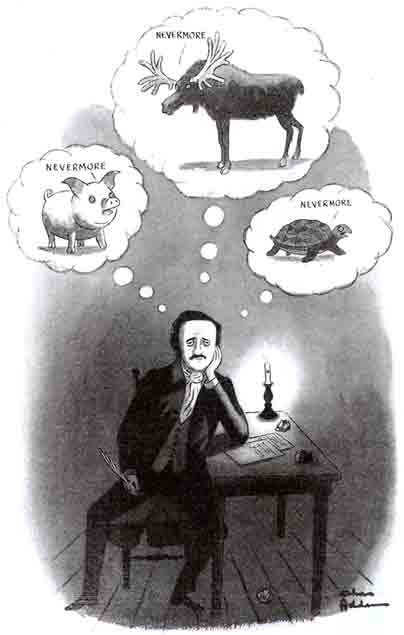
(I couldn’t resist leading this off with one of two brilliant Charles Addams cartoon about “The Raven.” The other has Poe pondering as a raven, perching over his door, says, “Occasionally.”)
***
I don’t know – Poe’s Raven has one of my favorite lines; it isn’t at all profound, but it is profoundly delightful to speak and to allow to roll over the brain like a cool river. I memorized the entire poem when I was a teen in the late 70’s and can still recite it. (But for the life of me, I can’t remember the “new” neighbor’s names, even though they have been here five or six years. Their dog is Annie. My priorities are laid bare, I suppose.)
“And the silken, sad, uncertain rustling of each purple curtain thrills me, fills me with fantastic terrors never felt before.”
There may be errors in there. I write it from memory alone. [JM: Pretty close! “And the silken, sad, uncertain rustling of each purple curtain, thrilled me—filled me with fantastic terrors never felt before”]
Poetry makes equals of us all. From Bukowski to Shakespeare. They speak to each person in their own way.
You can read the details of this completely predictable and in general ridiculous ice-dancing judging scandal here,here, and here. I’m not going recount the details because the details are misleading.
The ethics story is that the American ice dancing team of Madison Chock and Evan Bates lost the gold to the French team of Laurence Fournier Beaudry and Guillaume Cizeron because a French judge, Jezabel Dabouis, favored Beaudry and Cizeron by nearly eight points (make that “points”) over the three-time world champions in the free dance, a margin inexplicable when compared to the scores of the other judges, and so large that if her score were removed entirely, Chock and Bates would have won the top prize easily.
I like the show in general, but its writers need to catch up with the Rules of Professional Conduct and their interpretation.
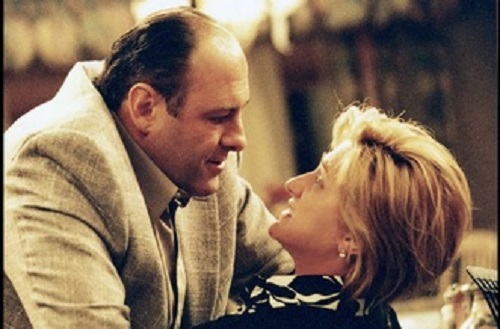
Twenty years ago, in “The Sopranos,” Tony and his wife Carmella were having marital problems—gee , I wonder why?—and Tony was tipped off that she was looking for a divorce lawyer. So Tony contacted every major divorce lawyer he could find to tell them all about his marriage on the pretext that he was considering retaining one of them.. The idea was to conflict them all out of representing her, because they had received confidential communications from Tony.
Rule 1.18, relatively new at the time, held that lawyers had to keep the confidences of even potential clients, making such a dastardly tactic possible. But not long after that episode of “The Sopranos” revealed the loophole in the rules, courts and legal ethics opinions closed it with the sensible holding that someone only consulting a lawyer to create a conflict and not as a good faith effort to seek legal representation was not a genuine potential client.
Nevertheless, in the current season of “The Lincoln Lawyer,” Mickey’s newly minted lawyer associate (and ex-wife) says she got her first family law client because the woman had been frozen out of hiring the established divorce lawyers after her louse of a spouse had pulled Tony’s old trick.
True, it’s not always easy to prove that an estranged spouse is seeking conflicts rather than a lawyer. Nonetheless, lawyer TV shows are ethically obligated not to deceive the public. Tony Soprano’s method is unlikely to work now, and hasn’t been viable for at least a decade.
In one area, “The Lincoln Lawyer” deserves praise for properly representing a lawyer’s duty that Hollywood almost always ignores. Whenever Mickey Haller, “The Lincoln Lawyer,” is presented with a plea deal or another offer from the opposing attorney, even if Mickey makes it clear that he thinks the offer is ridiculous, he always says, “I’ll run it by my client,” which he has to do. But even in some of the most celebrated legal films, like Paul Newman’s “The Verdict,” the lawyers don’t do that. As a result, many clients don’t know their attorney can’t reject or accept a settlement offer without consulting them. That misconception can cause real harm.
The previous installments of these legal ethics commentaries on the streaming series can be found here, here, and here.
The U.S. had a marijuana problem a half century ago, when an earlier wave of The Great Stupid washed over the land and all manner of important lessons a healthy and functioning society needed to remember and institutionalize were deliberately tossed away because a lot of passionate, anti-establishment assholes were sure that they knew better than anyone “over 30.” I fought this destructive development from college, when I watched one of my room mates suffer short term memory loss from getting stoned morning and night; in law school, when the student running my lightboard for a production of “Iolanthe” erased all the light cues that we had taken six hours to set up because he was higher than the moons of Jupiter, all the way onto this blog. I put up with the mockery of classmates and dorm mates over the fact that I would not “try” pot (“It’s illegal” wasn’t a winning argument, so I settled on “It’s stupid and destructive.”). I drew a line in the sand with my addiction-prone wife, a former pot-head who was already an alcoholic. My fellow lawyers quickly learned not to get stoned around me because they knew I regarded buying and selling pot when it was illegal grounds for reporting them to bar authorities and respected my integrity enough to have reasonable doubts that I might not pretend that I didn’t know what I knew.
I carried the battle onto Ethics Alarms as the relentless pro-stoner propaganda was heading to victory, resulting in the legalization of the drug, the inevitable result of which the assholes who edit the New York Times have the gall now to tell us “Oopsie!” about after being a significant part of the mob mentality that inflicted it on the public, probably forever.
Back in 2011, I drafted a post that I never finished titled, “To My Friends the Pot-Heads: I Know. I’ve Heard It All Before.” It began:
“I take a deep breath every time I feel it necessary to wade into the morass of the Big Ethical Controversies, because I know it invites long and fruitless debates with entrenched culture warriors with agendas, ossified opinions, and contempt for anyone who disagrees with them. War, abortion, religion, prostitution, drugs, torture, gay marriage…there are a lot of them, and all are marked by a large mass of people who have decided that they are right about the issue, and anyone disagreeing with them is stupid, evil, biased, or all three. Contrary to what a goodly proportion of commenters here will write whichever position I take, I approach all of these issues and others exactly the same way. I look at the differing opinions on the matter from respectable sources, examine the research, if it is relevant, examine lessons of history and the signals from American culture, consider personal experience if any, and apply various ethical systems to an analysis. No ethical system works equally well on all problems, and while I generally dislike absolutist reasoning and prefer a utilitarian approach, sometimes this will vary according to a hierarchy of ethical priorities as I understand and align them. Am I always right? Of course not. In many of these issues, there is no right, or right is so unsatisfactory—due to the unpleasant encroachment of reality— that I understand and respect the refusal of some to accept it. There are some of these mega-issues where I am particularly confident of my position, usually because I have never heard a persuasive argument on the other side that wasn’t built on rationalizations or abstract principles divorced from real world considerations. My conviction that same-sex marriage should be a basic human right is in this category. So is my opposition, on ethical grounds, for legalizing recreational drugs.”
Instead of finishing and posting that essay, I posted this one, which used as a departure point a Sunday ABC News “Great Debate” on hot-point issues of the period featuring conservatives Rep. Paul Ryan and columnist George Will against Democratic and gay Congressman Barney Frank and Clinton’s former communist Labor Secretary Robert Reich. [Looking back, it is interesting how all four of these men went on to show their dearth of character and integrity. Ryan proved to be a spineless weenie, rising to Speaker of the House but never having the guts to fight for the conservative principles he supposedly championed. Frank never accepted responsibility for the 2008 crash his insistence on loosening mortgage lending practices helped seed, preferring to blame Bush because he knew the biased news media would back him up. Will disgraced himself by abandoning the principles he built his career on in order to register his disgust that a vulgarian like Donald Trump would dare to become President. Reich was already a far left demagogue, so at least his later conduct wasn’t a departure. I wrote in part,
In this limited series of as yet undetermined length, I’ll be examining the legal ethics issues raised by the Netflix limited series of as yet undetermined length based on the Michael Connelly character, fed through the filter of the ubiquitous David Kelley.
I’m not going in strict order chronological order because why should I? This issue is a rich one, and arrived in Season 3 of the show. A prostitute whom Mickey had advised and had testified to help a client in Season 2 turned up dead, and he agreed to represent the man, her cyber pimp, accused of killing her before he realized she was the victim. Mickey liked and sympathized with the victim; whether he was officially her lawyer is a bit vague, but she seemed to think of him that way.
Can a lawyer represent a defendant accused of killing a lawyer’s client? Sure enough, this has happened; there’s even a Supreme Court case about it.






 Ethics Alarms