[This is Jack:Yikes! I didn’t realize that EA had been Curmie-less for a full four months!The second Ethics Alarms featured columnist has been both busy and seeking respite from politics, which unfortunately has been disproportionately rampant here during the Presidential campaign drama and related horrors. I’m hoping Curmie can leads us out of the dark into the light. Welcome back, Curmie!]
I’m not sure if this is sufficiently ethics-related for this blog, but since Jack posted it, so be it.
I retired from full-time teaching in August of 2021. It was August instead of May because I was hoping—to no avail, as it turns out—to do one more iteration of a Study Abroad program in Ireland; the trip had already been postponed from the previous summer. I did teach one course per semester in the 2021-22 academic year, but then not at all for two years.
I assumed that I’d never be in a classroom again except for an occasional guest appearance to be, apparently, the local authority on absurdism. But then a colleague got a one-semester sabbatical to work on her book. It would be extremely unlikely to find someone who had both the ability to teach all the courses in question and the willingness to move to small-town East Texas for a one-semester gig at crappy pay. The powers-that-be then decided to try to staff those courses locally. I suspect I was the only available qualified person in a 75-mile radius, so I was asked if I’d teach Theatre History I and II this semester. I agreed.
There were a lot of changes for me, completely apart from the two-year hiatus. I’d taught both courses numerous times, but never in the same semester, and always on a Monday/Wednesday/Friday schedule; this time it was Tuesday/Thursday. Back in the days when I was the only person teaching these courses I could insist that one of the research papers be on a certain type of topic; that’s no longer a requirement. And I ditched the expensive anthology I’d used for years, switching to things that were available online. This also allowed me to choose the plays I wanted to teach instead of necessarily the ones in the anthology: critics may agree that the The Cherry Orchard is Anton Chekhov’s best play, for example, but there is absolutely no question that The Seagull is far more important to theatre history, so I used that.
Last night I was totally blotto and depressed, took myself to a favorite restaurant to dine alone (I was looking for “a place where everybody knows my name” because the owner and some of the staff knew me and Grace because we started going there the week it opened, but none of them were around. Or were avoiding me…). I even had a stiff drink, my third this year.
I didn’t help. When I returned home, I decided to watch a semi-Christmas movie, the 1942 Irving Berlin movie musical “Holiday Inn” with Bing Crosby and Fred Astaire that I realized I hadn’t watched in decades, and never critically. The movie spawned several Irving Berlin classics, “White Christmas” and “Easter Parade” among them, as well as the movie “White Christmas,” which shares several ingredients with its predecessor—it’s a musical, it takes place at a resort inn in the country, Bing’s the star and sings his iconic Christmas song, he has an old friend and partner who dances, and there are two women who perform with them—but the movies have completely different plots.
And “White Christmas” has no blackface number….
One of the few moments I remembered from the film was Astaire’s number above, which is spectacular. In the movie he improvises it on the spot when his dancing partner doesn’t show up, which is of course impossible, even for Fred. In fact, the entire movie is so ridiculous and contrived that suspension of disbelief is out of the question: It makes “White Christmas” look like a documentary by comparison. Another realization: As well as Bing Crosby sang in the Fifties, his freak voice in the Forties was much better. Wow.
And yes, the movie was the inspiration for the founders of the motel chain to call it Holiday Inn. Apparently they didn’t pay Irving Berlin a penny, the cheap bastards.
“Holiday Inn” is definitely not about ethics, as it is completely mindless.
But you’re going to make your contributions to day about ethics, right?
Above are some examples of SCOTUS Justice Ketanji Brown Jackson making a spectacle of herself in her Broadway turn last weekend in the musical “& Juliet,” a LGBTQ adaptation of William Shakespeare’s “Romeo & Juliet.” Jackson portrayed Queen Mab, described as a “she/her” character on a production poster, in two scenes written especially for her. “I just also think it’s very important to remind people that justices are human beings, that we have dreams, and that we are public servants,” Jackson told“CBS Mornings” prior to the performance. One of her dreams was apparently to be an actress, long ago. (She made the right choice going into law.)
Except that judges, and especially Supreme Court justices, don’t have the option of doing whatever they feel like or dream about, as least if they are conservative justices. All of the criticism of the Roberts Court in the past few years has been over alleged ethical violations by the Justices making up the 6-3 conservative majority. The Justices appointed by Democrats Obama and Biden are, of course, as pure as Ivory Soap. And yet…
Netflix has a Christmas movie (well, if “Die Hard is a Christmas movie, this is) about a TSA agent caught up in a diabolical scheme to kill all the passengers on a commercial airplane for some reason or another—that part doesn’t really matter. In “Carry On,” our hero stumbles into the plot and is made the unwilling pawn of the villains, who are ubiquitous, brilliant and high-tech. Through an earpiece, the agent learns that the love of his life who is also pregnant is being watched by the bad guys and will be murdered at any second if he doesn’t use his position to get a piece of luggage containing a device that will release nerve gas through security screening. Suspense, thrills and unexpected twists ensue.
I’m probably not celebrating Christmas anywhere but on Ethics Alarms this year. Last Christmas was truly awful in every way, with my wife Grace in pain and suffering from some creeping malady that killed her in February and that I was too blind to detect (and so were her doctors). We were also in our worst financial crunch in 25 years of running our ethics business, my son was having personal problems, and all was definitely not happy and bright.
I am certainly conflicted about the holiday this year. I am a passionate Christmas booster, as long-time readers here know, because I regard the secular holiday as a vital social balm as well as an ethics catalyst. It is a unique holiday that calls on us to be kind, generous and forgiving, and, if possible (I’m trying!) to just be happy for life and its wonders. I am not religious, but I do believe that this is a profoundly ethical time of year. We all need Christmas, frankly. I need it, even though I dread every minute of it this year.
One of the special features of Christmas is that it is soaked with nostalgia and traditions along with bittersweet memories of people and events long past. Charles Dickens got this aspect of the holiday exactly right; it is why I love “A Christmas Carol” so much and have so often participated in public presentations of the story. My last professional directing gig was a staged reading of it, and that was the fourth time I have overseen one; I also have organized and directed three mass “radio” readings, using conference call technology and the sound effects wizardry of Keith Bell. (Where is Keith these days? See, there’s another memory knocking!).
With The American Century Theater, I co-wrote and presented two Christmas musical revues: “If Only In My Dreams,” which centered on the letters GIs wrote home at Christmastime during World War II, and “An American Century Christmas,” a salute to the old-fashioned TV Christmas specials and perennial Christmas movies like the three that have Ethics Alarms “guides’ here: “It’s A Wonderful Life,” which I posted at Thanksgiving, “White Christmas,” which will be updated and posted soon, and on Christmas Eve this year, “Miracle on 34th Street.” The first revue was more popular, but the second was my favorite, because it was generated entirely by my own warm memories of what Christmas was like for me and my sister growing up in Arlington, Massachusetts.
Both of our parents were Depression kids in poor families and their Christmases were spare at best, so both were determined to make the holiday magical for their children. And it was. We would decorate the tree carefully and lovingly a week before the 25th—I remember my mother insisting that each strand of genuine tin tinsel saved for years be placed individually on the branches—and go to bed after hanging our (huge) stockings with visions of sugarplums dancing in our heads. When we got up on Christmas morning, my parents had meticulous constructed a “Christmas panorama,” with the giant stockings stuffed with gadgets, oranges, walnuts and small packages lying by the fireplace, and the whole living room covered with presents, mine on the left of the living room, my sister’s on the right. The gifts were mostly unwrapped, and the vista was ever spectacular.
My father, a photography fanatic who was terrible at his hobby, had the old home movie projector spotlights blazing. He would record Edith and I coming down the stairs to see the amazing treasure left by Santa as mom looked on beaming and eager to see our reactions. My parents insisted on going through this ritual even after we were in college! My mother wouldn’t let the tradition go.
In 1963, the week before Christmas, Bing Crosby hosted “The Hollywood Palace,” a live variety show that was always headed by some entertainment legend, though Bing had the honor more than anyone else. That week he introduced a new Christmas song, the last popular Christmas song to have an unambiguous religious context. That was “Do You Hear What I Hear?,” and the video above was what I saw live. Something in the song immediately resonated with me; I was always a Bing Crosby fan, following the guidance of my father, but I loved everything about the new song despite its childlike simplicity. I said so immediately following Bing’s rendition. Sure enough, the song was playing on our old Magnavox stereo when my sister and I came down the stairs in our pajamas on Christmas morning.
“Do You Hear What I Hear?,” Bing’s version of course though there have been hundreds of covers, is the first Christmas song I play every year as soon as whiffs of holly, evergreens and mistletoe are in the air. It throws my mind back to those magical Christmases that Grace and I tried to recreate for our son every year while he was growing up. That magic was significantly dimmed when my father died, in his sleep, on my birthday in 2009, leading to the saddest Marshall Christmas. The spirit fell away a bit more the next year, when my mother, who never got over losing the love of her life after 58 years of marriage, was in the hospital fighting a voracious hospital infestion that killed her two months later. Christmas was never the same after Mom died: it was her joy and obsession. Still Christmas reminds me of her, and Dad, and that lost magic…and Bing.
I was pondering when and whether to put up a post about “Do You Here What I Hear?” this year when I checked out Ann Althouse’s blog and discovered that she had posted the video as a joke after her post about Jill Biden getting a laugh at her Christmas comments wishing the assembled “joy.” Apparently some took her choice of words as a sly swipe at Kamala Harris’s ill-fated “joy” theme.
In the comments to the post, some wags made jokes about how the shepherd boy tells the king to bring the “child shivering in the cold” silver and gold when what the baby needed was a blanket or a space heater. Yeah, good one: they made those jokes in 1963. Some jackass wrote, “If you listen to the lyrics, “Do You Hear What I Hear” ranks right up there with “Santa Claus is Coming to Town” for supposedly secular seasonal songs with aggressively creepy quasi-Christian imagery applied to Progressive pieties.”
Oh, bite me. The song was never intended to be “secular” and how it can be heard as “anti-Christian” is beyond me. And Bing: he was a devout Catholic, and one of the reasons Crosby became the voice of Christmas is that he sang Christmas music with such reverence and conviction. (The other reason was that he had that amazing, rich, expressive voice.).
It is especially perverse to impugn the lyrics of a Christmas song written by a man with the first name “Noël.” “Do You Hear What I Hear” was written in October of 1962 during the Cuban Missile Crisis, by a married songwriting team that wondered at the time if it would be the last thing they ever did. Regney, the lyricist, was born in France and had studied music at the Strasbourg Conservatory and at the Conservatoire National de Paris. When France was overwhelmed by Hitler’s troops in 1940, he was conscripted into the German army. As a Nazi soldier, Noël secretly joined the French underground and served as a spy, passing information along to the resistance. Once he led German soldiers into a trap where they were massacred by French fighters who cut them down in a crossfire. Regney was shot too, but survived. He then deserted and worked with the French underground until the end of the war. Continue reading →
You will not be surprised to learn that his enhancements are generally popular with the public. Nevertheless, the city is not amused. Eight artworks have been given eyes reminiscent of the villain in “Who Framed Roger Rabbit?” and the city announced on social media that removing the googly eyes has cost about $1,500 so far in labor and the process of removing the adhesive without harming the art. “While the googly eyes placed on the various art pieces around town might give you a chuckle, it costs money to remove them with care to not damage the art,” the City of Bend said in an Instagram post.
Now, some cities regard what could be called vandalism as itself art, as in the cases of urban paintings of walls and and buildings by graffiti artists. True, the googly eyes do unjustly interfere with the artist’s intent, and this is unfair as well as a Golden Rule breach. After all, what would Leonardo think if this..
… was the fate of his masterpiece?
Still, most public art is hideous, and there is no question that googly eyes would improve a lot of it. You may recall that the statue of the defiant little girl secretly placed in front of the angry bull sculpture on Wall Street was allowed to remain because the public appreciated the image of the bull being confronted by the saucy child more than it did the bull by itself.
If the purpose of public art is to please the public, maybe the googly eyes should be put to a vote. Maybe googly eyes present a palatable compromise with the statue topplers! Instead of tearing down Robert E. Lee’s statues, why not give him googly eyes instead?
A trigger warning for “The Pirates of Penzance”! I suppose we should be grateful that the weenification of Britannia has advanced so far, as we Colonists can now witness what lies ahead if we don’t get control over the culture and rescue it from the maw of The Great Stupid but quick.
“The Pirates of Penzance” is, of course, one of Gilbert and Sullivan’s most popular operettas, written during the Victorian era when almost everything was considered a justification for pearl-clutching. I have directed the show twice, performed it once, and seen it, oh, maybe 15 times not counting the mostly excellent film version starring Kevin Kline and Linda Ronstadt. A child above the age of three showing alarm at this silly, satirical musical comedy about tender-hearted pirates who kidnap young maidens to marry them with the assistance of a “doctor of divinity” and the conflicted buccaneer apprentice who is the victim of a legal technicality ought to provoke a visit to the kid’s home by child services. An adult traumatized by the show belongs in a rest home.
If “The Pirates of Penzance” gets a trigger warning of even two sentences, the average Shakespeare tragedy must require a brochure. “Titus Andronicus” would need a recitation of possible PTSD side effect like at the end of a TV drug commercial.
Seeing symptoms like this makes me despair of ever freeing Western civilization from The Great Stupid. I fear that it is now embedded in the human species’ DNA, just as perfluorooctanoic acid (PFOA), the chemical found in Teflon, is believed to be contaminating every American’s blood.
Gregory Maguire’s “Wicked: The Life and Times of the Wicked Witch of the West” became a critical and financial success by merging the Frank L. Baum children’s series with contemporary issues and values, notably discrimination, prejudice, the abuse of power, and corruption. The still-running Broadway musical “Wicked” softened the preaching and propaganda a bit, but it has come back with full force in the movie adaptation now playing at inflated prices in theater near you. (I purchased a box of Junior Mints and regular size coke. They cost 15 bucks.)
In the novel and the musical, the witch-to-be is born green, leading to a life of being the victim of hate and discrimination. The movie cast not just a black woman in the role, but one with pronounced African features (in contrast to, say, Halle Berry) making it nearly impossible not to experience the plot as a thinly veiled Critical Race Theory brief. Though there are black actors and actresses in Oz here and there, only the white characters are seen to be repulsed or frightened by Elphaba (Maguire gave her a name), because the director correctly calculated that in his film, the character is as much black as green. We see her rejected and cast aside (to be raised by a bear) by her father the moment he sees her skin shade, so it is clear where this is going: Elphaba is going to be forced to fight against the cruel culture that rejected her. Thus we know that she is a personification of the Black Lives Matter riots within the first ten minutes of the movie.
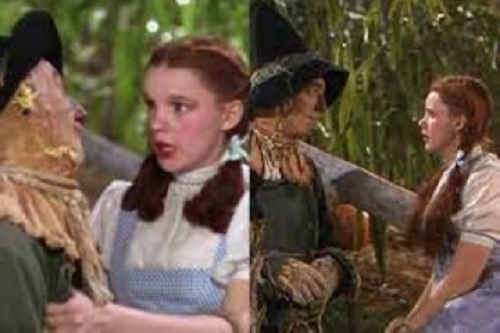
Just as early in the movie we know we are in the grip of sensitive wokism obsessions when we we find ourselves in Munchkinland and the Munchkins pretty much look like anyone you know. The movie “Wicked” is obsessed with, the 1939 classic “The Wizard of Oz,” had the Munchkins played by the Singer Midgets, a little people performing group. In the Baum book that started it all, they are described as being about the same size as Dorothy, who is about 10, but one way or the other, we know the Munchkins are small. Ah, but Disney’s endlessly delayed “Snow White” movie got into trouble after the most famous acting dwarf, Peter Dinklage, declared that the whole idea of portraying the Little People of the familiar fairy tale was offensive, so Disney eliminated the dwarfs entirely. That was also attacked by Little People activists—erasing them, you know. Similarly, Peter Jackson got in trouble for using computer magic to make a full size actor look like he was a a yard or so tall in the “Lord of the Rings series.” So “Wicked” director Jon M. Chu punted and just made the Muchkins normal size and boring. And that wasn’t all: to make sure Dinklage didn’t find some reason to take shots at his movie, the Little Actor was hired to provide the voice of a talking goat.
This is DEI at its silliest. The film gets credit for hiring an “under-represented minority” who was personally responsible for the film not hiring many more members of the same minority. Furthermore, while I like Dinklage (who became famous in “Game of Thrones”) as much as anybody, the only reason he’s a star is because he’s so short. Sure, he plays lawyers, doctors, gangsters, but no matter what he plays, he plays it as a dwarf. That’s the only thing that distinguishes him from hundreds of other equally able actors. It makes no sense at all to hire Peter Dinklage as a voice actor. His unique feature can add nothing to such a gig. The film took away another talented vocal actor’s job so it could be “inclusive” and hire a dwarf for his voice alone.
Trust me on this: the rave reviews you may have read about how wonderful the film version of “Wicked” is are the result of pure cognitive dissonance scale manipulation in action. It was cleverly engineered to be a love note to “Wizard of Oz” cultists, social justice warriors, Trump-Deranged fanatics and woke warriors, adding in the kind of people who listen to the Sirius-XM Broadway channel. It is not a great movie musical and arguably not even a good one. I wonder if its Hollywood architects and cast even realizes that the thing hoists itself on its own petard?
Allow me to get the artistic end out of the way before discussing the political and ethics mess in Part 2, Above all else, the movie is inexcusably bloated and long, and I say this as someone who has no problem with long movies if the time is necessary to tell a story, it is told well, and the director understands pacing. At two hours and 40 minutes, a film that covers the first act of the Broadway hit (“Wicked” is coming up on its 22nd year on Broadway) is just five minutes shorter than the entire stage musical. It is literally stuffed with gratuitous and pedestrian dialogue, extended scenes, CGI and show-off special effects.
I missed this pre-Great Stupid story in 2019, when it was a harbinger of stupid things to come, and missed it again this year, when it was back in the news a few days ago. It wasn’t too long ago that Fred and Pennagain reliably alerted me to ethics stories around the web that I otherwise might have missed. A few of you do send me story ideas regularly, but something like this shouldn’t slip through the cracks.
“This” is this (Source of that movie quote?): Absurdist artist Maurizio Cattelan taped a banana to a wall at an art show in 2019 and called it “Comedian.” He claimed that it was intended to force critics to consider how modern “art” is defined, but it just as easily have been a publicity stunt or a con. My late wife considered Jackson Pollock paintings no more “art” than bananas taped to a wall.
Performance artist David Datuna ripped the banana off the wall and ate it, so Cattalan just taped another banana to another wall. The New York Post recreated “Comedian” for just $5.75, but, see, because the Post isn’t an “artist,” that didn’t count.