My Friend, Greg

stand by me

I’m not sure exactly what this post has to do with ethics. Obligation, perhaps. Still, I have to write it.

Yesterday, I learned that Greg Davidson had died. The news thrust me into the heart of some intense and strange hybrid of “Stand By Me,” “Animal House,” “Mister Roberts,” and “The Sandlot.” I hadn’t seen or talked to Greg for 41 years, since the day he sold me my first car, a red Nova that I paid for with cash, using my bank account started for me by my Dad when I was a baby. Wiped it out, too. But that’s not why Greg Davidson was important in my life.

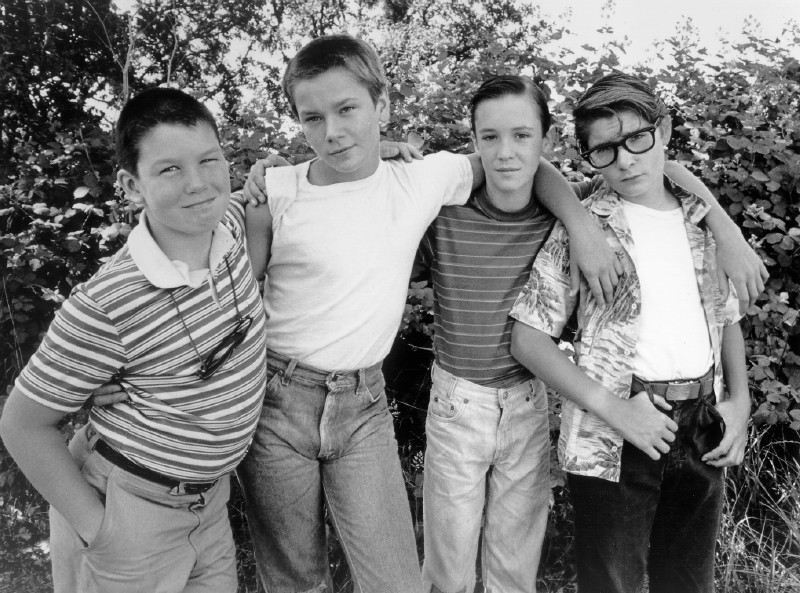
I met Greg in the 7th Grade, when we were both 12. He was the first un-self-consciously cool kid I ever met, and one of the few people I have known had this distinction. (I will embarrass him by saying this, but my son is one of them too.) If you can picture the character of Chris (River Phoenix) in “Stand by Me,” that was Greg—athletic, physically graceful, blond, with a buzz cut, relatively quiet, and a natural leader. He was, essentially, a man in attitude and conduct long before the rest of us (some of us are still working at it)—he won the affections of my 6th grade crush, Margie, and formed a famous, much admired steady couple with her that lasted well into high school.

He was smart, but defiant in a puckish and courageous way: this was the early Sixties, and we all regarded the regimentation of school as an insult. Greg undermined that, regularly, and at considerable personal cost, by waging clever, chaotic war against authority that he considered an affront to human dignity—the equivalent of Mr.Roberts throwing the Captain’s palm tree into the drink. One of my favorites was when he tweaked a pompous high school English teacher who chafed under the nick-name Greg had devised for him—“Tweety Bird”—because it caught on, and because it was so dead-on accurate. Greg went to the trouble of making stationery with a small picture of the Warner Brothers avian in the corner, distributed it, and that week poor Mr. Hendrickson received an assigned essay from every student on Tweety paper. Greg denied that he had anything to do with the plot, but accompanied his denials with Otter’s iconic wink to Dean Wormer, so he left no doubt who Mr. H’s true tormenter was, not there was any doubt.

The teacher did not take it well. Continue reading →
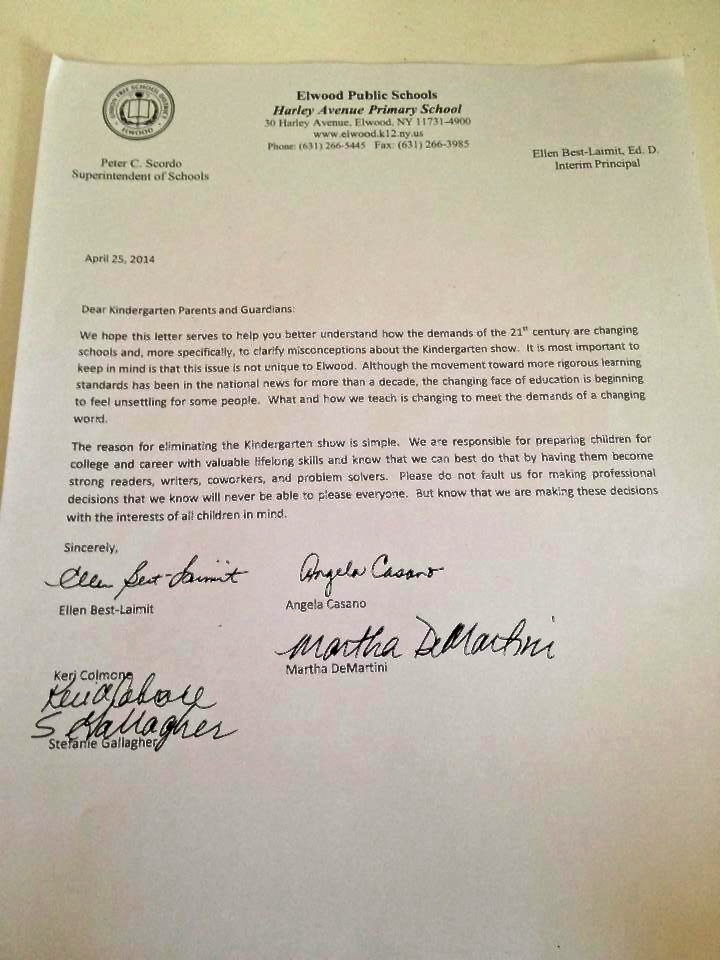
More Proof, As If More Were Needed, That The American Education System Breeds Hopelessly Dim And Foolish Administrators Who Understand Neither Children, Education, Childhood, Or Life, And Therefore Should Not And Must Not Be Entrusted With The Welfare Of Our Young In Any Way, Since These Fools Possess Neither Common Sense Nor The Judgment Possessed By The Average Garden Slug:

Kindergarten-1

Here’s the easy-reading version:

April 25, 2014

Dear Kindergarten Parents and Guardians,

We hope this letter serves to help you better understand how the demands of the 21st century are changing schools, and, more specifically, to clarify, misperceptions about the Kindergarten show. It is most important to keep in mind is [sic] that this issue is not unique to Elwood. Although the movement toward more rigorous learning standards has been in the national news for more than a decade, the changing face of education is beginning to feel unsettling for some people. What and how we teach is changing to meet the demands of a changing world.

The reason for eliminating the Kindergarten show is simple. We are responsible for preparing children for college and career with valuable lifelong skills and know that we can best do that by having them become strong readers, writers, coworkers and problem solvers. Please do not fault us for making professional decisions that we know will never be able to please everyone. But know that we are making these decisions with the interests of all children in mind.


Continue reading →

The Donald Sterling Mess: Watching An Ethics Train Wreck Develop Before Our Eyes

Circus Train wreck

I realized that the Donald Sterling controversy was going to be a full-blown ethics train wreck when, as I should have predicted but didn’t, President Obama once again tossed his office, authority and power into a completely non-governmental matter that his involvement could only confound, and can’t possibly help. “When ignorant folks want to advertise their ignorance you don’t really have to do anything, you just let them talk,” the President responded during a news conference in Kuala Lumpur,  after being asked about Sterling’s alleged remarks. At least he didn’t say that V. Stiviano, the NBA owner’s mistress who recorded the comments, could have been his daughter.

This continues a pattern, exemplified by the President’s gratuitous statements as the Trayvon Martin case was unfolding, of Obama being willfully ignorant of the injustice done when the President of the United States uses his bullhorn to warp independent investigations before they are complete, and attempts to sway public opinion in matters outside his proper duties. The NBA is currently examining the circumstances of Sterling’s statements, and Obama’s irresponsible interjections can do nothing but upset the process. He simply cannot or will not restrain himself. My view: this stuff is easy, an approximation of being Presidential for a leader who is foundering in dealing with the important, legitimate challenges of his job. It is an expression of weakness.

Meanwhile, it is increasingly likely that, in classic ethics train wreck fashion, everyone connected to and responding to this episode is or will be tainted. Sterling’s girlfriend, for example, broke the law: California is a state like Maryland ( Hello, Linda Tripp, wherever you are!) and others, where it is illegal to record anyone without their consent. Her motives were also despicable: reputedly she had vowed vengeance because Sterling’s wife (oh, yes, her sugar-daddy is still married) has sued her for embezzlement. His wife calls her a gold-digger; perhaps that is unfair, and perhaps she really loves the 80-year-old evident racist for the purity of his soul and vitality in the sack rather than his bank account, just as I may be secretly a bighorn sheep. But the incident roiling the worlds of sports and culture is clearly the product of domestic warfare and at least two thoroughly awful people. Continue reading →

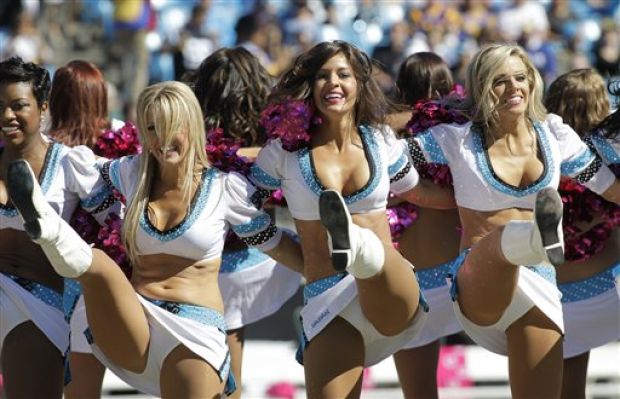
Beautiful, Desired, Happy and Exploited: The Life of an NFL Cheerleader

cheerleaders

National Football League cheerleaders volunteer. They receive a puny per-game honorarium, but nothing for their many hours of rehearsal, or the use of their images for promotion. Can this be squared with basic principles of fairness?

It cannot, but people will try. The cheerleaders  have such glamorous jobs! They are adored, and treated like royalty, or at least Kardashians! They get to date football players, and you know how hot and rich they are, at least until they become senile in their fifties! Most of all, the competition for the cheerleader squads is fierce!  They don’t want to be paid! The job is its own reward!

Weak. Athletes are paid mega-millions of dollars to play the same games they played for years as recreation. Actors receive union-dictated salaries for engaging in the same activities they fought like dogs to do for free in high school, college and community theater. The standard mantra is that joy and fulfillment in life arrives  when you are fortunate enough to be paid for doing what you love, not to be allowed to do what you love so someone else will make a lot of money, while you get dates. The NFL is a money machine, generating billions and paying its management, employees and contractors very well, but they “allow” young women to significantly enhance the NFL brand and  product for little or nothing. The word for this is exploitation. The NFL does it because it can, and the women put up with it because, well, they enjoy it. Continue reading →

Comment of the Day: “Ethics Quiz: Peeps Ethics”

Peeps Last Supper by Leonardo DiPeepchi

Peeps Last Supper by Leonardo DiPeepchi

Extradimensional Cephalopod’s thoughtful answer to today’s ethics quiz was instantly recognizable as a Comment of the Day, so here it is, EC’s musings on the ethical limits on peeps art, as posed by the post, Ethics Quiz: Peeps Ethics:

Full disclosure: I identify as a freethinker, which in my case means my opinions are informed by this idea: “It is the mark of an educated mind to be able to entertain a thought without accepting it.” –Aristotle (or so the Internet tells me)

With that in mind, offhand I’d say anyone who can’t handle the juxtaposition of a serious scene with a cutesy or comical medium is not emotionally mature enough to be trusted to react appropriately in today’s complex and nuanced culture, and their reverence is likely to be taken to unhealthy levels. I think it is not only ethical, but a requirement for intellectual health to be able to entertain different perspectives and styles of presenting even the most serious subjects. Before someone asks, yes, that includes depictions of the prophet Muhammad, along with all other historical figures on pedestals. I think taboos are unhealthy for a society because they limit critical thinking and creative free thought, both of which are necessary (yet seldom employed) to resolve social issues and differences in perspective.

Bad taste is still a valid concept, but it is context-dependent. It is possible that a subject is not appropriate for most contexts because it leads people to feel bad, but it is imperative that there be some place where it can be discussed, even if it is only under the Jester’s Privilege. My subjective judgment rules that depicting the Civil Rights Movement with marshmallows in this case is not intended with disrespect: the contest stipulated that the medium be marshmallows, and the artist chose a powerful scene without regard for the medium, as is the artist’s prerogative. I personally think the marshmallow scene is quite dignified, but then I am a bit out of sync with humanity as to what I take at face value and what I don’t. I form opinions of peeps by their actions, not by their countenance. It’s unethical for an artist to deliberately spread misconceptions about history, and it may be unethical for an artist to deliberately show disrespect to powerful agents of good. Disrespect is usually unethical because it causes so many problems. However, I’m not sure a sincerely respectful artist can be unethical in their art, unless they simply fail to do the research on the facts they depict and the cultural context for showing respect.

If depicting scenes from the Civil Rights Movement with marshmallows (and putting a good deal of effort into it) is wrong, though, what else is wrong? Crayon drawings by kids? Macaroni? Charcoal? Embroidery? Spray paint? Etch-A-Sketch? Is anything that looks insufficiently grandiose for depicting humanity’s legendary heroes an affront upon their memories? Are scenes of historical importance off-limits to mediocre artists, for fear the general public will lose respect for heroes drawn with funny expressions and ridiculous poses? What if an artist is deliberately depicting a heroic person comically, but without telling lies? Why can’t we be mature, and tell the history with respect while artists do their best in sincerity or spite? Why not simply say, “Well, it’s nice, but it really doesn’t do it justice,” and walk away?

Continue reading →

Ethics Quiz: Peeps Ethics

peeps winner

I collect sentences that can safely be said to have never been uttered before in the history of mankind, and encountered one this morning in a letter of complaint to the Washington Post. It read…

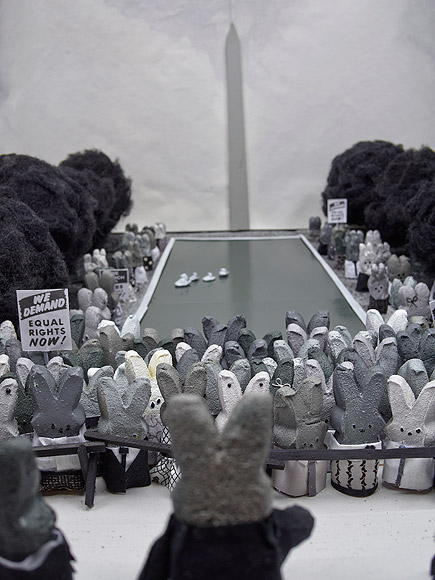
“To take a sacred and historic event in our nation’s history and depict it using marshmallow candy is highly insulting and offensive to the legacy of the Rev. Martin Luther King Jr. and to all those who worked, and continue to work, for racial justice in this country.”

Like all of the sentences in my collection, my favorite being my sister’s immortal, “That fish looks so good, from now on I think I’ll wear my bra on my head,” this one requires some context. The Post holds an annual contest for its readers around Easter, challenging them to submit the best diorama of a scene, using marshmallow peeps. This year’s winner was created by Matthew McFeeley, Mary Clare Peate, and Alex Baker, and involved meticulously painting the colorful bunny stand-ins for King and his throng  at the 1963 March on Washingtonian eight shades of gray to evoke the black-and-white photographs of the event.

Your Ethics Alarms Ethics Quiz, in the sadly neglected field of peeps ethics, is…

Is it unethical to use marshmallow candy as a medium to portray serious, solemn, or other events that many feel deserve respect and reverence?

I know my answer, but this time, I’ll hold my fire until I hear from readers. I’d also be interested in whether any events—Gettysburg…JFK’s assassination…the Lindbergh baby kidnapping…the Crucifixion…Pearl Harbor…9-11…  are ethically off-limits for peeps creativity as inherently offensive, or if this is just  an unappetizing mixture of “ick,” art, humor, and candy.

Cover Art Ethics: Sexism, “Rape Culture” or Just Marketing

If you had asked me thirty-five years ago whether we would still be debating what is the appropriate and ethical use of women as sex symbols—or “objectification,” if you like—in non-sex trade publications today, I would have answered, I think, “Are you kidding? By 2014 we will have hashed all this out. Either the combination of consensus  political correctness and the increased influence of women in business in general and publishing in particular will have reformed standards of acceptable practices, manners and taste, or emerging feminism will embrace the power of sexuality as a source of influence and power over the male of the species. The battles over this are too hot now to keep going on indefinitely! Either using sexy women and models in “take me” poses will be considered shameful and unappealing in 2014, or they will be accepted as part of an “anything goes” culture.”

No, I’m not very bright.

Case Study #1: The Golf Digest Cover

Paulina-Gretzky-on-cover-of-Golf-Digest

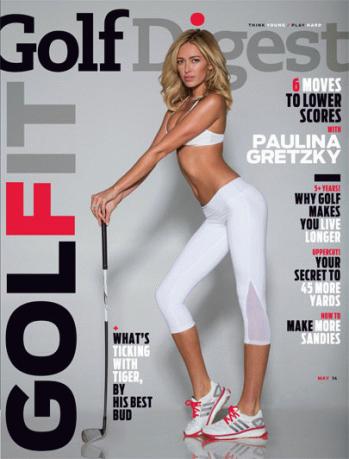
The cover of the latest issue of Golf Digest caused a stir by featuring Paulina Gretzky, who plays a little golf but who is primarily a model, and obviously there for other reasons. Until the Gretzky cover, the only woman to appear on the magazine’s cover without having won a pro or major amateur event was Golf Channel personality Holly Sonders, in May 2013. From the New York Times: Continue reading →

Now THIS Is A War On Women!

I wanna marry harry

Reality shows have now made parody impossible, because absolutely nothing is too exploitive, voyeuristic, disgusting, degrading or wrong to form the basis of a series, as long as people will watch it, and there is profit to be made. Nevertheless, in my continuing effort to at least chronicle the decline of decency and civilization without being able to stop it, Ethics Alarms will continue to throw ethics flags at the worst of the worst.

This brings us to the topic of  “I Wanna Marry ‘Harry’,” the latest offal in this genre from Fox. You may recall “Joe Millionaire,” though if you do, I have less respect for you, an earlier Fox reality dump in which a non-rich actor tricked gold-digging women into competing to win his love as he posed as a young tycoon. After the winner had fallen for “Joe” hard, he revealed that he was just a lovable working stiff—well, worse, really…an actor—and the audience got to see how the woman reacted. So many healthy relationships arise out of fraud and lies, after all. Well, that wasn’t despicable enough fr Fox, so now we have this: Continue reading →

John Paul Stevens’ Gilbertian Nonsense


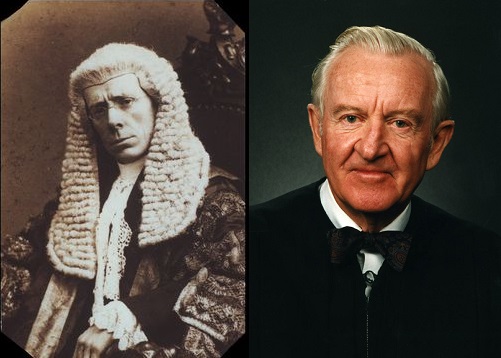
The Lord Chancellor-Stevens

A rather long preface is in order. Bear with me, please…

In the great, underperformed Gilbert and Sullivan operetta “Iolanthe,” W.S. Gilbert, a lawyer by training, devised a satirical judicial solution to a dire turn in the plot. Iolanthe, a fairy, violated Fairy Law by marrying a mortal, who happened to be the Lord Chancellor of England (he never noticed her wings, apparently.) The transgression commands the death penalty, but Iolanthe received a pardon on the condition that she allow her husband to think her dead, which she does for a couple of decades, much of which she spends doing penance at the bottom of a froggy stream, on her head.…but I digress.

When she learns, however, that her husband of yore is about to marry the sweetheart of her half-fairy son, who, though the Lord Chancellor doesn’t know it, is also his son, Iolanthe reveals herself and the paternity to the Lord Chancellor, who is duly stunned. This again triggers the death penalty and just minutes away from the finale, it looks like Iolanthe is going to end up like Carlo in “The Godfather,” as the fairy equivalent of Clemenza waddles on to the stage. (That’s how I would stage it, anyway.) Then this happens: Continue reading →

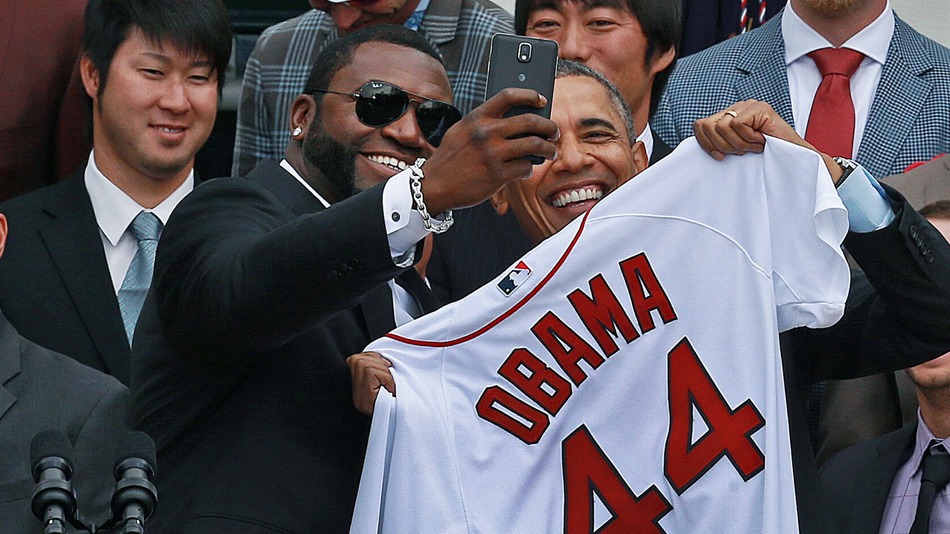
Selfie Ethics: Yes, Big Papi Exploited The President

Ortiz-Obama-Selfie.jpg

I wrote about this ethical breach when Ellen DeGeneris did it at the Oscars. The short version is this:

“It’s unethical to pretend that a selfie is a spontaneous  gesture of fun and friendship when you have a commercial agreement in place to use the photograph in a way that promotes the cell phone manufacturer.”

This is exploitation for commercial gain, and it’s wrong. It’s wrong when the victims are movie stars, and it’s wrong when the exploited party is President of the United States. Continue reading →