If the long Presidents Day weekend took you hither and yon and away from ethical dilemmas and controversies, welcome back! Here is what went on here in a lively three days:
The controversy of the weekend involved ESPN suspending an anchor for “racial insensitivity” who innocently used a fine, old idiom in an appropriate context.
What Max Bretos means by "chink in the armor." Not that ESPN cares.
The headline “Chink in the Armor: Jeremy Lin’s 9 Turnovers Cost Knicks in Streak-stopping Loss to Hornets” appeared on ESPN’s mobile web site last week, and it was quickly removed. ESPN apologized, then fired the over-night headline writer who thought it would be cute to make a racially-offensive play on words between the derogatory slur for a person of Chinese descent, and the old, respectable, and the completely non-racial phrase meaning “a flaw or weak point.”
ESPN’s response to the tasteless headline was appropriate.
But it wasn’t enough for ESPN, which was under a full barrage from the political correctness police and race bullies as well as Jeremy Lin fanatics. So the station also decided to make a victim of innocent anchor Max Bretos, suspending him for 30 days because he used the expression Wednesday when he asked New York Knicks legend Walt “Clyde” Frazier on air about Lin.
“If there is a chink in the armor, where can he improve his game?” Bretos asked. Continue reading →
I thought about a lot of possible headlines for this post. “Most Muddled Ethics Statement of the Century” was a real contender. I thought about making it an Ethics Alarms quiz, with the plaintive query,“Can anyone please tell me what the heck Paul McCartney thinks he is saying?” And, yes, I thought about skipping the story completely, as I am not eager to rattle the cages of the zealous pot enthusiasts, several of whom bombarded me, my business and my wife with vicious and threatening e-mails last week.
But this cannot pass without comment. Paul McCartney has given an interview to Rolling Stone in which, among other things, he announces that he is giving up smoking pot as a responsible father of an eight-year-old girl.
“I did a lot, and it was enough,” the co-writer of “With a Little Help From My Friends” (“I get high with a little help from my friends…”) and “Lucy in the Sky With Diamonds” tells the interviewer. “I smoked my share. When you’re bringing up a youngster, your sense of responsibility does kick in, if you’re lucky, at some point. Enough’s enough – you just don’t seem to think it’s necessary.”
This is completely bewildering. Is Paul saying he’s had his fill, and now that he has, come to think of it, it’s irresponsible to smoke pot? Is he expressing regret? Continue reading →
New Jersey Governor Chris Christie ordered New Jersey’s flags flown at half-staff in official mourning for Whitney Houston, and a lot of people are outraged. The critics of the honor fall into two categories: those who believe that the honor should be reserved for military heroes and high government officials, and those who believe that Houston is especially unworthy because of her well-documented substance abuse problems.
For his part, Governor Christie defiantly declares that Houston, as a daughter of New Jersey, deserves the state honor because of her contributions to the culture.
Technically and officially, Christie is out of line. Federal law is very specific about the proper treatment of the flag, including when it can be flown at half-staff. Simply put, celebrities don’t qualify, no matter who they are. A state governor can proclaim that the flag be flown at half-staff in his or her state for fallen soldiers, but not for non-military individuals. But governors ignore the law routinely, and have for decades. Tennessee’s governor lowered the flag when Elvis died. Massachusetts did the same for Red Sox great Ted Williams, though he was also a war hero, so no one was going to object. The law, in terms of custom and enforcement, is a dead letter, and probably should be.
True, some governors have abused the spirit of the law, including Christie, when he lowered the flag for Clarence Clemons, the saxophonist for Bruce Springsteen’s E Street Band—a great musician, but hardly a figure of transcendent national significance. If 4 USC Section 7 isn’t going to be followed or enforced, then we need some new standards, or before we know it they’ll be lowering the flag for Joan Rivers. Continue reading →
“Loyalty is the heart of Pat’s being. He is loyal to country, to church, to neighborhood to heritage. To Pat, the world can never be better than the one he grew up in as a young boy. Blessed Sacrament Church and Grade School, Gonzaga High School, Georgetown University. No country will ever be better than the United States of America of the early 1950s. It’s his deep loyalty to preserving that reality and all its cultural and ethnic aspects that has been his primal purpose and is what has gotten him into trouble. Not just now but over the years.”
"Pat, I may disagree with what you say, but I will defend to the death your right to say it...on some other network."
Matthews’ quote helps explain why loyalty is the most corrupting of the ethical virtues. Loyalty is important and admirable, but when it is divorced from the other values, it can lead to rigidity, stubbornness, and corruption. When a person, organization or cause no longer embodies the qualities that justified the loyalty in the first place, loyalty can undermine ethical conduct as strongly as any vice.
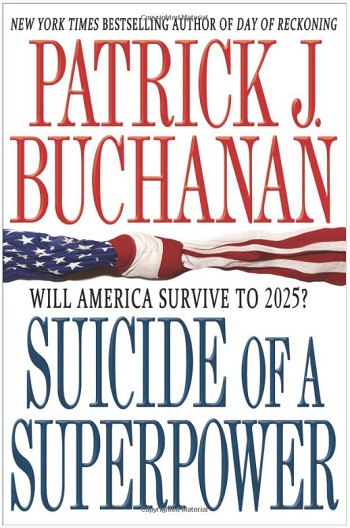
The right is attempting to frame Buchanan’s dismissal as part of a conspiracy to silence conservative voices. I never understood why Pat was on MSNBC anyway, unless it was to have a particularly Jurassic conservative around to make MSNBC’s extreme liberal bias look reasonable by comparison. It was Buchanan’s latest book, “Suicide of a Superpower: Will America Survive 2025?,” that finally triggered his ouster. I haven’t read it, but I’ve heard Buchanan on this topic sufficiently already. He may not be a racist, xenophobe, homophobe and anti-Semite, but his confusion of the need to hold on to American cultural values, with which I agree, with the need to keep America as white, Christian, heterosexual and Anglo-Saxon as possible is hard to distinguish from racism, homophobia, xenophobia and anti-Semitism. If I were running a news network, I wouldn’t employ him. Continue reading →
If enough of these tune in to your TV show, the number of real viewers don't matter. Which gave Oprah an idea...
Oprah Winfrey’s new cable network, OWN, is foundering, so the much-worshipped icon of female empowerment empowered herself to rig the ratings system by sending out this tweet to her gazillion Twitter followers ( all right, she has only 9, 253, 598) Sunday night:
“Every 1 who can please turn to OWN especially if u have a Neilsen* box.”
OWN was debuting a new show called “Oprah’s Next Chapter.” Since a Nielson household is one of the 25,ooo Americans whose viewing habits are extrapolated to calculate the estimated viewers of any program nationwide, a direct appeal to someone with a Nielson box is an attempt to cheat. Those boxes count as many thousands of viewers in the ratings process, which is why the identity of the Nielson household is carefully protected. It is also why the penalty for trying to manipulate the ratings (if only the Nielson households and nobody else watched Oprah’s show, the ratings would inaccurately indicate that the program was a sensation) is to have the offending program’s ratings erased entirely. Continue reading →
American Idol’s Group Day is the one stretch of the show that is more reality show than competition, and it usually delivers the best ethics dramas of the season. Last year, for example, the Group Day chaos—all the Idol wannabes have to form combos and rehearse an a capella number in harmony, often fighting, crying or collapsing in the process—produced a moment of courage and character when Scotty McCreery, the eventual winning Idol, stepped up and took full responsibility for the rotten conduct of his group, which had tossed out another young man at the last minute to take McCreery in.
This year there were ethics heroes and dunces, but mostly dunces. A real gem was the awful stage mother of competitor Brielle Von Hugel, who was filmed in rehearsals complaining how weak a singer her daughter’s fellow group member Kyle Crews was. After Crews crashed and burned in the performance, and was the only member of the group cut, Mrs. Von Hugel was shown insincerely telling him what a “good voice” he had. Kudos to Idol’s director for immediately re-running her backstage slamming of the kid’s voice in the previous episode. Continue reading →
John Wayne paddling his wife (Maureen O'Hara) in "McClintock!" I love ya, Duke, but this isn't funny any more....if it ever was.
Violence inflicted by one partner in a relationship upon another is absolutely unethical, yet it is one of those embedded cultural habits from the bad old days that still flourishes. Over at the Whitney Houston post, where I am being over-run by the drug-legalization zealots, sicced on me by a sad website where people indulge their dreams of legally de-braining themselves on a regular basis, there is widespread contempt for the concept that cultural norms of what is right, wrong and worthy of shame controls our worst impulses. That contempt is as crippling as it is ignorant, for controlling behavior is what cultures do, and why they are essential. And our culture is still giving confusing signals about domestic abuse. Two recent examples: Continue reading →
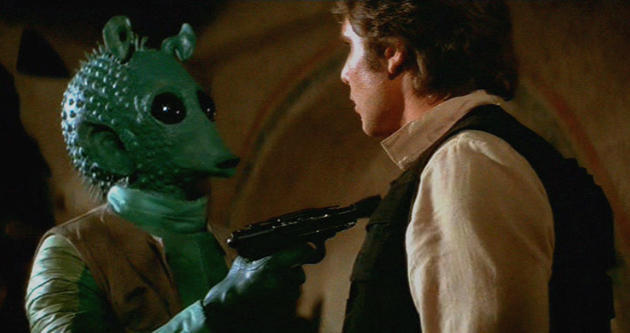
Jedi Emeritus George Lucas betrayed a warped concept of cowboy ethics, self-defense and ethics generally in a recent Hollywood Reporter interview in which he was quizzed about his technological fixes on the original Star Wars trilogy. The topic was the shooting of Greedo in the bar, when Han Solo blasts away at the green, fishy porcupine-like villain, who has a gun pointed at him:
Lucas:Well, it’s not a religious event. I hate to tell people that. It’s a movie, just a movie. The controversy over who shot first, Greedo or Han Solo, in Episode IV, what I did was try to clean up the confusion, but obviously it upset people because they wanted Solo [who seemed to be the one who shot first in the original] to be a cold-blooded killer, but he actually isn’t. It had been done in all close-ups and it was confusing about who did what to whom. I put a little wider shot in there that made it clear that Greedo is the one who shot first, but everyone wanted to think that Han shot first, because they wanted to think that he actually just gunned him down.
Lucas’s idea of what constitutes a “cold-blooded killer” runs counter to law, common sense, and ethics. Continue reading →
Whitney Houston, she of the musical gift we may see only once in a lifetime, is dead at 48. There has been no final determination, but there is little doubt: drugs killed her.
Houston, they say, and I have no reason to doubt it, was troubled by the pressures of show business, celebrity and stardom, and with a little help from her dead-beat, abusive husband, singer Bobby Brown, sought to relieve the stress with a variety of illegal substances, including cocaine. Over the past 15 years or so, Americans have been able to watch the relentless deterioration of Houston, once the epitome of a beautiful, intelligent, ebullient and charismatic presence, into an emaciated, ruined shell with only a hint of the glorious instrument that once, in the middle of a war abroad, delivered the most stirring rendition of the Star-Spangled Banner I have ever heard, or ever will hear.
This happened to Whitney Houston because when illegal drugs were among the options she could have chosen to accept or reject as a way to get through difficult days and troubled times, she did not have the instant reaction, hard-wired in her brain, that has to stop all of us from doing terrible, dangerous, irresponsible and anti-social things. There can be little doubt that some theoretical options would have triggered that reaction. They would be the options that did not seem like options at all, because the culture Whitney Houston lived in was unequivocal and unshakable in its verdict, a verdict virtually all members of that culture naturally adopted and accepted—because that’s what cultures do. And when that option presented itself, Whitney Houston, like the culture she was a part of, would have said “No.”
That she didn’t say no to drugs, and is dead because of it, was the direct result of an American culture that does not give its constituency a clear message and verdict. Instead, the clearest and most unequivocal signal from the culture, the fact that recreational drugs are illegal and that America enforces the laws against them, is progressively weakened by ridicule, attack, popular culture, and the defiance or hypocrisy of role models and public figures. Incredibly, though the deaths by drug-abuse among the tiny proportion of the world that is famous and talented—Michael Jackson, Amy Winehouse, Whitney—should make it obvious how massive the number of anonymous victims of drug abuse there must be, the destructive refrains grow louder: Legalize drugs! End the War on Drugs! And those calls weaken the cultural resolve further. Actually doing what they advocate would cripple it….and that day might come.
Whether they are preventing the culture from rejecting drug use because enforcement is expensive, or because they have a relative or friend in prison for drug-dealing; whether they are calling for legalization because they are libertarians and academics or Ron Paul, or because they are public officials who see a new revenue source; whether they are longing for the halcyon days of Haight-Ashbury and the Strawberry Alarm Clock, or just like getting stoned, these are the people whose advocacy continues to nurture a competing culture that killed Whitney Houston, as surely as if she had been shot her between the eyes.
I would say that if their insistence on legalization is followed, and the nation’s laws join the popular throng in pronouncing addictive and life-destroying drugs as legitimate “options,” many more like her will die….except there aren’t many more like her. But there are countless lives to destroy, and unimaginable losses to families, businesses and America to be endured.
I just watched the video of Whitney Houston’s glorious performance of our National Anthem at the Super Bowl, before the drugs had finished their work. She radiates confidence, strength and character, as well as that special joy that the fortunate few with magical gifts have. She brings a stadium full of Americans to their feet in cheers, with an exhibition of artistry that will continue to inspire forever. Drugs took all of that away, from Whitney Houston and from us.
Because our culture could not say no with enough conviction to save her.
Update (2/15/12): With some regret, I am closing comments on this post. Too many commenters refused to discuss the issue it was intended to raise, which was how cultural approval and disapproval of conduct is more powerful, ultimately, than the law in establishing standards. I have committed on this blog to responding to as many comments as possible, but the onslaught of pro-drug zealots whose tactic was to keep repeating the same arguments no matter how many times I gave my response led me into too many frustrated responses, too many nasty exchanges, and too many hasty replies that I wish I had stated more clearly. For those I apologize, both to the visitors involved and other readers. I also apologize for ending the discussion here, but I don’t have the time to monitor it. You are welcome to e-mail me personally.