Perspicacious Ethics: The Media Has A Duty Not To Make Us Dumber

Gore Vidal once said, “As societies grow decadent, the language grows decadent, too.” Certainly the media is accelerating the decadence of society; does it have to intentionally do in the language as well?

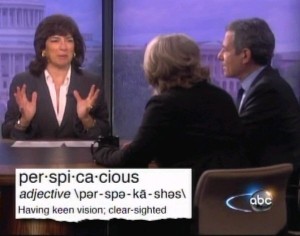
On ABC’s This Week, host Christiane Amanpour casually used the word “perspicacious.” Discussing the Constitution,  one of Amanpour’s guests mentioned that Benjamin Franklin wrote that he wouldn’t mind being preserved in a vat of Madeira wine in order to see if the Constitution held up 200 years later. Amanpour responded that Ben was amazingly perspicacious when the Constitution was signed.

Apparently  the word perspicacious stumped the 7th grade drop-outs in the booth, because suddenly a box appeared with the definition and pronunciation of the word under Amanpour. Then, commenting on the incident, the web site Mediaite wrote that Amanpour “might avoid using such fancy language so that viewers in the future don’t mistake her show for a Rosetta Stone class teaching the English language.” Continue reading →

Comment of the Day: “New Jersey Lottery Ethics…”

Tom Fuller, who can be perceptive when he isn’t peppering us with the quotations of others (all right, even sometimes when he is) makes a useful distinction in the Comment of the Day, on today’s post about the New Jersey Lottery:

“Don’t get me wrong. I’m no fan of government-sponsored lotteries, and I share all of the concerns about them mentioned above. But a facile slogan like “lotteries are a tax on people who don’t understand math” is, like most facile slogans, too simplistic a way of making the arguments. There are plenty of psychological and economic reasons why even people who understand the math buy lottery tickets that are, quite literally, bad bets. There is lots of research on this; one of the better articles is now 21 years old, but is still cited as a good, brief, and comprehensible overview.”  [You can read it here.]

“Every gamble is a losing bet in the long run; otherwise it wouldn’t be a gamble. The trouble with state-run lotteries is not so much that they exploit those who “don’t get it”; they exploit anyone, even a mathematical genius, who is drawn towards what society generally regards as undesirable actities, thereby sending the same mixed messages as taxes on tobacco and alcohol.”

The Ethics of “No-Body” Murder Prosecutions.

Oh! THERE's the body!!!

Texas lawyer Robert Guest has opined that a Texas jury would have convicted Casey Anthony in a heartbeat, and cites as proof the February conviction of Charles Stobaugh in Denton County. He was accused of killing his  estranged wife, though no body has ever been found at all.

Maybe.  There are a lot of differences in the circumstances of the two cases, not the least is that finding a badly decomposed body with a piece of electrical tape across her mouth has a big advantage over never finding any body at all: at least you are certain that the victim is dead.  Stobuagh, like Anthony, engaged in a pattern of lies and strange statements; for example, he suggested that his wife, who suddenly vanished and stopped using her bank account, credit cards and cell phone, was “playing a prank.”  He also began seeing a new girl friend more or less the moment his wife vanished. I’d say the biggest difference is the presumption of a motive: husbands killing their wives, especially their estranged wives, is a common and well-recognized form of homicide, with a motive that any married person immediately understands. A mother killing her young child, in contrast, is very unusual, and the presumption is that no mother would do it. The Anthony prosecution was more difficult than the prosecution of Stobuagh, even with Caylee’s body. Continue reading →

New Jersey Lottery Ethics…Well, Not Exactly

New Jersey has taken the live drawings for the state lottery off of television and placed it on the internet. Many regular lottery players are upset about this, it seems.

“I like to see them pull it so they don’t have the chance to switch it,” said one eighty-year-old player. “Older people don’t trust the system. We know what happens.” She doesn’t own a computer, nor do her friends, and they all say they won’t play the lottery again until they can watch the drawings on their televisions. Indeed, the New Jersey Lottery is getting many such complaints, and expected them.

Why?

Because the people most likely to play the lottery are poor, badly educated, ill-informed, dumb, or all of the above, that’s why. Continue reading →

Marcia Clark, Exploiting the Anthony Verdict for Her Own Sake

Marcia Clark. OK, this really isn't Marcia, but the real picture of her doesn't look like her either.

Marcia Clark’s article on the Casey Anthony verdict is so tainted with obvious conflicts of interest that it should have been rejected by The Daily Beast…or rather would be rejected by any website more selective and less shameless than the Daily Beast. This would be any fair site that does not deal in over-the-top opinion as a matter of course.

Marcia, like her colleague Chris Darden, is a rather tragic figure these days. The former lead prosecutor in the O.J. case is struggling to make it as a pundit, freshly botoxed and rendered almost unrecognizable so as to be fetching in those close-ups. After she sold the inevitable cash-in book about the Trial of the Century, she has wandered in the C-List celebrity wilderness, and will soon join Newt Gingrich and William Shatner as a celebrity novelist. She will be remembered, quite correctly, as the prosecutor who botched the O.J. murder trial, even if we give Darden an assist for the gloves debacle. (Why cable news shows insist on recycling failures as experts is an enduring mystery, the mystery being “how can the producers look themselves in the mirror after choosing recognizable flops over less well-known but more accomplished authorities?”)

But Clark apparently saw an opportunity in the Casey Anthony verdict to rehabilitate her tarnished reputation, and grabbed it. The result is “Worse Than O.J.!”, a new low in self-serving analysis. Continue reading →

“Professionalism?” What’s THAT? Julie Chen, CBS and the Descent of Broadcast Journalism

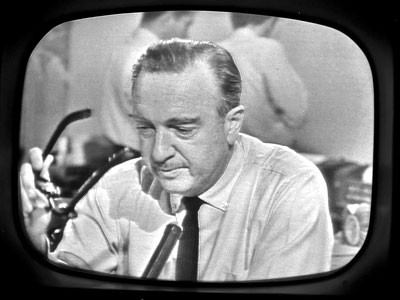
Walter could keep it together. Not Julie Chen.

The Casey Anthony verdict is doing some good: it is exposing the awful deficit in objectivity and professionalism in the broadcast media.

The latest example: while CBS’ “The View” rip-off, “The Talk,” was underway,  viewers saw co-host Julie Chen break down as she tried to read the news that Casey  Anthony had been found not guilty of killing her daughter Caylee. Chen attempted to read the verdict, but was overcome with emotion  and was unable to continue, asking her co-hosts,  “Help me out here.”

In 1937, radio broadcaster Herbert Morrison was correctly criticized for being unable to keep his composure and report the flaming destruction of the zeppelin The Hindenburg without weeping and becoming unintelligible. In 2011, a woman described in her official bio as a “news anchor; reporter; and journalist” couldn’t compose herself to read the news of a not guilty verdict. Continue reading →

Ethics Dunce: Mercedes Colwin

It's a mystery: why would Fox News choose her as a legal analyst?

Attorney Mercedes Colwin, an attorney and Fox News commentator, just committed pundit malpractice while discussing the Casey Anthony verdict on Sean Hannity’s radio show. Her professional biography says that she has practiced criminal defense law. If so, she has done so laboring under some serious legal ethics misconceptions.

Said Colwin, in response to Hannity’s query about her past representation of guilty defendants:

“If my client says he did it, then I can’t defend him. I can’t then go into court and say he’s innocent; I’m an officer of the court, Sean!”

What??? Wrong, wrong, outrageously wrong, inexcusably wrong! And also: ARRRRRGHHHHH! Continue reading →

Deadly Incompetence in Seattle….Luckily, It Was Just a Game

I know about the ADA, but still...hiring blind umpires who can't count just isn't working out...

It is rare that an ethics outrage repeats itself so closely that I could recycle a previous essay and just change the names. This occurred, however, in Seattle this past Saturday, in the baseball game between the Mariners and the San Diego Padres. San Diego’s Cameron Maybin walked on a 3-2 count (four balls are required by the rules) and eventually scored the only run of the game on Antonio Gonzalez’s fifth-inning single, allowing the Padres to defeat the Mariners 1-0 on Saturday night.

With one out in the fifth, Maybin walked when a pitch was called high by home plate umpire Phil Cuzzi. A video review of the at-bat by official scorer Dan Peterson confirmed the count should have been 3-2 when Maybin trotted to first base, meaning that his turn at the plate wasn’t completed. But Cuzzi, who like all umpires carries a pitch counter, saw that the stadium scoreboard showed a three-ball count before the pitch, and since 1) technology is always right 2) he wasn’t paying attention 3) he can’t count to “4” and 4) (or is it 3?) it isn’t like calling balls and strikes is his job or anything, he decided that the player had earned a base on balls. Continue reading →

Comment of the Day: “The Washington Post Flunks Integrity, Conflicts, and Trustworthiness”

I do want to hold the line on featuring Comments of the Day that I think exemplify awful ethical reasoning, as opposed to those that are provocative and enlightening, to a minimum. This one, however, is too rich to ignore. It is the defense of an apparent journalist for the ethics-busting behavior of the Washington Post in the recent Jose Antonio Vargas incident using a dizzying array of alibis and rationalizations, including “they’re better than most,” “people don’t care,” “you have to cheat to stay in business,” “they are better than the alternative,” and others. It also resorts to the time-honored “who are you to judge?” and “you couldn’t do a better job.”

If this is typical of how journalists view their profession’s ethical obligations—and I think it is—the comment explains a lot. You can read my lin-by-line response after the original post. Here is the Comment of the Day, by okonheim: Continue reading →

Ethics Quote of the Week: “Ethics Bob” Stone

Is Joe Scarborough the new Arthur Godfrey, as in "nice guy" revealed as "unethical creep"?

“It’s always upsetting when one of your heroes turns out to be an unethical creep.”

— Ethicist and business ethics professor Bob Stone on his blog “Ethics Bob,” expressing his disappointment in the conduct of MSNBC talk show host Joe Scarborough, who persuaded guest and colleague Mark Halperin to “go for it” when Halperin suggested that his description of President Obama’s press conference was not appropriate for public broadcast, and then did nothing to accept responsibility for the uproar when Halperin referred to Obama as “kind of a dick.” Halperin was suspended indefinitely by MSNBC, following a complaint from the White House.

Bob had expressed hope, in a comment to the Ethics Alarms criticism of Scarborough’s role in the incident, that Scarborough would do the right thing by the next day. He did not. And Bob is correct: this is proof positive that Scarborough is an unethical, cowardly creep.

What should “Morning Joe” have done? Several things: Continue reading →