Weekend Ethics Update, 10/18/20: As The Election Nears…Seeking Contrast And Perspective

  1. Ethics movie alert. Its heart is true blue—this is an Aaron Sorkin film, after all—but “The Trial of the Chicago Seven,” now on Netflix, is excellent, as well as must-watching for the astounding number of Americans under 40—50? 60?—who know almost nothing about the previous period of liberal arrogance, political incompetence and institutional failure, the late Sixties. The cast is excellent and star-studded; whoever came up with the idea of casting Sasha Baron Cohen as Abbie Hoffman should win a casting Oscar, for example. For me, the movie brought back memories sharp and grim: what a shitstorm that trial was. Frank Langella, whom I just watched in his remarkable performance as Richard Nixon more more than a decade ago in “Frost/Nixon,” is a memorable if unsympathetic Judge Julian Hoffman. Hoffman, I think, deserves better: like Judge Ito, Hoffman never had a chance to avoid judicial infamy once that trial became a circus, and that bwas something no judge on Earth could have stopped.

Then there is the frightening reality that the Chicago Seven (and Bobby Seale made Eight), who seemed like fringe-y, juvenile extremists at the time, look moderate and reasonable in comparison to today’s antifa, Black Lives Matter followers, and…dare I say it? … a nearly critical mass of Democrats.

2. Speaking of which…Senator Diane Feinstein is under attack from that nearly critical mass for indulging in traditional professional civility and bi-partisan responsibility by not pushing the recently completed hearings on the nomination of Amy Coney Barrett nomination to turn into a hyper-partisan fiasco, like the Kavanaugh hearings. She even praised her Republican counterpart, Senator Graham, for doing a good job (it wasn’t that good a job) in chairing the hearings, unlike, to just pick an example out of the murky past, the job Senator Joe Biden did during the infamous Clarence Thomas hearings. Feinstein is nearly 90, and should not be in the Senate at that age just as the unjustly sainted Justice Ginsburg should not have been on the Supreme Court long enough to die in office. Nonetheless, she is trying to hold the line against forces in her own party that would make peaceful and functioning Democracy impossible.


Continue reading

The Pre-Unethical Condition Of Planning A Public Memorial: The Maya Angelou Debacle [Corrected]

_maya_angelou_proposal

(The ghost family isn’t part of the design, in case you were wondering…)

I use the term “pre-unethical conditions” to describe situations which have a record of leading directly to ethical conflicts and misconduct. “Ethics Chess,” another Ethics Alarms term mandates that a participant think multiple moves ahead, and thus anticipate, plan for, and with luck and skill, even avoid the ethical perils ahead. The task of honoring a famous or accomplished public figure with a monument or memorial structure for the ages once was simple and straightforward: you put up a statue after a respected and credentialed artist designed it. Of course, if you picked a hack to do the job and got something like this…

Lucy statue

That’s supposed to be Lucille Ball, in a now-replaced statue in her home town.

..there would be trouble, but usually the standards for statues were reasonable and the public easy to satisfy. That was fortunate, because any committee decision involving art of any kind is bound to be contentious; as the saying goes, there’s no accounting for taste. I’ve had to oversee the organizational acceptance of a new logo more than once, and it is impossible. When the board meeting reaches the point where members are scribbling their own crude designs on pads, you know you’re doomed. Public art is much, much worse, because it’s more visible, there are people who make their livings criticizing whatever the final result may be, and it’s expensive. Good luck.

Continue reading

A “When Ethics Alarms Don’t Ring” Anniversary Retrospective: The Cancellation Of Charlie Rich

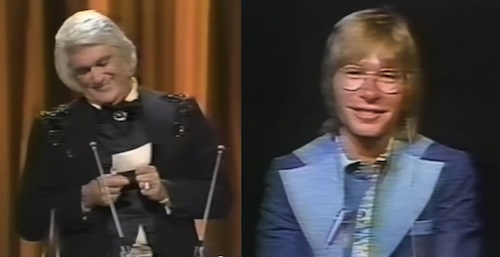
charlierichjohndenver

I wasn’t paying attention in 1975 when this episode occurred: it was a big year for me. I graduated from law school, took the bar, moved back to Massachusetts and then back to D.C. Most of all, the Red Sox went to the World Series and I had prime seats to see Carlton Fisk hit his immortal homer in the 12th inning of Game 6, waving the ball fair, but barely. The Country Music Awards (CMAs) were nowhere on my radar. They still aren’t: there isn’t a sock drawer in America I wouldn’t rather color-code that watch that show. But on October 13, 1975, 45 years ago to the day, an ethics drama unfolded with many lessons.

Charlie Rich, the soulful country music singer they called the Silver Fox (Even I had heard “Behind Closed Doors”) had been voted Entertainer of the Year by the Country Music Association of America one year earlier, and thus was chosen to  announce that year’s winner of the CMA’s greatest honor at the televised 1975 show.  He opened the envelope, appeared to read the name on the slip of paper,  and instead of announcing it, Rich reached into his pocket, took out a cigarette lighter and set the slip on fire.  While the paper burned, he finally announced that the winner was “my friend Mr. John Denver” Denver was only available to accept the awards via satellite linkup, so he made his acceptance speech with no knowledge of Rich’s gesture.

The audience was horrified, and many country music fans—and obviously John Denver fans— were furious. Charlie Rich was blacklisted from the CMA awards show for the rest of his career. His popularity crashed: from that moment until the end of his career in 1992, Rich had only one more #1 hit in those years, though a couple of songs reached #3 on the country charts. By any standard, his career after flaming John Denver was greatly diminished. Denver, universally regarded as a nice guy, was seen as the victim of a jerk. (The “my friend” seemed like a particularly nasty touch.)

What was going on here? The assumption was that Rich was taking a stand for country traditionalists against pop music turf invaders like Denver and Olivia Newton-John, who had won the Most Promising Female Vocalist award in 1973.  To this day, some even see his uncivil attack on Denver as courageous. The Saving Country Music blog opined in 2013:

Continue reading

Columbus Day Ethics Voyage, 10/12/2020: Portland And Washington, Which, Had Chris Known His Discovery Would Lead To Such Dens Of Madness, Might Have Caused Him To Turn Back

When you see me a day off like this, please understand that it is a direct result of the new, mandated, stupid WordPress system making it literally impossible to complete a post on my laptop. (Having a newly rescued, affection starved  large dog desperately needing to climb onto your lap doesn’t help either.) Once the office is closed for the night, getting back up there to complete a post is nigh impossible, not to mention domestically perilous, if you get my drift.

1. In Ethics, we call now this kind of problem “Portland”… Portland software company New Relic is roiled with a controversy over CEO Lew Cirne’s donations to a private Christian school that excludes gay students and opposes gay rights and to a controversial evangelist Cirne’s wife is a contributor to President Donald Trump’s reelection campaign. Can’t have that!

The aggrieved employees say Cirne’s personal values are not consistent with the “message of inclusion”n the company claims to represent. They see his wife’s donations to the President of the United States as also antithetical to the company’s stated values.

One New Relic employee told the media, “That is deeply concerning to me, especially to someone who is queer. I don’t feel like those diversity and inclusion initiatives are real or will be protective of me,” and says the company lured her into a false sense of security with its diversity pledges, pulling a bait and switch.

I advise Cirne to make this statement as soon as possible. No charge for my advice, and I recommend it, as an ethicist, to any company executive who encounters similar criticism:

“Our company does not mandate particular political opinions or social views among its employees. In the United States, we are blessed with freedom of expression, association, speech and religion. It is literally none of our business. As long as employees confine their conduct to company policies and values while doing their job, they have met all of their obligations to the company.

Similarly, executives of this company have those same rights, and will exercise them as they see fit. It is none of anyone’s business in this company how the company’s leadership or their family members choose to direct their charitable donations or devote their private time. Employees who cannot meet these fair and essential requirements are invited to seek employment elsewhere.

In addition, any employee, at any level of the corporation, who presumed to criticize another employee’s family members for their personal political or charitable activities is subject to firing for cause.”

[Pointer: Matthew B]

Continue reading

On “The Iceman Cometh”

It was this day, October 9, in 1946 that the greatest play of the greatest American playwright premiered. The playwright was Eugene O’Neill, and the drama was “The Iceman Cometh.” (Of course, that’s just my assessment, though I am not alone. I rate it the greatest non-Shakespeare play in the English language.) Like almost all O’Neill works it is an exploration of ethics. A traveling salesman, a professional liar, returns to a dive where he is worshiped by its drunken denizens to change their lives by forcing each of them to confront reality rather than avoid it using rationalizations, delusions and drink.

Few Americans have seen “The Iceman Cometh,” largely because it is seldom produced. The original version is well over four hours long, and in my view, every minute cut diminishes the play’s message and power. (The film version above was cut significantly) The play also requires a large ensemble cast of unusual talent and intelligence. It’s so much easier and safer to produce “To Kill A Mockingbird.”

Unfortunately, O’Neill’s plays are meant to be experienced on stage, and on stage, they work. Reading O’Neill is a chore, and another reason his works are not produced enough is that directors, producers and playreading committees can’t get past the text. O’Neill didn’t help by often writing dialogue in dialect. It’s tough going, though no more so than Shakespeare. (You can read the play here.)

Continue reading

Notes From The Great Stupid: “I’m an Asian TV Writer. Should I Take on Projects With Black Leads?”

As you may have guessed, that a question posed recently to Kwame Anthony Appiah, “The Ethicist” of the New York Times Magazine. Unlike most of the queries to that column that I periodically discuss here, I don’t think the question is difficult, challenging, or even interesting. What is interesting is that anyone would ask it, and further, that someone like Appiah would deem it worthy of spending over 800 words treating a question as a genuine ethics conundrum that is, in my view, merely evidence of brain seepage provoked by George Floyd Freakout propaganda.

The whole question was,

I’m an Asian television writer who has been extremely lucky in working fairly consistently since my first gig. I’m now in a position where people reach out to me to develop new projects. When these projects feature a Black lead character, is it ethical for me to pursue these opportunities?

As an Asian (and a woman), I’ve definitely experienced my fair share of racism and discrimination, and I can write authentically about that experience. But I’m “just” Asian, and I may be taking a job from a Black writer. Or because it is Hollywood, it’s more likely I’d be taking the job from a mediocre white dude, which, ethically, I feel just fine about. If any of these projects got off the ground, I’d be able to create a lot of opportunities for other BIPOCs, but again, it’s Hollywood, so who knows how likely it is the project would ever get to that stage.

The question is: Where do I, as an Asian, fall in this movement? I don’t want to be a tool of white supremacy, but visibility is important for my community too. Name Withheld

I admit that I have little patience for ethics navel-gazing when the answer to such question should be obvious, and thus the response to “Name Withheld” should begin with, “What the hell is the matter with you?” To his credit, “The Ethicist” gets this one right, but man does it take him a long time, apparently because he doesn’t want to seem unsympathetic to flagrant virtue signaling by Name—I wonder if that’s a common Asian moniker…

I would be tempted to respond,

Continue reading

Weekend Ethics Update, 10/4/2020

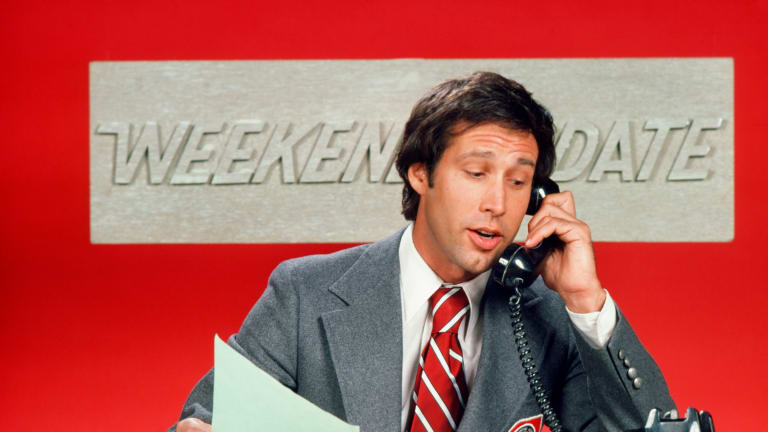
Weekend Update

1. I’m not going to dignify all of the online cheering of President Trump’s positive test for the Wuhan virus with quotes from celebrities and social media creatures, though I have them. There have been similar reactions to the fact that Kellyanne Conway recently tested positive as well. A reputable poll—assuming that any are reputable polls—found that 40% of Democrats surveyed were “happy” the President was sick. I have never been happy that anyone was sick in all my years on this planet. This is a mean, vicious, ethically warped group of people that are behind Joe Biden in this election, and one more factor pushing me to a tipping point. (No, I’m not there yet.) But I really do wonder how decent people can make common cause with hateful individuals like this.

For what it’s worth, my perspective is that if the President plays this right, the bout with the virus will help him in November.

I agreed with his decision to largely eschew masks in public appearances, just as FDR kept his wheelchair mostly hidden from public  view and like George Washington riding into battle in full uniform, gleaming white wig, ring a tall white charger. That’s part of leadership: looking strong while also being strong. The President got sick while doing his job. Joe Biden has been hiding in the basement, taking half-days and yesterday gave a speech while wearing a mask. He looks weak, and is weak. There has never been anything especially leader-like about Biden, and most of his support is based on blind, irrational hatred of his opponent fanned into dangerous intensity by the news media and the Angry Left. I think Donald Trump may have been the only President elected more out of dislike of the opposition than genuine support of the winning candidate, and I’m not even certain of that. The candidate perceived as the strongest leader almost always wins.

2. Nah, the First Amendment isn’t in any danger from progressives! Don’t be silly! In June, the president of Miami University appointed a task force of faculty, students and staff to develop recommendations on improving the school’s “diversity, equity and inclusion.” Tellingly, no lawyers or civil libertarians make the membership list.

Now the task force has produced its recommendations, and a more confounding mass of Authentic Frontier Gibberish it would be hard to find. ( “As an Ohio public university, Miami may serve the greater community by expanding IGD pedagogy and praxis to alums and the business community”… “Create internal and external diversity marketing plans to promote literacy around intergroup dialogue and allyship across diverse social identities with sensitivity to Miami’s status as a predominantly white institution…”)  Naturally, re-education and indoctrination are among the 43 recommendations: “Make IGD mandatory for all undergraduate students, beginning with first year students, by requiring incoming first-year students to take a 1-credit IGD course (equivalent to the CAWC’s Intro to Voices program) following UNV 101 (or similar discipline-designated courses; e.g., CHM 147). Thereafter, provide other academic and co-curricular IGD opportunities for further development.” Then there’s this:

Continue reading

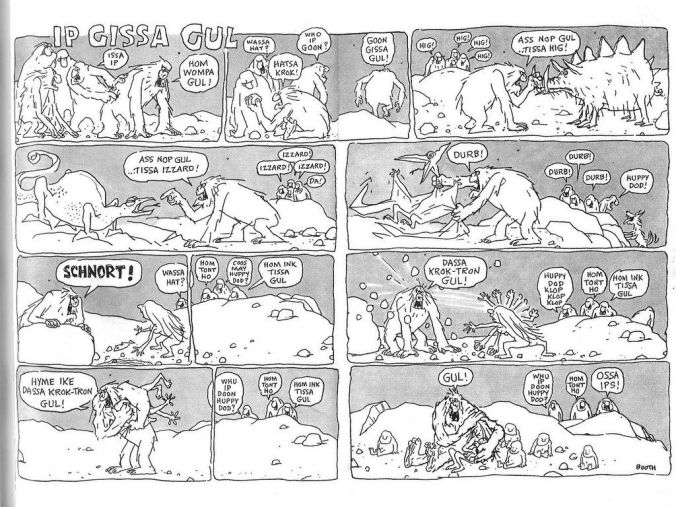
Ethics Poll: “Ip Gissa Gul”

The New Yorker cartoon above, by the magazine’s iconic cartoonist George Booth, first ran in 1975. I remember finding it strange then. I just ran across it again, and it seems ripe for an Ethics Alarms poll.

Ethics Quote Of The Week: Paul Mirengoff

“Conservative America is disgusted with the NBA, and therefore is tuning it out. We’re disgusted ….with the embrace of the radical BLM movement by the league and its players….My problem was what was allowed, indeed encouraged, during the games. I will not watch any sports event during which the preaching of politics or ideology occurs. I guess I’m not alone.”

—Conservative lawyer and blogger Paul Mirengoff on the Powerline blog, discussing the huge fall-off in TV ratings for the current NBA play-offs.

Mirengoff is wrong to attribute this reaction only to conservatives, however. I have spoken with many sports fans who would not fit that description who are equally disgusted with the professional sports leagues. All of the leagues made a foolish assumption that by embracing the views of many progressive activists, they would at least hold on to the allegiance of  fans who agreed with those positions. ESPN and many sportswriters have made the same mistake., and it’s a stupid one. If I go out to dinner and the service staff bombard me with their political views during the evening, it doesn’t matter if I agree with what they say: I didn’t come to the restaurant to listen to political diatribes.

If you’re wondering about the ellipses, I left out a reference to the NBA’s addiction to China’s money, leading the league to ignore the despicable human rights record and political oppression in that country. That is a conservative complaint, and a valid one, but I doubt it affects NBA play-off ratings one tick.

I haven’t finished my letter to the Boston Red Sox, but I write it as I completely ignore the baseball play-offs as I will through the World Series. I want to make sure the team realizes that if its ugly promotion of Black Lives Matter could alienate me, it is in big trouble in the community. The players need to understand that as well, but it was up to management to tell employees to do what they were paid for, and not use their celebrity to make incompetent and divisive political statements. Continue reading

Sunset Ethics, 9/30/2020: Conflicts Of Interest, Sexual Harassment, Movies And Lies

1. Conflicts of interest on my mind. I narrowly averted a disastrous conflict of interest yesterday out of pure moral luck, so the topic is much on my mind; I’m still distracted by the near miss. Professionally, it was the equivalent of almost being picked off by a bus.

NPR Legal Affairs Correspondent Nina Totenberg reacted to the death of Justice Ginsburg with an essay on her 48-year friendship with RBG, saluting Ginsburg’s “extraordinary character.” That’s funny: Totenberg never told NPR’s listeners, nor did  NPR, that she had a personal relationship with the Justice, despite being charged with covering the Court and critiquing its decisions.  Kelly McBride, NPR’s public editor and senior vice president of the Poynter Institute, threw a metaphorical ethics foul flag,

“In failing to be transparent about Totenberg’s relationship with Ginsburg over the years, NPR missed two opportunities,”she wrote on the NPR website. “First, NPR leaders could have shared the conversations they were having and the precautions they were taking to preserve the newsroom’s independent judgment,” McBride said. “Second, having those conversations in front of the public would have sharpened NPR’s acuity in managing other personal conflicts of interest among its journalists.”

Ginsburg, who officiated at Totenberg’s wedding in 2000. Nonetheless, the correspondent,  who wears her progressive bias on her sleeve as it is, denied that the conflict compromised to her journalism, telling  the Washington Post that NPR’s listeners benefited from ther friendship because it gave her greater insight into and Ginsburg’s  thinking.

And that justifies keeping the relationship secret from listeners how, Nina?

2. From the “When ethics alarms don’t work” files: Lawyer Phillip Malouff Jr. of La Junta, Colorado, was censured for a series of episodes of unprofessional behavior and sexual harassment.

In November 2016, Malouff  winked at a magistrate judge and said, “When you get back from your vacation, I better be able to see your tan lines.” When he visiting the same magistrate’s chambers to discuss scheduling matters, he  said, according to the female judge,: “Ask your husband a question for me when you get home tonight. Ask him what it’s like to have relations with someone who wears the robe. It has always been something I’ve wanted to do, but there have never been any women judges until now.”

Malouff  was informed that his comments were unprofessional and a violation of the Colorado Judicial Department’s anti-harassment policy. Ya think?

In July 2019, Malouff asked a judicial assistant to check whether the mother in a parental rights hearing had an outstanding warrant. When the assistant replied, “She is good.” Malouff  responded, “Her husband told me that she is good.

Wink wink, nudge nudge. Continue reading