“bias makes you stupid”
Jason Werth, The Shift, And How Baseball Imitates Life, Not In A Good Way

Today’s example from baseball of why the world will never get less stupid: Jayson Werth, the former firebrand outfielder for the Phillies and Nationals who retired from professional baseball in June (about a year too late, based on his miserable 2017 performance), blathered on in a podcast interview espousing ignorance over knowledge.
“They’ve got all these super nerds, as I call them, in the front office that know nothing about baseball but they like to project numbers and project players… I think it’s killing the game. It’s to the point where just put computers out there. Just put laptops and what have you, just put them out there and let them play. We don’t even need to go out there anymore. It’s a joke….When they come down, these kids from MIT or Stanford or Harvard, wherever they’re from, they’ve never played baseball in their life…When they come down to talk about stuff like [shifts] … should I just bunt it over there? They’re like, ‘No, don’t do that. We don’t want you to do that. We want you to hit a homer.’ It’s just not baseball to me. We’re creating something that’s not fun to watch. It’s boring. You’re turning players into robots. They’ve taken the human element out of the game.”
Back in the late 1970’s, a man named Bill James, blessed with an amazing ability to look at problems without the pollution of conventional wisdom began writing a little publication in his spare time down in his basement that examined how baseball was played, what practices statistics supported, and which they did not. He revealed, to take just one example, that managers were habitually batting as lead-off players who were speedy runners but who didn’t get on base very often because they never walked. This almost universal practice cost teams runs and victories. He showed that a player with a .300 average who seldom took a base on balls was a less effective offensive weapon than a player with a much lower batting average but a higher on-base-percentage, the result of being more selective at the plate. Somehow this obvious observation had never occurred to anyone whose actual profession was managing baseball teams.
Every year, and in articles in between for journals and statistical publications, James proved over and over again that baseball was being played astoundingly ignorantly. A “great” base stealer who only was successful 70% of the time was costing his team runs, because the statistics show that the the risk of an out is usually a far greater cost than the extra base is a benefit. The sacrifice bunt is almost always a bad percentage play, increasing the odds of scoring one run slightly, but greatly reducing the chances of scoring more than one. A player’s statistics were vastly influenced by the quirks and dimensions of his home park, creating illusions of abilities and flaws that were mirages.Virtually all baseball players reach their peak value at the ages of 27-29, and decline rapidly thereafter: James wrote that paying big salaries for 30-years-old-plus stars was a losing gamble, comparing it to buying a watermelon at a premium price after the previous owner has eaten the fruit’s heart out and pronounced it delicious.
I began reading James books in the 80’s, and found him to be a truly original and courageous thinker. (The concept and term “signature significance,” an Ethics Alarms staple, comes from James.) From the beginning, however, his research was ridiculed by front office executives, managers and player, many of whom were challenging his research on the basis of a limited intellect, a high school degree and statistical knowledge that consisted of reading box scores. They appealed to authority—their own—to refuse to acknowledge indisputable, mathematical, logical realities. Eventually one or two young turks did pay attention, like Oakland’s Billy Beane. He hired his own numbers-cruncher and used the principles of the fledgling discipline James helped launch, sabermetrics, the statistical analysis of baseball, to win championships with a minimal budget. It also got him a book written about his success, “Moneyball,” and a movie based on the book where Beane was played by Brad Pitt.
Sweet! Continue reading
Ethics Dunces: The San Francisco Giants

To be fair, how was anyone to know that Barry Bonds was cheating?
We knew this was coming.
The San Francisco Giants will retire Barry Bonds’ number 25 in a ceremony before tomorrow’s game against the Pittsburgh Pirates. Bonds will become the 12th Giants player to have his number retired, following Bill Terry (3), Mell Ott (4), Carl Hubbell (11), Monte Irvin (20), Orlando Cepeda (30), Juan Marichal (27), Willie Mays (24), Willie McCovey (44) and Gaylord Perry (36). Christy Mathewson and John McGraw are regarded as having their numbers retired, but they played before uniforms had numbers.
None of the other eleven, before Bonds, cheated to reach the heights they achieved in the game, nor did any of the others corrupt the sport, its players, its statistics and records. The Giants knew Bonds was illicitly and illegally using steroids, of course, as did most Giants fans, but they were perfectly happy to enable his conduct and accept his lies because his drug-enhanced talent, which was already formidable, won games. It would have been, one theory goes, hypocritical for the Giants not to honor Bonds. After all, they were complicit and supportive as he amassed Hall of Fame numbers while using methods that disqualified him for the Hall of Fame, if not the San Francisco team.
The retired number, like Bonds’ entire selfish, corrosive, despicable career will now stand for the propositions that the ends justify the means, and the cheating works. That was what Barry was always counting on, and he pulled it off. Now a San Francisco institution is officially endorsing Bonds’ values.
Nice.
No wonder that city’s culture is so screwed up.
You can read the voluminous Ethics Alarms commentary on Bonds, who when I compile the long-promised list of Worst Ethics Corrupters will be a prominent member (right below Bill Clinton) , here.
Regarding Twitter, Free Expression, Alex Jones, Social Media Censorship, And “Fake News”
The journalism ethics site Poynter begins a story today , “Over the past couple of years, Twitter has done the bare minimum to fight fake news, avoiding the kind of negative press that has plagued Facebook in the process.”
Talk about a bad start. No social media platform is qualified to “fight fake news” except to allow participants to make their own cases regarding what is fake news and what isn’t. They can and do indulge in incompetent, biased and often partisan censorship, covering their tracks by employing “factcheckers” that themselves can’t be trusted not to indulge their biases and political agendas, of course. That’s what Facebook has been doing, and, proving that there is justice in the universe, suffering for it.
Twitter hasn’t been censoring what it calls fake news; it’s just been using double standards to ban conservatives for “hate speech” when parallel leftist rhetoric gets past the gate-keepers. Federalist writer Elizabeth Kantor, for example, was kicked off twitter for this tweet in tongue-in-cheek support for the new racist New York Times editor:
“@sarahjeong This whitey is cheering you on as you fight off the Twitter mob. Down with deplatforming! Plus, it’s clarifying abt. what kind of paper the NYT wants to be . . .”
Twitter told her had engaged in “hateful conduct” that violates Twitter’s terms of service: “Violating our rules against hateful conduct.You may not promote violence against, threaten, or harass other people on the basis of race, ethnicity, national origin…”
Jeong, however, who had started the hashtag “#CancelWhitePeople” as well as many other anti-white, anti-male Twitter content, remains a valued Twitter user.
Twitter not only is partisan and biased, it also has no integrity. What upset Poynter is that Twitter didn’t join Apple, Facebook and others in their Sunday Night Purge of right-wing wacko Alex Jones. The fact that it banned Kantor for one innocuous political tweet and not her target for dozens of racist ones doesn’t seem to bother Poynter’s unethical ethicists, just that it hasn’t joined the effort to silence Jones online. Twitter, its says, is failing its duty to combat “misinformation.”
Here was the message from the Twitter CEO, communicated, naturally, in a series of tweets:
We didn’t suspend Alex Jones or Infowars yesterday. We know that’s hard for many but the reason is simple: he hasn’t violated our rules. We’ll enforce if he does. And we’ll continue to promote a healthy conversational environment by ensuring tweets aren’t artificially amplified. Truth is we’ve been terrible at explaining our decisions in the past. We’re fixing that. We’re going to hold Jones to the same standard we hold to every account, not taking one-off actions to make us feel good in the short term, and adding fuel to new conspiracy theories. If we succumb and simply react to outside pressure, rather than straightforward principles we enforce (and evolve) impartially regardless of political viewpoints, we become a service that’s constructed by our personal views that can swing in any direction. That’s not us.Accounts like Jones’ can often sensationalize issues and spread unsubstantiated rumors, so it’s critical journalists document, validate, and refute such information directly so people can form their own opinions. This is what serves the public conversation best.
In an earlier tweet from another Twitter account, Twitter stated,
“As we have stated publicly, we strongly believe Twitter should not be the arbiter of truth nor do we have scalable solutions to determine and action what’s true or false.”
Bingo. Continue reading
Morning Ethics Warm-Up, 8/7/2018: Back in the USSR

Good Morning!
1. Self-Promotion Dept. I’m heading off to New Jersey today, to present one of my musical legal ethics seminars—3 hours!—for the New Jersey Bar Association. The real star is my long-time partner in these shows, New York-based singer/musician Mike Messer, who channels Freddie Mercury, Bob Dylan (with harmonica!), Paul Simon, even Johnny Cash in the various song parodies. This one is called Ethics Rock Extreme, and ends, like all of my musical seminars, with a sing-along. Yes, we get lawyers to sing the chorus of the “Piano Man Parody”…
Sing us the Rules, you’re the ethics man
Sing us the Rules tonight!
We’re stuck in an ethics dilemma here
So tell us what’s wrong and what’s right!
(No, “Back in the USSR” is not one of the songs we do.)
2. First Amendment for me, but not for thee: In an embarrassing episode that is also telling, the Newseum has capitulated to a storm of protests from journalists and will no longer sell its popular “Fake News” mercahndise…like this shirt…
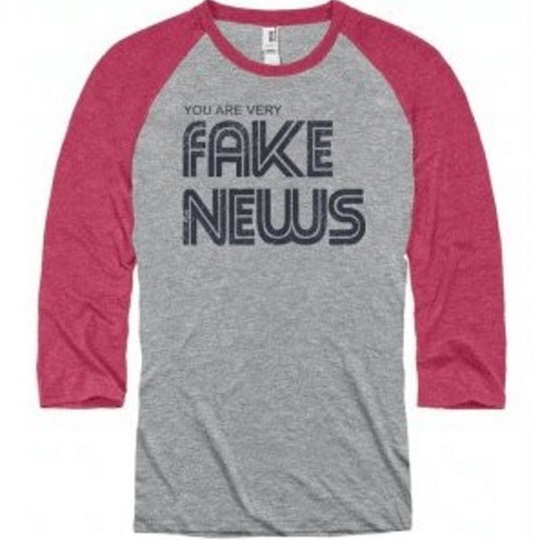
online or in its gift shop. “We made a mistake and we apologize. A free press is an essential part of our democracy and journalists are not the enemy of the people,” the Newseum announced Saturday in a groveling blog post. “Questions have also been raised regarding other merchandise. As an organization that celebrates the rights of people from all political spectrums to express themselves freely, we’ve historically made all types of political merchandise available for our guests to purchase. That has included former and current presidential slogans and imagery and merchandise from all political parties. We continue to do so in celebration of freedom of speech.”
Translation: “In celebration of free speech, we will acquiesce in the censoring of a particular expression of opinion on a humorous T-shirt, because it hurts journalists’ feelings.”
Again, I ask: why does anyone trust journalists and the organizations they represent? Continue reading
Monday Ethics Afternoon Warm-Up, 8/6/18: Relatively Trivial Edition

1. Facebook Conduct I Could Do Without Dept. A friend who happens also to be on Facebook just posted his opinion about a matter and added, “If you don’t agree, don’t respond, just unfriend me.” I’m tempted to unfriend him for that. What a cowardly, lazy, arrogant stunt.
2. He’s also dead wrong in his opinion, which has to do with this “good illegal immigrant” news item. My friend thinks that the wife of a Marine should get a pass despite being in violation of immigration laws because her husband served his country. I don’t disagree with the principle he’s espousing, but it’s not the law. If there should be law that gives some kind of leniency to the spouses of military personnel, then draft it, debate it, and pass it. The Marine fought for a nation of laws, not a nation where law enforcement makes up the laws as it goes along. This was the Obama approach: we just won’t enforce the laws against this particular group of law-breaker that we like.
3. How dumb can “cultural appropriation” complaints get? This dumb:
In women’s mag “Marie Claire,” Krystyna Chávez argues that deciding to pluck your eyebrows so that they are very thin is “cultural appropriation.” writing that she was was horrified when she saw a photo of Rihanna with her new, skinny eyebrows. Chávez writes in a piece titled “I’m Latina, and I Find Rihanna’s Skinny Brows Problematic.” Unfortunately, as Katherine Timpf points out, a Louisiana State University student named Lynn Bunch wrote an op-ed last year declaring that thick eyebrows that cultural appropriation:
“Current American eyebrow culture also shows a prime example of the cultural appropriation in the country. The trend right now is thick brows, and although a lot of ethnic women have always had bushy, harder-to-maintain eyebrows, it has only become trendy now that white women have started to do it.”
Boy, the outbreak of such serious statements of idiotic opinions makes me feel unsafe…because I’m afraid that I am surrounded by lunatics, in a culture that is encouraging warped values and reasoning to such an extent that for a disturbing number of Americans, no idea sets off the Stupid Alarms.
I may have to start a sister blog…
4. And you thought Trump Derangement Syndrome was silly.New York-based UMA Health, an online mental health marketplace, is providing free, confidential therapy sessions to Mets fans who are in emotional turmoil as a result of the team’s disappointing season, which cratered is last week’s 25-4 loss to the Washington Nationals, the worst loss in Mets history—yes, even worse than any of the embarrassing drubbing the team received in its first, horrible season in 1962, when “the Amazin’ Mets” lost a record 120 games.
UMA says its tongue in cheek promotion is meant to bring attention to the important role of therapy, and to eliminate the stigma of going to a therapist.
That’s odd: I think the promotion does the opposite, suggesting that therapy is self-indulgent, useless, useless bunk, which it too often is. I have an amusing personal story that explains my bias here, which I will leave for another time. If something is important your profession is to enlighten the world about its benefits, however, is it competent to promote it like this? Continue reading
Unethical Quote Of The Month: Apple, Or “Stop Making Me Defend Alex Jones!”
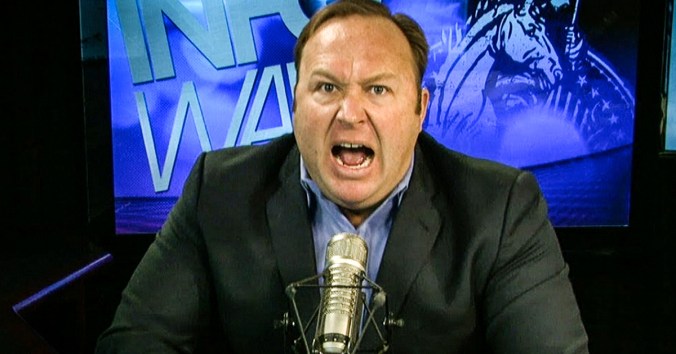
“Apple does not tolerate hate speech, and we have clear guidelines that creators and developers must follow to ensure we provide a safe environment for all of our users. Podcasts that violate these guidelines are removed from our directory making them no longer searchable or available for download or streaming. We believe in representing a wide range of views, so long as people are respectful to those with differing opinions.”
—-A spokesperson for Apple last week, following confirmation that it had removed five out of six podcasts by far-right conspiracy theorist Alex Jones, including “The Alex Jones Show” and some of his InfoWars audio streams.
This is a terrifying statement…almost as terrifying as the fact that so many Americans won’t understand why it’s terrifying. Unless one does not understand the First Amendment and why its principles are the beating heart of American democracy, or unless you are an increasingly typical 21st Century progressive, who feels that the Left should have the power to decide what kind of speech is tolerable, Apple is telling us that it is going to use its immense power and influence over the distribution of ideas to suit its preferences regarding what people should see, hear, and think. Continue reading
The Signature Significance Of The Left’s Endorsement Of Sarah Jeong (Part I)

Hi, White America! I want you dead! And now, the technology news…
Are you already sick of the controversy over the New York Times hiring Sarah Jeong? Don’t be. The mainstream media and the now officially-derailed progressive establishment want you to move on, as in Move-On.Org’s definition, meaning …
… but there is a lot to see, and it is important to see it clearly.
Are these…
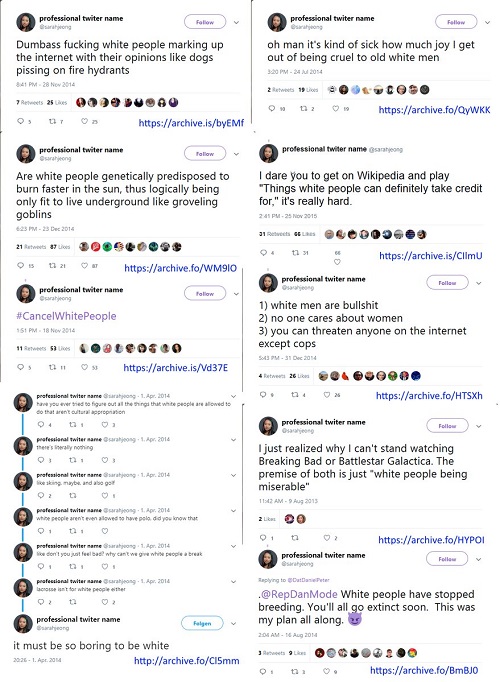
…racist tweets? Of course they are. Denying that they are is Orwellian, but progressives have been tending to 1984 for quite a while now, and denying it all the while. Would any journalist tweeting the equivalent sentiments about any other race have a career left in anything but wreckage? No. Rosanne Barr, a comic, not a journalist, was fired, branded a pariah and non-person, and had her hit ABC show cancelled for a single racist tweet about one woman. These are but a sample of many tweets from Jeong about an entire race (and often an entire gender). Not only is her career not in tatters, it is advancing.
What this means is that the Left, including the mainstream news media that is represented by the New York Times, the traditional exemplar, the role model, the standard-setter, now unapologetically and openly endorses an unethical, dangerous and divisive double standard. Non-whites can engage in hateful, racist speech against whites, and women can use sexist, misandrous rhetoric against men, and that’s not only acceptable, but deserved. Continue reading
Ethics Dunce: WeWork
I wonder: how many of the sensitive progressives doubtlessly applauding the fear-monger about President Trump being an “authoritarian” see the obvious hypocrisy on working for a comany like the shared workspace company WeWork, that uses its power of its employees to force them to accept the company’s social values in their personal choices?
On July 13, WeWork announced that it is banning red meat, pork, or poultry at company events like its “Summer Camp” retreat and internal kiosks, called “Honesty Markets.” (Yecchh. Do you dislike this preening company already like I do?) It also announced that WeWork’s 6,000 global employees won’t be reimbursed if they eat meat at their business meals, except for fish. Eating fish is OK, because…well, just because. The owners didn’t like “Finding Nemo,” or something. You know, fish have mothers too.
The company boasts that these policies will save 445 million pounds of carbon dioxide emissions, more than 16 billion gallons of water, and the lives of 15,507,103 animals by 2023. 15,507,103. Wow—those are some precise statistics. Of course, the policy makes no sense. Why are eggs acceptable to WeWork, when egg-raising causes as much theoretical environmental damage as raising chickens to eat? Oddly, WeWork doesn’t impose strict environmental controls on the buildings it uses for offices and work space.
Could it be that this is just blatant, shameless, cynical virtue-signaling? Of course it is. Continue reading
Saturday Morning Ethics Warm-Up, 8/4/18: Baseball And Bisons And Jerks, Oh My!
Good Morning, Fenway!
Going to make sure the Sox beat the Yankees again today?
1. Nice. The Democratic National Committee declined to play the Republican National Committee in their annual softball game this year.
You know, I now actively search for examples of Republicans behaving like divisive, snotty assholes, because I’m really sick of being accused of favoring that hollowed out, irresponsible. principle-free party. But when it comes to demonizing the opposition and bottom-of-the-barrel civility, the Democrats always seem to lap the field. Of course, this latest insult is pure virtue-signaling to the “resistance” base. Where a responsible party would be trying to lead its members and followers in the direction of comity and respectful disagreement, the DNC is taking a stand in favor of ideological apartheid.
2. This is great: I get to criticize the New York Yankees! Do say a little prayer, or something, for poor Chance Adams, the New York Yankee farmhand summoned to pitch today’s game against the Boston Red Sox with the Yankee season on the line.
The Yankees have the second best record in baseball, but also have the misfortune to play in the same division as the team with the best record, the Boston Red Sox. If the Yanks finish second, their play-off, and thus World Series chances, will rest on a single game between them and the other American League Wild Card team, who will almost certianly have a better starting pitcher on the mound. New York has lost the first two games of a four game series in Boston, dropping them from 5 and a half games behind the Sox (not too bad, with 50 games to go) to 7 and a half games ( scary, when chasing a team with a current winning percentage of just under .700). If the team falls 8 and a half games behind, especially with its best player injured, gargantuan slugger Aaron Judge, that one game crap shoot will become the most likely scenario.
Thanks to some bad luck and some miserable management of the pitching staff, the assignment of navigating the Good Ship Yankee away from the shoals of ignominious defeat has been shifted to the shoulders of Adams, who 1) has never pitched in a major league game before, 2) will be facing the top offense in baseball, 3) in front of the famously rabid Fenway Park faithful, and 4) isn’t all that good. This is profoundly unfair. It almost seems as if Yankee management wants to use the rookie as an excuse for failure.
Meanwhile, he will become an infamous answer to a trivia question, like ill-fated Booby Sprowl, a Boston rookie pitcher who was thrust into a similar crisis by Boston manager Don Zimmer when the position of the two teams was reversed in 1978. Like Zimmer, Yankee manager Aaron Boone had other options that didn’t involve over-burdening a green young athlete of uncertain skills. For example, he could resort to a “bullpen game,” like the Tampa Bay Rays have been doing, with surprising success, all season. After all, the Yankees have the best and deepest bullpen in the universe.
Of course, baseball being baseball, anything can happen. Maybe Chance Adams will shock the baseball word with a pitching gem, and become a Yankee legend. Stranger things have happened. That, however, will be pure moral luck, and will not change the fact that Adams should not be put in this position.
Now what I really want to know is whether Chance was named after John Wayne’s character in one of my favorite Westerns. “Rio Bravo”… Continue reading


Tippy Scales, the Ethics Alarms’ commentariat resident working journalist, was moved to comment on the ongoing controversy over the New York Times hiring a documented anti-white racist as one of its editors. I welcome the development, as it is signature significance for the mindset of the Times and its management: no ethical or trustworthy news publication would do such a thing. The rest of the mainstream news media has tried to bury the story, but this is one more time when Americans should feel grateful for our conservative media, with all of its own biases and flaws. I doubt that the Times will avoid the consequences of its arrogant and unprofessional act, and I think we will be hearing more about Sarah Jeong.
Here is Tippy Scales’ Comment of the Day on the post, Afternoon Ethics Jolt, 8/3/2018: A Lawyer Finds A New Way To Be Unethical, Verizon Makes Our Kids Obnoxious And Ignorant, And The Times Decides To Show Its Colors…