Correction: No, The White House Did NOT Try To Airbrush Away A Key Q & A In The Helsinki Press Conference…


Call this not “Fake News,” but “Confirmation Bias Leaping To Conclusions News.”

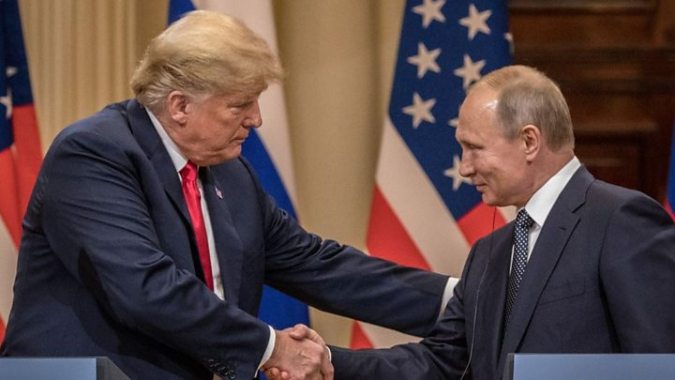
Many sources prone to assume the worst of anything related to President Trump, including MSNBC and my source here, Jonathan Turley, reported  that the White House had intentionally excised a question asked of Russian President Vladimir Putin during last week’s news conference in Helsinki and his answer.  Maddow gleefully reported in her best “gotcha! you bastards!” tone,

“We can report tonight that the White House video of that exchange has also skillfully cut out that question from the Reuters reporter as if it didn’t happen!”

Ah, but the good, MSNBC-allied, “resistance”- friendly Washington Post also had posted the same transcript, and set about putting Maddow et al, straight, as much as it must have hurt.

“No, the White House didn’t intentionally edit a question to Putin out of a video,” explained the Post’s usually Trump-a-phobic Phillip Bump: Continue reading →

Morning Ethics Warm-Up, 7/25/18: Bricks In The Wall [UPDATED]

1. Nah, that’s not a misleading title! An op-ed in the Times yesterday had the alarming header, “Trump’s New Target: Citizenship.” In fact, the piece was about the movement to end automatic U.S. citizenship for those born here of illegal immigrant parents, and the Trump administration policy of seeking to “denaturalize” foreign-born citizens who achieved citizenship status by withholding disclosure of previous crimes.

As with many aspects of the bizarre national immigration debate, support for continuing the first principle is hard to justify. It is a remnant of a time when there were no restrictions on U.S. immigration, so the birthright rule made sense. Now, when illegal immigration is a serious concern, the same principle creates a perverse incentive to break the law, and makes immigration law enforcement complicated and difficult. The second issue is more debatable. The New York Times has another “good immigrant” story, this time one that seeks sympathy for Norma Borgoño, a Peruvian immigrant who took the oath of citizenship in 2007. The Justice Department has moved to revoke  Borgoño’s citizenship, claiming that she committed fraud when she applied for it. She apparentlyfailed to disclose that she had taken part in a serious crime several years before her application, then four years later, in 2011, pleaded guilty when she was charged for helping her employer  defraud the Export-Import Bank of the United States of $24 million.

Writes the Times, “Since President Trump took office, the number of denaturalization cases has been growing, part of a campaign of aggressive immigration enforcement that now promises to include even the most protected class of legal immigrants: naturalized citizens.” That is a deceitful sentence, full of spin, as is the entire story. For “aggressive immigration enforcement” read “enforcement.” The U.S. has every right, and in fact a duty, to assess what kind of people it wants to allow to become citizens, and criminals need not apply—after all, we have enough of them already. The Times finds it significant that Borgoño hasn’t been charged with her crime when she  applied for citizenship, but she was still a criminal, and the crime wasn’t stealing a loaf of bread, either. It also spins that her aiding a massive theft was “to no benefit of her own.” Oh! Then that’s OK, then! Presumably there was the benefit of keeping her job with her boss the felon, at very least.

The Trump administration isn’t “targeting citizenship,” but rather naturalized citizenship that was improperly granted, based on false representations.

2. The irresponsible neglect of the national infrastructure continues. I could write about this every day, and maybe I should. A microcosm of the national crisis is illustrated in the recent news that the New York City subway system is still falling apart, and even after the city spent about $333 million on emergency repairs its condition has barely improved. Waiting until transit systems, bridges, roads, railroad track, waterways, sewer and water pipes,  airports, the power grid and the rest of the structures that support civilization start crumbling, stifling commerce and killing people is an idiotic and suicidal approach to a basic  function of government, but  that has been our national policy since the 1960s. President Trump has claimed that addressing this was a priority, and maybe it will be, but recent history suggests that nothing will be done of substance until there is a lot of sickness, death, and destruction. Continue reading →

Late Verdict On The Helsinki Press Conference Freak-Out: I’m Convinced. It’s Just More Unethical, Double-Standard, Anti-Trump, “Resistance” And News Media Coup-Fodder, Only Noisier And Dumber Than Usual

I don’t appeal to authority very often.

What I do occasionally do is look for someone with judgment, experience and honesty I trust whose assessment of a particular situation jibes with my ethical analysis at times when I have begun to judge my own sanity. When I started reading people writing, in horror-stricken tones,”Can you believe what Trump said at that joint press conference?,” which I initially missed because these events are always stagey, insincere, all-puffery affairs, I assumed that President Trump finally done something really over-the-top this time, like spitting at CNN reporter, or singing “The Volga Boatman” to irritate Putin. When I read what he in fact did say, and saw the videos, my brain literally couldn’t reconcile it with the hysterical claims that it was “treasonous,” or like “Pearl Harbor,” or “Kristallnacht” or warranted impeachment (Plan N). It didn’t compute, as the robot in “Lost in Space” used to say.

I know I don’t often seem like it, but I have my doubts sometimes. I write as if I am certain I am right, because that’s my style, but often within me there meet a combination of antithetical elements which are at eternal war with one another. Driven hither by objective influences — thither by subjective emotions — wafted one moment into blazing day, by mocking hope — plunged the next into the Cimmerian darkness of tangible despair, I am but a living ganglion of irreconcilable antagonisms. All right, that was from my favorite exchange in “H.M.S. Pinafore,” but I’m not completely facetious. When I read almost every one of hundreds of Facebook friends writing, to universal agreement from their echo ch..freinds, that an extemporaneous statement in a Finnish press conference proves that Putin “has something” on the President, I begin to think, since I don’t see it at all, that the problem must be me. I am so thoroughly sick and disgusted at the relentless unethical and unprecedented efforts to interfere with this President, and his efforts to do the job he was elected to do, by Democrats, progressives, “the resistance” NeverTrumpers and the news media, that maybe my indignation against their dangerous, democratic institution-eroding vengeance because this odd and offensive man shattered the dreams of the Obama Worshipers and the Clinton Conned, had finally metastasized into bias, and made me impervious to something that should have me, for once, agreeing with them. For bias makes us all stupid, you know.

That is why I was so relieved to read this, the transcript of the comments of NYU Russia expert Stephen F. Cohen, a contributing editor at “The Nation,” the most extreme leftist magazine of national prominence in the country. He is clearly NOT being driven by bias, but his analysis was exactly the same as mine:

“The reaction by most of the media, by the Democrats, by the anti-Trump people is like mob violence. I’ve never seen anything like it in my life. This is the president of the United States, doing what every president… since FDR in 1943 with Stalin, meeting with the head of the Kremlin. And every president since Eisenhower, a Republican by the way, has met with the leader of the Kremlin for one existential purpose: To avoid war between the two nuclear superpowers. Today, in my considered, scholarly, long-time judgment, relations between the U.S. and Russia are more dangerous than they have ever — let me repeat, ever — been, including the Cuban missile crisis. I want my president to do — I didn’t vote for this president– but I want my president to do what every other president has done. Sit with the head of the other nuclear superpower and walk back the conflicts that could lead to war, whether they be in Syria, Ukraine, in the Baltic nations, in these accusations of cyber attacks. Every president has been encouraged to do that an applauded by both parties. Not Trump. Look what they did to him today. They had a kangaroo court. They found him guilty. And then you had the former head of the U.S. CIA, who himself ought to be put under oath and asked about his role in inventing Russiagate, calling the President of the United States treasonous. What have we come to in this country? And what is going to happen in the future?”

Whew! What a relief: I thought I was going crazy. Like Cohen, except not close to matching his scholarly efforts, I know quite a bit about how past Presidents treated Russian leaders in their various summits, meetings and diplomatic encounters. Only Trump was expected to insult the Russian leader to his face. Only Trump was asked an outrageous question inviting him to insult a Russian leader to his face. (The reporter should have been ejected from the conference.) President Trump was not only criticized for behaving as every other President has and should have behaved, but was excoriated for doing so.

I wish, of course, that the President’s rhetorical skills were not so blunt and confounding, so he could defend his own conduct without resorting to “fake new!” retorts. I wish he had the nuance and sense to simply dodge such a disruptive and irresponsible question without walking into a true “when did you stop beating your wife” question that made him choose between undermining U.S. intelligence or undermining the whole reason he was at the summit in the first place. I wish that the President was not so much like Donald Trump, in other words, but unlike Anderson Cooper, George Will, Chuck Schumer, John McCain and my hysterical Facebook Friends, I regard constantly becoming more and more irrational over something that happened 19 months ago  to be civic incompetence. Continue reading →

Nah, Snopes Isn’t A Spinning, Left-Biased Fake Fact-Checking Organization! OK, I’m Kidding, It Really Is. [UPDATE]

If you hear about a social media company of a media organization that cites Snopes and a reliable authority, that’s all you need to know. They’ll lie to you, just like Snopes, and probably to assist a progressive political agenda.

Here’s an especially blatant example of Snopes’ fake fact-checking, as opposed to what they claim to do, which is to check fake facts, from 2016. It’s actually pretty funny.

The fact being checked:

Bernie Sanders has been criticized as hypocritical for only paying his interns $12 an hour despite his campaigning to raise the minimum wage to $15 an hour.

Snopes’ unbiased and objective analysis:

WHAT’S TRUE: Bernie Sanders pays his interns $12 an hour.

WHAT’S FALSE: Bernie Sanders pays his staff workers $12 an hour.

Ah! It’s misleading to say that Bernie, who said during the campaign,

“Millions of Americans are working for totally inadequate wages. We must ensure that no full-time worker lives in poverty. The current federal minimum wage is starvation pay and must become a living wage. We must increase it to $15 an hour over the next several years.”

was a hypocrite who, as a meme circulating in 2016 claimed, he only payed his “staff interns” $12 an hour while simultaneously campaigning to raise the national minimum wage of $15.

Says Snopes, spinning like mad: Continue reading →

Morning Ethics Wake-Up, 7/17/2018: Swans, Nazis Kids, Rand Paul, And More Freakouts [UPDATED]

Good Morning!

1. And today’s anti-Trump freakout topic is…The complete media/”resistance”/Democrat social media meltdown over whatever President Trump thought he was doing yesterday was typical of what we were talking about in the threads on Monday’s Warm-Up. It’s all so boring and predictable. It’s predictable that the President will say things he shouldn’t; it’s predictable that the people who have already made it clear that they hate is guts will erupt with over-the-top condemnation; it’s predictable that the social media echo chamber will adopt whatever unscrupulous Democratic Party talking point that is launched—yes, yes, Facebook Friend, yesterday proves that Putin “has something” on the President like Nancy Pelosi says. Did she call him “Bush” this time?—and that anyone who tries to point out that the reaction is wildly out of proportion to reality is a Trump-loving racist Nazi. I seriously don’t know how a responsible commentator who isn’t out of his mind is supposed to react. Ignore it, because some new hysteria will be right along, like Leo Slezak’s swan. (Don’t you know this story? It’s one of my favorites! Leo Slezak, a famous Austrian opera singer in the Thirties, was playing the role of Lohengrin in Wagner’s opera, which ends with the hero being carried off to Valhalla on the back of a giant swan. In one performance, the swan, pulled by stage hands on tracks, just swam right by him up stage, leaving the hero stranded. Slezak turned to another singer on stage and asked, loudly enough so the audience could hear him, “What time’s the next swan?” His son, Hollywood actor Walter Slezak, made the line the title of his autobiography.)

2. Obligatory freakout notes: a.  All that matters is what, if anything, comes of the summit. The President (obviously) has his own theories of negotiation. Sometimes they work. b. John Brennan’s statement that the Putin-Trump press conference was “treasonous” was two things: 1) the most ridiculous thing said yesterday by anybody, including the idiot who lives down the street here who said, reportedly, “Rpeterbokle?“, and 2) immediate confirmation of why the President said that he doesn’t trust American intelligence agencies any more than he trusts Putin. c. If anyone can point me to an unbiased authority who can explain how leaders holding joint press conferences help their nations by insulting each other, please do. d. John McCain should either show he can do his job, or he should resign and let someone able do it. Right now, apparently his only role is to snipe at the President. e. Gee, I wonder why President Trump doesn’t trust the FBI, after watching a smug FBI agent who texted about insurance policies against his Presidency and how “we” would “stop” him lecture Congress about his lack of bias? f. Nixon said much nicer things about China and Chou En Lai when Dick made his famous visit. FDR affectionately called mass murderer Stalin “Uncle Joe.” President Bush (absurdly) said that he had seen Putin’s soul, and pronounced it pure. JFK feted the Butcher of the Ukraine and Hungary, Nikita Khrushchev, during a visit to America without condemning him in a pres conference. President Obama whispered to Putin that, in essence, he was going to play tough but would be accommodating after the election. Conclusion: As usual, this President is subjected to a double standard, and it is wildly hypocritical. g. Yes, Trump’s comments were unpresidential and inappropriate. This, however, is no longer news.
Continue reading →

On “Chappaquiddick” And My Multiple “KABOOMS!” As I Watched It.

I finally saw “Chappaquiddick” after delaying the ordeal as long as I could. It isn’t an ethics movie; nor is it the unethical movie I feared that it might be. What “Chappaquiddick” is a very discouraging movie, one that depressed me greatly. It is telling that the Kennedy Legacy Collective didn’t swoop down and try to kill the film, as it is devastating in it depiction of the late Senator. I can only assume that increased focus on what really happened in, say, a libel trial would only affirm the portrayals, and do more damage than a little-seen film alone.

Of course, the movie is open to attack by Kennedy defenders on the grounds that it speculates what Ted Kennedy was thinking, as well as on  the conversations that went on behind closed doors. Nonetheless, the bare fact that Senator Kennedy waited 10 full hours before reporting the accident that killed Mary Jo Kopechne to police has been damning enough since that summer day in 1969 without further elaboration. The cover story—no, we can’t prove it was a cover story, but it was a cover story—that Ted was dazed and in shock from a concussion and wandered around aimlessly, explaining his actions—was never credible, certainly not at my Arlington, Massachusetts home.

I experienced the film this week as a simultaneous flashback and a series of head explosions. I had forgotten the ridiculous neck brace Kennedy wore to Mary Jo’s funeral (but not before or after it); the film states that it was a prop, and I remember that this was the consensus at the time. My biggest head explosion? It was probably the statement of the Martha’s Vineyard judge who gifted Kennedy with the shortest sentence possible for the lesser offense the Senator agreed to plead to, which was leaving the scene of an accident. Kennedy got a two months suspended sentence, and the judge said that he would be “punished enough.” (If you are unfamiliar withe my opinion of THAT rationalization, you can check out this post from 5 years ago; I have another one somewhere about a father who let his baby die in a hot, locked car, and both people involved in those tragedies were less despicable than Ted Kennedy.) Punished enough? The judge presumably meant that Teddy would take a big hit to his White House aspirations, poor guy.

You know, I’d say that every citizen locked up for negligent homicide, which is the real crime Kennedy was guilty of, can kiss their Presidential aspirations good-bye.

KABOOM #2 was the film’s version of first thing out of Kennedy’s mouth when he began explaining the fateful night’s events to cousin and family lawyer Joe Gargan: “I’m never going to be President.” I can’t find substantiation for this; the line isn’t in the version of the screenplay on the web. The subsequent conferences with Kennedy advisors and fixers, however, showed callousness that was not much worse. The film took a lot of its facts from “Senatorial Privilege” by Leo Damore, which was written from interviews with Kennedy friends and relatives, including Gargan.  Kennedy  made over 30 phone calls from the hotel payphone, none of which involved rescuing Mary Jo.   His driving license had been expired for 6-months, so Kennedy’s fixers pulled the right strings and the DMV issued him a new license on that Sunday, before he surrendered to police.

My head blasted the third time watching the recreation of Ted’s nationally televised speech, written by Kennedy wordsmith Ted Sorensen. This is the real version; the movie shortens it quite a bit…

My fellow citizens:

I have requested this opportunity to talk to the people of Massachusetts about the tragedy which happened last Friday evening. This morning I entered a plea of guilty to the charge of leaving the scene of an accident. Prior to my appearance in court it would have been [im]proper for me to comment on these matters. But tonight I am free to tell you what happened and to say what it means to me.

On the weekend of July 18th, I was on Martha’s Vineyard Island participating with my nephew, Joe Kennedy — as for thirty years my family has participated — in the annual Edgartown Sailing Regatta. Only reasons of health prevented my wife from accompanying me.

On Chappaquiddick Island, off Martha’s Vineyard, I attended, on Friday evening, July 18th, a cook-out I had encouraged and helped sponsor for a devoted group of Kennedy campaign secretaries. When I left the party, around 11:15pm, I was accompanied by one of these girls, Miss Mary Jo Kopechne. Mary Jo was one of the most devoted members of the staff of Senator Robert Kennedy. She worked for him for four years and was broken up over his death. For this reason, and because she was such a gentle, kind, and idealistic person, all of us tried to help her feel that she still had a home with the Kennedy family.There is no truth, no truth whatever, to the widely circulated suspicions of immoral conduct that have been leveled at my behavior and hers regarding that evening. There has never been a private relationship between us of any kind. I know of nothing in Mary Jo’s conduct on that or any other occasion — and the same is true of the other girls at that party — that would lend any substance to such ugly speculation about their character. Nor was I driving under the influence of liquor.

Little over one mile away, the car that I was driving on an unlit road went off a narrow bridge which had no guard rails and was built on a left angle to the road. The car overturned in a deep pond and immediately filled with water. I remember thinking as the cold water rushed in around my head that I was for certain drowning. Then water entered my lungs and I actual felt the sensation of drowning. But somehow I struggled to the surface alive.

I made immediate and repeated efforts to save Mary Jo by diving into the strong and murky current, but succeeded only in increasing my state of utter exhaustion and alarm. My conduct and conversations during the next several hours, to the extent that I can remember them, make no sense to me at all.

Although my doctors informed me that I suffered a cerebral concussion, as well as shock, I do not seek to escape responsibility for my actions by placing the blame either on the physical and emotional trauma brought on by the accident, or on anyone else.

I regard as indefensible the fact that I did not report the accident to the police immediately.

Instead of looking directly for a telephone after lying exhausted in the grass for an undetermined time, I walked back to the cottage where the party was being held and requested the help of two friends, my cousin, Joseph Gargan and Phil Markham, and directed them to return immediately to the scene with me — this was sometime after midnight — in order to undertake a new effort to dive down and locate Miss Kopechne. Their strenuous efforts, undertaken at some risk to their own lives, also proved futile.

All kinds of scrambled thoughts — all of them confused, some of them irrational, many of them which I cannot recall, and some of which I would not have seriously entertained under normal circumstances — went through my mind during this period. They were reflected in the various inexplicable, inconsistent, and inconclusive things I said and did, including such questions as whether the girl might still be alive somewhere out of that immediate area, whether some awful curse did actually hang over all the Kennedys, whether there was some justifiable reason for me to doubt what had happened and to delay my report, whether somehow the awful weight of this incredible incident might in some way pass from my shoulders. I was overcome, I’m frank to say, by a jumble of emotions: grief, fear, doubt, exhaustion, panic, confusion, and shock.

Instructing Gargan and Markham not to alarm Mary Jo’s friends that night, I had them take me to the ferry crossing. The ferry having shut down for the night, I suddenly jumped into the water and impulsively swam across, nearly drowning once again in the effort, and returned to my hotel about 2:00am — and collapsed in my room. I remember going out at one point and saying something to the room clerk.

In the morning, with my mind somewhat more lucid, I made an effort to call a family legal advisor, Burke Marshall, from a public telephone on the Chappaquiddick side of the ferry and then belatedly reported the accident to the Martha[‘s] Vineyard police.

Today, as I mentioned, I felt morally obligated to plead guilty to the charge of leaving the scene of an accident. No words on my part can possibly express the terrible pain and suffering I feel over this tragic incident. This last week has been an agonizing one for me and for the members of my family. And the grief we feel over the loss of a wonderful friend will remain with us the rest of our lives.

These events, the publicity, innuendo, and whispers which have surrounded them and my admission of guilt this morning raises the question in my mind of whether my standing among the people of my State has been so impaired that I should resign my seat in the United States Senate. If at any time the citizens of Massachusetts should lack confidence in their Senator’s character, or his ability — with or without justification — he could not in my opinion adequately perform his duties and should not continue in office.

The people of this State, the State which sent John Quincy Adams, and Daniel Webster, and Charles Sumner, and Henry Cabot Lodge, and John Kennedy to the United States Senate are entitled to representation in that body by men who inspire their utmost confidence. For this reason, I would understand full well why some might think it right for me to resign. For me, this will be a difficult decision to make.

It has been seven years since my first election to the Senate. You and I share many memories — some of them have been glorious, some have been very sad. The opportunity to work with you and serve Massachusetts has made my life worthwhile.

And so I ask you tonight, the people of Massachusetts, to think this through with me. In facing this decision, I seek your advice and opinion. In making it, I seek your prayers — for this is a decision that I will have finally to make on my own.

It has been written:

“A man does what he must — in spite of personal consequences, in spite of obstacles, and dangers, and pressures — and that is the basis of all human morality……whatever may be the sacrifices he faces, if he follows his conscience — the loss of his friends, his fortune, his contentment, even the esteem of his fellow man — each man must decide for himself the course he will follow. The stories of the past courage cannot supply courage itself. For this, each man must look into his own soul.”

I pray that I can have the courage to make the right decision. Whatever is decided, whatever the future holds for me, I hope that I shall have — be able to put this most recent tragedy behind me and make some further contribution to our state and mankind — whether it be in public or private life.

Thank you and good night.

I had forgotten that Kennedy never apologized to the Kopechnes for getting their daughter killed. But he did use the recently departed Mary Jo as a convenient device to signal his virtue, standing up for her reputation, while being mostly concerned about his own. The poetic quote was a a typical Sorensen touch, and laying it on a bit thick: a Churchillian passage of dubious provenance that sainted brother Jack had used in his Pulitzer Prize-winning “Profiles in Courage”—which was, after all, written by Ted Sorensen.

The final series of head explosions occurred at the end, as the film showed archival footage of Massachusetts voters, Kennedy worshipers, most of them, talking about how “anyone can make a mistake” and what good things Ted and his dead brothers had done in the past, and how sure, they would vote for him again.

Of course, they did.

The modern progressive movement in the Democratic Party was substantially built on the career of this weak, corrupt man, the product of the triumph of nepotism, mythology, celebrity, money and privilege over merit and justice.

And people deny that there could have been any bias, political manipulation and corruption in the investigation of Hillary Clinton’s private server.

Kaboom.
Sunday Morning Ethics Hangover, 7/15/2018: “Animal House” And The Death Of Truth [UPDATED!]

Good Morning!

(WordPress isn’t working properly this morning. Perfect…)

1. Not being biased helps you be non-stupid…Yesterday, chatting with lawyer attendees at my ethics seminar, a former government attorney told me that he had several ex-FBI colleagues who were horrified at many aspects of the Peter Strzok hearings, as was he. Among their concerns:

  • The news media was failing its duty to explain to the public the duties of professionals, and why Strzok’s conduct was unacceptable, unethical, and undermined the credibility of the investigations he was involved in.
  • Democrats were defending the indefensible, and also breaching their duty to the public. They ought to be exactly as outraged as Republicans at a figure as demonstrably biased as Strzok polluting important law enforcement inquiries, and also should have rebuked him for his defiant attitude.
  • The Strzok scandal was immensely damaging to the public image of the FBI, and should be. It demonstrates an agency that has been seriously mismanages, and that has a damaged culture.
  • The simple fact that Strzok would use FBI equipment to send his texts demonstrated outrageous incompetence and lack of judgement. Even setting aside the bias issue, for a key figure in an investigation to behave so recklessly proves that the current FBI is untrustworthy.

Naturally this is gratifying, since the positions are all consistent with those I have expressed here, and also because they are correct.

2.  When miscreants emulate “Animal House” and Democrats applaud...We also discussed Strzok’s ridiculous “Otter defense”in the hearing, as he emulated the cynical (but in that case, funny) argument offered by the “Animal House” character played by Tim Mathieson (“Take it easy! I’m pre-law!” “I thought you were pre-med!” “What’s the difference?”) in a student council hearing over his fraternity members’ outrageous conduct, especially his own:

” Ladies and gentlemen, I’ll be brief. The issue here is not whether we broke a few rules, or took a few liberties with our female party guests – we did. But you can’t hold a whole fraternity responsible for the behavior of a few, sick twisted individuals. For if you do, then shouldn’t we blame the whole fraternity system? And if the whole fraternity system is guilty, then isn’t this an indictment of our educational institutions in general? I put it to you, Greg – isn’t this an indictment of our entire American society? Well, you can do whatever you want to us, but we’re not going to sit here and listen to you badmouth the United States of America!”

This, of course, is exactly the disingenuous tactic employed by Strzok when he pronounced himself grievously offended that his accusers would dare to impugn the integrity of the FBI, knowing well that the harm done to his agency was entirely due to his own actions. Continue reading →

From The Conservative Media: More Fake Stupid News

Boy I’m tired of falling for this kind of click-bait on the conservative news websites.

“Hillary Clinton Says Supreme Court Nominee Brett Kavanaugh Will Bring Back Slavery” shouted the headline on a story at PJ Media by Tyler O’Neill.  Uh, no, that’s not really what she said. This is; Clinton told the American Federation of Teachers (AFT) at its national convention:

“Let me say a word about the nomination of Judge Kavanaugh to the Supreme Court,”  “This nomination holds out the threat of devastating consequences for workers rights, civil rights, LGBT rights, women’s rights — including those to make our own health decisions. It is a blatant attempt by this administration to shift the balance of the Court for decades and to reverse decades of progress,” the former Democratic presidential nominee declared. I used to worry that they [the Republicans] wanted to turn the clock back to the 1950s. Now I worry they want to turn it back to the 1850s.”

Says O’Neill, maybe with a straight face: “Clinton was clearly suggesting that Trump and Kavanaugh want to return to the days when slavery was legal in the South.”

What hypocrisy. Continue reading →

Morning Ethics Warm-Up, 7/13/2018: Trump And Strzok

Good Morning, London!

1. Trump Trump Trump. You know, I was on a political Facebook page in 2016 where an idiot kept posting “Trump Trump Trump” despite everyone, including the moderator, telling him to cut it out. Eventually he was banned from the site. Unfortunately, there is no similarly simple solution to this problem when a combination of the Trump-hostile news media and the President himself forces a variety of ethics issues on me, when I would rather be musing about baseball, old sitcoms, and guys in lobster hats.

  • The pardons. President Trump  pardoned Dwight L. Hammond, now 76, and his son, Steven D. Hammond, 49, a pair of Oregon cattle ranchers who had been serving out five-year sentences for arson on federal land, which had sparked the armed occupation of a wildlife refuge in 2016. Naturally these pardons were attacked, because anything Trump does will be attacked. The resulting conflict brought widespread attention to anger over federal land management in the Western United States,and that’s a good thing. How can the federal government justify owning almost half of Western land?

As for the pardons, both men have served most of their sentences already, and not only were the sentences unusually harsh for their offenses, the cases had the whiff of political prosecutions about them. They were perfectly legitimate objects for Presidential pardons, but then so are hundreds of thousands of other cases. Presidents should issue as many pardons as possible, which means eliminating a lot of the red tape. So far, Trump has sucked the tape by cherry-picking beneficiaries in his own, eccentric, biased way, using his unique, unassailable Constitution-based power to court supporters, celebrities and particular constituencies—not that there’s anything wrong with that, as long as other deserving citizens also get pardoned, and really, all but the most unrepentant, vile and dangerous felons deserve mercy and compassion eventually. Unless the pardon power is used broadly and constantly, its blessings too often depend on who you know. In the case of the ranchers, for example, a large donor to Vice-President Pence lobbied for the pardons. Again, that doesn’t mean the pardons can’t be justified. It does mean the process is skewed by factors not related to justice or fairness.

I found this to be the most ethically intriguing paragraph in the Times story about Pence pal, tycoon Forrest Lucas, and his likely influence on the pardons:

“While other presidents have also gone ahead of Justice officials to pardon apparent allies, they have often waited until their final days in office to do so. Mr. Trump, by comparison, has issued high-profile pardons early and comparatively often — seemingly unconcerned by the appearance of leaning his ears toward those at the top.”

So is Trump being unethical in a more ethical fashion than his predecessors?

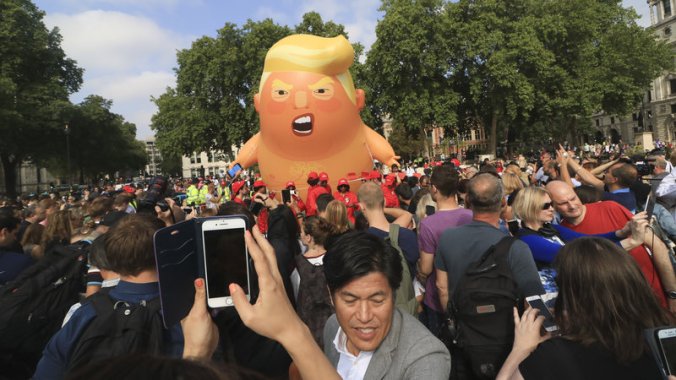
  • Bad host, worse guest. The President’s derogatory comments about the British Prime Minister were indefensible, of course. We know how he thinks: Great Britain, as he has said, with justification, has made him feel unwelcome—that insulting “Trump baby” blimp over London is a real diplomatic low—and thus, in Trump’s rudimentary ethics system, akin to that of a lizard, the proper response is tit-for-tat. None of this is unexpected, and nobody who voted for Trump can say that they didn’t give him license to behave this way by electing him.

I do wonder now why I ever thought that he would react to being elected by moderating the very conduct that, in his mind and probably in reality, got him where he is today. My role model for him was President Arthur, who was about as different in character and background from Donald Trump as a human being could be.

I’m an idiot. Continue reading →

Ann Althouse And “Green Acres”, Or “When Trusted Bloggers Don’t Know What The Hell They Are Talking About”

This is a Popeye-–the Ethics Alarm category in which I have been forced to post because something irritated me so much I couldn’t stand it, or in Popeye’s immortal words,

As frequent readers here know, I am a fan of retired University of Wisconsin law professor Ann Althouse’s wide-ranging blog (even if she does refuse to include Ethics Alarms in her blogroll...). However, loyalty goes only so far.

Today I read this from Ann…

“Green Acres The Musical is a fast-paced, contemporary story that features the best in comedy, music and dance. This is the spirited musical comedy love story of Oliver and Lisa Douglas….He is a high-powered, Manhattan attorney and she is an aspiring fashion designer and, together, they are living ‘the good life’ in New York City. Faced with the overwhelming pressure to run his family’s law firm and live up to his father’s reputation, Oliver longs for the simple life, but New York and all that it has to offer is Lisa’s perfect world. What happens when two people in love find themselves wanting opposite lives sends us on a journey that is both hilarious and filled with heart.”

That’s the press release — published in Entertainment Weekly — for a “Broadway-bound” musical. I guess there’s no limit to how stupid and touristy theater in New York City can become.

When “Green Acres” was on TV in the 1960s, it was one of many sitcoms set in rural America. From the Wikipedia article on the “rural purge” —

the systematic cancellation of all that stuff: “Starting with ‘The Real McCoys,’ a 1957 ABC program, U.S. television had undergone a “rural revolution”, a shift towards situation comedies featuring “naïve but noble ‘rubes’ from deep in the American heartland”. CBS was the network most associated with the trend, with series such as “The Andy Griffith Show,” “The Beverly Hillbillies,” “Green Acres,” “Mister Ed,” “Lassie,” “Petticoat Junction,” and “Hee Haw”….

… CBS executives, afraid of losing the lucrative youth demographic, purged their schedule of hit shows that were drawing huge but older-skewing audiences….

It was decided that those rural shows — a refuge from the social and political upheaval of the 60s — were too damned unsophisticated and irrelevant for 1970s America. I don’t know if the long arc of history bends toward sophistication, but it makes me sad to see that one of the shows that were seen — half a century ago — as too naive and out of it for television is now the basis for a Broadway show. What is happening to us?

Well, what’s happened to you, Ann, is that you have forgotten the #1 obligation of a serious blogger, which is not to make your readers less informed, more ignorant, and more biased than they already are.  Ann is about my age, meaning that she had the same opportunity as I did to actually experience those Sixties era TV shows she is denigrating and lumping together, but either she did not, and is thus relying on a typically half-baked Wikipedia entry by their usual anonymous non-professional researchers, or she is deliberately misrepresenting them to justify a side joke (Donald Trump once performed the “Green Acres” song on TV, and Ann posted the video), or, as I long suspected, she’s a snob. Just as one shouldn’t review dinosaur movies if one isn’t interested in dinosaurs, a blogger shouldn’t pretend to analyze Sixties TV shows if she didn’t watch Sixties TV shows, and if Ann had watched those shows, she would have instantly known that her Wikipedia source article was crap.

At the end of the post, she says, returning to Broadway,

When I was a teenager in the 1960s, I saw the Broadway play “Marat/Sade” — “The Persecution and Assassination of Jean-Paul Marat as Performed by the Inmates of the Asylum of Charenton Under the Direction of the Marquis de Sade.” That’s where it looked as though Broadway would go. Into immense creativity and sophistication. It’s so sad what happened instead.

I won’t argue that Broadway, the Broadway musical in particular, hasn’t hit the skids, and that it now generally seeks to be more of a theme park ride or a nostalgia-fest for wealthy tourists than a source of new ideas and daring entertainment. That case, however, could have and should have been made (I’ve made it myself in other venues) without ridiculing an unseen musical based on its source material. Continue reading →