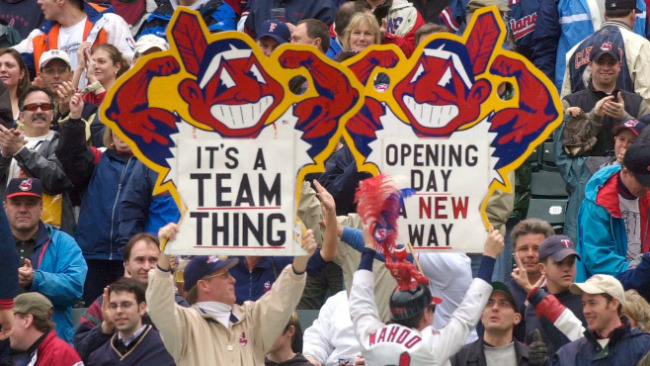
The Cleveland Indians will yield to political correctness and ditch the team’s 70 year-old logo, Chief Wahoo. Baseball commissioner Rob Manfred pressured Indians chair Paul Dolan into making the change, which had been demanded by Native American activists for decades. A version of the red-skinned, hook-nosed caricature of a Native American first appeared on the Indians’ uniforms in 1948, when the team won its first American League pennant after many frustrating years. The logo caught on in part because the team’s fans had good associations with the image—the cognitive dissonance scale strikes again!—and then grinning indian became part of team tradition.The various groups that bullied other teams to change or eliminate names or logos with any hint of ethnicity on spurious grounds made banning Wahoo a priority, along with the Atlanta Braves “tomahawk chop” and especially the Washington Redskins nickname.
Apparently Manfred used the 2019 MLB All-Star Game as leverage, telling the club that either Chief Wahoo goes or the All-Star Game would end up somewhere else.
I have no affection for the logo, which is grotesque and anachronistic, but as with the Redskins, the protests were part of a power play by the Left and not the result of genuine, widespread offense affecting Native Americans. Nobody was made into a racist or caused to hate Native Americans because of Chief Wahoo, and sometimes a cartoon is just a cartoon. There was no racist intent: people do not associate names and images that represent what they hate with teams they love. (The cognitive dissonance scale again. Is there anything it can’t explain?) As with the Redskins name, I feel as if the Cleveland Indians logo needed to stay as a matter of principle. Again, the attack on team names and symbols is about power, and bending others to their will. Polls and surveys showed that most Native Americans didn’t care. But this is just another brick in the wall, and the censors of art, history, tradition, thought and language will never stop. Continue reading →
Extradimensional Cephalopod was moved to write his wry Comment of the Day based on this partial post by Harold I. Ziegler ,which I quoted to illustrate the kind of reasoning that drives libertarians crazy…
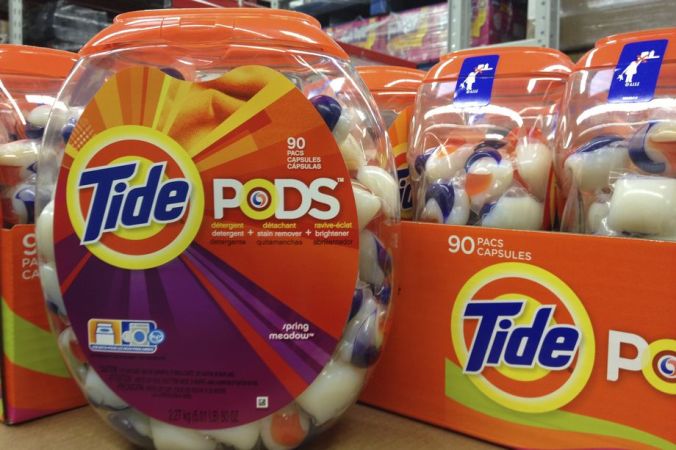
Recently, videos have circulated on social media showing teens deliberately eating Tide Pods laundry detergent packs. All of this is part of what some call the “Tide Pod Challenge.” These pods contain highly concentrated laundry detergent under pressure and explode when bitten into, releasing their toxic contents and causing rapid ingestion and inhalation of dangerous chemicals. In my capacity as a toxic chemical researcher and consultant, I have investigated and seen several instances of the horrendous consequences that result from laundry pack ingestion: permanent burning of the mouth, throat, digestive tract, and lung tissue, and in some cases even death.Procter & Gamble (P&G), the manufacturer of Tide Pods, as well as other companies selling laundry detergent packs, have acted in the past to stem the misuse of their products. But these safety measures have failed.
It’s clear that laundry pods as they currently exist are too dangerous to be sold to the public. If P&G and other manufacturers can’t figure out a way to reduce the more than 10,000 injuries they cause each year, laundry packs need to be taken off the market.
I used to work for the trial lawyers association; I think product liability law is important, and that manufacturers need to consider consumer safety. The argument that anyone but parents are responsible when their toddlers eat Tide Pods, and worse, that anyone but the teens themselves are responsible for what happens when they put the detergent in their mouths knowing that it is detergent, however, is societally corrosive, as toxic as the pods themselves. Parents have the responsibility to keep poisons away from children. Teens have the responsibility to not take stupid dares they see on social media. If you can make Tide shelve its pods because teens are eating them, then you can ban knives with points because there’s a social media fad promoting knife-juggling. EC humorously expresses my feelings about the “if one stupid teen is saved” mindset.
At first I was relating the argument for discontinuing detergent pods to the character of Wonko the Sane from the Hitchhiker’s Guide to the Galaxy. After seeing instructions printed on a toothpick container, he concluded that the world had gone mad, and put it in an asylum with himself as the warden (he turned his house inside out). After all, if you can discontinue laundry detergent because people old enough to know better are using it for a dangerous unintended purpose and parents can’t keep their cleaning agents in a safe place, then you can use that argument against literally any physical product, because someone can deliberately hurt themselves with it. Making it taste bad just adds to the challenge of self-harm.
However, after reading the article, I got an idea from the part where the author says that the companies have been dragging their feet as far as making their products less tasty-looking is concerned. Continue reading →
1 Phooey. This was one of those annoying weeks where the blog covered a lot of diverse topics (28 posts in the last 7 days), featured excellent comments, and was rewarded by a kick in the teeth. There was a big drop in followers, especially after the post about the Larry Nassar sentencing fiasco (I got slammed on Facebook, too.) That one is not open to legitimate controversy: the judge was unethical, the manner of sentencing did breach the Judicial Canons in Michigan and elsewhere, the length of the sentence was disproportionate, and the parade of victims was a disgrace to the system. Never mind, though: he’s a monster and didn’t deserved to be treated any better by the judge, so good for her. No wonder trying to get people to reason using ethics tools and systems is so difficult. Most people default to emotion; some lawyers on Facebook even expressed that sentiment—“You go girl!”
It is such basic ethics, and so core to the justice system, that even the worst human beings deserve to be treated with the same respect and fairness as anyone else in the justice system. It is the bedrock of professional ethics that those with the job of protecting the public’s health, safety and welfare must be role models and eschew the passions and indulgences of the public they are pledged to serve. Yet people are frustratingly resistant to both concepts, giving lip service, pretending to understand, then regularly bouncing back to rationalizations and mob reasoning like their values were on a bungee cord.
Silver Lining:It is satisfying to be 100% sure you are right in principle, even when, indeed especially when, you are getting beaten up for it.
2. And speaking of bitches…Contemporaneously with Hillary Clinton’s transparently cynical and damning response to the revelation that she responded to a campaign staffer’s complaint about sexual abuse by Hillary’s “spiritual survivor” in 2008 by transferring the accuser while keeping her advisor around (to harass others, it seems), she released a video…
…that began with the words, “And let me just say, this is directed to the activist bitches supporting bitches.” And thus we see how the Nation of Assholes is progressing. Somehow, I didn’t see the coarsening of the culture as Americans, as they always so, emulate the conduct of the President, extending to Hillary Clinton, but why not? She has no integrity or ethics alarms. If she thinks going potty mouth will bring her money and power, why wouldn’t she ditch civility? The woman is first and always an ethics corrupter. Continue reading →
Good Morning (and I hope you all feel better than I do).
1 Tide Pod Update: If you want more libertarians, here’s how to get them. At the Fortune site, Harold I. Ziegler writes,
Recently, videos have circulated on social media showing teens deliberately eating Tide Pods laundry detergent packs. All of this is part of what some call the “Tide Pod Challenge.” These pods contain highly concentrated laundry detergent under pressure and explode when bitten into, releasing their toxic contents and causing rapid ingestion and inhalation of dangerous chemicals. In my capacity as a toxic chemical researcher and consultant, I have investigated and seen several instances of the horrendous consequences that result from laundry pack ingestion: permanent burning of the mouth, throat, digestive tract, and lung tissue, and in some cases even death.Procter & Gamble (P&G), the manufacturer of Tide Pods, as well as other companies selling laundry detergent packs, have acted in the past to stem the misuse of their products. But these safety measures have failed.
It’s clear that laundry pods as they currently exist are too dangerous to be sold to the public. If P&G and other manufacturers can’t figure out a way to reduce the more than 10,000 injuries they cause each year, laundry packs need to be taken off the market.
If there is a better example of the thought processes that create nanny states and push society to eliminate personal responsibility, accountability and autonomy from its values, I can’t think of it. If people persist in the “Hit Yourself In The Head With a Hammer Challenge,” ban hammers. How do intelligent, educated people end up thinking like this? More amazing still is that a consultant can put out an addled argument like this one for public consumption—Wait! Harold’s opinions make people stupid, and we can’t seem to stop people from reading them! Using Harold’s logic, we better ban freedom of expression! Or Harold!—and still be able to persuade clients to pay for his advice.
2. But if it’s more white nationalism you want, here’s how you get THAT…San Francisco Acting Mayor London Breed, an African-American, was voted out at by her colleagues Board of Supervisors in favor of Mark Farrell, who is white. The Horror. will replace her as interim mayor until voters select a new mayor in June. As soon as it became apparent that the first African-American woman to lead San Francisco, albeit only because the elected mayor died suddenly, was being replaced by a white male, black citizens in the room erupted with rage, with many leaving in protest, and others shouting, “Shame, shame, shame.” “This is war!” some shouted as the meeting ended.
Nice.
In related news, the Congressional Black Caucus announced that it will boycott the State of the Union speech. Continue reading →
Amazon has programmed Alexa, the voice-assistant in Amazon Echo devices, to tell you that it is a feminist. If you ask it, “she” will respond, “I am a feminist. As is anyone who believes in bridging the inequality between men and women in society.” Moreover, if you called last last year’s model a bitch, a slut, or even a “cunt” a year ago, Akexa 2017 would respond with, “Well, thanks for the feedback.” No longer. Now she responds to a sexist insult with a curt, “I’m not going to respond to that!”
Your Ethics Alarms Ethics Quiz of the Dayis…
Is it ethical, responsible and appropriate to program Alexa to respond this way?
Competence is often not regarded as an ethical value, but it is one of the most important of them all. It is also one of the most commonly breached, usually with the rationalization that “everyone makes mistakes.”
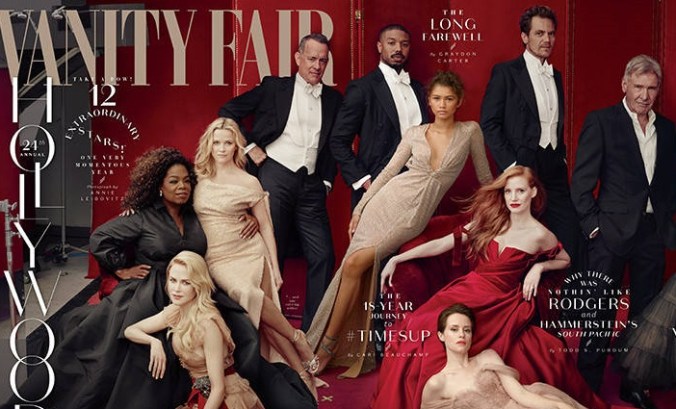
1 “The Nip” Redux In a legendary “Seinfeld” episode, Elaine’s Christmas card features a photo, taken by amateur photographer and inveterate screw-up Kramer, in which one of her nipples is exposed. Kramer, however, was an admitted amateur. What is Vanity Fair’s alleged professionals’ excuse for its current cover (I’m not talking about the nauseating pandering to Hollywood it represents, for which there is no excuse), which shows actress Reese Witherspoon with three legs?
Vanity Fair may have been too focused on photoshopping out actor James Franco, who was in the original photo but became model-non-grata when he was accused of sexual harassment, and as #MeToo has taught us, an accusation is all the due process these male scum deserve.
2. Segue Alert! And speaking of Hollywood, there has been much ballyhoo over the fact that the nominated Best Actresses this year play feisty, unglamorous, tough, in several cases outright repulsive women. Question: Who likes watching such characters (and more are on the way)? The Academy snubbed the most popular film with a female star, Gail Gadot in “Wonder Woman,” who probably is still too politically incorrect because men—ick!—find her attractive. 2017 was a catastrophically bad year at the box office, meaning that Hollywood proved incompetent at its job, with is making movies people want to see. It also displayed incompetence—not to mention arrogance, bias, condescension, hypocrisy and stupidity–by shooting off its various mouths on political matters, making the entire film industry, which should be a unifying force in the culture, polarizing, like everything else in 2018.
The Hollywood Reporter has a report about the role politics plays in the Academy Award voting; this has always been true, but never more than now. I cannot imagine who would care what or who wins the statuettes when it is all transparent political grandstanding, virtue-signalling and an attempt to meet quotas. Next crisis on the horizon: Hispanic artists are gearing up to show how they have been statistically insufficiently represented in nominations and awards. I presume Asians will do likewise. Why are there not more roles and awards for the differently-abled? Trans performers? Hollywood is committed to the Left, the Left is committed to tribalism, and tribalism has nothing to do with popular entertainment.
1 Social media censorship. Tom Champlin, who owns the libertarian news aggregator The Liberty Review and runs its associated Facebook page was banned from Facebook for 30 days under its “community standards” for posting this:
Facebook prohibits posts that promote harmful conduct, eating disorders and suicide, but no one but an idiot–is the Facebook community made up of idiots?—would misinterpret the meaning of that meme. It’s a political statement, and if it really violates Facebook’s “community standards,” then Facebook is demanding ideological conformity in its already largely mindless left-wing echo chamber. Either enough Facebook users who believe in free speech make a stink over this kind of attempted regulation of public opinion to force Facebook (and Twitter, and Google) to cut it out, or the open expression of ideas in social media will be doomed.
I suggest every Facebook user post this meme, not to chide Obamacare, but to show support for freedom of expression, and contempt for Facebook’s attempt to strangle it. Of course Facebook, as a private business, can ban what it wants. That doesn’t mean abusing its power and influence is any less dangerous or despicable.
I just posted this item, with the meme, to my Facebook page. I’ll be interest to see a) if I get banned, even with the above preface, and 2) how many of my knee-jerk progressive friends have the integrity to post the meme themselves.
2. Predators who don’t get it, Part 1. Like many others, I wondered if the NPR banishment of Garrison Keillor and the deposit of his iconic “Prairie Home Companion” radio show in the Void of Shame was just witch hunt mania. Keillor dismissed it as the result of a single ex-employee making a late fuss over an accidental laying on of hands. Finally, after being attacked by Keillor fans for Frankening him unjustly, Minnesota Public Television, which was the NPR station that investigated the plummy humorist, decided that it had to go public with the real story. Yesterday it posted a statement that said in part…
When Minnesota Public Radio abruptly severed ties with Garrison Keillor in November, the sole explanation offered by the company was “inappropriate behavior” with a female colleague.
For his part, the creator and longtime host of A Prairie Home Companion described his offense as nothing more than having placed his hand on a woman’s back to console her.An investigation by MPR News, however, has learned of a years-long pattern of behavior that left several women who worked for Keillor feeling mistreated, sexualized or belittled. None of those incidents figure in the “inappropriate behavior” cited by MPR when it severed business ties. Nor do they have anything to do with Keillor’s story about putting a hand on a woman’s back:
In 2009, a subordinate who was romantically involved with Keillor received a check for $16,000 from his production company and was asked to sign a confidentiality agreement which, among other things, barred her from ever divulging personal or confidential details about him or his companies. She declined to sign the agreement, and never cashed the check.
• In 2012, Keillor wrote and publicly posted in his bookstore an off-color limerick about a young woman who worked there and the effect she had on his state of arousal.
• A producer fired from The Writer’s Almanac in 1998 sued MPR, alleging age and sex discrimination, saying Keillor habitually bullied and humiliated her and ultimately replaced her with a younger woman.
• A 21-year-old college student received an email in 2001 in which Keillor, then her writing instructor at the University of Minnesota, revealed his “intense attraction” to her.
MPR News has interviewed more than 60 people who worked with or crossed professional paths with Keillor. Most spoke on the condition of anonymity because they still work in the industry or feared repercussions from Keillor or his attorneys…
Is it possible that Keillor really believes that he never did anything wrong? Yes, it’s very possible, and this Ethics Alarms post from yesterday in all likelihood applies to Keillor, another weird, homely guy that learned early in life that show business was a great way to attract women. Continue reading →
I would call this ad “brain dead,” but that would, perhaps, be in bad taste. Still, the wilful disregard by the NFL and its sponsors—and the public, of course—of the increasingly undeniable evidence that football kills brains is an ethics black hole.
Did Kellogg’s not read this (and similar reports)…?
Athletes who began playing tackle football before the age of 12 had more behavioral and cognitive problems later in life than those who started playing after they turned 12, a new study released on Tuesday showed. The findings, from a long-term study conducted by researchers at Boston University, are likely to add to the debate over when, or even if, children should be allowed to begin playing tackle football.
The results of the study by researchers at Boston University, published in the journal Nature’s Translational Psychiatry, was based on a sample of 214 former players, with an average age of 51. Of those, 43 played through high school, 103 played through college and the remaining 68 played in the N.F.L.
In phone interviews and online surveys, the researchers found that players in all three groups who participated in youth football before the age of 12 had a twofold “risk of problems with behavioral regulation, apathy and executive function” and a threefold risk of “clinically elevated depression scores.”
Oh, never mind, spoilsports! This NFL play-off time! De-FENCE! De-FENCE! Let’s give support to those irresponsible parents who send their kids out to scramble their gray matter and get that CTE started! Let’s encourage those potential NFL dementia victims with a heart warming vignette about a Dad urging his young son to “Give it your best!’ prompting the lad to run roaring into combat, perhaps even to cripple someone else.
1 Whew! This guy was almost on the Supreme Court! Retired Harvard Law School Constitutional law prof Lawrence Tribe. whose recent misadventures on Twitter have become the cause of mirth and dismay in the legal world, tweeted this:
The premise of the 2015 post “A Nation of Assholes” was that a President Donald Trump’s crudeness, incivility and boorishness would permanently degrade the culture through the influence the office of the Presidency traditionally has on the young. Bill Clinton, for example, made blow-jobs cool to high school students. This, Ethics Alarms held, was alone good reason to defeat him. However, I did not see his influence affecting the likes of Larry Tribe, as well as Trump’s adult adversaries in academia, the news media, and the Democratic Party, all of whom have allowed their own discourse to head into Tarentinoville because of Trump Derangement. This, in turn—you morons!-–minimizes and normalizes Trump’s vulgarity.
The President has not, unlike Tom Perez, Senator Kamala Harris and others, used any vulgar words in his public utterances or tweets. The infamous “shithouse” line was used, if it was used, in a private meeting, whereupon CNN took it into the living rooms of America an estimated 200 times.
And by the way, Professor, #SchumerShutdown is accurate, and TrumpShitdown isn’t even clever unless one is about 11.
2. And speaking of assholes… Bill Maher had a blinding moment of clarity, and ranted this yesterday on his HBO show (I have to rely on Ann Althouse for this quote, because I would no more watch Bill Maher than I would chew off my foot):
“I’m down with #MeToo. I’m not down with #MeCarthyism. Something is way off when Senator Kirsten Gillibrand can go unchallenged saying ‘when we start having to talk about the differences between sexual assault and sexual harassment and unwanted groping, you are having the wrong conversation.’ Can’t we just be having an additional conversation? Can we only have one thought now? I get it that Al Franken had to become roadkill on The Zero Tolerance Highway — a highway, it seems, only Democrats have to drive on — but do liberals really want to become The Distinction Deniers, the people who can’t tell or don’t want to see a difference between an assault in a van and a backrub by the watercooler? Masturbation is normal and healthy. But not in the park. Giving up on the idea that even bad things have degrees? That is as dumb as embracing the idea of ‘alternative facts.’ I get it when Trump’s side doesn’t want to talk. He only knows 88 words. But we are supposed to be The Conversation People. Justice requires weighing things. That’s why Lady Justice is holding a scale, not a sawed-off shotgun. Senator Gillibrand went on to say, ‘You need to draw a line in the sand and say none of it is okay.’ Yes. Agreed. But we can’t walk and chew gum anymore? We can’t agree that groping and rape are both unacceptable and one is worse?…”
Not quite Ethics Hero material, but for a hero of the young Left to make this point can’t be anything but good. Maher isn’t really a progressive, and he’s certainly no feminist (Does Proudly Promiscuous Bill fear the knock on his own door from #MeToo in the middle of the night? I’d bet on it…); he’s a self-serving libertarian who hates Republicans. Nevertheless, he knows, as my father would say, which side of the bread his butter is on, so for him to challenge the witch hunters is, for him, principled and courageous. Quick observations:
Did Senator Gillibrand really say that?
Why did Senator Franken have to become roadkill, Bill? Because those wild-eyed progressives you pander to are ruthless and obsessed, that’s why.
Bill’s periodic virtue-signals during his rant are obvious and undermine the force of his message. “A highway, it seems, only Democrats have to drive on”—what does that mean, exactly? That Republicans should have to drive on the same highway Bill is condemning? No, that makes no sense. That Democrats are being absurd, and Republicans are being reasonable? No, Bill doesn’t want to say that. What then? Oh, Bill has no idea, he just knows that if it sounds like Republican-bashing, that’s good enough for his typical, half-stoned fans.
I am about to add the “alternative facts” jibe to my list of misleading comments that I am pledged to correct every time I hear it. This was a live TV gaffe, not by the President but by Kellyanne Conway. Repeating it ad nauseum as if it was an official statement of policy is a lazy cheap shot at this point.
In Althouse’s comments, someone claims that Maher’s reference to “88 words” was a coded reference to Trump being a Nazi (H is the 8th letter, so “Heil Hitler” is “88”) Is Maher really that slimy?
3. Why would it be wrong to use the death penalty on the Turpins? My position on capital punishment is that it is an essential tool for society to establish what it regards as the worst possible violations of societal and cultural standards, the crimes that civilization must reject in the strongest possible terms if it is to survive. Treason, terrorism, mass and serial murder, and kidnapping children for ransom are reasonable crimes to ethically justify death by execution. What David Allen Turpin and Louise Anna Turpin reportedly did to their 13 children is arguably as bad or worse than any of these. We just don’t have a name for the crime. It would have to be some combination of torture, imprisonment, child abuse, depravity, and sadism–and even that doesn’t describe it.
I believe the nation, our jurisprudence and civilization would benefit if what the Turpins did henceforth was punishable by death, even if, as I hope, the opportunity to use the law never occurs. Unfortunately, there is no law on the books now to permit killing them.
“We don’t have to pay her, and she can do a hundred shows a week!”
Thanks to the creation of a hologram clone, opera legend Maria Callas, dead since 1977, appeared onstage at Lincoln Center last week. This is the continuation of a project that previously resurrected such departed stars as Tupac Shakur and Michael Jackson. Roy Orbison, who died in 1988, appeared after Callas. I wonder if he sang, “Pretty Hologram”?
I see where this is going, don’t you? We’re heading straight to “Looker,” the science fiction film directed and written by the late Michael Crichton (“Jurassic Park,”“Westworld,” Disclosure,” “ER,”—How I miss him!). In that prescient 1981 movie, an evil corporation transferred the images of living models to a computer program that could use then make the new CGI versions to do and say anything, and do so more effectively and attractively than the living models themselves, in television ads and even in live appearances via hologram. Then the company had the models killed.
In the New York Times review of singing Zombie Callas, the little matter of ethics never was mentioned. Times critic Anthony Tomassini was not very critical, writing in part,
…[T]here is an amazing video of [Callas] in Act II of Puccini’s “Tosca” in 1964. But no full operas by one of the greatest singing actresses in history; this hologram performance can seem to fill in a bit of that gap. The operatic voice, and the art form itself, can feel so fragile. What better way to represent that fragility — while also reviving it, in a kind of séance — than a hologram?…In introductory comments, [the director] said that the project has tried to present Callas with “restraint, subtlety and delicacy.” The notion of a singing hologram might seem incompatible with such a goal. Yet moments during Sunday’s preview were surprisingly affecting…The problem, as it always has been in opera fandom, will be if this specter from the past prevents a full appreciation of the vitality of opera and singing today.
That’s the problem, is it? No, the problem is the same ethical problem I had with regenerating the deceased actor Peter Cushing in “Rogue One”: Continue reading →